
The quick answer before you start typing
You have a 1,500-word essay due at midnight and one nagging question: how many pages is that, really? The honest answer is that it depends on your font, spacing, and margins — but with the standard classroom setup, it's about 3 pages single-spaced or 6 pages double-spaced.
Most teachers and professors assume a specific baseline: 12-point Times New Roman or Arial, 1-inch margins on all sides. On that setup, a single-spaced page holds roughly 500 words, and a double-spaced page holds roughly 250 words. Every estimate on this page comes from those two numbers, so once you know them, you can work out any assignment in your head.
These are estimates, not promises. Your actual page count shifts with headings, paragraph breaks, block quotes, and images. But for planning how much you still have to write — or checking whether you've hit the target — they're close enough to trust.
The full words-to-pages reference table
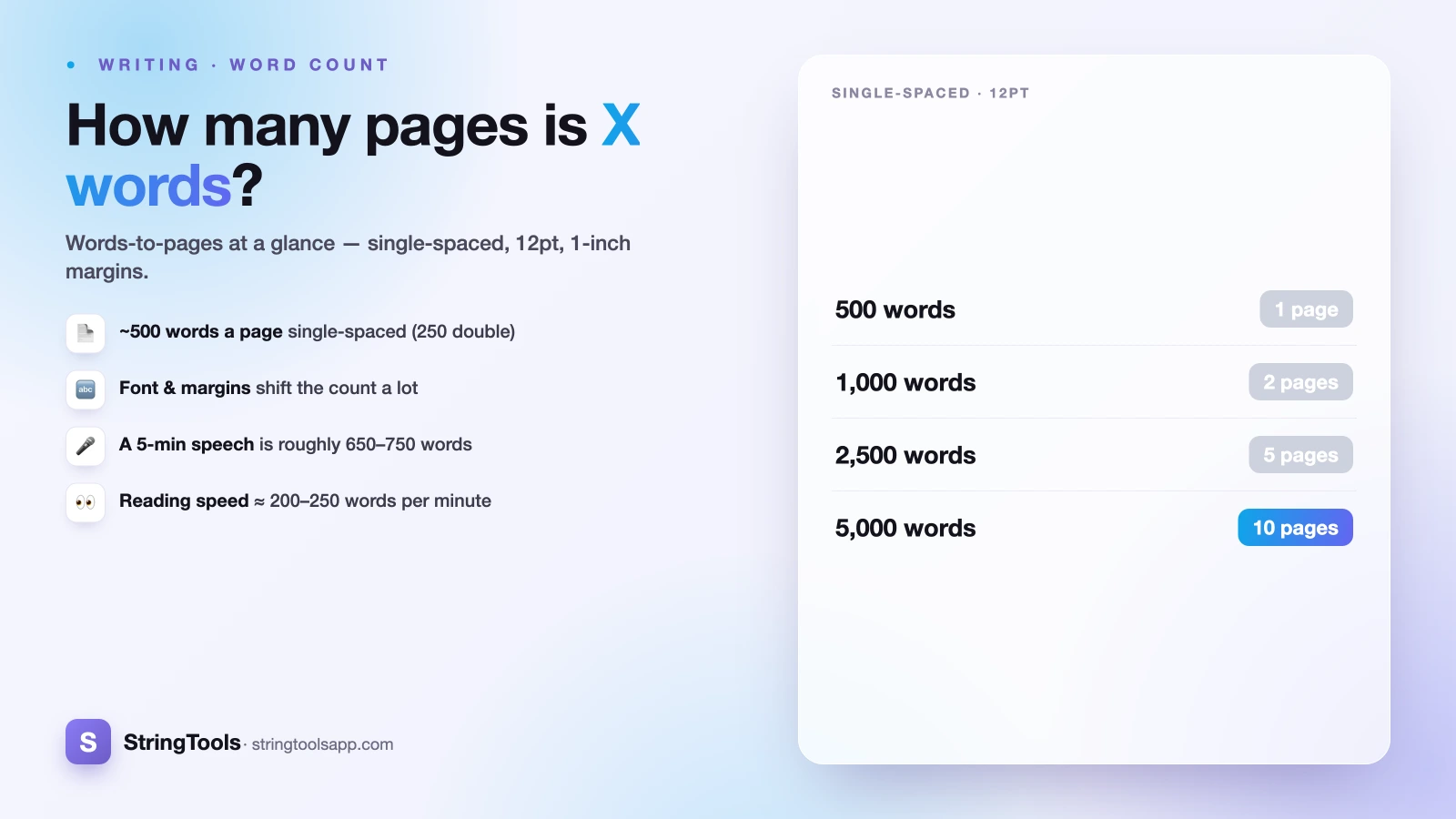
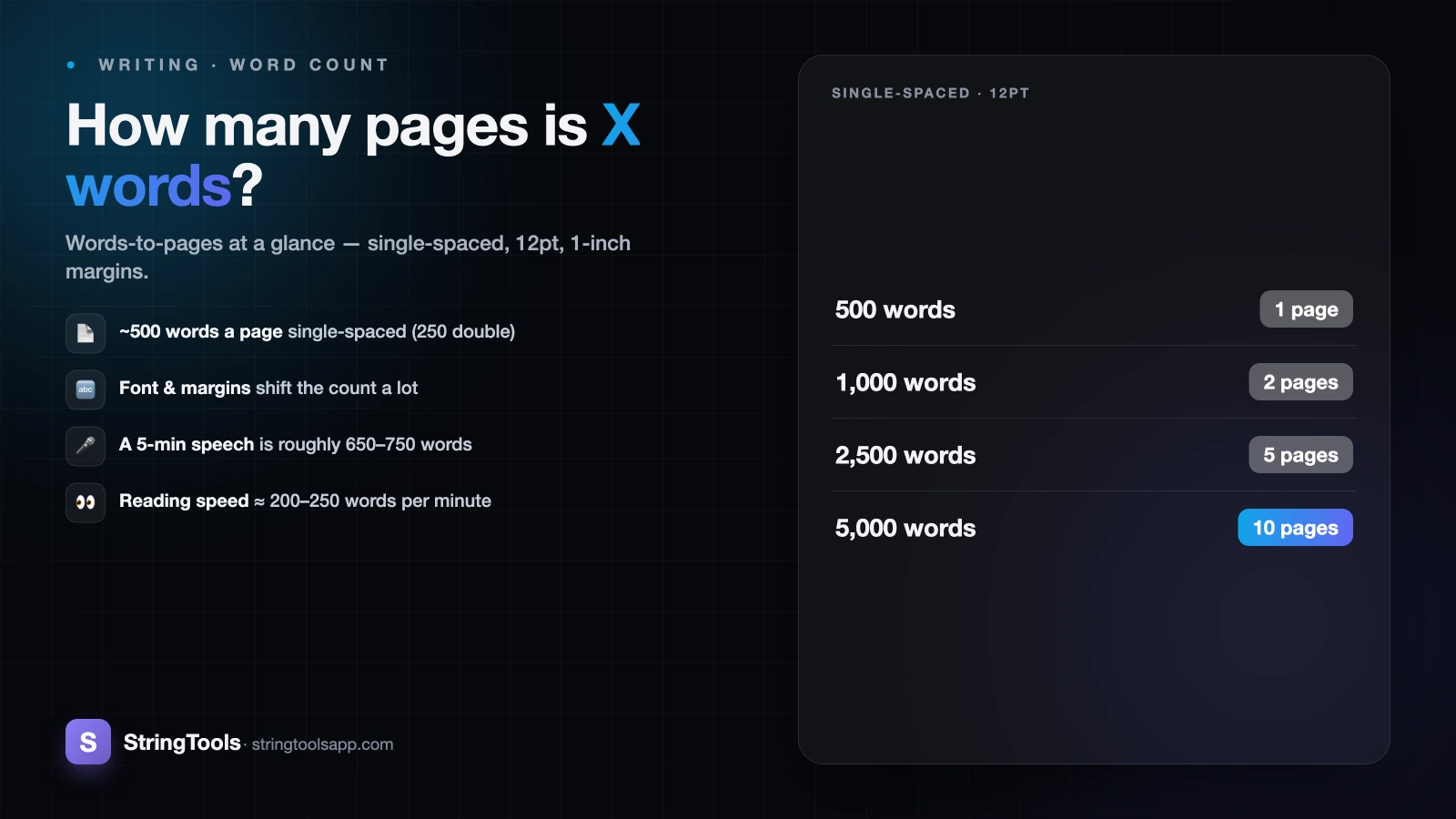
Here's the rundown for the assignment sizes students hit most often, using 12pt Times New Roman or Arial with 1-inch margins. The first number is single-spaced, the second is double-spaced.
500 words is about 1 page single-spaced, or 2 pages double-spaced. 1,000 words is about 2 pages single, 4 pages double. 1,500 words is about 3 pages single, 6 pages double. 2,000 words is about 4 pages single, 8 pages double. 2,500 words is about 5 pages single, 10 pages double. And 5,000 words is about 10 pages single, or 20 pages double.
Notice the pattern: single-spaced page count is roughly your word count divided by 500, and double-spaced is your word count divided by 250. So a 3,200-word paper lands near 6.4 pages single or 12.8 pages double. That mental shortcut works for any number your instructor throws at you, whether it's a tidy 750 words or an awkward 1,850.
Why font, spacing, and margins change everything
The table above assumes the classroom standard, but small formatting choices move the needle more than most students expect. Switch from Times New Roman to Arial and the same word count takes noticeably more space, because Arial's letters are wider — a 1,000-word essay that filled two tidy pages in Times can spill onto a third in Arial.
Spacing is the biggest lever. Going from single to double spacing doubles your page count outright. And 1.5 line spacing, which many style guides prefer, sits between the two — roughly 335 words per page — so a 1,500-word paper runs about 4.5 pages at 1.5 spacing instead of 3 or 6.
Margins matter too. Widening your margins from 1 inch to 1.25 inches shrinks the writing area and adds pages; narrowing them does the opposite. Font size follows the same logic: 11pt fits more words per page than 12pt, and 14pt fits fewer. If your instructor specifies a format, follow it exactly — padding margins or bumping the font to fake a page count is one of the first tricks graders learn to spot.
Writing a speech? Count by minutes, not pages
If your assignment is a speech or presentation, page count is the wrong unit entirely — what matters is how long you'll be talking. Most people speak at a comfortable, clear pace of about 130 to 150 words per minute. Nervous speakers rush faster; deliberate, dramatic delivery runs slower.
At that rate, a 5-minute speech works out to roughly 650 to 750 words. A 3-minute speech is around 400 to 450 words, and a 10-minute talk lands near 1,300 to 1,500 words. If you have a strict time limit, write to the word count rather than the page count, then read your draft aloud with a timer to check.
Reading aloud is the real test. Slides, pauses for emphasis, audience laughter, and a live Q&A all eat into your minutes. It's smart to aim for the low end of your word estimate so you have breathing room, rather than racing through your final paragraph as the timer runs out.
How long will people spend reading it?
There's a second timing question that trips students up: how long does it take someone to read what you wrote? Silent reading is much faster than speaking. The average adult reads at roughly 200 to 250 words per minute, so a 1,000-word blog post or essay takes about four to five minutes to read.
That's why the little "7 min read" label at the top of articles exists — it's just word count divided by a reading speed near 225 words per minute. A 2,000-word piece is roughly a 9-minute read; a 5,000-word deep dive is closer to 22 minutes.
Knowing this helps you match length to your reader's patience. A quick how-to guide should respect that people skim, while a research paper earns its length with depth. If you're writing for the web, front-load your key points — many readers decide within the first paragraph whether to keep going, no matter how many pages you've written.
How to actually check your count in seconds
You don't need to eyeball paragraphs or trust a rough guess. Paste your draft into a free word counter and it counts every word and character instantly, right in your browser. Because the whole thing runs client-side, your writing never leaves your device or gets uploaded anywhere — handy when the draft is a graded assignment or something you'd rather not paste into a random site.
A good counter shows more than a single number. Watching your word count climb toward the target as you write keeps you honest about pacing, and the character count matters when you're up against hard limits — a scholarship essay capped at 500 words, a college application short-answer, or a caption with a strict ceiling.
When you know your count, you can flip it into pages with the divide-by-500 (single) or divide-by-250 (double) shortcut from earlier, or into minutes for a speech. One number answers all three questions.
A few honest caveats before you submit
Every figure here is an estimate, and the word "about" is doing real work. Cover pages, titles, subheadings, bibliographies, footnotes, and figures all change how your words spread across the page. A paper stuffed with short dialogue lines and paragraph breaks runs longer per word than one built from dense, unbroken paragraphs.
Style guides add their own rules. MLA and APA both call for double spacing and specific margins, so a paper formatted to their standards will track close to the double-spaced column in the table above. Always check your assignment brief first — if it names a page count, format to the required font and spacing and let the pages fall where they may, rather than reverse-engineering the layout.
One last tip: if your instructor asks for a word count, give them exactly that. It's the one measure that doesn't wobble with formatting. And while you're polishing, a quick read of title case vs sentence case can save your headings and title from a common, avoidable mistake.
Ready to see where you stand? Drop your draft into the word counter and get your exact word and character count in one click — then use the shortcuts above to turn it into pages or minutes.
Frequently Asked Questions
How many pages is 500 words?
About 1 page single-spaced or 2 pages double-spaced, using 12-point Times New Roman or Arial with 1-inch margins. This is an estimate — your actual page count shifts with font choice, line spacing, margins, headings, and paragraph breaks. Switching to a wider font like Arial or adding 1.5 spacing will nudge it higher.
How many pages is 2000 words double-spaced?
Roughly 8 pages, based on the classroom standard of about 250 words per double-spaced page in 12pt Times New Roman or Arial with 1-inch margins. If you use 1.5 line spacing instead, the same 2,000 words fills closer to 6 pages. Always format to your assignment's required style before judging length.
How many words is a 5-minute speech?
Around 650 to 750 words, assuming a clear speaking pace of 130 to 150 words per minute. Nervous speakers talk faster and finish early, while dramatic pauses slow you down. Write to the word count, then read your draft aloud with a timer, aiming for the lower end so pauses and audience reactions don't push you over the limit.
Does font and spacing really change the page count?
Yes, significantly. Double spacing doubles your pages versus single spacing, and 1.5 spacing falls between them. Wider fonts like Arial take more room than Times New Roman for the same words, and larger fonts or bigger margins add pages too. That's why word count, not page count, is the reliable target instructors trust.
How do I check my exact word count?
Paste your text into a free online word counter. It counts words and characters instantly in your browser, so your writing stays on your device and isn't uploaded anywhere. Then convert to pages with the shortcut: divide by 500 for single-spaced pages or by 250 for double-spaced, using the standard 12pt, 1-inch-margin setup.