
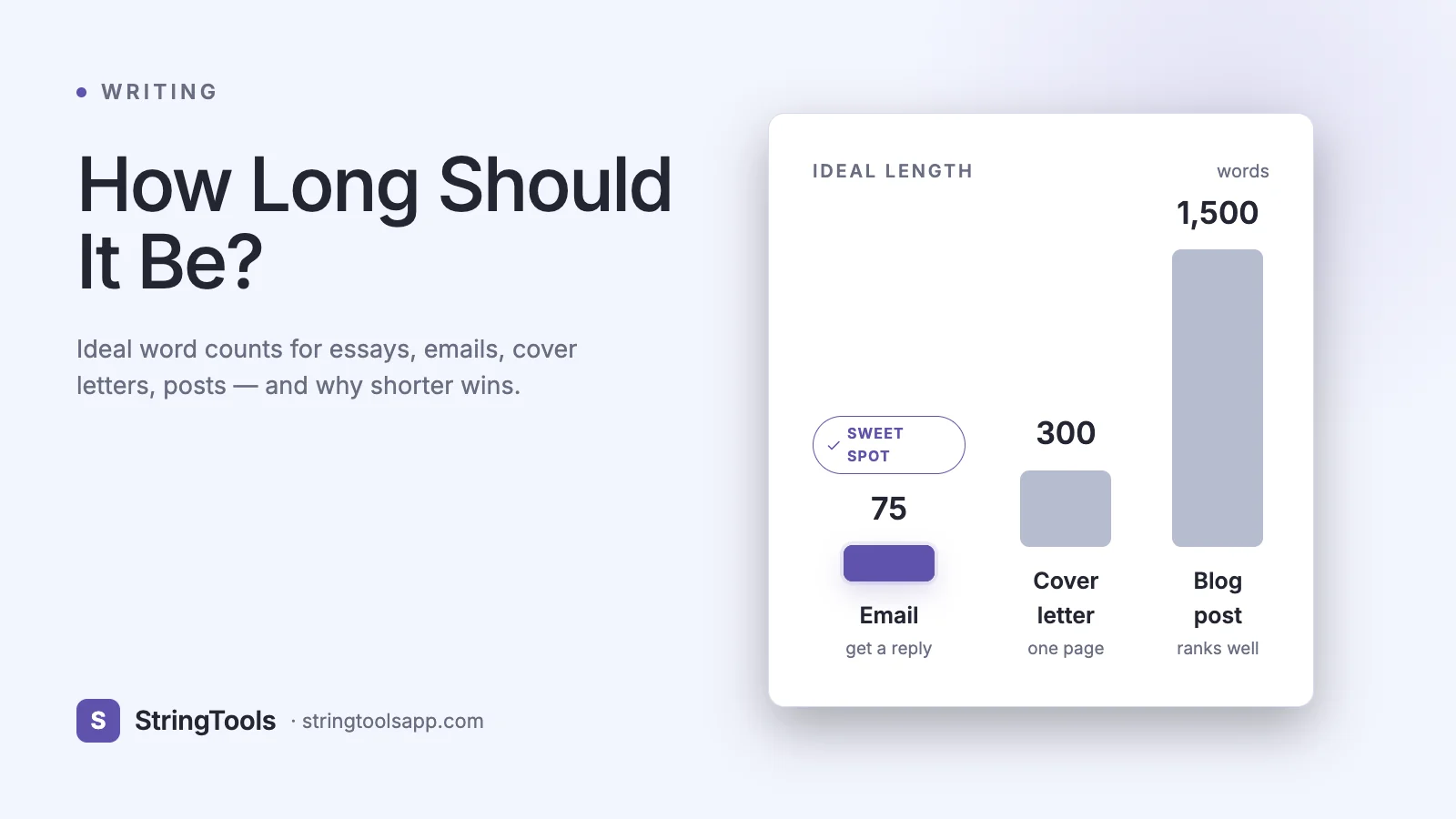
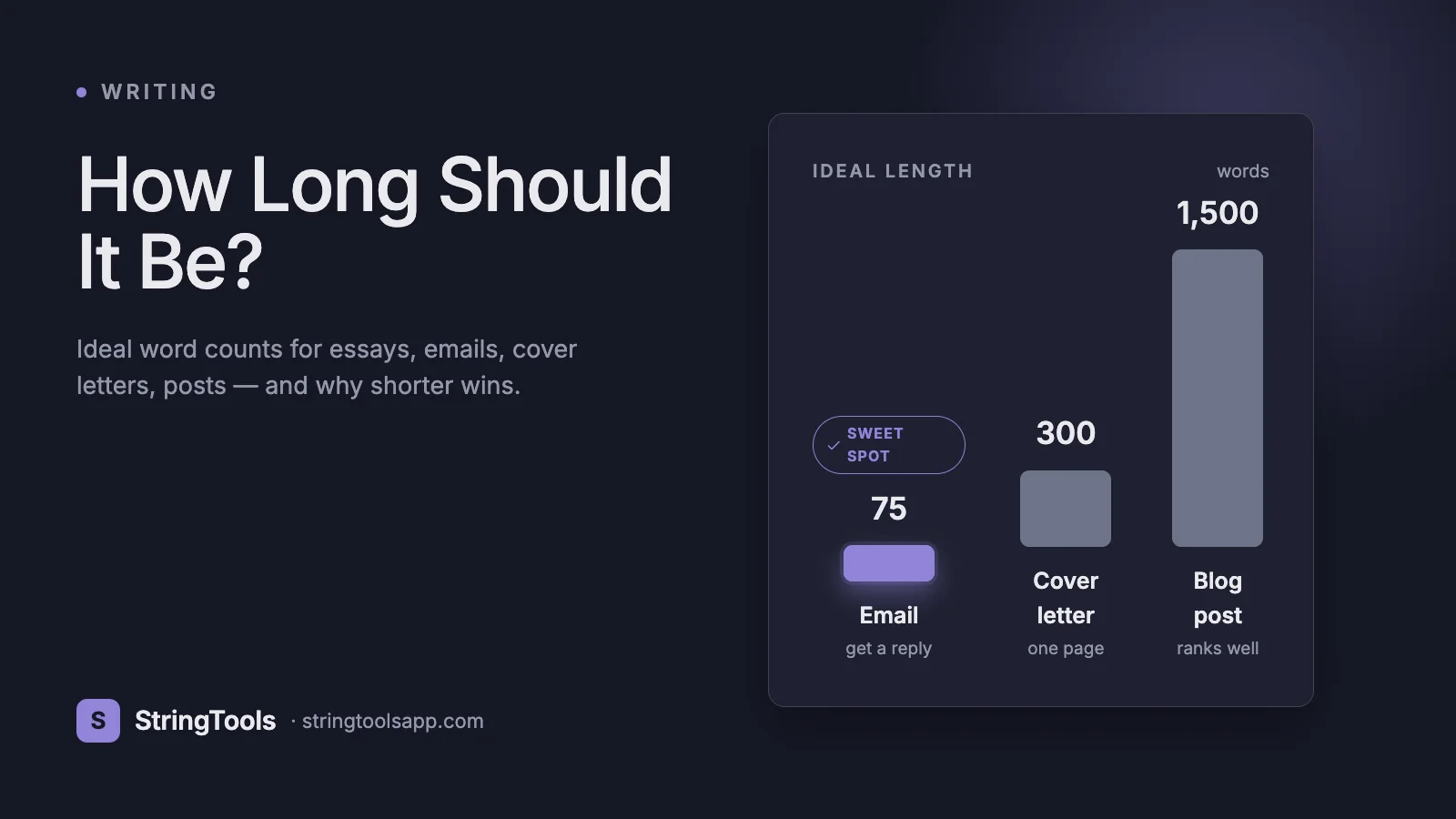
Quick answer: A college application essay: 500–650 words (hard cap 650). A professional email: 50–125 words. A cover letter: 250–400. A LinkedIn post: make the first ~200 characters carry the hook (that's where "see more" cuts). A 5-minute speech: ~650 words at 130 wpm. And the conversions everyone needs: ~500 words per single-spaced page, ~250 per double-spaced — so 1,000 words ≈ 2 pages single or 4 double. Full tables for every format below.
The Question Behind Every Blank Page
"How long should this be?" might be the most-asked question in all of writing — asked by students at midnight, professionals hovering over the send button, and best men rehearsing in hotel bathrooms. It gets asked so much because length is the one requirement that's usually explicit, checkable, and graded.
The honest answer has two layers. The first is the number — and real numbers exist, from the Common App's hard 650 to the research on email reply rates. The second is the principle underneath: the right length is the shortest version that does the whole job, and that principle explains nearly every number in this guide. We'll give you both: the reference tables for every common format (academic, professional, social, spoken), the words-to-pages and words-to-minutes conversions, and the reasoning, so you can handle formats no table covers. Check any piece you're writing against its target live with our free word counter, which shows words, characters, reading time, and speaking time as you type.
The Master Table: Every Format at a Glance
| What you're writing | Ideal length | The governing constraint |
|---|---|---|
| Common App college essay | 500–650 words | Hard cap at 650 |
| Standard course essay | As assigned (±10% at most) | The rubric |
| Professional email | 50–125 words | Reply rates fall as length grows |
| Email subject line | 6–10 words | Mobile truncation |
| Cover letter | 250–400 words | Recruiter skim time |
| Resume | 1 page (2 for 10+ yrs experience) | Six-second first scan |
| X / Twitter post | Under 280 chars; punchier shorter | Hard limit 280 |
| LinkedIn post | Hook in first ~200 chars | "See more" fold |
| Instagram caption | Short hook; limit 2,200 chars | First line does the work |
| Wedding toast | 2–4 min ≈ 260–520 words | Audience patience |
| Conference talk (10 min) | ≈ 1,300 words | 130 words/minute pace |
| Blog post (SEO) | 1,500–2,500 words | Covered in our SEO word-count guide |
Every figure justified in its section below. Paste any draft into the word counter to check against these live.
Words to Pages: The Conversions
Teachers assign pages; word processors count words. The bridge, at standard formatting (12-point Times New Roman or similar, 1-inch margins):
| Word count | Single-spaced pages | Double-spaced pages |
|---|---|---|
| 250 words | 0.5 | 1 |
| 500 words | 1 | 2 |
| 1,000 words | 2 | 4 |
| 1,500 words | 3 | 6 |
| 2,500 words | 5 | 10 |
| 5,000 words | 10 | 20 |
The rules of thumb worth memorizing: ~500 words per single-spaced page, ~250 per double-spaced page. Font, margins, and paragraph density move these by 10–20%, which is exactly why instructors increasingly assign word counts instead of pages — and why the word count is the number to manage, not the page count.
Academic Writing: Essays and Papers
The Common App essay — the highest-stakes 650 words most people ever write — allows 250 to 650 and cuts off at the cap. Admissions readers consistently advise using most of the room: 500–650 words signals effort without bloat, while a 260-word submission reads as disengagement. The cap is enforced by the text box itself, so "a little over" isn't an option.
Course essays follow one rule above all: the assigned count is the assignment. The folk tolerance of ±10% is real at many institutions but professor-dependent; going under usually signals thin analysis, going far over signals no editing. If a 1,500-word essay is the task, 1,350–1,650 is the honest zone — and structurally, a classic plan is ~10% introduction, ~80% body, ~10% conclusion, so that 1,500-word essay wants roughly a 150-word intro, 1,200 words of argument, and a 150-word close.
Word-count strategy tip that improves grades more than padding ever will: write 10–15% long in the draft, then cut. Every essay has throat-clearing in it; deleting it gets you under the limit and raises the density of actual argument — the thing being graded.
Professional Writing: Emails, Cover Letters, Resumes
Email is where brevity is money. Large-scale analyses of reply behavior (notably by the email-analytics firm Boomerang) found response rates peak for messages of roughly 50–125 words, with rates falling steadily as emails grow past that. The intuition matches the data: a short email presents one clear ask that can be answered from a phone; a long one gets deferred to "later," which is where replies go to die. Practical form: context in one sentence, the ask in one sentence, logistics in a line or two, done.
Subject lines: 6–10 words, front-loaded — mobile clients truncate around 30–40 characters, so the first three words carry the message.
Cover letters: 250–400 words, always under one page. The working structure: why this role (one paragraph), evidence you can do it (one or two), why this company specifically (one), and a confident close. Recruiters report skimming letters in under a minute; a letter that respects that fact reads as judgment, which is itself a qualification.
Resumes: one page as the default, two defensible past roughly ten years of experience. The governing constraint is the famous six-to-ten-second first scan — bullets of 12–20 words, led by verbs and numbers, survive that scan; paragraphs don't.
Social Posts: Limits vs. Ideal Lengths
Social platforms publish limits, but the number that matters is the fold — where the platform truncates your post behind a "see more" link:
| Platform | Hard limit | The number that actually matters |
|---|---|---|
| X / Twitter | 280 characters | All of it shows — but punchy beats padded |
| 3,000 characters | ~200 characters before "see more" | |
| 2,200 characters | First line visible in feed | |
| Very high | Truncates after a few lines |
The craft implication is the same everywhere: your first 200 characters are the headline, whatever the total length. Long LinkedIn posts perform fine — but only when the pre-fold hook earns the click. Write the hook first, count its characters (the character-with-spaces counter is the tool here), and treat everything after the fold as optional reading you must earn. Full platform-by-platform character tables live on our word counter page.
Spoken Words: Speeches, Toasts, and Talks
Spoken length is time, and the conversion is stable: a clear presentation pace is about 130 words per minute (conversational speech runs faster; nerves run faster still — which is an argument for writing to 130 and letting adrenaline provide the margin).
| Speaking slot | Word budget @ 130 wpm | Typical use |
|---|---|---|
| 30 seconds | ≈ 65 words | Elevator pitch, introduction |
| 2 minutes | ≈ 260 words | Short toast, standup update |
| 5 minutes | ≈ 650 words | Wedding speech, class presentation |
| 10 minutes | ≈ 1,300 words | Conference slot, best-man epic |
| 18 minutes | ≈ 2,340 words | TED-length talk |
| 30 minutes | ≈ 3,900 words | Keynote, lecture |
Two speech-specific notes. First, pauses are content: laughter, emphasis, and slide changes consume time the word count doesn't show, so a script that reads exactly 5:00 will run 5:30–6:00 live — budget 10% under your slot. Second, the reverse conversion rescues over-runners: if your draft's speaking time (our word counter computes it automatically) says 7 minutes for a 5-minute slot, you need to cut ~260 words, not talk faster. Talking faster is how good toasts become blurs.
Why Shorter Usually Wins (and When It Doesn't)
Across emails, posts, and speeches, one asymmetry repeats: the reader's attention is the scarce resource, not your word supply. Every additional sentence spends attention the earlier sentences earned; when the balance goes negative, the reader leaves — silently online, visibly at weddings. That's why reply rates fall with email length, why the pre-fold hook decides a post's fate, and why the toast everyone remembers is the short one.
The exceptions are formats where completeness is the assignment: essays, analyses, documentation, and in-depth guides. There, artificial brevity is its own failure — a 700-word answer to a 1,500-word question reads as thin. But even in long forms, the winning process is identical: draft long, then cut everything that doesn't advance the argument. Length should be the residue of necessary content, never a target you pad toward. (For long-form web content specifically — where search engines add their own length dynamics — see our word count & SEO guide.)
Frequently Asked Questions
How many pages is 1,000 words?
About 2 pages single-spaced or 4 pages double-spaced at standard 12-point formatting. Memorize the rules of thumb: ~500 words per single-spaced page, ~250 per double-spaced.
How long should a college essay be?
Common App: 250–650 words with a hard cap; aim for 500–650. Course essays: the assigned count, with ±10% as the outer tolerance at most institutions — and under is riskier than slightly over.
What is the ideal length for a professional email?
Roughly 50–125 words — one screen, one ask. Subject line: 6–10 words, key words first. Longer than ~200 words? Consider a document plus a two-line email, or a call.
How long should a cover letter be?
250–400 words, under one page: why this role, proof, why this company, close. Skimmability is the feature being evaluated.
How many words is a 5-minute speech?
About 650 at a 130 words-per-minute presentation pace — and write 10% short of the slot, because pauses and laughter spend time the script doesn't show. Paste your script into the word counter to see its speaking time instantly.
Does going over a word limit matter?
Yes: application portals cut you off, graders penalize, editors reject. When a limit exists, finishing under it is part of the demonstrated skill — and the trim almost always improves the piece.
Is longer or shorter writing better?
Shorter for persuasion and requests; complete-but-tight for analysis. Universal method: overwrite the draft, then cut until every sentence earns its keep.
Check Your Draft
Every target in this guide becomes actionable the moment you can see your own numbers. Paste your draft into our free word counter: it shows words, characters with and without spaces (for the social folds), sentences, reading time at 200 wpm, and speaking time at 130 wpm — the exact conversions used throughout this article — updating live as you edit. Write, check, cut, check again: the gap between a draft and its best version is usually one honest word count and fifteen minutes of deletion.
This article offers general writing guidance. Specific limits and expectations vary by institution, employer, platform, and publication — when a rubric, style guide, or application portal states a requirement, it overrides any general rule here.