
The two cases everyone confuses
You type a headline, capitalize a few words on instinct, and move on. Then an editor flags it, a colleague rewrites it, and you realize nobody quite agrees on which words deserve a capital letter. Welcome to the quiet chaos of English capitalization.
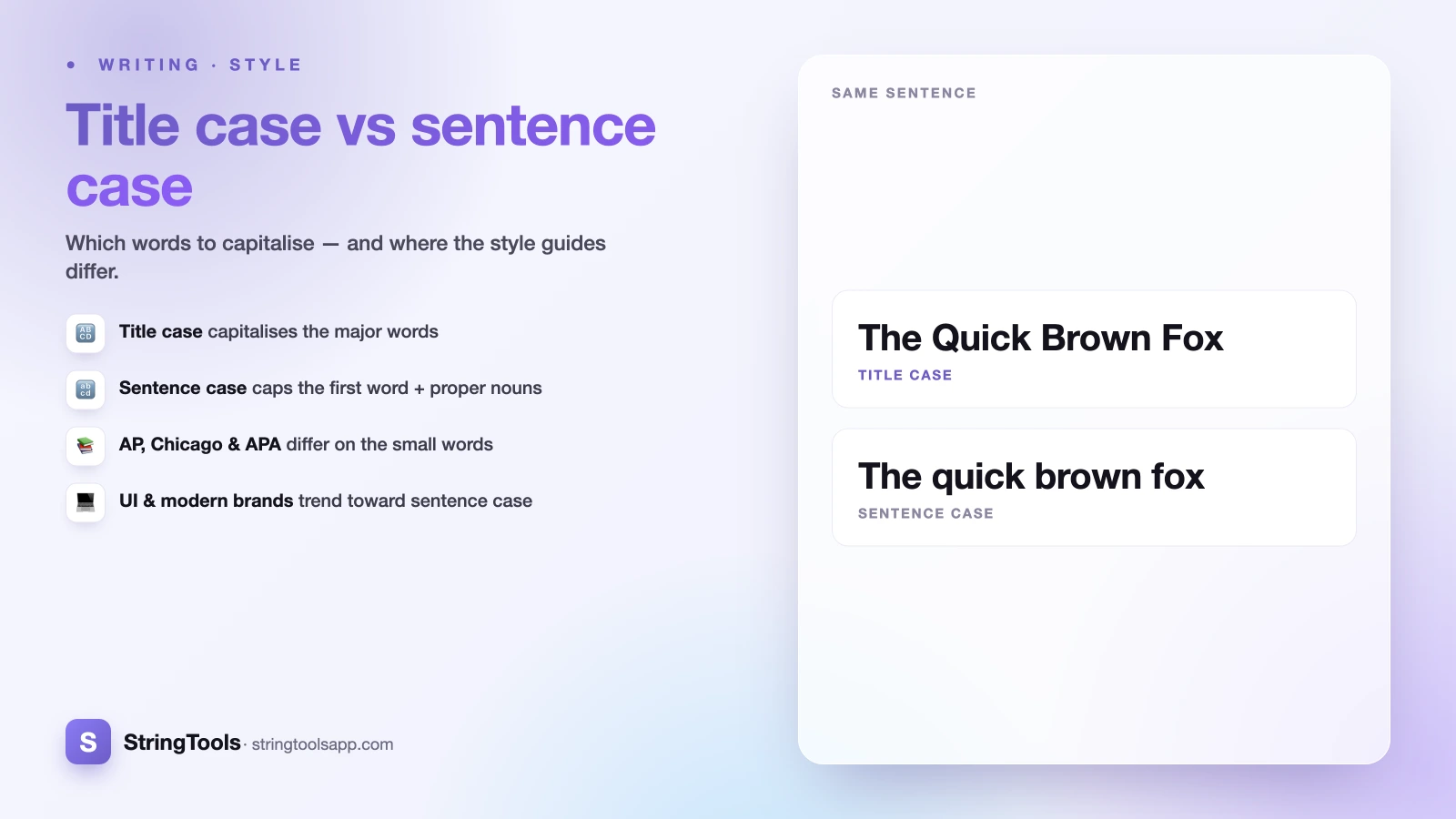
There are really just two systems worth mastering. Sentence case capitalizes the first word and any proper nouns, exactly like a normal sentence: "How to write a great headline." Title case capitalizes the important words and lowercases the little ones: "How to Write a Great Headline." That single difference decides how professional your writing looks in a book title, an email subject line, a button, or a blog post.
The catch is that title case is not one rule. It is a family of rules, and AP, Chicago, and APA each draw the line in a slightly different place. Below, we untangle all of it, show the mistakes that trip people up most, and explain when each style actually fits. If you just want to flip text between the two right now, our text converter does it in one click.
Sentence case, the plain-English default
Sentence case is the easiest to explain because you already use it every day. Capitalize the first word of the line. Capitalize proper nouns, brand names, and the pronoun "I." Leave everything else lowercase. That's the whole rule.
So "Ten tips for faster email replies" is correct sentence case. "Ten Tips for Faster Email Replies" is not sentence case at all, it's title case wearing the wrong hat. The only capital letters in sentence case beyond the first word come from names: "How Google ranks new pages" keeps "Google" capitalized because it's a proper noun, but "ranks" and "pages" stay lowercase.
Sentence case has quietly become the modern default. Most product interfaces, app menus, marketing copy, and the headlines at many contemporary publications now use it because it reads faster and feels less shouty. It's also the norm in most languages other than English, so international and localized content leans on it heavily. When in doubt for web copy, sentence case is rarely wrong.
Title case, and which words get a capital
Title case is where people stumble, so here is the shared backbone that every major style guide agrees on. Capitalize the major words: nouns, pronouns, verbs, adjectives, and adverbs. Lowercase the minor words: short articles (a, an, the), short coordinating conjunctions (and, but, or, nor), and short prepositions. Always capitalize the first and last word of the title no matter what part of speech it is.
So "The Art of War" capitalizes "Art" and "War" (nouns) and the leading "The" (first word), while "of" stays lowercase because it's a short preposition. "Gone with the Wind" lowercases "with" and "the" in the middle. "To Kill a Mockingbird" lowercases "a" but capitalizes the opening "To."
The part that catches people out: forms of the verb "to be" are still verbs. "Is," "Are," "Am," "Was," and "Be" all get capitalized in title case, even though they're short. "It" is a pronoun and gets a capital too. We'll come back to this common mistake, because lowercasing them is one of the most frequent title-case errors.
Why AP, Chicago, and APA disagree
Here's the honest truth most quick guides skip: there is no single correct title case. The style guides genuinely differ, and the disagreement centers almost entirely on prepositions and word length.
AP style (Associated Press, common in journalism and news) lowercases prepositions and conjunctions of three letters or fewer, but capitalizes prepositions of four letters or more. So under AP, "with" (4 letters) and "from" (4 letters) get capitalized, while "for," "and," and "the" stay lowercase.
Chicago style (the Chicago Manual of Style, common in books and publishing) lowercases all prepositions regardless of length. Under Chicago, "with," "from," and even longer prepositions like "between" and "through" stay lowercase unless they're the first or last word.
APA style (American Psychological Association, common in academia) uses a length rule too, but a broader one: capitalize any word of four letters or more, and that includes prepositions. This means the same headline can be correctly capitalized three different ways. "A Guide to Writing with Confidence" is Chicago-correct, but AP and APA would capitalize "With." None of them is wrong; they just follow different books.
A side-by-side example
Concrete examples make the differences click. Take the phrase: notes on working from home.
Sentence case: "Notes on working from home." Only the first word is capitalized.
AP style title case: "Notes on Working From Home." AP lowercases "on" (2 letters) but capitalizes "From" because it has four letters.
Chicago style title case: "Notes on Working from Home." Chicago lowercases "from" because it's a preposition, full stop, regardless of length.
APA style title case: "Notes on Working From Home." APA capitalizes "From" under its four-letter rule, matching AP here but for a different reason.
Notice that AP and APA land in the same place for "From" while Chicago diverges. That won't always be true. The takeaway is not to memorize every case but to pick one style guide, stay consistent within a document, and let a tool handle the mechanical lowercasing. Trying to eyeball prepositions by length across a hundred headlines is exactly where errors creep in.
The mistakes that trip people up
A handful of errors show up again and again. The biggest is lowercasing short verbs and pronouns. "Is," "Are," "It," "Be," and "Do" look small, so people lowercase them, but they are verbs and pronouns and must be capitalized in every title-case style. "Why It Is Worth Trying" is correct; "Why it is Worth Trying" is wrong twice over.
The mirror-image mistake is capitalizing every single word, including articles and short prepositions: "How To Write A Great Headline." Capitalizing "To" and "A" mid-title is a classic overcorrection. The words "a," "an," "the," "to," "of," and "in" should stay lowercase unless they open or close the title.
A third trap is mixing styles inside one document, capitalizing "With" in one headline and lowercasing it in the next. Readers may not name the rule, but inconsistency reads as sloppy. Finally, watch hyphenated words: in most title-case styles you capitalize both parts of a major compound, so "State-of-the-Art" becomes "State-of-the-Art," not "State-Of-The-Art." When these edge cases pile up, running the text through our text converter removes the guesswork.
When to use each, plus ALL CAPS and friends
Choosing a case is mostly about context. Use title case for the things that traditionally wear it: book titles, article and blog headlines, movie and song titles, formal report titles, and academic references. It signals "this is a titled thing" and looks polished in those settings.
Use sentence case for user interfaces, buttons, menu items, email subject lines, most web and marketing copy, and any non-English content. It's cleaner, faster to scan, and it's where the modern web is heading. When you're unsure which one a project wants, sentence case is the safer default for screens.
Beyond the big two, a few other cases exist. ALL CAPS ("LIMITED TIME OFFER") grabs attention but hurts readability and reads as shouting, so use it sparingly for short labels only. all lowercase carries a casual, understated brand voice popular with some startups. And kebab-case ("title-case-vs-sentence-case") joins words with hyphens for URLs and slugs, which is why this article's own web address uses it. Knowing they exist means you can convert into them deliberately rather than by accident.
Convert between cases instantly
You don't have to hold four style guides in your head. Draft your headline in whatever case is comfortable, then convert it to the exact format you need. Our free text converter transforms any text between title case, sentence case, ALL CAPS, lowercase, and more, right in your browser. Nothing is uploaded, so your drafts stay on your device.
A practical workflow: write in sentence case because it's fast, convert to title case when you're finalizing a headline, then eyeball the short verbs and prepositions against your chosen style guide for the last mile. It turns a fiddly, error-prone chore into a two-second step.
If you're deep in a writing project and juggling more than capitalization, you might also find how many pages is X words useful for planning length. Either way, capitalization should be the least of your worries. Get the words right, and let the tool get the capitals right. Try the text converter on your next headline and see the difference a consistent case makes.
Frequently Asked Questions
Is "is" capitalized in title case?
Yes. "Is" is a form of the verb "to be," and title case capitalizes all verbs regardless of length. The same goes for "Are," "Am," "Was," and "Be." Lowercasing them is one of the most common title-case mistakes. So "Why This Is Important" is correct, while "Why This is Important" is wrong.
What's the difference between title case and sentence case?
Sentence case capitalizes only the first word and proper nouns, like a normal sentence: "Tips for better writing." Title case capitalizes the major words (nouns, verbs, adjectives, adverbs, pronouns) and lowercases short articles, conjunctions, and prepositions: "Tips for Better Writing." Title case suits book and article titles; sentence case suits UI, emails, and most web copy.
Do AP, Chicago, and APA capitalize titles the same way?
No, and the difference is mostly about prepositions. AP lowercases prepositions of three letters or fewer but capitalizes those with four or more. Chicago lowercases all prepositions regardless of length. APA capitalizes any word of four letters or more, including prepositions. Pick one guide and stay consistent within a document.
When should I use sentence case instead of title case?
Use sentence case for user interfaces, buttons, menu items, email subject lines, and most web and marketing copy. It reads faster and feels less formal. It's also standard in most non-English content. Reserve title case for book titles, article and blog headlines, and formal or academic titles where the traditional look is expected.
How do I convert text between title case and sentence case?
Use a free case converter like our text converter. Paste your text, pick the target case (title case, sentence case, ALL CAPS, lowercase, and more), and it transforms instantly in your browser with nothing uploaded. It handles the mechanical lowercasing of minor words, so you avoid errors like capitalizing "a" or "the" mid-title.