
cm to Inches: The Exact Formula
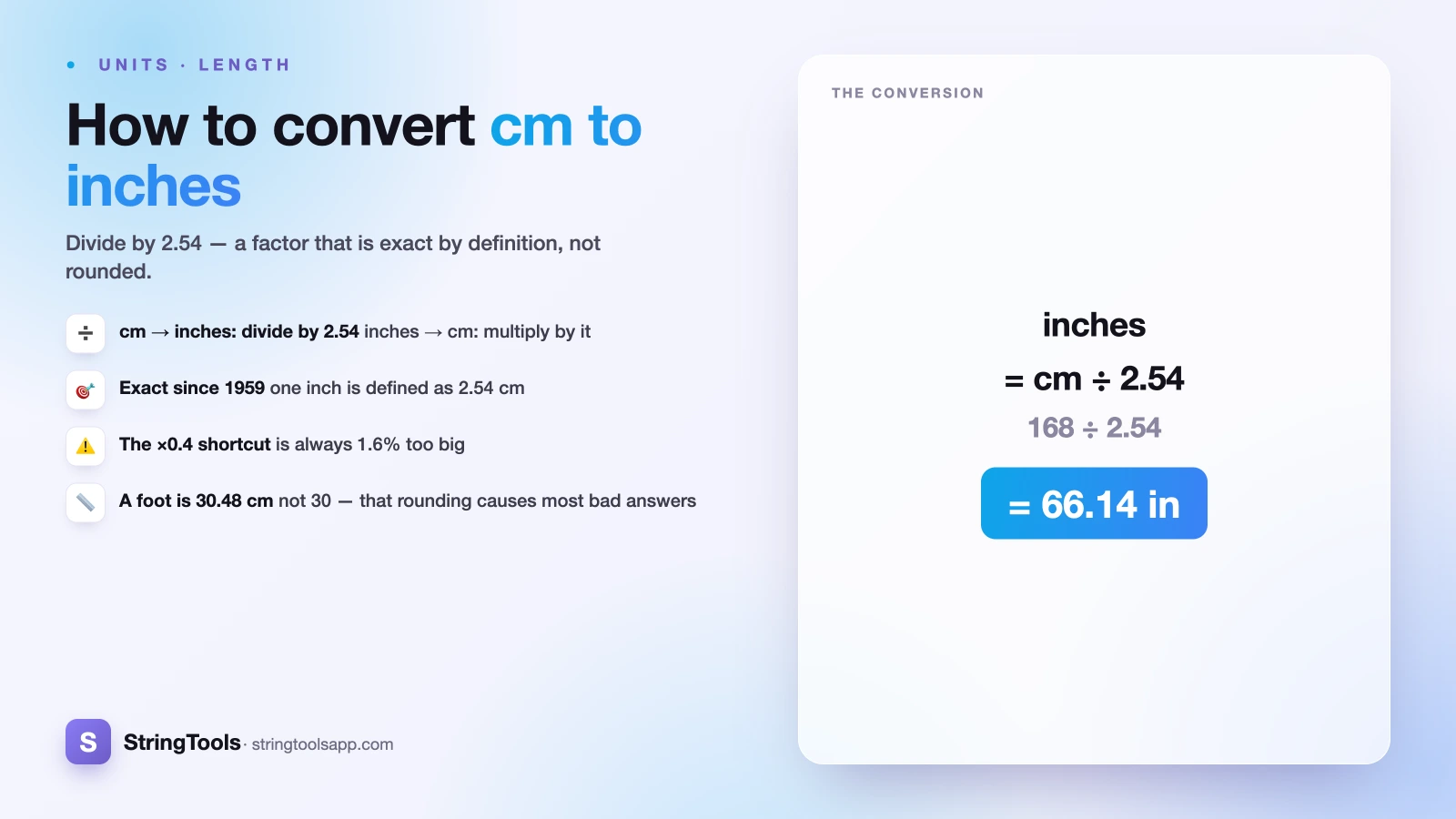
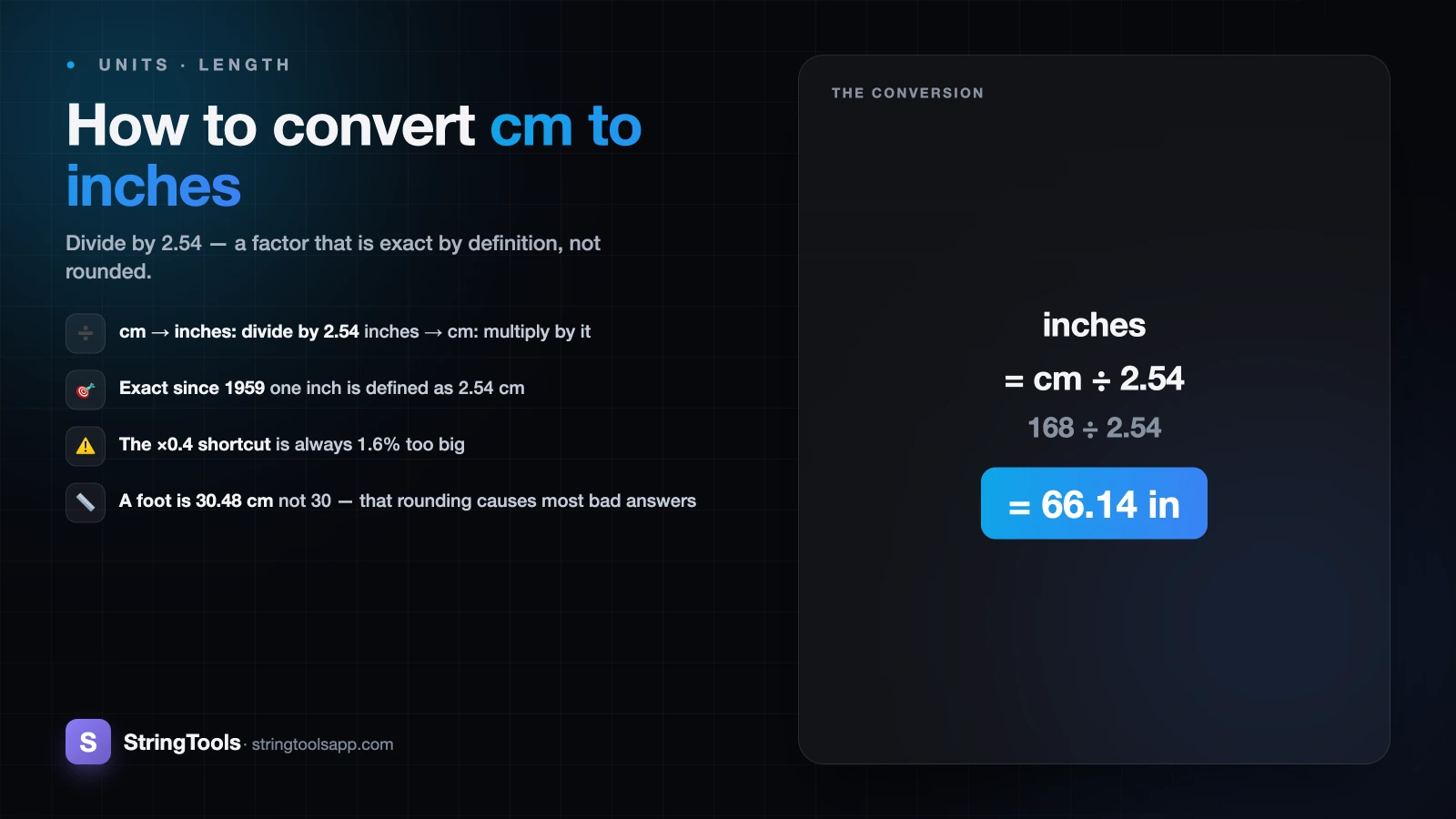
To convert centimetres to inches, divide the number of centimetres by 2.54. To convert inches to centimetres, multiply by 2.54. That factor is exact by definition, not a rounded approximation: one inch is defined as exactly 2.54 centimetres, so the only error in your answer is the error in your original measurement.
Key Takeaways
- cm to inches: divide by 2.54. Inches to cm: multiply by 2.54. Nothing else is needed.
- 2.54 is exact, agreed by international treaty in 1959. It is not a rounded figure like 3.28084 feet per metre, which genuinely is truncated.
- 1 cm = 0.3937 in and 1 m = 39.37 in. Both of those decimals repeat forever, so they are the rounded side of the relationship.
- The common mental shortcut of multiplying centimetres by 0.4 is always 1.6% too big - fine for a shelf, wrong by nearly 3 cm at adult height.
- For height, convert to total inches first, then divide by 12: the remainder is your inches.
- A foot is 30.48 cm, not 30 cm. That single rounding is behind most bad conversions.
Worked both ways, using 168 cm and 30 inches:
- 168 / 2.54 = 66.14 in
- 30 x 2.54 = 76.2 cm
The division is the part people fumble, because 2.54 is awkward in your head. If you are converting a batch of measurements rather than one, a unit converter removes the arithmetic entirely and keeps every figure to the same number of decimal places, which matters more than it sounds once you start cutting material to those numbers.
Why 2.54 Is Exact and Not a Rounded Value
This is worth understanding, because it is the reason you never need more than one conversion factor and never need to worry about which country's inch you are using.
Until 1959 the inch was not the same length everywhere. The United States, the United Kingdom and the Commonwealth countries each maintained their own physical standards, and they disagreed in the sixth decimal place. The US inch worked out at roughly 2.540005 cm; the British one was slightly different again. For everyday work this made no difference, but for surveying, engineering and international trade it was an irritation.
The International Yard and Pound Agreement of 1959, signed by the US, UK, Canada, Australia, New Zealand and South Africa, fixed the yard at exactly 0.9144 metres. Divide that by 36 and you get an inch of exactly 0.0254 metres, or 2.54 centimetres, or 25.4 millimetres. Since then, every inch in the English-speaking world is defined in terms of the metre.
The imperial system is metric underneath
That last point catches people out. The inch has no independent physical standard any more. The metre is defined by fixing the speed of light in vacuum at 299,792,458 metres per second, as set out by the International Bureau of Weights and Measures, and the inch is then defined as a fixed fraction of the metre. When you divide by 2.54 you are not approximating across two rival systems; you are applying a definition.
One legacy exception has now closed. The United States kept a separate survey foot, very slightly longer than the international foot, for land surveying and mapping. NIST and the National Geodetic Survey retired it at the end of 2022, so US surveying has moved to the same international foot as everyone else. Unless you are reading a land deed drafted decades ago, 2.54 is the only number you need.
If the broader history of why two systems coexist at all interests you, the metric versus imperial units guide covers how the split happened and why the US, UK and Canada each ended up with a different compromise.
cm to Inches Conversion Table
Decimal inches are what you want for spreadsheets and screen sizes. The nearest sixteenth is what you want at a workbench, because that is the finest mark on most imperial tape measures. Every row below is computed from the exact factor and then rounded once.
| Centimetres | Inches (decimal) | Inches (nearest 1/16) |
|---|---|---|
| 1 cm | 0.394 | 3/8 |
| 2 cm | 0.787 | 13/16 |
| 3 cm | 1.181 | 1 3/16 |
| 4 cm | 1.575 | 1 9/16 |
| 5 cm | 1.969 | 1 15/16 |
| 6 cm | 2.362 | 2 3/8 |
| 7 cm | 2.756 | 2 3/4 |
| 8 cm | 3.150 | 3 1/8 |
| 9 cm | 3.543 | 3 9/16 |
| 10 cm | 3.937 | 3 15/16 |
| 11 cm | 4.331 | 4 5/16 |
| 12 cm | 4.724 | 4 3/4 |
| 13 cm | 5.118 | 5 1/8 |
| 14 cm | 5.512 | 5 1/2 |
| 15 cm | 5.906 | 5 7/8 |
| 16 cm | 6.299 | 6 5/16 |
| 17 cm | 6.693 | 6 11/16 |
| 18 cm | 7.087 | 7 1/16 |
| 19 cm | 7.480 | 7 1/2 |
| 20 cm | 7.874 | 7 7/8 |
| 25 cm | 9.843 | 9 13/16 |
| 30 cm | 11.811 | 11 13/16 |
| 40 cm | 15.748 | 15 3/4 |
| 50 cm | 19.685 | 19 11/16 |
| 60 cm | 23.622 | 23 5/8 |
| 70 cm | 27.559 | 27 9/16 |
| 75 cm | 29.528 | 29 1/2 |
| 80 cm | 31.496 | 31 1/2 |
| 90 cm | 35.433 | 35 7/16 |
| 100 cm | 39.370 | 39 3/8 |
| 120 cm | 47.244 | 47 1/4 |
| 150 cm | 59.055 | 59 1/16 |
| 180 cm | 70.866 | 70 7/8 |
| 200 cm | 78.740 | 78 3/4 |
A few of these are worth committing to memory. 10 cm is just under 4 inches (3.937 in, or 4 inches minus a sixteenth). 30 cm is just under a foot (11.81 in). 1 metre is 39.37 inches, which is 3 feet 3.37 inches - noticeably more than a yard, and the reason a metre stick will not fit in a 36-inch case.
Notice how quickly the shortfall grows. At 10 cm the gap between the true answer and a round 4 inches is 1.6 mm and nobody cares. At 200 cm the same proportional error is 3.2 cm, which is the difference between a wardrobe fitting under a ceiling and not.
Inches to cm, and the Anchors Worth Memorising
Going the other way is easier, because multiplying by 2.54 is kinder than dividing by it, and because every answer is exact rather than a repeating decimal.
| Inches | Centimetres (exact) |
|---|---|
| 1 in | 2.54 cm |
| 2 in | 5.08 cm |
| 3 in | 7.62 cm |
| 4 in | 10.16 cm |
| 5 in | 12.7 cm |
| 6 in | 15.24 cm |
| 7 in | 17.78 cm |
| 8 in | 20.32 cm |
| 9 in | 22.86 cm |
| 10 in | 25.4 cm |
| 11 in | 27.94 cm |
| 12 in | 30.48 cm |
| 18 in | 45.72 cm |
| 24 in | 60.96 cm |
| 36 in | 91.44 cm |
| 48 in | 121.92 cm |
| 60 in | 152.4 cm |
| 72 in | 182.88 cm |
There is a decomposition that makes this trivial in your head, and it is exact rather than approximate. Since 2 + 0.5 + 0.04 = 2.54:
Double the inches, add half the inches, then add 4% of the inches.
For 32 inches: 64 + 16 + 1.28 = 81.28 cm. That is not a shortcut with an error term, it is the exact answer arrived at in three easy steps. For 55 inches: 110 + 27.5 + 2.2 = 139.7 cm.
Exact anchors
These are the pairs where both sides land on tidy numbers. They are useful as sanity checks - if your answer is on the wrong side of the nearest anchor, you have made an error somewhere.
| Anchor | Exact equivalent | Why it is handy |
|---|---|---|
| 1 in | 2.54 cm (25.4 mm) | The definition itself |
| 5 in | 12.7 cm | Half a foot, near enough |
| 10 in | 25.4 cm | Shift the decimal on 2.54 |
| 1 ft (12 in) | 30.48 cm | Not 30 cm, which is the classic slip |
| 1 yd (36 in) | 91.44 cm | Just under a metre |
| 50 in | 127 cm | A rare round number in both systems |
| 100 in | 254 cm | Same trick, one decimal over |
| 1 m (100 cm) | 39.3700787... in | Never round to 39.5 |
| 1 mile | 1,609.344 m | Exact, because the inch is exact |
Mental Shortcuts, and Exactly How Wrong They Are
Most people carry one of two rules in their head: divide centimetres by 2.5 (the same thing as multiplying by 0.4), or multiply inches by 2.5. Both work, both are biased in a known direction, and knowing the size of the bias is what makes them safe to use.
Dividing by 2.5 instead of 2.54 makes the answer 1.6% too large, every single time. Multiplying inches by 2.5 instead of 2.54 makes the answer about 1.6% too small (1.57%, precisely), every single time. The percentage never changes; only the absolute size of the mistake grows.
| Conversion | Shortcut | Shortcut gives | True value | Error |
|---|---|---|---|---|
| 10 cm to in | multiply by 0.4 | 4 in | 3.94 in | +0.06 in (+1.6%) |
| 30 cm to in | multiply by 0.4 | 12 in | 11.81 in | +0.19 in (+1.6%) |
| 100 cm to in | multiply by 0.4 | 40 in | 39.37 in | +0.63 in (+1.6%) |
| 180 cm to in | multiply by 0.4 | 72 in | 70.87 in | +1.13 in (+1.6%) |
| 200 cm to in | multiply by 0.4 | 80 in | 78.74 in | +1.26 in (+1.6%) |
| 12 in to cm | multiply by 2.5 | 30 cm | 30.48 cm | -0.48 cm (-1.6%) |
| 32 in to cm | multiply by 2.5 | 80 cm | 81.28 cm | -1.28 cm (-1.6%) |
| 55 in to cm | multiply by 2.5 | 137.5 cm | 139.70 cm | -2.20 cm (-1.6%) |
| 72 in to cm | multiply by 2.5 | 180 cm | 182.88 cm | -2.88 cm (-1.6%) |
That 180 cm row is the one to remember. The shortcut turns a 180 cm person into exactly 6 feet. They are actually 5 ft 10.9 in. If you are converting your own height for a form, a visa application or a dating profile, the lazy rule will promote you by more than an inch.
Two shortcuts that are actually accurate
The first is a one-line correction to the rule you already use: divide by 2.5, then take 1.6% off the answer. For 180 cm, dividing by 2.5 gives 72; 1.6% of 72 is about 1.15; 72 - 1.15 = 70.85 inches, against a true 70.87. That is close enough to hang a picture by.
The second uses the anchors instead of a factor. Split the measurement into round chunks you know: 1 m is 39.37 in and 80 cm is 31.5 in, so 180 cm is 39.37 + 31.5 = 70.87 in. Break 168 cm into 100 + 60 + 8 and you get 39.37 + 23.62 + 3.15 = 66.14 in. Adding memorised values beats dividing by 2.54 in your head, and it does not drift.
In practice, use the rough rule for a quick sense of scale and the exact division for anything you will act on. The pattern is the same one that trips people up converting weight, where 2.2 pounds per kilogram is the rounded stand-in for the exact figure; the kg to pounds conversion guide works through that error in the same way.
Converting cm to Feet and Inches for Height
Height is the single most common reason anyone converts centimetres, and it needs one extra step because feet and inches are a mixed unit.
The method
- Step 1. Divide the centimetres by 2.54 to get total inches. 175 / 2.54 = 68.90 in.
- Step 2. Divide the total inches by 12. The whole number is your feet: 68.90 / 12 = 5.74, so 5 feet.
- Step 3. The remainder is your inches: 68.90 - (5 x 12) = 8.90 in.
- Result: 175 cm is 5 ft 8.9 in, written 5'9" once rounded.
The common error is stopping after step 2 and reading 5.74 as 5 feet 7 inches. The 0.74 is a fraction of a foot, not a count of inches. Multiply it by 12 before you say it out loud.
Height conversion table (140-200 cm)
Feet and inches are rounded to the nearest whole inch, which is how heights are normally quoted. The middle column gives the unrounded figure if you need it.
| Centimetres | Inches | Feet and inches |
|---|---|---|
| 140 cm | 55.1 | 4 ft 7 in |
| 141 cm | 55.5 | 4 ft 8 in |
| 142 cm | 55.9 | 4 ft 8 in |
| 143 cm | 56.3 | 4 ft 8 in |
| 144 cm | 56.7 | 4 ft 9 in |
| 145 cm | 57.1 | 4 ft 9 in |
| 146 cm | 57.5 | 4 ft 9 in |
| 147 cm | 57.9 | 4 ft 10 in |
| 148 cm | 58.3 | 4 ft 10 in |
| 149 cm | 58.7 | 4 ft 11 in |
| 150 cm | 59.1 | 4 ft 11 in |
| 151 cm | 59.4 | 4 ft 11 in |
| 152 cm | 59.8 | 5 ft 0 in |
| 153 cm | 60.2 | 5 ft 0 in |
| 154 cm | 60.6 | 5 ft 1 in |
| 155 cm | 61.0 | 5 ft 1 in |
| 156 cm | 61.4 | 5 ft 1 in |
| 157 cm | 61.8 | 5 ft 2 in |
| 158 cm | 62.2 | 5 ft 2 in |
| 159 cm | 62.6 | 5 ft 3 in |
| 160 cm | 63.0 | 5 ft 3 in |
| 161 cm | 63.4 | 5 ft 3 in |
| 162 cm | 63.8 | 5 ft 4 in |
| 163 cm | 64.2 | 5 ft 4 in |
| 164 cm | 64.6 | 5 ft 5 in |
| 165 cm | 65.0 | 5 ft 5 in |
| 166 cm | 65.4 | 5 ft 5 in |
| 167 cm | 65.7 | 5 ft 6 in |
| 168 cm | 66.1 | 5 ft 6 in |
| 169 cm | 66.5 | 5 ft 7 in |
| 170 cm | 66.9 | 5 ft 7 in |
| 171 cm | 67.3 | 5 ft 7 in |
| 172 cm | 67.7 | 5 ft 8 in |
| 173 cm | 68.1 | 5 ft 8 in |
| 174 cm | 68.5 | 5 ft 9 in |
| 175 cm | 68.9 | 5 ft 9 in |
| 176 cm | 69.3 | 5 ft 9 in |
| 177 cm | 69.7 | 5 ft 10 in |
| 178 cm | 70.1 | 5 ft 10 in |
| 179 cm | 70.5 | 5 ft 10 in |
| 180 cm | 70.9 | 5 ft 11 in |
| 181 cm | 71.3 | 5 ft 11 in |
| 182 cm | 71.7 | 6 ft 0 in |
| 183 cm | 72.0 | 6 ft 0 in |
| 184 cm | 72.4 | 6 ft 0 in |
| 185 cm | 72.8 | 6 ft 1 in |
| 186 cm | 73.2 | 6 ft 1 in |
| 187 cm | 73.6 | 6 ft 2 in |
| 188 cm | 74.0 | 6 ft 2 in |
| 189 cm | 74.4 | 6 ft 2 in |
| 190 cm | 74.8 | 6 ft 3 in |
| 191 cm | 75.2 | 6 ft 3 in |
| 192 cm | 75.6 | 6 ft 4 in |
| 193 cm | 76.0 | 6 ft 4 in |
| 194 cm | 76.4 | 6 ft 4 in |
| 195 cm | 76.8 | 6 ft 5 in |
| 196 cm | 77.2 | 6 ft 5 in |
| 197 cm | 77.6 | 6 ft 6 in |
| 198 cm | 78.0 | 6 ft 6 in |
| 199 cm | 78.3 | 6 ft 6 in |
| 200 cm | 78.7 | 6 ft 7 in |
Two things fall out of this table. First, five feet is 152.4 cm and six feet is 182.88 cm - not 152 and 183, though those are the usual shorthand. Second, rounding to the nearest inch throws away up to 1.27 cm in either direction, so someone quoted as 5 ft 11 in could be anywhere from about 179 cm to 181.6 cm. If you convert 180 cm to 5 ft 11 in and then convert back, you get 180.34 cm. That drift is harmless for a passport form and unhelpful for anything measured twice.
Where This Actually Comes Up
Screens are measured on the diagonal
A television or monitor size is the diagonal of the viewable panel, not its width. That is why a 55-inch set is nowhere near 55 inches across. The table below gives the diagonal in centimetres and the panel width and height for a standard 16:9 screen, so you can check whether it fits the alcove before it arrives.
| Advertised size | Diagonal | Panel width (16:9) | Panel height (16:9) |
|---|---|---|---|
| 24 in | 61.0 cm | 53.1 cm | 29.9 cm |
| 27 in | 68.6 cm | 59.8 cm | 33.6 cm |
| 32 in | 81.3 cm | 70.8 cm | 39.8 cm |
| 43 in | 109.2 cm | 95.2 cm | 53.5 cm |
| 50 in | 127.0 cm | 110.7 cm | 62.3 cm |
| 55 in | 139.7 cm | 121.8 cm | 68.5 cm |
| 65 in | 165.1 cm | 143.9 cm | 80.9 cm |
| 75 in | 190.5 cm | 166.0 cm | 93.4 cm |
| 85 in | 215.9 cm | 188.2 cm | 105.8 cm |
Add the bezel and the stand feet to those widths - manufacturers publish the outer dimensions separately, and they are always larger than the panel.
Paper sizes never quite match
The A series is defined in millimetres and the US series in inches, which is why documents sent across the Atlantic print with odd margins. A4 is narrower and taller than Letter.
| Paper size | Centimetres | Inches |
|---|---|---|
| A5 | 14.8 x 21 cm | 5.83 x 8.27 in |
| A4 | 21 x 29.7 cm | 8.27 x 11.69 in |
| A3 | 29.7 x 42 cm | 11.69 x 16.54 in |
| US Letter | 21.59 x 27.94 cm | 8.5 x 11 in |
| US Legal | 21.59 x 35.56 cm | 8.5 x 14 in |
| US Tabloid | 27.94 x 43.18 cm | 11 x 17 in |
The practical consequence: A4 is 0.23 inches narrower than Letter but 0.69 inches taller. A Letter-formatted document scaled to A4 loses roughly 6 mm of usable width at the sides.
Luggage
Airlines publish limits in whichever unit suits them, and the two common cabin-bag standards are not the same box. A frequently quoted North American allowance is 22 x 14 x 9 inches, which is 55.9 x 35.6 x 22.9 cm. A frequently quoted European one is 55 x 40 x 20 cm, which is 21.7 x 15.7 x 7.9 inches. The depths are the problem: a bag built to a 9-inch depth is 22.9 cm and will not pass a 20 cm gauge. Checked-bag rules often use a 62-inch total of length plus width plus depth, which is 157.5 cm and is usually advertised as 158 cm. Always check the specific airline before you fly, because these figures vary by carrier, route and fare.
Clothing
Trouser and chest measurements convert cleanly: a 32-inch waist is 81.3 cm, a 34-inch waist is 86.4 cm, a 40-inch chest is 101.6 cm. What does not convert cleanly is the label. Sizing on clothing is a brand's own scale rather than a measurement, so a labelled 32 rarely measures 32 inches. Measure the garment, convert the measurement, and ignore the tag. Shoes are a separate system again - most brands' charts are built on foot length in millimetres, so use the manufacturer's chart rather than converting a UK or US size arithmetically.
Rounding Without Getting Burned
The conversion is exact. Almost every error that survives to the finished job is a rounding error you introduced afterwards, and there are four that account for most of them.
Round once, at the end. If you convert 247 cm to 97.24 in, round it to 97, then divide by 3 for shelf spacing, you have baked a quarter-inch error into every shelf. Carry the decimals through the whole calculation and round the final cut.
Never round-trip. Converting cm to inches, rounding to the nearest sixteenth, and then converting back to centimetres compounds two roundings. Keep the original measurement in its original unit as the master figure and convert only for the tool you are holding.
Know what a sixteenth is worth. A millimetre is finer than a sixteenth of an inch, so a metric tape is slightly more precise than an imperial one at the same reading effort. This table is the one to have on your phone in a hardware shop.
| Fraction | Decimal inches | Millimetres (exact) |
|---|---|---|
| 1/16 in | 0.0625 | 1.5875 mm |
| 1/8 in | 0.125 | 3.175 mm |
| 3/16 in | 0.1875 | 4.7625 mm |
| 1/4 in | 0.25 | 6.35 mm |
| 5/16 in | 0.3125 | 7.9375 mm |
| 3/8 in | 0.375 | 9.525 mm |
| 7/16 in | 0.4375 | 11.1125 mm |
| 1/2 in | 0.5 | 12.7 mm |
| 5/8 in | 0.625 | 15.875 mm |
| 3/4 in | 0.75 | 19.05 mm |
| 7/8 in | 0.875 | 22.225 mm |
Match your precision to the job. Two decimal places in inches is about a quarter of a millimetre, which is finer than any tape measure can be read and far finer than timber behaves. Quoting a wall as 118.11 inches is false precision if you measured it to the nearest centimetre. As a rule: one decimal place in inches for anything structural, two for machining or CAD, none for a screen size or a shoe box.
The last habit is the most useful and the least technical: write the unit down. Most genuinely expensive conversion mistakes are not arithmetic failures at all, but a number that travelled from one document to another without its unit attached, and was then read in the wrong one. The UK government's guidance on weights, measures and packaging law exists partly for this reason: for trade, the unit is not decoration, it is part of the figure. Label every measurement at the moment you take it, and the conversion itself will never be the thing that goes wrong.
Frequently Asked Questions
How many inches is 1 cm?
One centimetre is 0.3937 inches, or a shade under two-fifths of an inch. The full value is 0.39370078740... and it repeats, because the exact relationship runs the other way: 1 inch is defined as exactly 2.54 cm. For most purposes 0.3937 is plenty; for rough mental work, 0.4 is 1.6% too high.
Is 2.54 exact or is it rounded?
It is exact. The International Yard and Pound Agreement of 1959 defined the yard as exactly 0.9144 metres, which makes one inch exactly 2.54 cm or 25.4 mm. There are no hidden decimals. The rounded figures are the ones going the other way: 1 cm = 0.3937 in and 1 m = 39.37 in are both truncated.
How do I convert cm to feet and inches?
Divide the centimetres by 2.54 to get total inches, then divide that by 12. The whole number is the feet and the remainder is the inches. For 183 cm: 183 / 2.54 = 72.05 in; 72.05 / 12 = 6 remainder 0.05; so 183 cm is 6 ft 0 in. Do not read the decimal part of the feet as inches - multiply it by 12 first.
How many cm is 5 foot 10?
5 ft 10 in is 70 inches, and 70 x 2.54 = 177.8 cm exactly. For reference, 5 ft 8 in is 172.72 cm, 5 ft 11 in is 180.34 cm and 6 ft 0 in is 182.88 cm. Because a whole inch is 2.54 cm, quoting a height to the nearest inch leaves an uncertainty of up to about 1.3 cm either way.
Why is a 55-inch TV not 55 inches wide?
Screen sizes are the diagonal of the viewable panel, corner to corner, not the width. A 55-inch 16:9 panel has a 139.7 cm diagonal but measures about 121.8 cm wide and 68.5 cm tall. The bezel and stand add more on top of that, so check the manufacturer's outer dimensions before you measure the alcove.
What is 1 metre in inches and feet?
One metre is 39.37 inches, which is 3 feet 3.37 inches. It is longer than a yard, which is 36 inches or 91.44 cm - a metre beats a yard by about 3.37 inches. This is why a metre rule will not fit in a case built for a yardstick, and why 'a metre is roughly a yard' is fine for pacing out a garden and not for ordering material.
Sources and references
International Bureau of Weights and Measures (bipm.org) · NIST (nist.gov) · UK government's guidance on weights, measures and packaging law (gov.uk). Content was reviewed against these sources as of the last-updated date above; external figures and rules may change after publication.