
kg to lb: The Exact Conversion Factor
One kilogram equals approximately 2.2046226 pounds, because one pound is defined as exactly 0.45359237 kilograms. To convert kilograms to pounds, multiply by 2.2046226. To go the other way, multiply pounds by 0.45359237. For everyday use, multiplying by 2.2 is close enough for almost every purpose.
Key Takeaways
- 1 lb = 0.45359237 kg exactly. That figure is a definition agreed by treaty, not a measurement, so it never drifts and never gets revised.
- 1 kg is about 2.2046226 lb. This direction is a rounded reciprocal — the true value is an endless decimal, so pick your precision and stick to it.
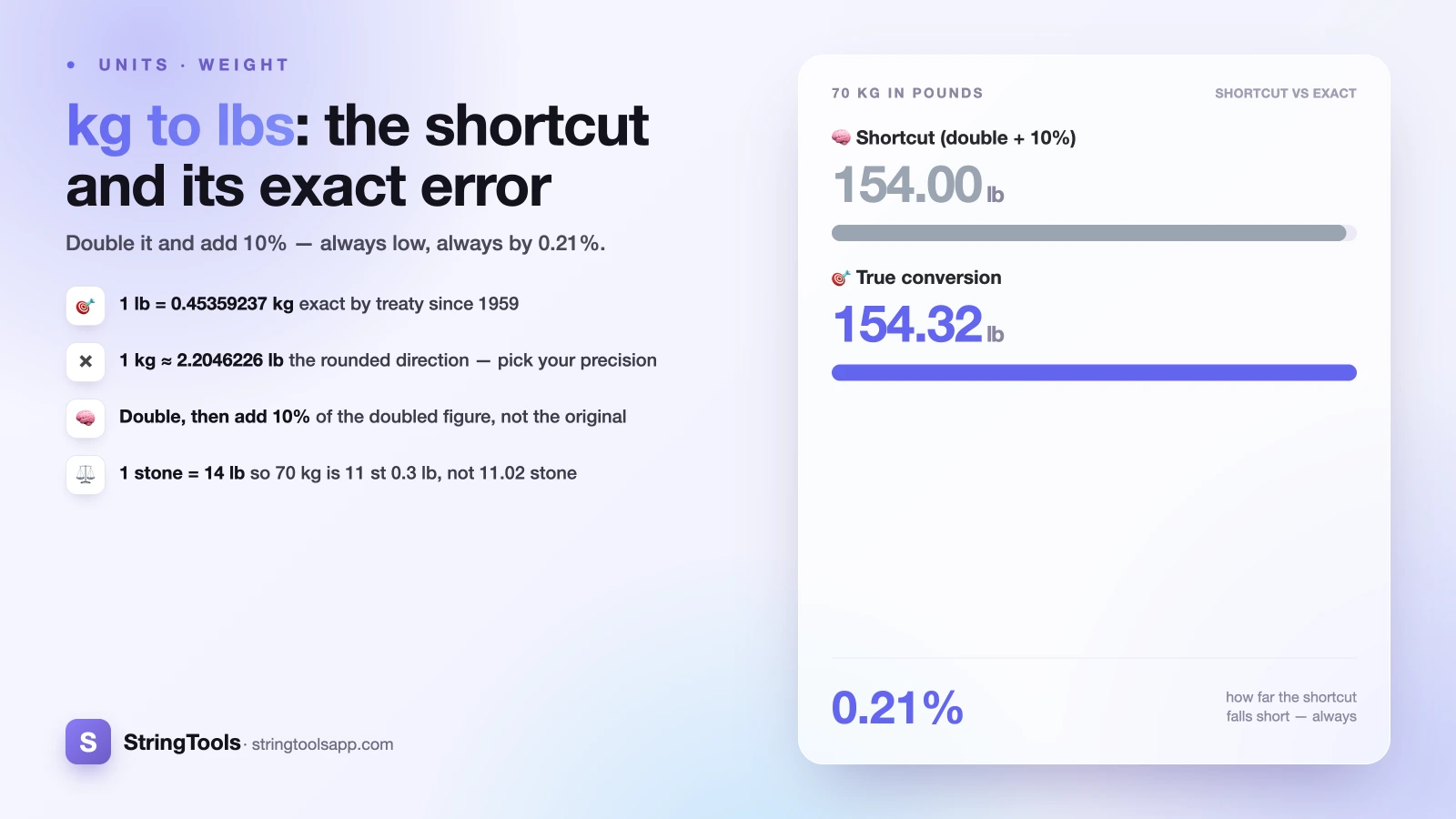
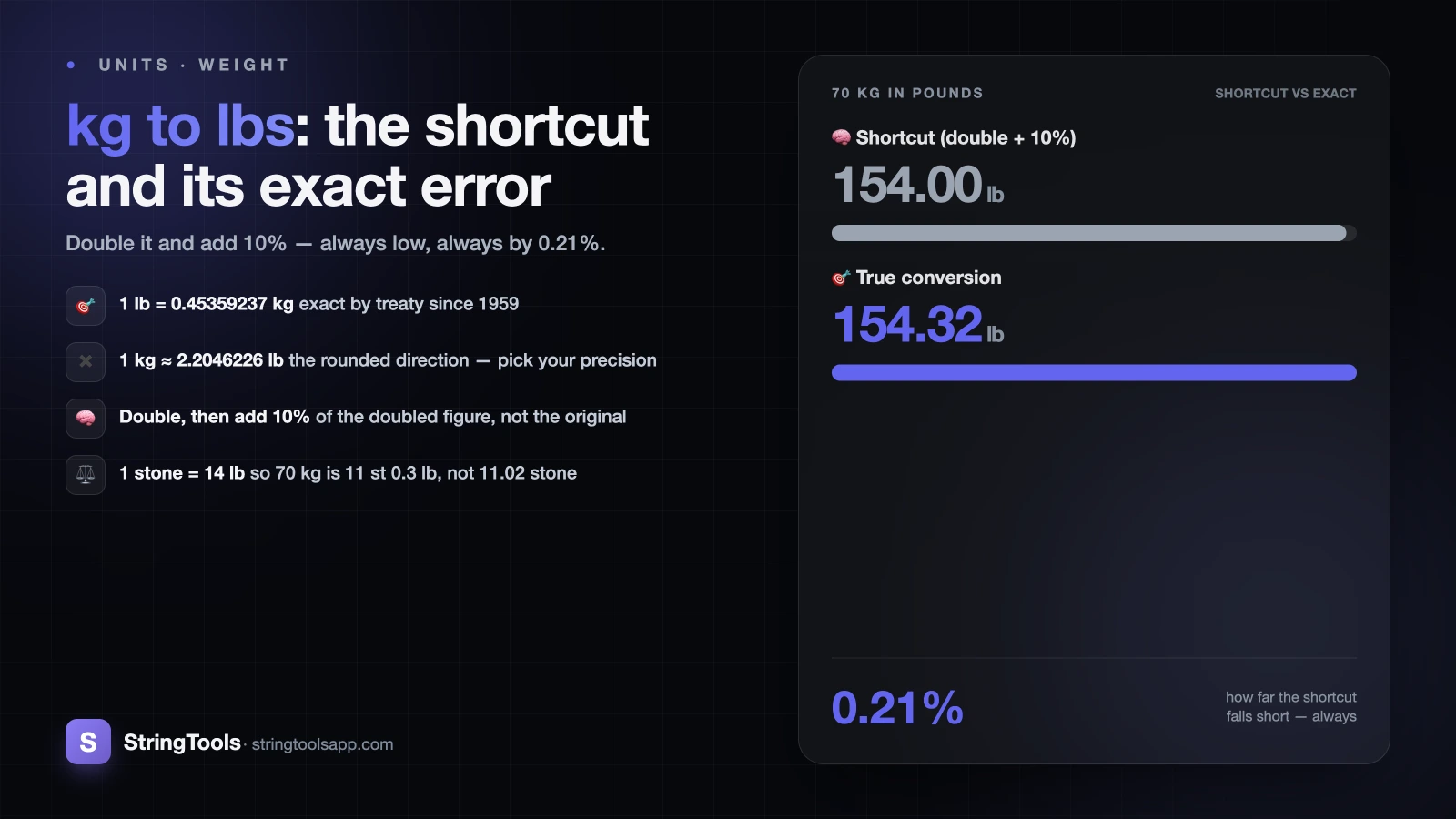
- The double-it-and-add-10% shortcut is always low by exactly 0.21%, which is under half a pound at 100 kg.
- 1 stone = 14 lb exactly. 70 kg is 11 st 0.3 lb, not "11.02 stone" — the number after the stone is pounds, not a decimal.
- Kilograms measure mass; pounds get used for both mass and force, which matters in engineering and almost never at the bathroom scale.
- Run any figure through the unit converter, or sanity-check a body weight with the BMI calculator.
The exactness is worth dwelling on, because most conversion factors are not exact. Since the international yard and pound agreement of 1959, the United States, the United Kingdom, Canada, Australia, New Zealand and South Africa have all used the same international avoirdupois pound, fixed at exactly 0.45359237 kilograms. Before that, the American and British pounds differed slightly — enough to matter in precision manufacturing and nowhere else. Today there is one pound, and it is defined in terms of the kilogram.
That one-way dependency is why the two directions behave differently. Pounds to kilograms is exact: multiply by 0.45359237 and you have the true answer. Kilograms to pounds is not, because 1 ÷ 0.45359237 does not terminate. You get 2.204622621848... and you have to cut it off somewhere.
The kilogram itself has the stranger history. Until 2019 it was defined by a physical object: a platinum-iridium cylinder kept in a vault near Paris, with official copies distributed around the world that slowly, inexplicably, disagreed with it. In May 2019 the BIPM redefined the kilogram in terms of the Planck constant, so it is now a fixed relationship between physical constants rather than a lump of metal. The pound came along for the ride: because a pound is a fixed number of kilograms, redefining the kilogram silently redefined the pound too.
The Mental Shortcut: Double It, Then Add 10%
The shortcut everybody eventually works out for themselves is this: to turn kilograms into pounds, double the number, then add 10% of the doubled figure. So 70 kg becomes 140, plus 14, which is 154 lb. The trap is adding 10% of the original instead — 140 plus 7 gives 147 lb, which is nearly seven pounds out. Ten percent of the doubled number is the version that works, because it is just kg × 2.2 said slowly.
The shortcut is not exact, but its error is beautifully predictable. You are using 2.2 where the true factor is 2.2046226, so you are always low, always by 0.21%, no matter the size of the number.
| Kilograms | Shortcut (double + 10%) | True pounds | Shortcut is short by |
|---|---|---|---|
| 50 kg | 110.0 lb | 110.23 lb | 0.23 lb |
| 70 kg | 154.0 lb | 154.32 lb | 0.32 lb |
| 90 kg | 198.0 lb | 198.42 lb | 0.42 lb |
| 110 kg | 242.0 lb | 242.51 lb | 0.51 lb |
| 130 kg | 286.0 lb | 286.60 lb | 0.60 lb |
The error does not reach a full pound until roughly 216 kg. For body weight, luggage, parcels, groceries and gym plates, the shortcut is simply correct enough — it will never mislead you about whether a suitcase is over a 50 lb limit unless you were within half a pound anyway, in which case you should be weighing it properly.
If you want one more decimal place of accuracy for free, use 2.205 instead of 2.2. That is high by 0.017%, which is around one twentieth of a pound at 100 kg — better than the shortcut in both directions.
The reverse shortcut is weaker and worth knowing about. Halving pounds and taking off 10% gives you lb × 0.45, which is 0.8% below the true 0.45359237 — nearly four times the error of the forward shortcut. A 200 lb figure comes out as 90 kg instead of 90.7 kg. If you convert pounds to kilograms often, memorise 0.4536 instead and multiply properly, or let the unit converter do it.
Kilograms to Pounds Conversion Table
This covers the range most people actually need — body weight, hold luggage, checked freight and gym loading. The middle column is the true conversion rounded to two decimals; the right-hand column is what you would say out loud.
| Kilograms | Pounds (2 dp) | Nearest pound |
|---|---|---|
| 40 kg | 88.18 lb | 88 lb |
| 45 kg | 99.21 lb | 99 lb |
| 50 kg | 110.23 lb | 110 lb |
| 55 kg | 121.25 lb | 121 lb |
| 60 kg | 132.28 lb | 132 lb |
| 65 kg | 143.30 lb | 143 lb |
| 70 kg | 154.32 lb | 154 lb |
| 75 kg | 165.35 lb | 165 lb |
| 80 kg | 176.37 lb | 176 lb |
| 85 kg | 187.39 lb | 187 lb |
| 90 kg | 198.42 lb | 198 lb |
| 95 kg | 209.44 lb | 209 lb |
| 100 kg | 220.46 lb | 220 lb |
| 105 kg | 231.49 lb | 231 lb |
| 110 kg | 242.51 lb | 243 lb |
| 115 kg | 253.53 lb | 254 lb |
| 120 kg | 264.55 lb | 265 lb |
| 125 kg | 275.58 lb | 276 lb |
| 130 kg | 286.60 lb | 287 lb |
| 135 kg | 297.62 lb | 298 lb |
| 140 kg | 308.65 lb | 309 lb |
| 145 kg | 319.67 lb | 320 lb |
For values between the rows, interpolate: each extra kilogram adds 2.2 lb, and each extra 100 g adds a shade over 0.22 lb. Half a kilogram is 1.1 lb, which is a handy anchor — a scale that moves 0.5 kg has moved a bit more than a pound.
Going the other way, these are the round American figures translated back into kilograms:
| Pounds | Kilograms |
|---|---|
| 100 lb | 45.4 kg |
| 120 lb | 54.4 kg |
| 140 lb | 63.5 kg |
| 150 lb | 68.0 kg |
| 160 lb | 72.6 kg |
| 180 lb | 81.6 kg |
| 200 lb | 90.7 kg |
| 220 lb | 99.8 kg |
| 250 lb | 113.4 kg |
The UK Stone: Where kg to lb Conversions Go Wrong
Britain and Ireland are the only places that still quote body weight in stones and pounds, and it is the single most common way a kilogram conversion goes wrong. A stone is exactly 14 pounds, which makes it exactly 6.35029318 kg.
The mistake looks like this. You convert 70 kg to 154.32 lb, divide by 14, get 11.02, and write "11.02 stone". That decimal is not pounds — it is hundredths of a stone. The correct reading is 11 stone and 0.3 pounds, because 0.02 of a stone is about a third of a pound. Anyone quoting body weight as "11.02 st" has skipped the second half of the conversion.
The method that works every time:
- Convert kilograms to pounds:
kg × 2.2046226. - Take the whole number of times 14 goes into that — those are your stones.
- Whatever is left over, in pounds, is the second half of the answer.
| Kilograms | Pounds | Stones and pounds |
|---|---|---|
| 45 kg | 99.2 lb | 7 st 1.2 lb |
| 50 kg | 110.2 lb | 7 st 12.2 lb |
| 55 kg | 121.3 lb | 8 st 9.3 lb |
| 60 kg | 132.3 lb | 9 st 6.3 lb |
| 65 kg | 143.3 lb | 10 st 3.3 lb |
| 70 kg | 154.3 lb | 11 st 0.3 lb |
| 75 kg | 165.3 lb | 11 st 11.3 lb |
| 80 kg | 176.4 lb | 12 st 8.4 lb |
| 85 kg | 187.4 lb | 13 st 5.4 lb |
| 90 kg | 198.4 lb | 14 st 2.4 lb |
| 95 kg | 209.4 lb | 14 st 13.4 lb |
| 100 kg | 220.5 lb | 15 st 10.5 lb |
| 105 kg | 231.5 lb | 16 st 7.5 lb |
| 110 kg | 242.5 lb | 17 st 4.5 lb |
| 115 kg | 253.5 lb | 18 st 1.5 lb |
| 120 kg | 264.6 lb | 18 st 12.6 lb |
| 125 kg | 275.6 lb | 19 st 9.6 lb |
| 130 kg | 286.6 lb | 20 st 6.6 lb |
| 135 kg | 297.6 lb | 21 st 3.6 lb |
| 140 kg | 308.6 lb | 22 st 0.6 lb |
| 145 kg | 319.7 lb | 22 st 11.7 lb |
Notice how the pounds column marches backwards down the table — 1.2, then 12.2, then 9.3 — because 5 kg is 11.02 lb, which is 14 minus roughly 3. Every third or fourth row the pounds figure rolls over into another whole stone.
The round stone figures are worth committing to memory if you deal with British weights: 10 st is 63.5 kg, 12 st is 76.2 kg, 15 st is 95.3 kg, and 20 st is 127.0 kg. UK medical settings work in kilograms — the NHS records and prescribes in metric — while patients almost always answer in stones, so both units end up on the same page. An American reading "12 stone" will usually need it as 168 lb before it means anything at all.
Mass or Weight? The Distinction Physicists Care About
A kilogram is a unit of mass — the amount of matter in something, unchanged whether it sits on a kitchen counter, floats in orbit or rests on the Moon. Weight is different: it is the force gravity exerts on that mass, and it changes with where you are.
The pound is where this gets muddled, because English-speaking countries use the word for both. The pound-mass (lbm) is the 0.45359237 kg unit this whole article is about. The pound-force (lbf) is the force that standard gravity exerts on one pound of mass — exactly 4.4482216152605 newtons. In casual use the two are used interchangeably and nobody is confused, because at the Earth's surface a pound of mass weighs a pound of force by definition.
The link between them is W = m × g, where standard gravity is defined as 9.80665 m/s². So one kilogram of mass weighs 9.80665 newtons at the Earth's surface. Take the same kilogram to the Moon and its mass is still one kilogram, while its weight drops to roughly a sixth.
Your bathroom scale is technically lying to you, in a useful way. It measures force — the load on a strain gauge — and then divides by standard gravity to display a mass. Since real gravity varies by about half a percent between the equator and the poles, an uncalibrated scale would read a 70 kg person around a third of a kilogram differently in Singapore than in Oslo. Manufacturers either calibrate for a region or ignore a discrepancy smaller than the scale's own precision.
Where it does matter:
- Engineering and aerospace. Mixing lbm and lbf in the same equation without the conversion constant is a classic source of factor-of-32.174 errors. This is why the slug and the pound-mass both exist, and why metric engineering is less error-prone.
- Structural loads and torque. Anything quoted in pound-feet, psi or pounds of thrust is a force, not a mass, and cannot be converted to kilograms at all.
- Anything leaving the Earth. Spacecraft budgets are in mass, because that is the quantity that does not change.
Where it does not matter: your body weight, your shopping, your luggage, your dog. On the ground, the numbers coincide, which is exactly why the ambiguity has survived so long. NIST publishes the official conversion factors for both senses of the pound if you need the formal definitions.
For a wider look at why two systems exist at all, see metric vs imperial units.
Where Kilograms and Pounds Collide in Practice
Gym plates. Metric and imperial gyms use plates that look equivalent and are not. A metric Olympic bar is 20 kg (44.09 lb); an American bar is 45 lb (20.41 kg). Load them identically and the metric bar is 0.91 lb — about 0.41 kg — lighter before you add a single plate.
| Metric plate | In pounds | Imperial plate | In kilograms |
|---|---|---|---|
| 25 kg | 55.12 lb | 45 lb | 20.41 kg |
| 20 kg | 44.09 lb | 35 lb | 15.88 kg |
| 15 kg | 33.07 lb | 25 lb | 11.34 kg |
| 10 kg | 22.05 lb | 10 lb | 4.54 kg |
| 5 kg | 11.02 lb | 5 lb | 2.27 kg |
| 2.5 kg | 5.51 lb | 2.5 lb | 1.13 kg |
A 225 lb bench — the American milestone of a bar plus two 45s a side — is 102.06 kg. The metric milestone next to it is a flat 100 kg, which is 220.46 lb. They are not the same lift, and neither is 100 kg the same as "220 lb loaded" if your gym rounds.
Airline baggage. Most economy allowances are set in kilograms and advertised in pounds with a rounding that favours the airline. A 23 kg allowance is 50.71 lb, quoted as 50 lb. A 32 kg allowance is 70.55 lb, quoted as 70 lb. If you are packing against a US scale reading in pounds, a bag at 50.5 lb is 22.91 kg and still under a 23 kg limit — but do not argue that at a check-in desk unless you enjoy it.
Recipes. One pound is 453.59 g and one ounce is 28.35 g. American recipes that call for "a pound of mince" mean roughly 450 g, and the 3.6 g difference will not change dinner. Bread and pastry are the exception, where percentages matter and you should convert properly.
Clinical dosing. Medicine doses are calculated per kilogram of body weight, especially for children. If a form asks for weight in kilograms, give kilograms — convert with lb ÷ 2.2046226, and let a pharmacist or clinician confirm anything that affects a dose rather than self-converting under pressure.
BMI. The metric formula is weight in kg divided by height in metres squared. The imperial version is weight in pounds divided by height in inches squared, multiplied by 703 — and that 703 is simply the kilogram-and-metre conversion folded into a single constant. Our BMI calculator accepts either. If heights are your other problem, how to convert cm to inches covers the same ground for length.
Rounding, Precision and Knowing When to Stop
The most common failure in unit conversion is not using the wrong factor. It is carrying more decimal places than the original measurement deserves, or chaining conversions through rounded intermediates until the answer drifts.
Do not quote more precision than you measured. A bathroom scale reading of 70 kg is accurate to perhaps ±0.1 kg. Converting it to 154.323584 lb implies you know your weight to a hundredth of a gram. Write 154.3 lb, or just 154 lb.
Never chain through a rounded value. Converting 82.4 kg to "182 lb" and then dividing by 14 gives 13 stone 0 lb. Doing it properly — 82.4 ÷ 0.45359237 = 181.66 lb — gives 12 st 13.7 lb, a different stone figure entirely. Round once, at the end.
Sensible precision by context:
| Situation | Round to | Why |
|---|---|---|
| Body weight | 0.1 kg or 1 lb | Beyond that you are measuring your clothes |
| Stones and pounds | Nearest pound | The half-pound is noise on any home scale |
| Recipes | Nearest 5 g | Domestic scales rarely resolve finer |
| Shipping and freight | Round up | Carriers bill by the next band, always |
| Gym loading | Nearest available plate | The plates decide, not the arithmetic |
| Clinical, legal or trade | Full factor | Use 0.45359237, keep the working |
Round up on anything you will be charged for. Couriers and airlines charge by band and round in their own favour, so a parcel at 5.02 kg is billed as 6 kg on many tariffs. Treat your own conversion as a floor, not a target.
Check the direction before you trust the number. The commonest arithmetic slip is multiplying when you should divide. A sanity check takes a second: pounds are the smaller unit, so a weight in pounds is always the bigger number. If your converted figure went down, you inverted the factor. Any answer where kilograms exceed pounds is wrong on its face.
Finally, keep the exact factor where you can find it. 1 lb = 0.45359237 kg is short enough to memorise and settles every argument, including the ones about stones. Everything else in this article is that one number, applied carefully.
Frequently Asked Questions
How many pounds is 1 kg?
One kilogram is about 2.2046226 pounds. The relationship is defined the other way round: one pound is exactly 0.45359237 kilograms, and 2.2046226 is that figure inverted and rounded. For everyday purposes 2.2 lb per kilogram is fine, and 2.205 is more accurate still if you want a second decimal without carrying the full number.
Is 1 kg exactly 2.2 pounds?
No. 2.2 is a rounding, and it is low by 0.21%. The true value is 2.204622621848..., an endless decimal, because only the pounds-to-kilograms direction is exact. In practice the 2.2 shortcut is under half a pound out at 100 kg and does not reach a full pound of error until around 216 kg, so it is safe for body weight, luggage and cooking.
How do I convert kg to stones and pounds?
Multiply kilograms by 2.2046226 to get pounds, then divide by 14. The whole number is your stones; the remainder, in pounds, is the second part of the answer. For example 70 kg is 154.3 lb, and 154.3 ÷ 14 is 11 with 0.3 lb left over, so 70 kg is 11 st 0.3 lb. Writing that as "11.02 stone" is the usual mistake — that decimal is hundredths of a stone, not pounds.
How many kg is 150 lb?
150 pounds is 68.04 kg. Multiply pounds by 0.45359237, which is an exact conversion in this direction. Other common figures: 120 lb is 54.4 kg, 180 lb is 81.6 kg and 200 lb is 90.7 kg. The mental shortcut of halving and taking off 10% gives 67.5 kg, which is about 0.8% low — usable, but noticeably worse than the kilograms-to-pounds shortcut.
Is a pound a unit of mass or of weight?
Both, depending on context. The pound-mass is the 0.45359237 kg unit used for body weight, groceries and freight. The pound-force is a unit of force, defined as the pull of standard gravity on one pound of mass, or exactly 4.4482216152605 newtons. Kilograms are only ever mass. At the Earth's surface the two senses of the pound coincide numerically, which is why the ambiguity almost never causes trouble outside engineering.
What is 70 kg in pounds and stone?
70 kg is 154.32 lb, which is 11 stone 0.3 pounds. It is one of the tidier conversions, landing almost exactly on a whole stone. For reference, 60 kg is 9 st 6.3 lb, 80 kg is 12 st 8.4 lb and 100 kg is 15 st 10.5 lb.
Sources and references
BIPM (bipm.org) · NHS (nhs.uk) · NIST (nist.gov). Content was reviewed against these sources as of the last-updated date above; external figures and rules may change after publication.