
The Formula, in One Line
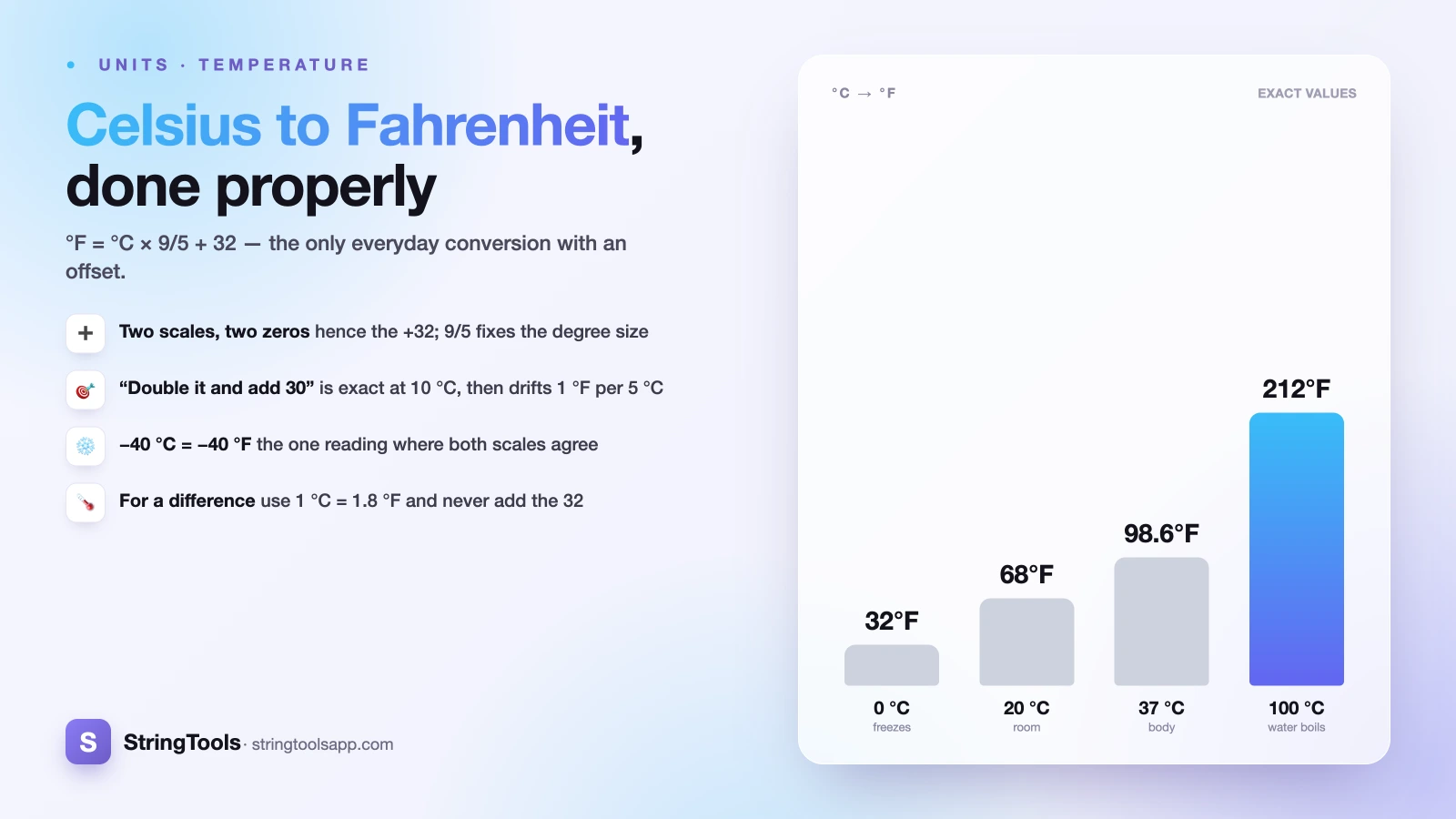
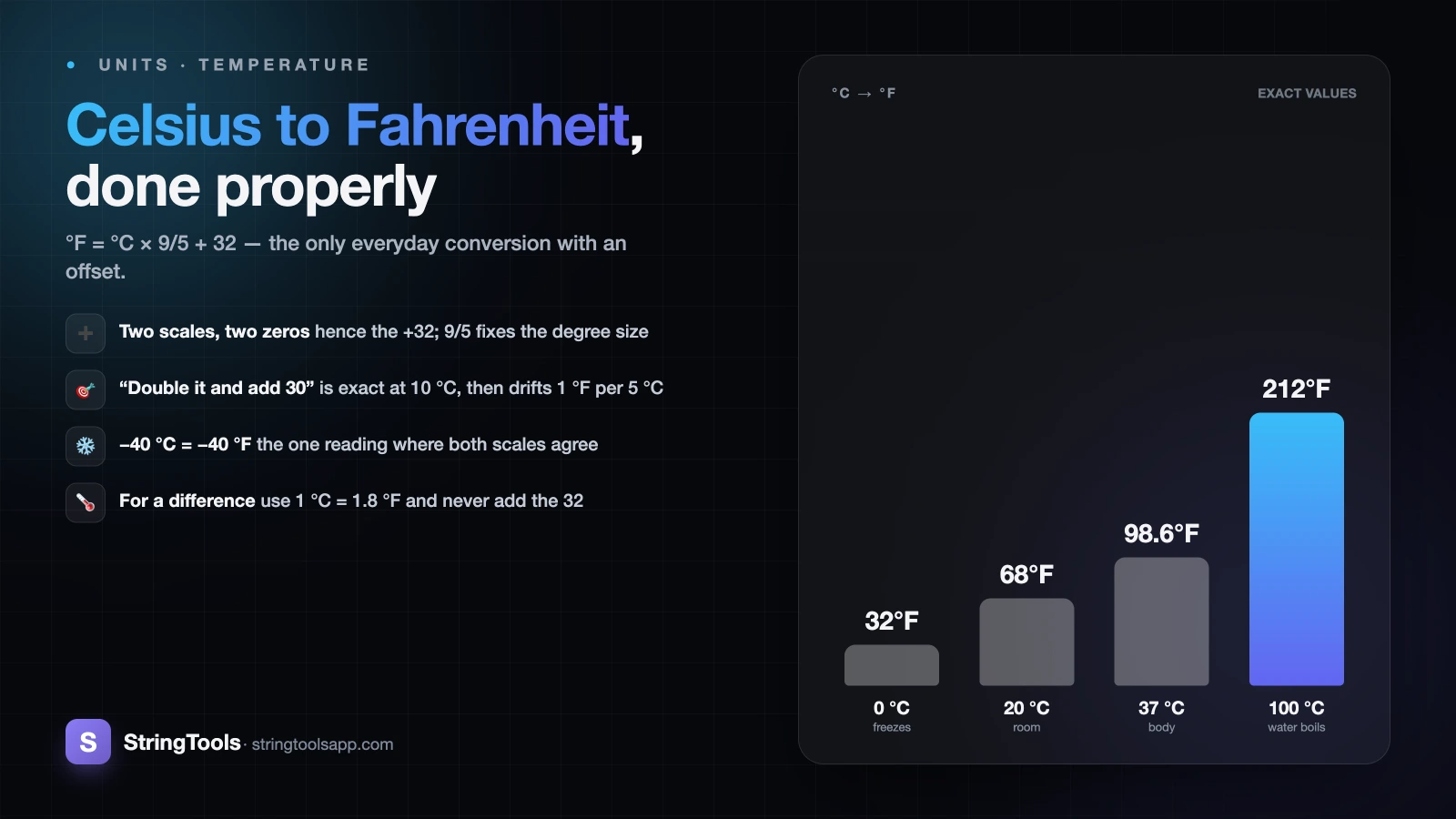
To convert Celsius to Fahrenheit, multiply by 9/5 (that is 1.8) and add 32: °F = °C × 9/5 + 32. To go the other way, subtract 32 first, then multiply by 5/9: °C = (°F - 32) × 5/9. Both formulas are exact by definition, not approximations.
The order matters more than the arithmetic. Going up you multiply then add; coming down you subtract then multiply. Reverse those steps on 20 °C and you get 93.6 °F rather than 68 °F — wrong, but plausible enough to slip past you.
Key Takeaways
- °F = °C × 9/5 + 32 and °C = (°F - 32) × 5/9, both exact by definition.
- The conversion needs an offset because the scales put their zeros in different places, and a multiplier because their degrees are different sizes.
- "Double it and add 30" is exact only at 10 °C, drifting 1 °F per 5 °C away from it.
- -40 °C = -40 °F — the only temperature where the scales read the same number.
- Kelvin shares Celsius's degree size but starts at absolute zero: 0 K = -273.15 °C. It takes no degree symbol.
- For a difference in temperature, use 1 °C = 1.8 °F and drop the 32.
Why Temperature Is the Only Everyday Conversion With an Offset
Almost every unit conversion is a single multiplication. Inches to centimetres is × 2.54; pounds to kilograms is × 0.45359237. Nothing is added, because zero inches and zero centimetres describe the same thing: no length at all.
Temperature is different because Celsius and Fahrenheit are interval scales, not ratio scales: their zeros are conventions, and the two disagree. Celsius fixes 0 at the freezing point of water and 100 at its boiling point under standard pressure. Fahrenheit's zero came from a brine mixture Daniel Fahrenheit could reproduce in his workshop, leaving water to freeze at 32 and boil at 212. That leaves two problems, and each contributes a piece of the formula:
- The zeros sit in different places, so you need the
+ 32. - The degrees are different sizes. The same physical gap — freezing to boiling — is 100 Celsius degrees but 180 Fahrenheit degrees, and 180 ÷ 100 = 9/5 exactly.
One consequence gets missed constantly: because the zero is arbitrary, ratios between Celsius or Fahrenheit readings are meaningless. 20 °C is not "twice as hot" as 10 °C, it is 10 degrees warmer, and that is all you can say. Only a scale starting at absolute zero supports ratio claims, which is why physicists work in kelvin.
Which factors are exact matters, because it changes how you round: 1 inch = 2.54 cm, 1 lb = 0.45359237 kg and °F = °C × 9/5 + 32 are exact by definition, while 1 mile = 1.61 km is a rounded convenience. Our guide to metric versus imperial units sorts one from the other across the everyday units.
Celsius to Fahrenheit Reference Table
Everyday temperatures, computed exactly. Columns three and four show what the "double it and add 30" shortcut would have said, and how far off it lands.
| °C | °F (exact) | Shortcut (2 × °C + 30) | Shortcut error | Roughly |
|---|---|---|---|---|
| -40 | -40 | -50 | -10 °F | Skin at risk in minutes |
| -30 | -22 | -30 | -8 °F | Deep continental winter |
| -20 | -4 | -10 | -6 °F | Hard freeze |
| -10 | 14 | 10 | -4 °F | Cold winter day |
| -5 | 23 | 20 | -3 °F | Ice on the roads |
| 0 | 32 | 30 | -2 °F | Water freezes |
| 5 | 41 | 40 | -1 °F | Coat weather |
| 10 | 50 | 50 | 0 °F | Cool spring morning |
| 15 | 59 | 60 | +1 °F | Mild, light jacket |
| 20 | 68 | 70 | +2 °F | Room temperature |
| 25 | 77 | 80 | +3 °F | Warm summer day |
| 30 | 86 | 90 | +4 °F | Hot |
| 35 | 95 | 100 | +5 °F | Shade-and-water heat |
| 40 | 104 | 110 | +6 °F | Heatwave |
Two rows anchor the rest: 0 °C = 32 °F and 100 °C = 212 °F. Between them every 5 °C step is exactly 9 °F, the pattern running down the second column. If you would rather not do it in your head, the unit converter handles temperature alongside length, weight and volume.
"Double It and Add 30": An Honest Account
The shortcut is genuinely useful and also wrong almost everywhere, and the second half of that is easy to quantify. The real formula is 1.8 × °C + 32; the shortcut is 2 × °C + 30. Subtracting one from the other:
Shortcut error (in °F) = (°C - 10) ÷ 5
So it is exact at 10 °C and drifts by 1 °F for every 5 °C you move away, up or down. That gives it a working range and a hard edge:
- Between 0 °C and 20 °C it is never more than 2 °F out — fine for deciding what coat to wear.
- Between -10 °C and 30 °C it stays within 4 °F, still usable for weather.
- Outside that it falls apart, always erring towards making cold sound colder and heat hotter.
Two examples show why it should never go near a kitchen or a thermometer. At 37 °C it says 104 °F, 5.4 °F above the true 98.6 °F — the difference between a normal reading and one that sends you to a doctor. At 100 °C it says 230 °F, 18 °F past the boiling point of water.
The reverse trick has the same shape. °C ≈ (°F - 30) ÷ 2 is exact at 50 °F and runs about 1 °C low for every 18 °F above that: 68 °F gives 19 °C rather than 20 °C, and 86 °F gives 28 °C rather than 30 °C. Fine for skimming a forecast, useless to a tenth of a degree.
-40: The One Number Both Scales Agree On
Exactly one temperature makes a Celsius thermometer and a Fahrenheit thermometer show the same number, and finding it takes two lines of algebra:
- Start with
F = 1.8 × C + 32 - Ask when
F = C, soC = 1.8 × C + 32 - Rearrange:
-0.8 × C = 32, soC = -40
Check it forwards: -40 × 9/5 = -72, and -72 + 32 = -40. -40 °C = -40 °F.
This is why "minus forty" turns up in aviation manuals, cold-chain specifications and prairie weather reports with no unit attached. There the unit genuinely does not matter, and it is the only such point: two straight lines with different slopes cross exactly once.
Body Temperature: Reading 98.6 °F Carefully
The arithmetic is not in dispute: 37 × 9/5 + 32 = 98.6 exactly, which is why 98.6 °F looks so suspiciously precise — it is 37 °C converted with no rounding at all.
The claim underneath it deserves more care. The 37 °C figure comes from nineteenth-century clinical measurements and became the textbook standard, but it is a convention rather than a constant. Large analyses of modern clinical records have found average body temperatures a few tenths of a degree lower, and individual variation is wide. Your own normal shifts with the time of day (lowest in the early morning, higher in the late afternoon), with age, and with where the reading is taken — oral, ear, forehead and rectal thermometers do not agree by design.
| °C | °F (exact) | Commonly described as |
|---|---|---|
| 35.0 | 95.00 | Hypothermia threshold in clinical guidance |
| 36.0 | 96.80 | Within many people's normal range |
| 37.0 | 98.60 | The traditional textbook "normal" |
| 37.5 | 99.50 | Slightly raised |
| 38.0 | 100.40 | The usual threshold for a fever |
| 39.0 | 102.20 | High fever |
| 40.0 | 104.00 | Very high, medical attention advised |
| 41.0 | 105.80 | Medical emergency |
The practical point: one reading tells you less than a change from your own baseline. The NHS and Mayo Clinic both publish plain-language advice on when a raised temperature needs attention — a better guide than any conversion table. This section is arithmetic, not medical advice.
Oven Temperatures, Gas Marks and Why Recipes Round
Cooking is where conversion errors change an outcome, and where nobody uses exact numbers. Every recipe rounds, and the rounding is not symmetrical.
| °F (US recipes) | °C (exact) | °C (as printed) | Gas mark |
|---|---|---|---|
| 225 | 107.2 | 110 | 1/4 |
| 250 | 121.1 | 120 | 1/2 |
| 275 | 135.0 | 140 | 1 |
| 300 | 148.9 | 150 | 2 |
| 325 | 162.8 | 160 | 3 |
| 350 | 176.7 | 180 | 4 |
| 375 | 190.6 | 190 | 5 |
| 400 | 204.4 | 200 | 6 |
| 425 | 218.3 | 220 | 7 |
| 450 | 232.2 | 230 | 8 |
| 475 | 246.1 | 240 | 9 |
Notice what the rounding does at the two commonest settings. A recipe's 350 °F is really 176.7 °C but is printed as 180 °C, so the metric version runs about 6 °F hotter. At 400 °F it goes the other way: 204.4 °C becomes 200 °C, about 8 °F cooler. Neither gap matters for roast vegetables; both matter for meringues, custards, caramel and bread. Gas marks run on their own ladder, each mark 25 °F above the last from gas mark 1 = 275 °F, which is why the metric column looks so uneven.
Two more things before you trust any oven number. Fan (convection) ovens are conventionally set about 20 °C below the stated temperature, so 180 °C becomes roughly 160 °C fan. And domestic ovens are often out by more than any of this rounding, so an oven thermometer answers the question faster than arithmetic. For the rest of the kitchen, see common cooking measurement conversions.
Where Kelvin Fits, and Why It Has No Degree Symbol
Kelvin is the third scale you will meet, and the simplest to convert: it borrows Celsius's degree size and only moves the zero.
- K = °C + 273.15
- °C = K - 273.15
There is no multiplier: a kelvin and a Celsius degree are exactly the same size, so a 5 K rise is a 5 °C rise. Only the starting point changes. 0 K is absolute zero, which is -273.15 °C, or -459.67 °F. Nothing can be colder, so kelvin has no negative values. That makes it a ratio scale, which is why scientific work uses it: 400 K really is twice the thermodynamic temperature of 200 K, in a way 40 °C is not twice 20 °C.
The missing degree symbol is deliberate, not a typographic accident. Until the late 1960s the unit was the "degree Kelvin", written °K. The General Conference on Weights and Measures then renamed it simply the kelvin, symbol K — lower case spelled out, capital K as a symbol, no degree sign — exactly like the metre or the second. It is one of the seven SI base units, and since the 2019 redefinition it is fixed by assigning an exact value to the Boltzmann constant rather than by any property of water. The BIPM publishes the SI Brochure that defines it, and NIST maintains the US guidance on writing SI units.
One more scale survives in US engineering: Rankine is to Fahrenheit what kelvin is to Celsius — °R = °F + 459.67, with 0 °R at absolute zero.
Converting in Your Head, Exactly
Two mental methods give the exact answer, each only one step longer than the sloppy version.
Celsius to Fahrenheit — double it, take 10% off, add 32. Exact, because doubling and then removing a tenth leaves 1.8, precisely 9/5.
- 25 °C: double to 50, take off 5, giving 45, add 32 → 77 °F
- 37 °C: double to 74, take off 7.4, giving 66.6, add 32 → 98.6 °F
Fahrenheit to Celsius — subtract 32, halve it, add a ninth. Also exact, because a half plus a ninth of a half is five-ninths.
- 86 °F: 86 - 32 = 54, halve to 27, add 3 → 30 °C
- 98.6 °F: 98.6 - 32 = 66.6, halve to 33.3, add 3.7 → 37 °C
One rule catches people out: when you convert a difference rather than a temperature, drop the 32 entirely. A forecast saying tomorrow will be 6 °C warmer means 10.8 °F warmer, not 42.8 °F warmer. The offset positions the scale; the multiplier alone handles the size of a step. The same goes for tolerances, ranges and rates of change.
If the numbers are awkward, the unit converter does Celsius, Fahrenheit and Kelvin together and keeps full precision rather than rounding as it goes.
Frequently Asked Questions
What is the formula to convert Celsius to Fahrenheit?
Multiply the Celsius value by 9/5 (1.8) and then add 32: °F = °C × 9/5 + 32. For example, 20 °C × 1.8 = 36, plus 32 = 68 °F. To reverse it, subtract 32 first and then multiply by 5/9: °C = (°F - 32) × 5/9. Both formulas are exact by definition, so no rounding is built into them. The most common mistake is doing the two steps in the wrong order.
How accurate is the "double it and add 30" trick?
Its error in °F is exactly (°C - 10) ÷ 5, so it is right only at 10 °C and drifts by 1 °F for every 5 °C either side. Between 0 °C and 20 °C it stays within 2 °F, which is fine for weather. It breaks down badly outside that range: at 37 °C it gives 104 °F instead of 98.6 °F, and at 100 °C it gives 230 °F instead of 212 °F. Use it for choosing a jacket, never for cooking or a thermometer reading.
At what temperature are Celsius and Fahrenheit the same?
At -40. Setting C = 1.8 × C + 32 and solving gives C = -40, and checking it forwards, -40 × 9/5 = -72 and -72 + 32 = -40. So -40 °C = -40 °F. It is the only such point, because the two scales are straight lines with different slopes and can cross only once. Kelvin and Celsius never meet at all, since they have the same slope and differ only by an offset of 273.15.
Is 37 °C really normal body temperature?
37 °C converts to exactly 98.6 °F, and that pairing has been the textbook figure since nineteenth-century clinical measurements. It is best read as a convention rather than a constant. Large analyses of modern clinical records have found average body temperatures a few tenths of a degree lower, and normal varies between individuals, across the day, with age, and with whether the reading is oral, ear, forehead or rectal. A fever is usually described as 38 °C / 100.4 °F or above. For anything clinical, check current guidance from a source such as the NHS or Mayo Clinic rather than a conversion table.
What is 180 °C in Fahrenheit?
180 °C is exactly 356 °F: 180 × 1.8 = 324, plus 32 = 356. US recipes normally write that setting as 350 °F, which is really 176.7 °C, so the two versions of the same recipe differ by about 6 °F. In the UK it is gas mark 4. In a fan oven, 180 °C conventional is usually set at about 160 °C — and most domestic ovens vary by more than any of these differences anyway.
Why is there no degree symbol on Kelvin?
Because the unit was formally renamed. Until the late 1960s it was the "degree Kelvin", written °K. The General Conference on Weights and Measures then made it simply the kelvin, symbol K, one of the seven SI base units alongside the metre and the second — and base units do not take a degree sign. Write it lower case when spelled out and as a capital K as a symbol: 300 K, not 300 °K. Conversion is K = °C + 273.15, with 0 K = -273.15 °C.
Sources and references
NHS (nhs.uk) · Mayo Clinic (mayoclinic.org) · BIPM (bipm.org) · NIST (nist.gov). Content was reviewed against these sources as of the last-updated date above; external figures and rules may change after publication.