
Why a Cup of Flour and a Cup of Sugar Weigh Different Amounts
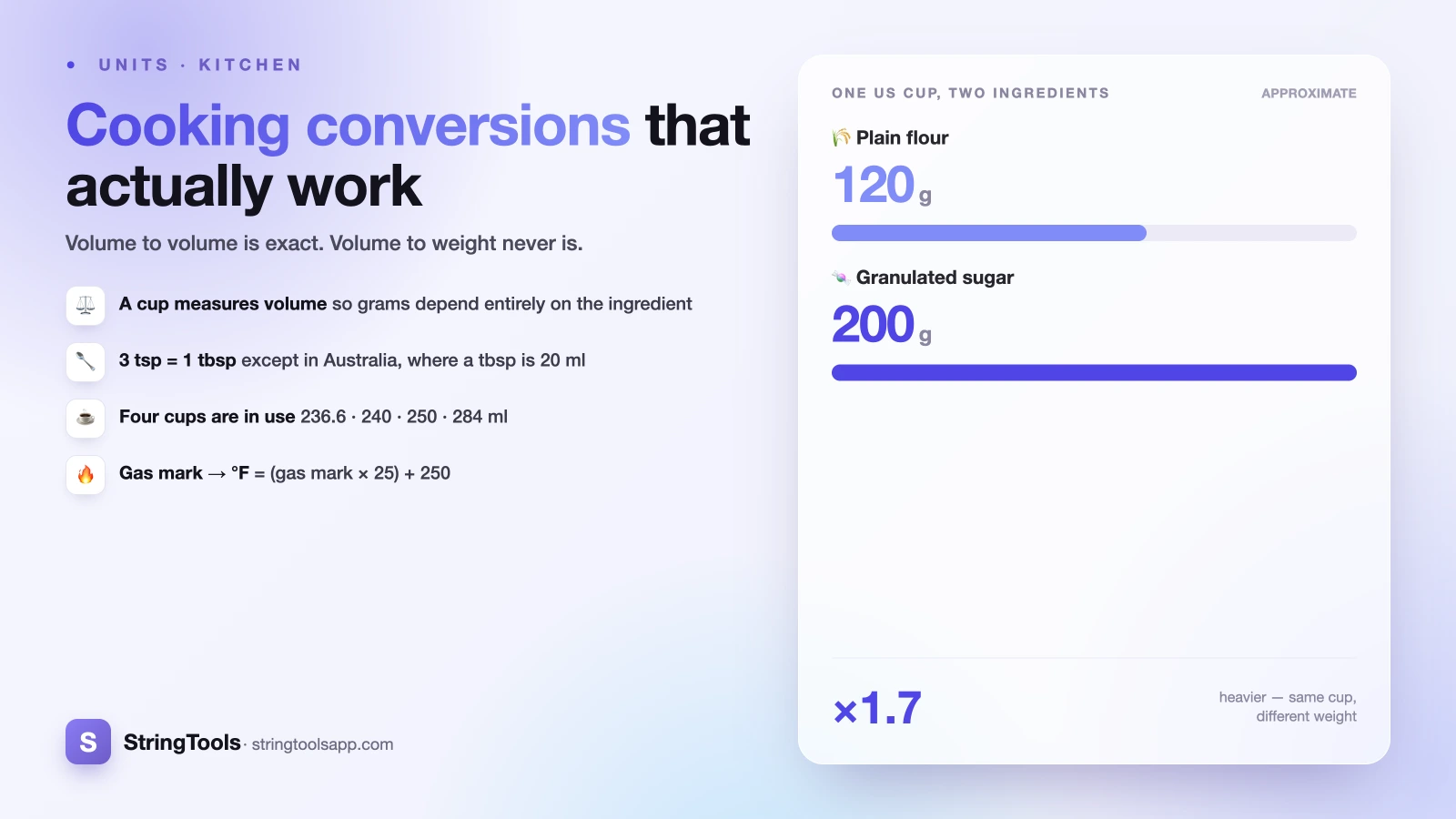
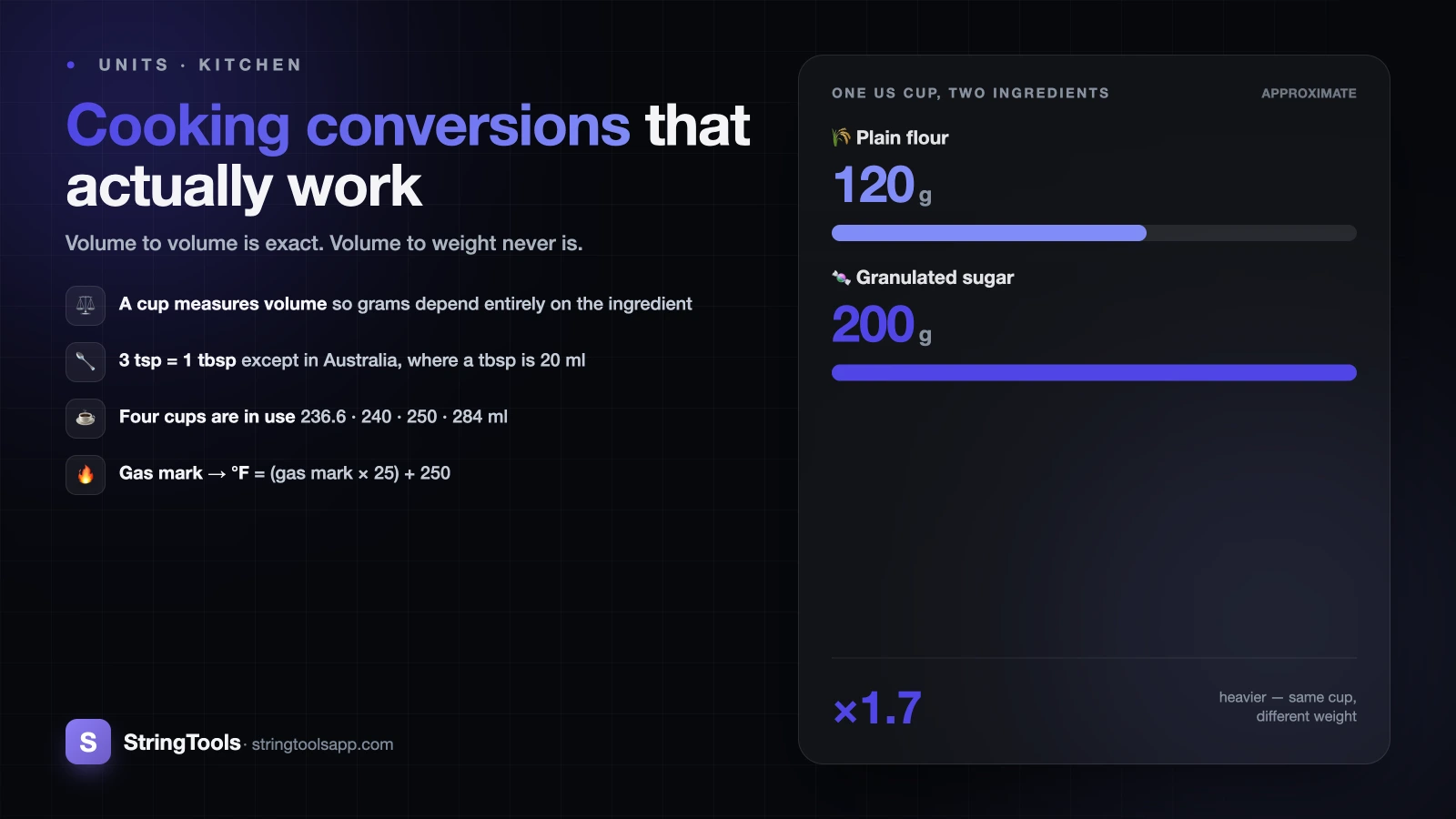
Cooking measurements convert reliably only when you keep volume and weight apart. A cup measures volume, so cups-to-grams depends on the ingredient: a US cup of flour is about 120 g, while a cup of granulated sugar is about 200 g. Volume-to-volume conversions are exact; volume-to-weight never is.
That single distinction explains why so much cooking conversion content is wrong. A chart that says "1 cup = 240 g" has quietly assumed you are measuring water. Flour is fluffy and full of air, sugar is dense crystals, honey is denser still, and cocoa powder is barely there. Pour each into the same cup and you get four very different weights out of the same volume in.
There is a second trap underneath the first. There is no single cup. The cup in a US measuring set holds 236.588 ml, the cup on a US nutrition label is 240 ml, an Australian recipe means 250 ml, and a 1950s British cookbook probably meant half an imperial pint at 284 ml. Recipes rarely say which one they mean.
Key Takeaways
- Cups measure volume, grams measure mass. Converting between them requires knowing the ingredient's density, so every cups-to-grams figure is an approximation.
- A US customary cup is 236.588 ml exactly, but the US legal cup used on nutrition labels is 240 ml, and a metric cup is 250 ml.
- Spoons are near-universal except in Australia, where a tablespoon is 20 ml, not 15 ml. That is one extra teaspoon per tablespoon.
- US and imperial fluid ounces differ: 29.5735 ml versus 28.4131 ml, and an imperial pint is 20 fl oz against the US pint's 16.
- Gas mark to Fahrenheit is a clean formula: °F = (gas mark x 25) + 250, for marks 1 to 9.
- Fan or convection ovens run about 20 °C lower than the conventional temperature in a recipe — US manuals usually phrase the same adjustment as 25 °F.
The Volume Conversions That Are Exact
Within one measuring system, the ratios between spoons and cups are fixed by definition, so these numbers are exact and worth memorising.
- 3 teaspoons = 1 tablespoon
- 16 tablespoons = 1 US cup
- 48 teaspoons = 1 US cup
- 2 US cups = 1 US pint; 2 US pints = 1 US quart; 4 US quarts = 1 US gallon
The millilitre figures follow from the definition of the US gallon as exactly 3.785411784 litres, which makes a US fluid ounce exactly 29.5735295625 ml. Everything below is derived from that, then rounded for display.
| Measure | Teaspoons | Tablespoons | US fl oz | ml (US customary) | ml (rounded kitchen metric) |
|---|---|---|---|---|---|
| 1 tsp | 1 | 1/3 | 1/6 | 4.93 | 5 |
| 1 tbsp | 3 | 1 | 1/2 | 14.79 | 15 |
| 1/4 cup | 12 | 4 | 2 | 59.15 | 60 |
| 1/3 cup | 16 | 5 1/3 | 2 2/3 | 78.86 | 80 |
| 1/2 cup | 24 | 8 | 4 | 118.29 | 120 |
| 2/3 cup | 32 | 10 2/3 | 5 1/3 | 157.73 | 160 |
| 3/4 cup | 36 | 12 | 6 | 177.44 | 180 |
| 1 cup | 48 | 16 | 8 | 236.59 | 240 |
| 1 pint | 96 | 32 | 16 | 473.18 | 480 |
| 1 quart | 192 | 64 | 32 | 946.35 | 960 |
The last column is the convention most recipe writers use when they add metric figures in brackets: teaspoon 5 ml, tablespoon 15 ml, cup 240 ml. It is about 1.4% high against the true US customary cup. For a cake that is invisible. For a 2% salt brine or a bread dough at a specific hydration, it is not, and you should weigh instead.
If you want to run any of these both ways, including the ones that are not neat fractions, the unit converter handles volume, mass and temperature in one place.
Which Cup Does the Recipe Mean?
"One cup" is not a single quantity. Four different cups are in circulation, and a fifth is common in Japanese recipes.
| Cup | Volume | Where you meet it |
|---|---|---|
| US customary cup | 236.588 ml (exactly 8 US fl oz) | US recipes; the cups in a US measuring set |
| US legal cup | 240 ml exactly | US nutrition labels and serving sizes |
| Metric cup | 250 ml exactly | Australia, New Zealand, metric Canadian recipes |
| UK traditional cup | 284.13 ml (half an imperial pint) | Older British and Commonwealth cookbooks |
| Japanese cup | 200 ml exactly | Japanese recipes. The rice-cooker cup is a different unit again — one go, 180 ml |
The 240 ml legal cup comes from US food labelling rules: 21 CFR 101.9 fixes the household measure "cup" at 240 mL for nutrition labelling. It exists so that nutrition panels are comparable, not so that anyone bakes with it — but it has leaked into recipe writing, which is why "1 cup (240 ml)" appears so often.
The practical gap that matters is US against metric. A metric cup is 250 ml against the US customary 236.588 ml, so an Australian cup is about 5.7% larger. Multiply that across a recipe using four cups of flour and you are roughly a quarter of a US cup out, which is enough to turn a soft dough stiff.
Modern British recipes mostly sidestep the problem by giving grams and millilitres. If a British recipe does say "cup", check the publication date and the rest of the ingredient list: if it also lists ounces and imperial pints, assume the 284 ml breakfast cup; if it lists grams, assume the writer means the 250 ml metric cup.
US vs Imperial: Fluid Ounces, Pints and the 20 ml Tablespoon
Fluid ounces are the other place where a familiar word hides two different quantities.
- 1 US fluid ounce = 29.5735295625 ml (exact by definition)
- 1 imperial fluid ounce = 28.4130625 ml (exact by definition, from the imperial gallon of exactly 4.54609 litres)
So an imperial fluid ounce is smaller than a US one by about 4%. But an imperial pint contains 20 fluid ounces where a US pint contains 16, so an imperial pint is about 20% larger overall. That is why a "pint" of beer in a British pub is noticeably bigger than a US pint, and why halving a British recipe by pints without checking is a reliable way to ruin a custard.
| Unit | US | Imperial (UK) | Difference |
|---|---|---|---|
| Fluid ounce | 29.5735 ml | 28.4131 ml | Imperial is ~3.9% smaller |
| Pint | 473.18 ml (16 fl oz) | 568.26 ml (20 fl oz) | Imperial is ~20.1% larger |
| Quart | 946.35 ml | 1136.52 ml | Imperial is ~20.1% larger |
| Gallon | 3.7854 L | 4.54609 L | Imperial is ~20.1% larger |
Note that a fluid ounce measures volume and an ounce measures mass — 28.349523125 g exactly, in both systems. They only coincide for water, and even then only roughly. "8 oz of flour" and "8 fl oz of flour" are completely different amounts. If a recipe says "oz" for a dry ingredient it almost certainly means weight; put it on the scale.
Spoons are calmer, with one significant exception:
| Spoon | Volume | Notes |
|---|---|---|
| US teaspoon | 4.93 ml | 1/6 US fl oz; universally treated as 5 ml |
| Metric teaspoon | 5 ml exactly | UK, EU, Australia, NZ, Canada |
| US tablespoon | 14.79 ml | 1/2 US fl oz; 3 US teaspoons |
| Metric / UK tablespoon | 15 ml exactly | 3 metric teaspoons |
| Australian tablespoon | 20 ml exactly | 4 metric teaspoons, not 3 |
| UK dessertspoon | 10 ml | Appears in older British recipes |
The Australian tablespoon is the one that catches people out. It is a third larger than everyone else's. In a recipe calling for a tablespoon of oil it does not matter; in one calling for three tablespoons of baking powder, cornflour or salt, it very much does. If you are cooking from an Australian source and the result tastes over-seasoned or the sauce is too thick, this is usually why. When an Australian recipe uses teaspoons, though, the teaspoon is the ordinary 5 ml one — only the tablespoon is different.
Cups to Grams by Ingredient (Approximate)
This is the table that cannot be exact, and any site presenting it as exact is misleading you. Every figure below is approximate, drawn from the conventions used by baking references and ingredient databases such as the USDA's FoodData Central. Treat them as good starting points, not physical constants.
Figures are grams per US customary cup. For a 250 ml metric cup, multiply by 1.057.
| Ingredient | g per US cup (approx) | Caveat that matters |
|---|---|---|
| Plain / all-purpose flour | 120 g | Spooned into the cup and levelled. Scoop straight from the bag and you get 140-150 g |
| Bread flour | 120-127 g | Same scooping problem as plain flour |
| Cake flour | 113-120 g | Sifts down easily; sift first for consistency |
| Wholemeal / whole wheat flour | 113-130 g | Varies a lot with grind coarseness |
| Granulated / caster sugar | 198-200 g | Free-flowing; one of the more reliable entries |
| Brown sugar, firmly packed | 213-220 g | Loosely spooned it drops to roughly 145-160 g |
| Icing / powdered sugar, unsifted | 113-125 g | About 100 g once sifted |
| Butter | 227 g | 2 US sticks = 8 oz; close to exact because it is sold by weight |
| Water | 237 g | Density is very close to 1 g/ml |
| Whole milk | 240-245 g | Slightly denser than water |
| Vegetable oil | 215-220 g | Less dense than water, so lighter per cup |
| Honey or golden syrup | 336-340 g | Nearly 1.5x the weight of a cup of water |
| Cocoa powder, unsweetened | 85-100 g | Very light and compressible; sift and spoon |
| Rolled oats | 89-95 g | Whether they are jumbo or quick oats moves this |
| Long-grain white rice, uncooked | 185-200 g | |
| Chocolate chips | 170 g | Chip size changes how they pack |
| Peanut butter | 250-260 g | |
| Table salt | ~290 g | See the salt note below |
Salt deserves its own warning because the crystal shape changes the density enormously. One teaspoon of fine table salt weighs about 6 g. One teaspoon of Morton kosher salt is about 4.8 g, and one teaspoon of Diamond Crystal kosher salt is only about 2.8 g. Swap one for another spoon-for-spoon and you can more than double the salt in a dish. American recipes that specify a brand of kosher salt are not being fussy — they are working around exactly this problem.
Notice the spread in the flour row. The difference between spooning flour into a cup and scooping it with the cup is around 20-25%, which is the single largest source of error in home baking. That is not measurement pedantry; it is the difference between a tender crumb and a dry one.
Why Weighing Beats Measuring for Baking
A scale removes the density problem entirely. 200 g of flour is 200 g of flour whether it was sifted, packed, humid or freshly milled. That is why professional bakeries, and almost every serious baking book published in the last decade, give weights.
The specific advantages are worth naming:
- Repeatability. Your loaf comes out the same on Sunday as it did on Tuesday, because you removed the variable that changes most between attempts.
- Ratios you can actually reason about. Baker's percentages — hydration, salt at 2% of flour weight, yeast at 1% — only work on weight. You cannot express a 70% hydration dough in cups.
- Fewer things to wash. Tare the bowl, add flour, tare, add water, tare, add salt. One bowl, no measuring cups.
- Accuracy at small quantities. A 0.5 g increment on a scale beats trying to judge an eighth of a teaspoon.
- Scaling is arithmetic. Multiplying 312 g by 1.5 is trivial. Multiplying "2 and 2/3 cups plus 3 tablespoons" by 1.5 is not.
Volume is still fine for liquids, where density is close enough to constant, and for anything where a 20% error does not matter — a splash of oil for the pan, stock for a soup, water for rice. Reserve the scale for flour, sugar, butter, cocoa, leaveners and salt, which is to say for baking.
A digital kitchen scale that reads to 1 g and holds at least 3 kg costs very little and will outlast several sets of measuring cups. If you buy one, get one with a tare button and a gram/ounce toggle.
Oven Temperatures: Celsius, Fahrenheit, Gas Marks and Fan
Oven conversion has three moving parts: the Celsius-Fahrenheit arithmetic, the British gas mark scale, and the fan adjustment.
The temperature formula is exact: °F = (°C x 9/5) + 32, and back the other way °C = (°F - 32) x 5/9. There is no rounding hidden in it. What is rounded is the recipe convention: 350 °F is really 176.7 °C, but every recipe writer calls it 180 °C, because ovens are not accurate to a tenth of a degree and dials do not have those markings. The walk-through in Celsius to Fahrenheit explained covers why the two scales meet at -40 and how to do the sum in your head.
Gas marks follow a straight line: °F = (gas mark x 25) + 250, valid for marks 1 through 9. Gas mark 4 is therefore (4 x 25) + 250 = 350 °F, the standard moderate oven. Below mark 1 the scale continues downward in halves and quarters.
| Gas mark | °C (conventional) | °C (fan / convection) | °F | Common description |
|---|---|---|---|---|
| 1/4 | 110 | 90 | 225 | Very cool |
| 1/2 | 120 | 100 | 250 | Very cool |
| 1 | 140 | 120 | 275 | Cool |
| 2 | 150 | 130 | 300 | Cool |
| 3 | 170 | 150 | 325 | Warm |
| 4 | 180 | 160 | 350 | Moderate |
| 5 | 190 | 170 | 375 | Moderately hot |
| 6 | 200 | 180 | 400 | Fairly hot |
| 7 | 220 | 200 | 425 | Hot |
| 8 | 230 | 210 | 450 | Very hot |
| 9 | 240 | 220 | 475 | Very hot |
The fan column is the conventional temperature minus 20 °C, the standard British and European adjustment. A 20 °C interval is a 36 °F interval, though US oven manuals conventionally state the reduction as 25 °F. A fan moves hot air across the food, so heat transfers faster and the effective cooking temperature is higher than the dial suggests. Some manufacturers recommend 25 °C; check the manual for your oven if you have it.
Two practical notes. First, the °C column is the recipe convention, not a precise conversion — 325 °F is 162.8 °C, shown as 170 °C. Second, oven thermostats drift, often by 10-20 °C, and the cycle between the element switching on and off swings wider than that. An oven thermometer that sits on the shelf tells you what your oven actually does, which is more useful than any conversion table.
A Working Method for Converting Any Recipe
Here is the sequence that gets a foreign recipe onto your counter without guesswork.
1. Work out where the recipe is from. Cups plus Fahrenheit plus sticks of butter means US. Cups plus Celsius plus millilitres means Australia or New Zealand, so the cup is 250 ml and the tablespoon is 20 ml. Grams plus gas marks means Britain. Grams and millilitres throughout means you have nothing to convert.
2. Convert the volumes that are exact, exactly. Spoons, cups, pints and fluid ounces have fixed relationships within their system. Use the tables above, or run them through the unit converter rather than doing fractions on the back of an envelope. The broader picture of why two systems exist at all is in metric vs imperial units.
3. Convert dry ingredients to weight, and accept that it is an estimate. Use the density table. Where a range is given, take the middle unless the recipe tells you the method — "1 cup flour, spooned and levelled" means 120 g, "1 cup flour, scooped" means closer to 145 g.
4. Fix the oven before you fix anything else. Set the temperature, convert to your scale, and subtract 20 °C if your oven has a fan and the recipe does not already say "fan".
5. Keep the ratios rather than the numbers. If a bread recipe is 500 g flour and 350 g water, that is 70% hydration. Once you know the ratio, you can make any size of loaf without converting anything again.
6. Write down what you actually did. The most valuable cooking notes are the ones recording that you used 132 g of flour per cup and the biscuits were dry. Two attempts of that and you stop needing conversion tables for the recipes you cook often.
One last note on standards. The relationships between metric units are fixed internationally by the BIPM, while US customary units are defined by reference to metric ones through the NIST Office of Weights and Measures. That is why a US fluid ounce has such an awkward decimal value: it is defined in terms of the litre, not the other way round. Nothing in a kitchen conversion is arbitrary — but nothing about ingredient weights is exact either, and knowing which is which is most of the skill.
Frequently Asked Questions
How many grams is 1 cup?
There is no single answer, because a cup measures volume and grams measure mass. A US cup holds about 120 g of plain flour, 200 g of granulated sugar, 227 g of butter, 237 g of water and 340 g of honey. Any chart giving one number for "1 cup" has assumed a single ingredient, usually water. Look up the specific ingredient, or weigh it.
How many ml is a cup?
It depends on the cup. A US customary cup is 236.588 ml exactly, being 8 US fluid ounces. The US legal cup used on nutrition labels is 240 ml exactly. A metric cup, used in Australia, New Zealand and metric Canadian recipes, is 250 ml exactly. An older British recipe may mean the traditional cup of half an imperial pint, 284.13 ml. Most recipes that print a metric figure use 240 ml.
Is an Australian tablespoon really different?
Yes. An Australian tablespoon is 20 ml, equal to four metric teaspoons, where the UK, US, Canadian and European tablespoon is 15 ml, or three teaspoons. That is a third larger. The Australian teaspoon is the ordinary 5 ml one, so only the tablespoon differs. When cooking from an Australian recipe, use 4 level teaspoons wherever it calls for a tablespoon of a potent ingredient such as salt, baking powder or cornflour.
What is gas mark 4 in Celsius and Fahrenheit?
Gas mark 4 is 180 °C, or 350 °F, the standard moderate oven. The gas mark scale is linear: °F = (gas mark x 25) + 250, so gas mark 1 is 275 °F, gas mark 6 is 400 °F and gas mark 9 is 475 °F. If your oven has a fan, set it to about 160 °C for gas mark 4, since fan ovens are conventionally run 20 °C below the stated temperature.
Why do my baked goods come out dry when I measure flour in cups?
Almost always because of how the flour goes into the cup. Dipping the cup into the bag compacts the flour and can give 140-150 g, while spooning it in loosely and levelling the top gives about 120 g. That is a 20-25% difference in the main structural ingredient, which shows up as a dry, tough crumb. Either spoon and level consistently, or switch to a scale and weigh 120 g per cup.
Are US and UK fluid ounces the same?
No. A US fluid ounce is 29.5735295625 ml and an imperial fluid ounce is 28.4130625 ml, so the imperial one is about 3.9% smaller. Pints go the other way: an imperial pint is 20 fluid ounces at 568.26 ml, while a US pint is 16 fluid ounces at 473.18 ml, making the imperial pint about 20% larger. A fluid ounce is volume; an ounce of weight is 28.349523125 g exactly in both systems.
Sources and references
21 CFR 101.9 (ecfr.gov) · FoodData Central (fdc.nal.usda.gov) · BIPM (bipm.org) · NIST Office of Weights and Measures (nist.gov). Content was reviewed against these sources as of the last-updated date above; external figures and rules may change after publication.