
Why two systems still exist
Two systems still exist because the metric system was designed from scratch in revolutionary France, while imperial units grew out of centuries of English custom. By the time metric became the global scientific standard, the United States had already built its factories, roads and habits around customary units, and switching is expensive.
Key Takeaways
- Metric's modern form is the SI, whose seven base units have, since 20 May 2019, been defined entirely by fixed values of physical constants rather than by any physical object.
- Almost every country has officially adopted SI. The interesting question is not adoption but usage — the US, UK and Canada run both systems side by side in daily life.
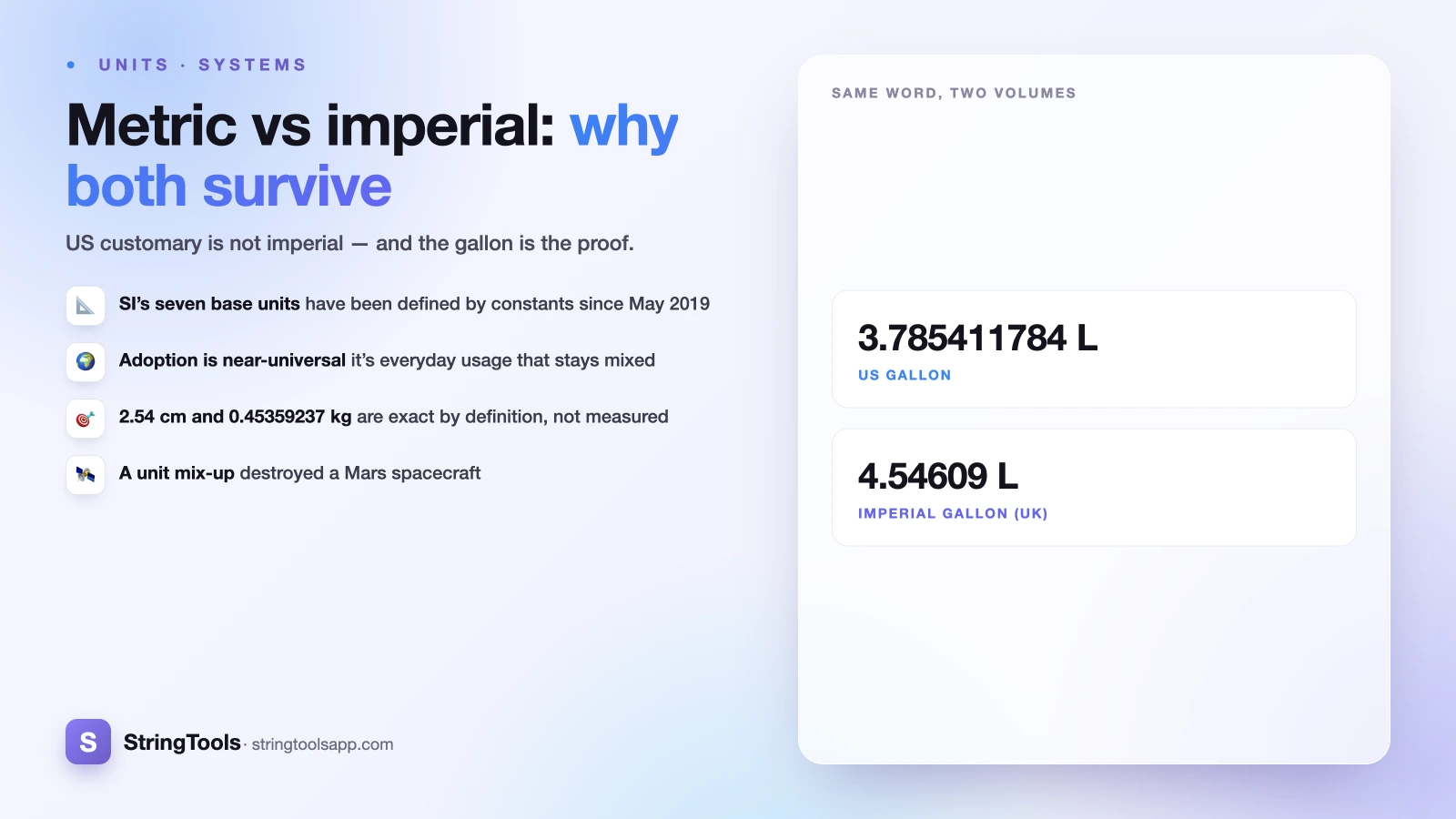
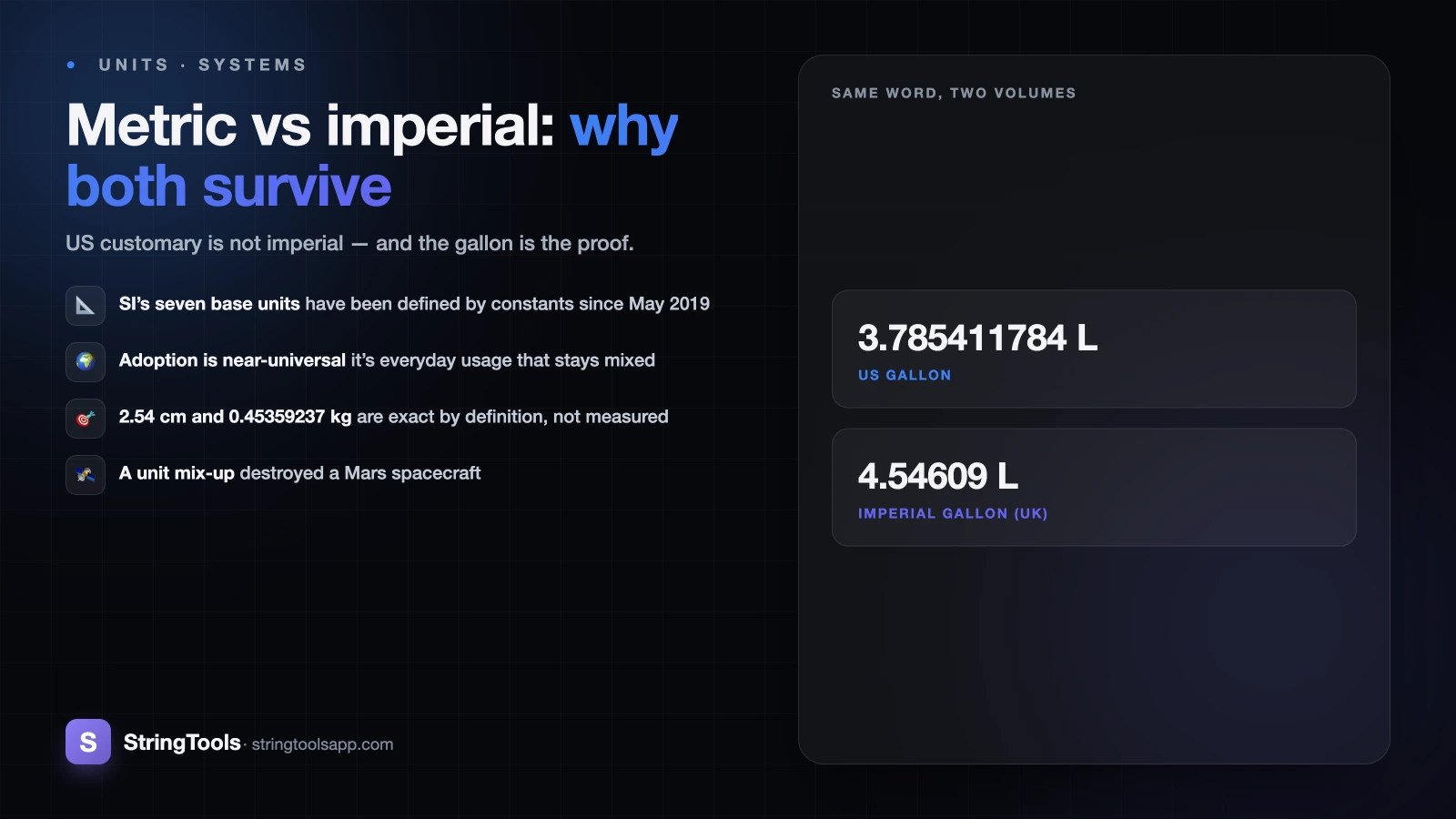
- US customary units and British imperial units are not the same system. They share the inch and the pound but not the gallon: 3.785411784 L in the US, 4.54609 L in the UK.
- Many conversion factors are exact by definition, not measured approximations. One inch is exactly 2.54 cm; one pound is exactly 0.45359237 kg.
- Mixing the systems has destroyed a Mars spacecraft and left a passenger jet gliding without engines. Both were unit errors, not equipment failures.
The split feels arbitrary when you meet it in a recipe or on a road sign, but it has a clean logic. Metric was a deliberate design: one coherent set of units, all decimal, all derived from nature. Imperial was the opposite — an accumulation of trade standards, each sensible in its own market, none designed to work together.
What SI actually is, and how it was rebuilt in 2019
The metric system's modern form is the Systeme international d'unites, universally abbreviated SI, maintained by the International Bureau of Weights and Measures (BIPM) on behalf of the countries that signed the Metre Convention in 1875.
SI has seven base units, and everything else — the newton, joule, watt, volt, pascal — is a combination of them. That coherence is the point: one newton acting through one metre does exactly one joule of work, with no conversion constant in the middle. Imperial offers no such guarantee, which is why engineering in customary units drags around numbers like 32.174 to reconcile pounds-mass with pounds-force.
For most of its life the kilogram was a lump of platinum-iridium in a vault outside Paris. If that lump gained a fingerprint's worth of contamination, the mass of everything in the universe technically changed. That ended on 20 May 2019, when the SI was redefined so every base unit derives from a constant whose numerical value is fixed by definition. Strictly, only four units changed substance — the kilogram, ampere, kelvin and mole — but the effect was that the last physical artefact left the system.
| Quantity | Unit | Symbol | Fixed constant that defines it |
|---|---|---|---|
| Time | second | s | Caesium-133 hyperfine frequency = 9,192,631,770 Hz |
| Length | metre | m | Speed of light c = 299,792,458 m/s |
| Mass | kilogram | kg | Planck constant h = 6.62607015 x 10⁻³⁴ J s |
| Electric current | ampere | A | Elementary charge e = 1.602176634 x 10⁻¹⁹ C |
| Thermodynamic temperature | kelvin | K | Boltzmann constant k = 1.380649 x 10⁻²³ J/K |
| Amount of substance | mole | mol | Avogadro constant = 6.02214076 x 10²³ mol⁻¹ |
| Luminous intensity | candela | cd | Luminous efficacy K = 683 lm/W |
Two oddities worth knowing. The kilogram is the only base unit whose name carries a prefix, a historical accident nobody has been willing to unpick. And the litre is not an SI unit at all — it is a non-SI unit accepted for use with SI, defined as exactly one cubic decimetre, a courtesy also extended to the hour, the tonne and the hectare.
Which countries use which system, and why the map lies
The popular claim is that only three countries have not adopted the metric system: the United States, Myanmar and Liberia. It makes a good graphic and it is roughly true at the level of national policy, but it collapses on contact with reality.
The United States has legally recognised metric units since 1866, and the Metric Conversion Act of 1975 declared SI the nation's preferred system for trade. American science, medicine, the military and most export manufacturing run on metric, and NIST still runs a standing programme to push adoption further. What the US never did was mandate the switch for everyday life, so the shop floor, the road sign and the kitchen stayed customary.
The UK is the clearest case of a country living in both systems at once and being comfortable about it:
- Road distances are in miles and yards; speed limits are in miles per hour.
- Draught beer and cider are sold in pints.
- Packaged food, loose goods and fuel are metric — petrol has been sold in litres since the 1980s.
- Body weight is commonly given in stones and pounds, but a doctor records kilograms and centimetres.
Canada metricated in the 1970s and still buys plywood in 4x8 sheets and quotes baby weights in pounds. Australia's conversion was the most thorough of the English-speaking countries, and even there people give their height in feet and inches.
The honest summary is not "three holdout countries". It is that official adoption is near-universal while everyday usage is mixed — and the mixing is where errors come from.
US customary is not imperial, and the gallon proves it
This is the distinction most people miss, and the one that actually costs money. Imperial units are the British system standardised by the Weights and Measures Act of 1824. US customary units descend from the older English units that crossed the Atlantic before 1824. They are cousins, not twins.
Where they agree, they agree exactly. The 1959 international yard and pound agreement fixed the yard at 0.9144 m and the avoirdupois pound at 0.45359237 kg for the US, UK, Canada, Australia, New Zealand and South Africa. Where they disagree, they disagree by a lot — and it is nearly all about volume.
| Unit | US customary | Imperial (UK) | Practical difference |
|---|---|---|---|
| Gallon | 3.785411784 L | 4.54609 L | Imperial about 20% larger |
| Pint | 473.176473 mL | 568.26125 mL | Imperial about 20% larger |
| Fluid ounce | 29.5735295625 mL | 28.4130625 mL | Imperial about 4% smaller |
| Fluid ounces in a pint | 16 | 20 | Different subdivision |
| Ton | 2,000 lb (907.18474 kg) | 2,240 lb (1,016.0469088 kg) | Long ton 12% heavier |
| Hundredweight | 100 lb | 112 lb | Different by 12% |
| Yard, foot, inch, mile | Identical | Identical | Unified in 1959 |
| Pound and ounce (mass) | Identical | Identical | Unified in 1959 |
The fluid ounce is the trap inside the trap. The imperial fluid ounce is smaller than the US one, yet the imperial pint is larger, because a US pint holds 16 fl oz and an imperial pint holds 20. A recipe calling for "a pint of stock" means 473 mL in Boston and 568 mL in Bristol — a 20% swing that will ruin a reduction.
Two more American peculiarities. The US keeps a separate dry measure for produce, so a US dry pint is not a US liquid pint. And until recently there were two slightly different feet: the international foot and the older US survey foot, differing by about two parts per million — negligible at arm's length, metres of error across a state. NIST and NOAA retired the survey foot on 1 January 2023.
The conversion factors that are exact by definition
A conversion factor is exact by definition when the customary unit has been formally defined in terms of a metric one. These are not measurements with uncertainty; they are legal definitions, and every digit is correct. Anything derived by dividing one of them is a repeating or irrational decimal, so it can only be rounded.
| Conversion | Value | Status |
|---|---|---|
| 1 inch | 2.54 cm | Exact by definition |
| 1 foot | 0.3048 m | Exact by definition |
| 1 yard | 0.9144 m | Exact by definition |
| 1 mile | 1.609344 km | Exact by definition |
| 1 nautical mile | 1,852 m | Exact by definition |
| 1 pound (avoirdupois) | 0.45359237 kg | Exact by definition |
| 1 ounce (avoirdupois) | 28.349523125 g | Exact by definition |
| 1 US liquid gallon | 3.785411784 L | Exact (231 cubic inches) |
| 1 imperial gallon | 4.54609 L | Exact by definition |
| 1 US fluid ounce | 29.5735295625 mL | Exact by definition |
| 1 imperial fluid ounce | 28.4130625 mL | Exact by definition |
| 1 acre | 4,046.8564224 m² | Exact (4,840 square yards) |
| Celsius to Fahrenheit | (C x 9/5) + 32 | Exact by definition |
| Celsius to kelvin | C + 273.15 | Exact by definition |
| 1 kilometre | 0.621371 miles | Rounded (1 / 1.609344) |
| 1 kilogram | 2.204623 pounds | Rounded (1 / 0.45359237) |
| 1 litre | 0.264172 US gallons | Rounded (1 / 3.785411784) |
| 1 litre | 0.219969 imperial gallons | Rounded (1 / 4.54609) |
Notice the pattern: customary to metric is exact, metric back to customary is not. The customary units were redefined in metric terms, not the other way round. So when precision matters, multiply by the exact factor rather than dividing by a rounded one. Ten miles times 1.609344 is 16.09344 km with no error at all.
For everyday work the mental shortcuts are fine: a kilometre is about six-tenths of a mile, a kilogram is a bit over two pounds, a litre is a bit under a US quart. When it matters, use the defined factor. Our unit converter covers length, mass, temperature, volume, area, speed, data and time using those defined values. For body measurements and fabric, the centimetres to inches guide works that one through in detail; Celsius to Fahrenheit explained covers why temperature needs both a multiplier and an offset when the others need only a multiplier.
When units collide: a lost orbiter and a gliding 767
Unit errors are not a theoretical risk. They are a documented failure mode with a body count of hardware.
The Mars Climate Orbiter, 1999
NASA's Mars Climate Orbiter launched on 11 December 1998 and reached Mars the following September. On 23 September 1999, as it fired its engine to enter orbit, contact was lost and never regained. It had approached far too low and was destroyed in the Martian atmosphere.
The cause was not a broken thruster or a bad sensor. As NASA's mission record puts it, ground software worked in customary units while the onboard software expected metric ones. Small thruster firings used to nudge the spacecraft's attitude were reported in pound-force seconds and consumed as newton-seconds. Each error was tiny; accumulated over a nine-month cruise, they shifted the arrival trajectory enough to turn an orbit insertion into an atmospheric entry. The systemic cause is the part worth remembering: nothing in the process was checking for it.
The Gimli Glider, 1983
On 23 July 1983, Air Canada Flight 143, a Boeing 767, ran out of fuel at cruising altitude over Ontario and lost both engines. The crew glided it to a former air force base at Gimli, Manitoba, and landed with no engines and no fatalities.
The aircraft had taken off with roughly half the fuel it needed. Air Canada was mid-conversion to metric, and the 767 was among its first aircraft with instruments in kilograms rather than pounds. With the fuel quantity indicating system unserviceable, the load had to be worked out by hand: a manual dripstick reading under the wing, converted to a volume in litres from a table. The figure used to convert that volume to weight was the density in pounds per litre, about 1.77, when the aircraft needed kilograms per litre, about 0.8. The arithmetic was done correctly. The units were wrong.
Similar mix-ups have caused mechanical failures elsewhere. In December 2003 a train on Space Mountain at Tokyo Disneyland derailed after an axle broke: the axle specification had been converted from imperial to metric in 1995, and replacement axles were later ordered against the superseded pre-conversion drawing, so the part was made undersize. NIST keeps a running list of metrication errors and mishaps. The pattern is constant: a number moves between two documents, its unit does not travel with it, and the receiving system has no way to notice.
Why the United States never finished the job
The United States has tried to metricate more than once, and each attempt failed the same way: the benefit is diffuse and long-term, while the cost is concentrated and immediate.
Thomas Jefferson proposed a decimal system of weights and measures in 1790. The US sent delegates to the Metre Convention in 1875 and has kept its own prototype metre and kilogram ever since. The Metric Conversion Act of 1975 created a board to plan the transition — and made compliance voluntary. Without a mandate or a deadline, the sectors that would bear the retooling cost simply did not move, and the board was wound up in 1982.
Compare that with Australia, New Zealand and South Africa, which converted in the 1960s and 1970s using a legislated timetable, a funded conversion authority and hard cutover dates for road signs, packaging and trade. Metrication works when it is a scheduled project with an end date, and stalls when it is an aspiration.
There is also a real argument on the other side, beyond inertia: a country's physical infrastructure encodes its units. American lumber, fasteners, pipe threads and machine tooling are built around inch-based dimensions and stocked in inch-based sizes, and changing the label does not change the stock. Hence the actual US strategy — hard metric where it is cheap (science, medicine, pharmaceuticals, the military, cars, exports) and soft metric elsewhere, where a package simply prints both numbers. Two-litre bottles and 35 mm film are metric; the two-by-four is not going anywhere.
Working across both systems without getting caught out
Both systems will outlast your working life, so the practical skill is not picking a side but handling the boundary safely.
Carry the unit with the number, always. The single change that would have prevented both incidents above is writing 4,500 kg instead of 4,500. In spreadsheets, put the unit in the column header. In code, put it in the variable name — distance_km, mass_lb — so a mismatch is visible at the point of use rather than three functions later.
Say which gallon, which pint, which ton. For an international audience, "US gallon" and "imperial gallon" are two extra words that remove a 20% ambiguity. The same goes for short ton, long ton and tonne, which are three different masses with nearly the same name.
Sanity-check the magnitude before you trust the maths. Most unit errors are off by a distinctive factor: roughly 2.2 (kg to lb), 2.54 (in to cm), 1.6 (mi to km), 1.2 (US to imperial gallon), or a power of ten. If a result is out by about one of those, suspect the unit before the arithmetic.
Convert once, at the edge. Pick one system as the internal standard — metric, for anything technical — and convert only when data arrives or leaves. Repeated back-and-forth conversion compounds rounding error and multiplies the chance of a mismatch.
The two systems are not a problem to be solved. They are a permanent feature of the world, and the cost of living with them stays small as long as every number you hand to someone else arrives with its unit attached.
Frequently Asked Questions
Why doesn't the United States use the metric system?
It partly does. Metric units have been legal in the US since 1866, and the Metric Conversion Act of 1975 made SI the preferred system for trade. But the Act was voluntary, with no deadline and no funding for retooling, so industries built around inch-based tooling and stock never converted. American science, medicine, pharmaceuticals, the military and export manufacturing are metric; construction, retail and everyday speech are not.
Is the imperial gallon the same as a US gallon?
No. A US liquid gallon is exactly 3.785411784 litres and an imperial gallon is exactly 4.54609 litres, so the imperial gallon is about 20% larger — roughly 1.2 US gallons. This matters most when comparing fuel economy: a car rated at 40 miles per imperial gallon does about 33 miles per US gallon, with no change to the car.
Which countries have not adopted the metric system?
The three usually named are the United States, Myanmar and Liberia, but that is a statement about official policy rather than daily life. Almost every country has formally adopted SI, including the US. The more accurate picture is that several countries — notably the US, the UK and Canada — use metric officially while keeping customary units for roads, drinks, body weight or building materials.
Is an inch exactly 2.54 centimetres?
Yes, exactly. The 1959 international yard and pound agreement defined the yard as exactly 0.9144 metres, which makes the inch exactly 2.54 cm with no rounding. The pound is likewise defined as exactly 0.45359237 kg. Conversions the other way are not exact: 1 cm is 0.3937007874... inches, a repeating decimal that has to be rounded somewhere.
Did NASA really lose a spacecraft because of a units error?
Yes. The Mars Climate Orbiter was lost on 23 September 1999 when it approached Mars far too low and was destroyed in the atmosphere. NASA's investigation found that ground software reported thruster impulses in customary units while the onboard navigation software expected metric ones. The individual errors were tiny but accumulated over a nine-month cruise into a fatal trajectory error.
Does the UK use metric or imperial units?
Both, by design. Trade, packaged goods, fuel and science are metric. Road signs and speed limits remain in miles and miles per hour, draught beer is sold in pints, and people commonly give their weight in stones and their height in feet and inches. Medical records use kilograms and centimetres. In practice most British adults read both systems and switch by context.
Sources and references
International Bureau of Weights and Measures (BIPM) (bipm.org) · NIST (nist.gov) · NASA's mission record (science.nasa.gov) · NIST keeps a running list of metrication errors and mishaps (nist.gov). Content was reviewed against these sources as of the last-updated date above; external figures and rules may change after publication.