
The short answer
No, renting is not throwing money away, but buying is not pure investment either. Rent buys you housing and flexibility. A large share of an owner's payment is equally unrecoverable: mortgage interest, property tax, maintenance, insurance and transaction costs. Only the principal portion builds equity, and in the early years that portion is small.
Key Takeaways
- Rent buys shelter for a period. Mortgage interest buys the use of someone else's capital for a period. Neither comes back.
- In year one of a typical 30-year mortgage, only about 17% of the principal-and-interest payment reduces the loan. The rest is interest.
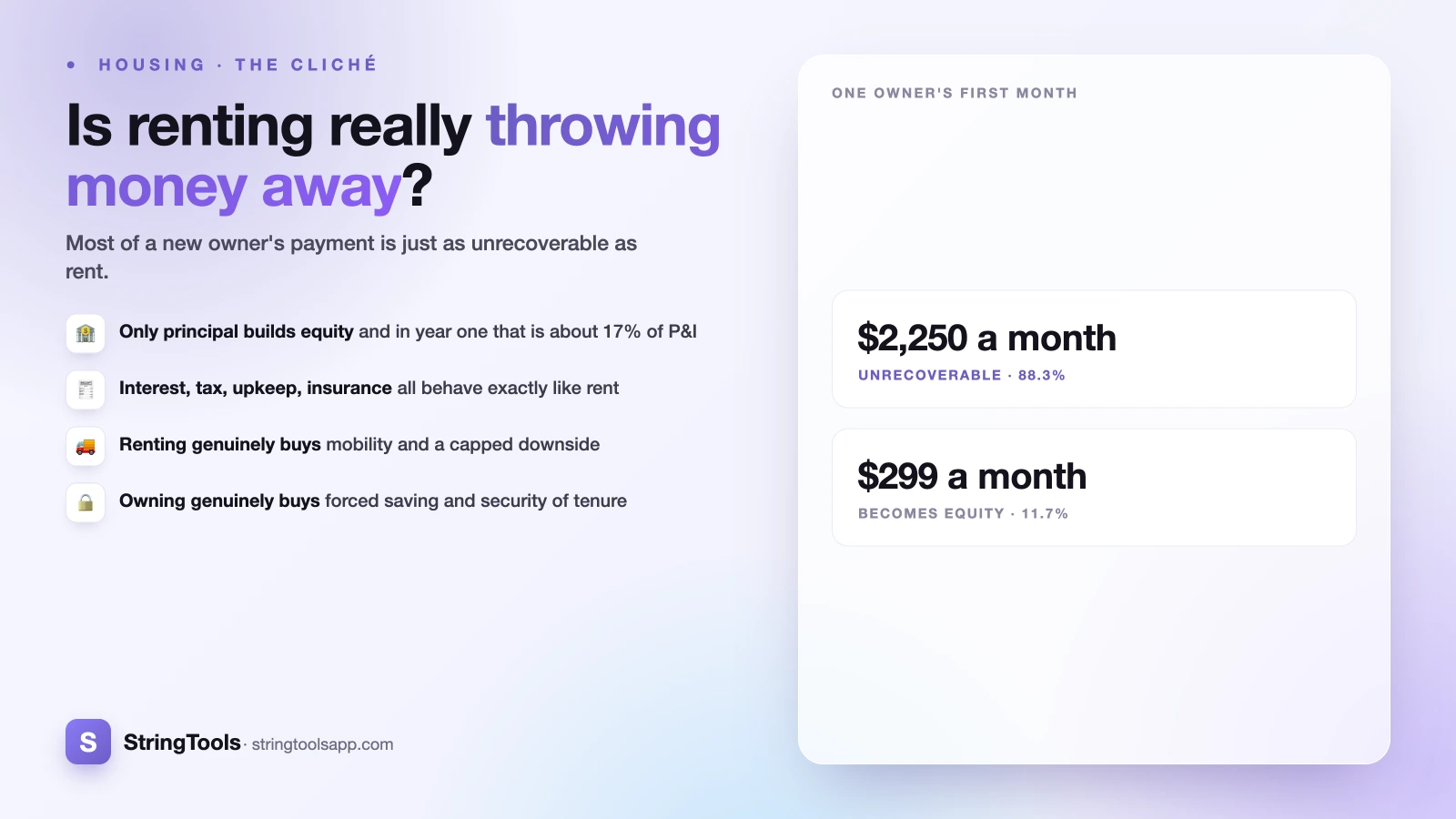
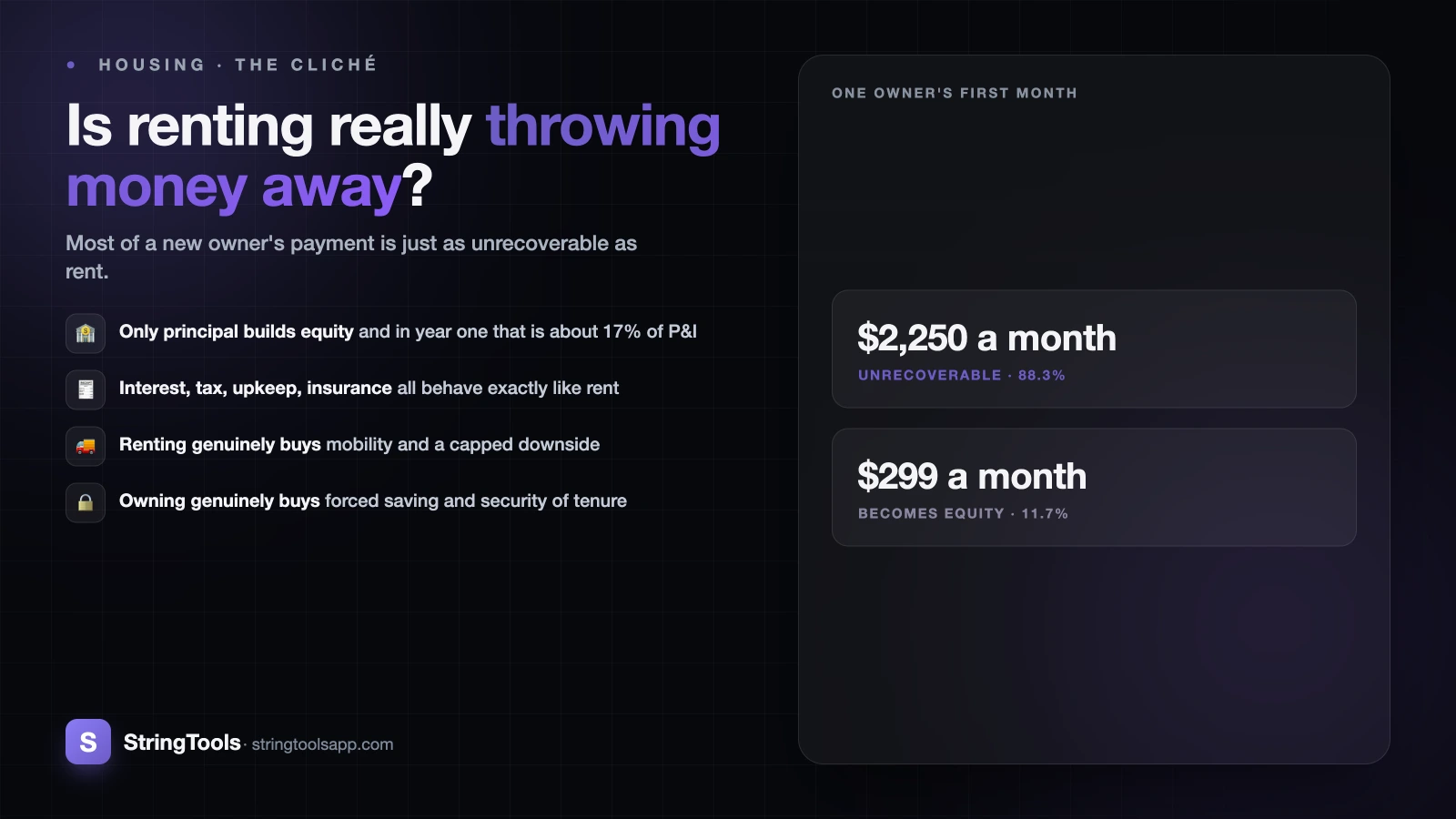
- Add tax, maintenance and insurance and most of a new owner's outlay is unrecoverable — 88% in the example below.
- Renting genuinely buys mobility, a capped downside and freedom from maintenance risk. Owning genuinely buys forced saving, security of tenure and an eventual end to housing payments.
- The answer turns on how long you will stay, what homes cost relative to rents where you live, and what you would otherwise do with the deposit.
- This is general information, not financial advice.
The cliché survives because it contains a real observation: at the end of a tenancy you own nothing, and at the end of a mortgage you own a house. But it treats housing as only an asset purchase. Housing is first a consumable service — a roof, heat, somewhere to keep your things — and that service costs money whether you rent it or own it. A renter buys the service directly. An owner buys the same service and bundles it with a leveraged investment in one building on one street.
So the right comparison is not "rent versus mortgage payment". It is the unrecoverable cost of renting against the unrecoverable cost of owning, with the investment question handled separately. For a renter that is simply the rent; the deposit comes back. For an owner it is a longer list, and adding it up is the part the cliché skips. Consumer bodies publish neutral guidance rather than a recommendation for exactly this reason — see the Consumer Financial Protection Bureau and the UK's MoneyHelper.
Where an owner's money actually goes
Take a $375,000 home, a 20% deposit of $75,000, and a $300,000 mortgage over 30 years. Assume 6% a year to keep the example simple — an illustrative rate, not a current or predicted one, and the shape of the result holds at any rate. Property tax and maintenance are each assumed at 1% of value a year, common planning rules of thumb rather than measured figures for your area, and insurance at $1,500 a year.
The monthly principal-and-interest payment is $1,798.65. In the first month, interest takes $1,500.00 and only $298.65 reduces the balance.
| Monthly cost, first month | Amount | Does it come back? |
|---|---|---|
| Mortgage principal | $299 | Yes — becomes equity |
| Mortgage interest | $1,500 | No |
| Property tax (1% of value a year) | $313 | No |
| Maintenance and repairs (1% a year) | $313 | No |
| Buildings insurance ($1,500 a year) | $125 | No |
| Total monthly outlay | $2,549 | — |
| Recoverable share | $299 | 11.7% |
| Unrecoverable share | $2,250 | 88.3% |
That is the figure the cliché ignores. In month one, 88 cents in every dollar behaves exactly like rent: it buys the service of housing and does not come back. The owner is not throwing money away either — they are paying for shelter, for the lender's capital, for the services the tax funds, and for keeping the building standing. But so is the renter, in one line instead of five.
A sanity check: $2,250 a month is $27,000 a year, or 7.2% of the home's value. A widely used shorthand puts the unrecoverable cost of owning at roughly 5% of value a year — about 1% tax, 1% maintenance and around 3% cost of capital. That version assumes cheaper capital than 6% borrowing implies, which is why it should be recalculated when rates move rather than treated as a constant. Run your own price, deposit and rate through the rent vs buy calculator, and see the payment split month by month with the mortgage calculator.
Why the equity portion starts so small
This is not a quirk of the example; it is how amortisation works. Interest is charged on the balance you still owe, so at the start — when the balance is largest — it eats most of a fixed payment. As the balance falls the interest slice shrinks and the principal slice grows, slowly at first and then quickly near the end. Investopedia's entry on amortisation has the formula.
Here is the same $300,000 loan at 6% across its whole life.
| Year of a 30-year loan | Interest paid | Principal paid | Principal share | Balance at year end |
|---|---|---|---|---|
| 1 | $17,900 | $3,684 | 17% | $296,316 |
| 5 | $16,903 | $4,681 | 22% | $279,163 |
| 10 | $15,270 | $6,313 | 29% | $251,057 |
| 15 | $13,068 | $8,516 | 40% | $213,147 |
| 20 | $10,097 | $11,486 | 53% | $162,011 |
| 25 | $6,090 | $15,494 | 72% | $93,036 |
| 30 | $685 | $20,898 | 97% | $0 |
Read the fourth column slowly. It takes until roughly year 19 or 20 before more than half of each payment buys equity rather than rents money from the bank. After fifteen years — half the term — the balance has fallen by less than 29% of the original loan.
That matters most over short horizons. Someone who buys and sells within five years has, on this example, converted about $20,800 of payments into equity while paying about $87,100 in interest. The forced-savings effect is real, and it is small relative to the cost of getting it.
Two costs both sides forget
Transaction costs. Buying and selling is expensive in a way renting is not. Legal fees, survey, arrangement fees, transfer or stamp taxes on the way in, agent commission on the way out: the round trip commonly lands somewhere between 5% and 15% of the price depending on the jurisdiction, with many markets near 8% to 10%. Assume 8% of our $375,000 example and it costs $30,000, which spread over the time you own the place is a monthly cost:
| Years before you sell | $30,000 round trip, per month |
|---|---|
| 2 years | $1,250 |
| 3 years | $833 |
| 5 years | $500 |
| 10 years | $250 |
| 20 years | $125 |
This is why holding period dominates. The same purchase looks reckless over two years and sensible over twenty with nothing changed but the denominator. That relationship is worked through in how long until buying beats renting.
Opportunity cost of the deposit. The $75,000 is not spent, but it is committed. A renter could invest it. At an illustrative 5% a year — chosen to keep the arithmetic simple, not a forecast — that is $3,750 a year, or $312.50 a month of return the buyer gives up. Returns are never guaranteed, past performance does not predict future results, and an invested deposit can fall as easily as a house can.
Add it up honestly. The owner's true unrecoverable cost in year one is $2,250 of outgoings, plus $313 of forgone return, plus $250 a month of transaction costs if they stay ten years: about $2,813 a month. If the same house rents for less, the renter is ahead on cash flow in year one — provided they actually invest the difference. If it rents for more, the owner is ahead from day one. Everything beyond that is a forecast, and forecasts are where these comparisons go wrong.
What renting genuinely buys you
Renting has real advantages, and they are not consolation prizes.
- Mobility. A tenancy ends in weeks. A sale takes months and costs thousands. If your job, relationship, health or city might change within a few years, the ability to leave cheaply has genuine value — and it is the advantage most often left out of the cliché.
- No exposure to a single asset. A home concentrates a large share of household net worth in one building, on one street, in one local labour market, often leveraged four or five to one. That magnifies gains and losses alike. A renter's savings can be spread.
- No maintenance risk. A failed boiler, a roof, subsidence, a bad survey finding: for a renter these are a phone call. For an owner they are a five-figure bill arriving without warning. The 1% maintenance assumption above averages quiet years with expensive ones.
- Lower entry cost. A deposit plus fees is a large sum to assemble, and while it is being assembled it is doing nothing else.
- A capped downside. A renter cannot owe more than a property is worth. A leveraged owner in a falling market can, and that is what traps people in homes they need to leave.
The usual counter is that renters have nothing to show for it. They have the years they lived somewhere, and whatever they built with the money they did not commit — if they committed it to something. That condition is the honest catch, and the next section is its mirror image.
What owning genuinely buys you
Owning has real advantages too, and some are behavioural rather than financial.
- Forced saving. The strongest argument for buying, and not really an investment argument. A mortgage payment is compulsory; investing the difference between rent and a mortgage is voluntary, and voluntary saving often does not happen. A house makes you save whether you feel like it or not.
- An inflation hedge on housing costs. With a fixed-rate mortgage the largest part of your housing cost is fixed in nominal terms while rents around you move with the market. Tax, insurance and maintenance still rise, so it is a partial hedge — but over decades a substantial one.
- Security of tenure. You cannot be asked to leave because the owner wants to sell. For families settled around a particular school, that is worth real money even though it never appears in a spreadsheet.
- Eventually, no housing payment. At the end of the term the interest stops and the principal stops with it. Tax, insurance and maintenance continue, but the largest line disappears — a structural change in a retirement budget, not a marginal one.
- Control. You can rewire it, extend it, keep a dog in it. Not financial, and often the real reason people buy.
Leverage belongs here too, but honestly. With a 20% deposit, a 10% rise in value is roughly a 50% rise in your equity before costs — and a 10% fall works exactly the same way in reverse. Leverage amplifies whatever happens; it does not make good outcomes likelier.
How to work out your own answer
The comparison is local, so what helps is a method rather than a verdict.
1. Find your price-to-rent ratio. Divide the purchase price by the annual rent on an equivalent home. Our $375,000 house against $2,300 a month rent gives 13.6, which leans towards buying; against $1,800 it gives 17.4, which is closer to neutral. A rough heuristic treats ratios under about 15 as favouring buying and over about 21 as favouring renting, with a wide grey band between. It is a screen, not an answer.
2. Add up your real unrecoverable owning cost. Year-one mortgage interest, plus property tax, maintenance, insurance, any service charge or ground rent, plus the round-trip transaction cost divided by the months you honestly expect to stay, plus the forgone return on your deposit. Compare that with the rent on an equivalent home — not with the mortgage payment.
3. Set an honest holding period. Not the one you hope for. If there is a real chance you move within three years, the transaction table above probably decides it.
4. Ask what the deposit would otherwise do. If the answer is "sit in a current account", the forced-saving argument gets much stronger. If you already invest consistently, it gets weaker.
5. Stress test it. What if the boiler goes in year two, your fixed rate ends higher, the value falls 10%, or one income stops? Buying is fine when it survives those questions and fragile when it only works if nothing goes wrong.
The rent vs buy calculator runs steps one and two on your own numbers, and rent vs buy: which is cheaper walks through a full side-by-side comparison.
The honest verdict
There is no general answer, but there are reliable patterns, and they beat a slogan.
Renting tends to win when your holding period is short or uncertain, local price-to-rent ratios are high, rates make the interest portion large, you would be stretching to afford the deposit and the buffer behind it, or your income or location is unstable. It also wins for anyone who would rather not carry maintenance risk — a legitimate preference, not a failure of ambition.
Owning tends to win when you will stay long enough for transaction costs to amortise, price-to-rent ratios are low, you can fix your rate for a long period, you hold a cash buffer for the repairs that will come, and you know that without a compulsory payment you would not save the difference.
The cliché endures because it is emotionally satisfying, not because it is arithmetically sound. "You get nothing back" is true of rent and equally true of the 88% of a new owner's payment in the table above. Anyone who gives you the answer without asking how long you plan to stay, what homes cost relative to rents locally, and what you would do with the deposit is repeating a slogan rather than doing the maths.
Run the version that uses your numbers and treat the result as a range rather than a verdict. If the two options come out close, they are close, and the tie-breaker should be the life you want rather than a decimal place. Because this is usually the largest financial commitment a household makes, treat all of the above as general information — a regulated adviser or mortgage broker is the right person to check your case.
Frequently Asked Questions
Is renting really throwing money away?
No. Rent buys housing for the period you pay it, in the same way that mortgage interest buys the use of a lender's capital. Neither comes back. The only part of an owner's payment that returns to them is the principal, and in year one of a 30-year mortgage that is roughly 17% of the principal-and-interest payment. Once property tax, maintenance and insurance are included, close to 90% of a new owner's monthly outlay is unrecoverable too.
How much of my mortgage payment goes to principal in the first year?
On a $300,000 loan at an illustrative 6% over 30 years, the payment is about $1,799 a month. In the first year roughly $3,684 reduces the balance and about $17,900 is interest — a principal share of about 17%. The share rises slowly: around 29% in year 10, and it does not pass 50% until roughly year 19 or 20. Lower rates shift that crossover earlier and higher rates push it later.
How long do I need to own a home before buying beats renting?
There is no universal figure — it depends on transaction costs, the price-to-rent ratio where you live, and what your deposit would otherwise earn. The mechanism is simple: at an illustrative 8% of the price, a round trip costs $1,250 a month if you sell after two years and $250 a month if you sell after ten. Short holding periods are where buying most often loses.
Does renting mean I will never build wealth?
Not necessarily, but it removes the automatic mechanism. A mortgage forces you to save; renting does not. A renter who consistently invests the difference between rent and the full cost of owning — including the deposit that is not tied up — can end up in a comparable position, though returns are never guaranteed in either direction. A renter who spends the difference will not. The behavioural question is usually more decisive than the arithmetic one.
What is the price-to-rent ratio and how do I use it?
Divide a home's purchase price by the annual rent on an equivalent property. A $375,000 home against $2,300 a month rent gives 13.6; against $1,800 it gives 17.4. As a rough screen, ratios under about 15 lean towards buying and over about 21 lean towards renting, with a wide neutral band between. It ignores interest rates, your holding period and maintenance risk, so treat it as a first filter rather than a decision.
Is buying a home a good investment?
A home is a leveraged, undiversified, illiquid asset that also delivers a service you would otherwise have to buy, which makes it hard to compare with a portfolio. It can build substantial equity over decades, largely through forced saving and inflation-fixed borrowing, and it can also fall in value while costing you tax, maintenance and interest throughout. Assess it as somewhere to live that has an investment dimension, rather than an investment you happen to sleep in. This is general information, not financial advice.
Sources and references
Consumer Financial Protection Bureau (consumerfinance.gov) · MoneyHelper (moneyhelper.org.uk) · amortisation (investopedia.com). Content was reviewed against these sources as of the last-updated date above; external figures and rules may change after publication.