
Refinancing in One Minute
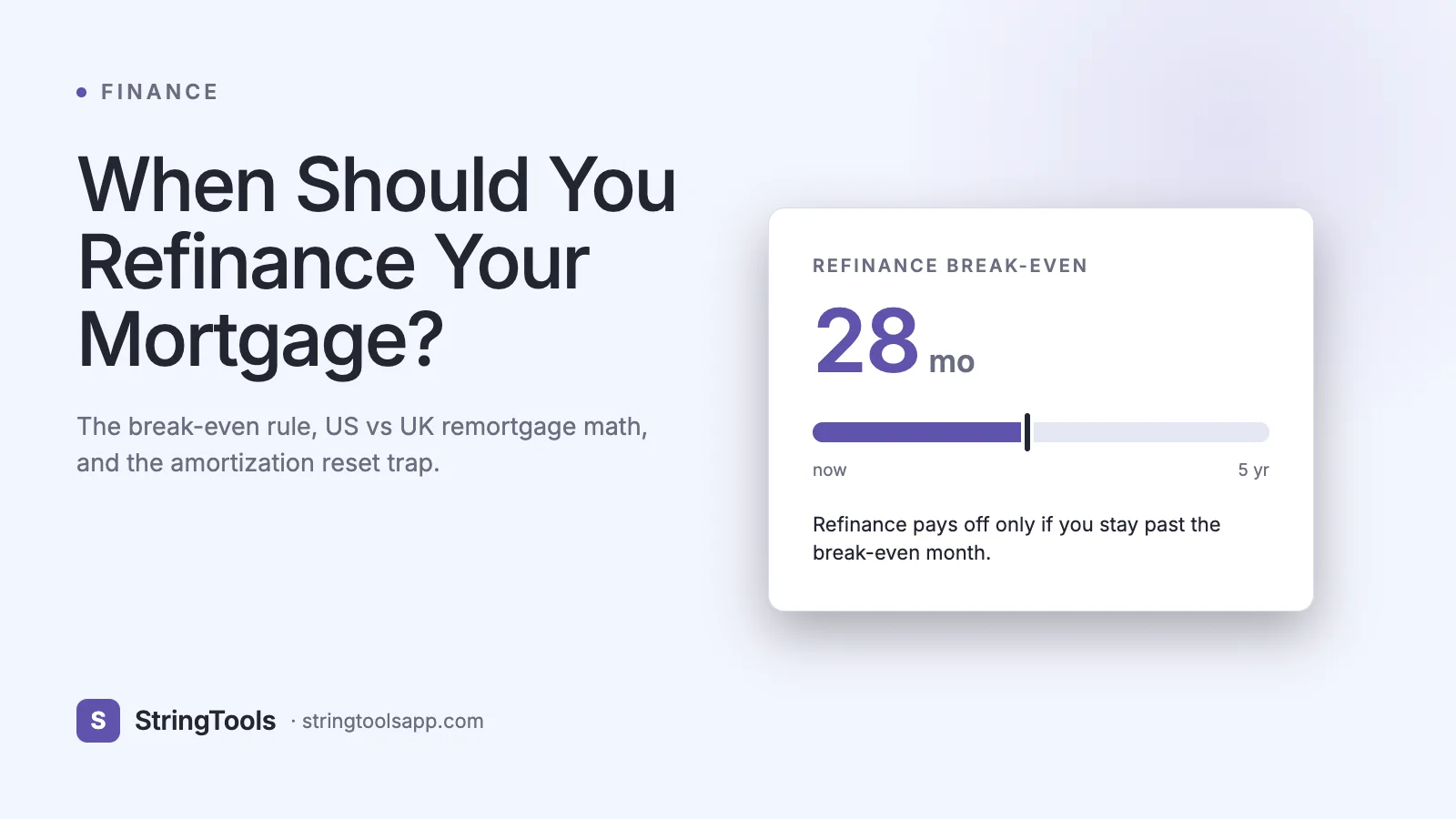
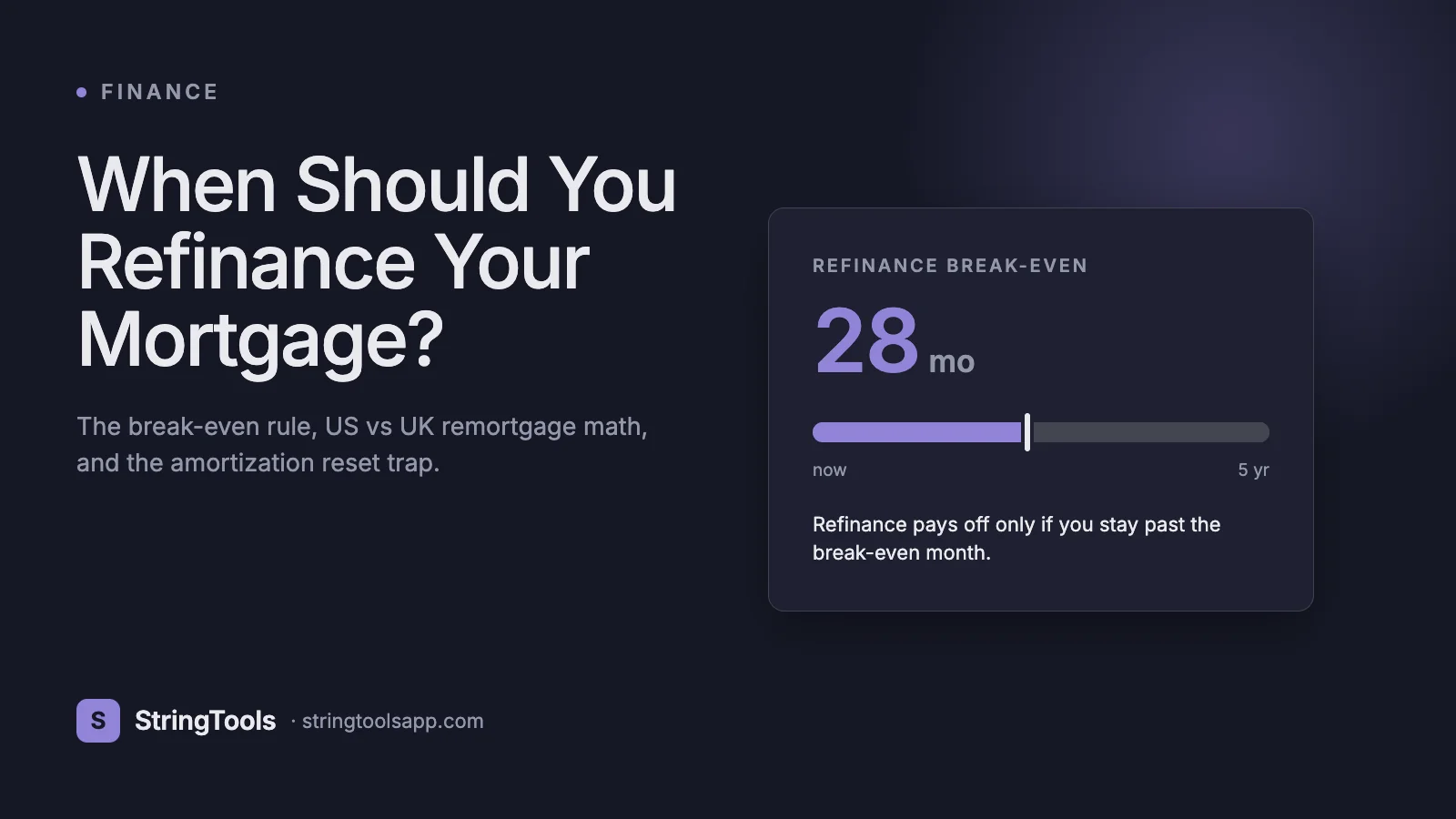
Refinancing your mortgage means replacing your current home loan with a new one — ideally at a lower rate, a shorter term, or better terms. The decision usually comes down to one number: how many months it takes for your monthly savings to repay the upfront cost of switching. That is the break-even point, and it is the single most important test of whether a refinance is worth it.
This guide walks through the break-even math with worked US and UK examples, explains the difference between a rate-and-term and a cash-out refinance, and shows the trap that catches even careful borrowers — restarting the amortization clock and paying more total interest even at a lower rate.
Key Takeaways
- The break-even rule is simple: total upfront cost ÷ monthly saving = months to break even. If you will stay in the home past that point, refinancing can pay off.
- In the US this is a refinance with closing costs; in the UK it is a remortgage with an arrangement (product) fee and possible early repayment charges (ERCs).
- A rate-and-term refinance changes your rate or length; a cash-out refinance also borrows against your equity, raising your balance and usually your rate.
- Refinancing can make sense when rates drop meaningfully, when you can drop mortgage insurance, when you shorten the term, or when you move from an adjustable or variable rate to a fixed one.
- The biggest hidden cost is resetting to a fresh 30-year term — a lower rate spread over a longer period can raise your lifetime interest even as the monthly payment falls.
- If you plan to move or repay soon, or you face a large ERC, refinancing often loses money.
- Always compare the total cost of the loan, not just the headline rate or the new monthly payment.
What Refinancing (and Remortgaging) Actually Means
A refinance pays off your existing mortgage with a brand-new loan. The property does not change hands; only the debt does. You go through underwriting again — a credit check, income verification, and usually a fresh valuation of the home — and the new lender settles the old balance directly.
In the United States, this is called refinancing, and the upfront cost is a bundle of closing costs: lender origination or application fees, an appraisal, title insurance, recording fees, and sometimes discount points you pay to buy the rate down. These typically run 2% to 5% of the loan amount, though they vary widely by lender and state.
In the United Kingdom, the same move is called remortgaging, and the timing is different. Most UK borrowers are on a fixed-rate deal (often two or five years). When that deal ends, the loan rolls onto the lender’s standard variable rate (SVR), which is usually much higher — so people remortgage to a new fixed deal to avoid the SVR jump. The main upfront cost is an arrangement fee (also called a product fee), often a few hundred to around £1,500, plus valuation and legal fees, though many remortgage deals bundle those in for free. The catch is the early repayment charge (ERC): if you leave a fixed deal before it ends, the lender charges a penalty, commonly 1% to 5% of the outstanding balance, which can wipe out the benefit of switching early.
Across much of the EU, practices sit between the two. In some markets (for example the Netherlands and parts of Scandinavia) refinancing to chase a lower rate is routine; in others (notably France and Germany) fixed-for-life or very long fixed periods, plus prepayment penalties set by national law, make mid-term refinancing less common. Wherever you are, the mechanics are the same: a new loan, an upfront cost, and a monthly saving to weigh against it. To see how the payment itself is built from principal, rate, and term, our explainer on how mortgage payments are calculated breaks down the amortization formula.
The Break-Even Rule, Step by Step
The break-even point is the number of months it takes for your monthly savings to repay everything you spent to refinance. The formula is deliberately simple:
Break-even (months) = Total upfront cost ÷ Monthly payment saving
If you plan to keep the mortgage past that point, the refinance starts putting money in your pocket. If you will sell, move, or pay the loan off before then, you lose money on the deal.
Here is a US worked example (all figures ILLUSTRATIVE). Say your closing costs come to $6,000 and the new loan lowers your payment by $200 a month:
$6,000 ÷ $200 = 30 months — so you break even in two and a half years. Stay longer than that and you are ahead; move within two years and you have lost money.
The table below shows how the answer shifts with different costs and savings:
| Closing costs (illustrative) | Monthly saving | Break-even | In years |
|---|---|---|---|
| $3,000 | $250 | 12 months | 1.0 |
| $6,000 | $200 | 30 months | 2.5 |
| $8,000 | $150 | 54 months | ~4.5 |
| $4,500 | $300 | 15 months | 1.25 |
Two rules of thumb fall out of this. First, bigger monthly savings shorten the break-even — which is why a larger rate drop matters more than a tiny one. Second, lower upfront costs shorten it too — a “no-closing-cost” refinance can look attractive, but the lender usually recovers those costs through a slightly higher rate, so compare the two side by side.
A more precise version of the break-even test uses your after-tax saving and accounts for the fact that you restart interest-heavy early payments, but the simple division above is the right first filter. You can model the new payment against your current one with our mortgage calculator in a couple of minutes.
A UK Remortgage Example — Fees and ERCs
The UK math works the same way, but the cost side of the equation looks different. Instead of thousands in closing costs, you are usually weighing a single arrangement fee — and, critically, whether an early repayment charge applies.
Here is an illustrative remortgage (all figures ILLUSTRATIVE). Your fixed deal has ended and you have rolled onto the SVR. You switch to a new two-year fix with an arrangement fee of £1,499, and the new deal lowers your payment by £220 a month:
£1,499 ÷ £220 = 6.8 months — you break even in under seven months. Because your fixed deal has already ended, there is no ERC, so this is an easy win: over a two-year fix you save roughly £220 × 24 − £1,499 ≈ £3,781.
Now change one thing. Suppose you are tempted to switch 12 months before your fixed deal ends to grab a lower rate. Your balance is £250,000 and the ERC is 2% of the balance:
ERC = 2% × £250,000 = £5,000, on top of the £1,499 fee — £6,499 upfront. At the same £220 monthly saving, break-even jumps to £6,499 ÷ £220 = 29.5 months. If your new fix only lasts 24 months, you never break even before you would need to remortgage again. That is why UK borrowers usually wait until they are within the last few months of a deal (many lenders let you lock a new rate up to six months ahead) or until the deal has ended.
The lesson is universal: the upfront cost in the break-even formula must include every penalty and fee to leave the old loan, not just the fee to arrange the new one.
Rate-and-Term vs Cash-Out Refinance
Not all refinances have the same goal, and the type you choose changes both the risk and the math.
Rate-and-term refinance This is the classic version: you replace the loan to get a better rate, a different term, or both, without borrowing extra. Your balance stays roughly the same (plus any rolled-in fees). Because you are not increasing the debt, lenders view it as lower risk and generally offer their best rates. Every example so far in this guide is a rate-and-term refinance.
Cash-out refinance Here you take out a new loan that is larger than what you owe and pocket the difference in cash — often to fund home improvements, consolidate higher-interest debt, or cover a large expense. If you owe $200,000 on a home worth $340,000 and refinance into a $260,000 loan, you walk away with about $60,000 (minus costs), but your mortgage balance and monthly payment both rise.
Cash-out refinancing usually carries a slightly higher rate than rate-and-term because the lender is taking on more risk, and it converts unsecured or short-term debt into debt secured against your home — meaning the house is on the line if you cannot pay. It can be sensible when the new blended rate is well below what you are paying on the debt you are replacing, but it is easy to erode the equity you have built. The UK equivalent, borrowing more on a remortgage, works the same way and is assessed against affordability rules and your loan-to-value.
A quick sanity check for a cash-out: would you take out a separate loan at this rate for this purpose? If not, borrowing it against your mortgage does not make it a better idea — it just spreads it over 20 or 30 years.
When Refinancing Makes Sense
Refinancing is worth serious consideration in a handful of clear situations. In each, run the break-even test before committing.
- Rates have dropped meaningfully. There is no magic threshold — the old “refinance if you can save 1%” rule ignores your balance and costs. What matters is whether the monthly saving clears your break-even within the time you will hold the loan. A large balance makes even a small rate drop worthwhile; a small balance may need a bigger drop.
- You can drop mortgage insurance. In the US, if your home has appreciated or you have paid down enough that you now have 20%+ equity, refinancing can remove private mortgage insurance (PMI) — a saving that is pure profit and does not depend on rates at all.
- You want to shorten the term. Moving from a 30-year to a 15- or 20-year loan usually comes with a lower rate and dramatically less lifetime interest. The payment often rises, but you own the home outright far sooner. See 15-year vs 30-year mortgage for the full trade-off.
- You are on an adjustable or variable rate and want certainty. Refinancing from a US adjustable-rate mortgage (ARM) — or a UK borrower moving off the SVR — into a fixed rate locks your payment and protects you if rates climb. The value here is stability, not just the headline number.
- Your credit has improved. A materially higher credit score since you first borrowed can qualify you for a better rate than your original loan.
If your real goal is to be mortgage-free sooner rather than to lower a payment, compare refinancing against simply overpaying your current loan — often the cheaper path, as we cover in how to pay off your mortgage early.
When It Does NOT Make Sense — The Amortization Reset Trap
The most expensive refinancing mistake is not a bad rate — it is quietly restarting a fresh 30-year term and confusing a lower monthly payment with a cheaper loan.
Mortgages amortize: early payments are mostly interest, later payments mostly principal. When you refinance into a new 30-year loan, you throw away the years of principal progress you already made and start the interest-heavy phase over again. Even at a lower rate, spreading a balance across more total years can raise the lifetime interest you pay.
Here is an illustrative case (all figures ILLUSTRATIVE). You took a $300,000 loan at 6.5% over 30 years, paying about $1,896/month. Eight years in, you owe roughly $266,000 with 22 years left. Rates fall to 6.0% and you consider two refinances:
| Option (illustrative) | Rate | Years left | Monthly payment | Remaining interest |
|---|---|---|---|---|
| Keep original loan | 6.5% | 22 | ~$1,896 | ~$235,000 |
| Refi to a new 30-year | 6.0% | 30 | ~$1,595 | ~$308,000 |
| Refi to a 20-year | 6.0% | 20 | ~$1,906 | ~$191,000 |
Look at what happens. The new 30-year refinance cuts the payment by about $300 a month — genuinely helpful for cash flow — but because the clock resets from 22 years back to 30, remaining interest climbs from roughly $235,000 to $308,000, about $73,000 more over the life of the loan. The 20-year refinance, by contrast, keeps the payment almost identical to the original but cuts remaining interest to about $191,000 and clears the debt two years sooner.
The takeaway: a lower rate does not guarantee a cheaper loan. If cash flow is the goal, a longer term may be a reasonable trade — just do it with eyes open. If saving money is the goal, refinance into a term no longer than the years you have left, or keep making your old (higher) payment amount on the new lower-rate loan so the extra goes straight to principal.
Refinancing also tends not to pay when you will move or repay soon (you never reach break-even), when a UK ERC dwarfs the saving, or when your credit or equity position means you would not actually qualify for a better rate. And never treat your home like a cash machine — repeatedly refinancing to pull out equity resets the clock every time and can leave you owing more than you started with.
A Simple Decision Framework
Before you commit to a refinance or remortgage, work through five questions in order:
1. What is the true upfront cost? Add every fee to leave the old loan and set up the new one — closing costs or arrangement fees, valuation, legal fees, discount points, and any early repayment charge. This is the numerator in your break-even. 2. What is the real monthly saving? Compare like-for-like payments, not the headline rate. A “no-cost” loan with a higher rate may save less than a fee-bearing loan with a lower rate. 3. What is the break-even, and will I stay past it? Divide cost by saving. If you will hold the loan comfortably beyond that many months, keep going; if not, stop here. 4. What happens to the term? Check whether you are extending your payoff date. If you are, compare lifetime interest, not just the monthly payment, and consider a shorter term or overpaying to offset the reset. 5. Is the type right? Confirm whether you need a straightforward rate-and-term switch or genuinely want to release equity with a cash-out — and that you are comfortable securing that borrowing against your home.
If you can afford the payment either way, running the numbers against your budget first is wise; our guide on how much house can I afford is a useful gut check. Model the new payment in the mortgage calculator, and you will usually know within minutes whether a refinance clears the break-even bar.
For official, non-commercial guidance, US readers can consult the Consumer Financial Protection Bureau at https://www.consumerfinance.gov and UK readers the government-backed MoneyHelper service at https://www.moneyhelper.org.uk.
This article is general education, not financial advice; mortgage rates, fees, and early-repayment charges vary by lender and change over time, so confirm current terms with your lender or a regulated mortgage broker before refinancing.
Frequently Asked Questions
How much does a rate need to drop before refinancing is worth it?
There is no fixed threshold — the old “1% rule” ignores your balance and costs. What actually matters is whether the monthly saving repays your upfront costs within the time you will keep the loan, which is the break-even test. On a large balance, even a 0.5% drop can be worth it; on a small balance you may need a bigger drop to justify the fees. Divide your total upfront cost by the monthly saving and compare that number of months to how long you plan to stay.
Does refinancing restart my mortgage term?
It can, and that is the most common hidden cost. If you refinance into a fresh 30-year loan when you already had 22 years left, you extend the total repayment period back to 30 years. Even at a lower rate, stretching the balance over more years can increase the total interest you pay over the life of the loan, even though your monthly payment falls. To avoid this, refinance into a term no longer than the years you have remaining, or keep paying your old payment amount so the extra reduces principal.
What is the difference between a rate-and-term and a cash-out refinance?
A rate-and-term refinance replaces your loan to get a better rate or a different length without borrowing extra, so your balance stays roughly the same and you usually get the best rates. A cash-out refinance replaces it with a larger loan and gives you the difference in cash, which raises your balance, your payment, and typically your rate. Cash-out is useful for funding renovations or consolidating higher-interest debt, but it converts that debt into borrowing secured against your home. Only use it when the new blended rate is clearly lower than what you are replacing.
What is an early repayment charge and how does it affect remortgaging?
An early repayment charge (ERC) is a penalty UK lenders apply if you leave a fixed-rate deal before it ends, commonly 1% to 5% of the outstanding balance. Because it can run into thousands of pounds, it must be added to your upfront cost when you calculate the break-even point. Switching a year early to grab a lower rate often does not pay once the ERC is included. Most borrowers wait until the last few months of their deal — many lenders let you lock a new rate up to six months before the current one ends.
Can refinancing to a lower interest rate actually cost me more money?
Yes, if it extends your term. Interest is charged on the balance over time, so spreading a loan across more years can raise the total interest even when the rate per year is lower. A borrower with 22 years left who refinances into a new 30-year loan at a lower rate might cut their monthly payment by hundreds but pay tens of thousands more in lifetime interest. Always compare the total remaining interest of both options, not just the monthly payment or the headline rate.
When should I not refinance my mortgage?
Avoid refinancing if you plan to sell or repay the loan before you reach the break-even point, because you will not recoup the upfront costs. It also rarely pays when a large early repayment charge or set of closing costs outweighs your monthly saving, or when your credit and equity position means you would not qualify for a meaningfully better rate. Repeatedly refinancing to pull out equity is another trap, since it resets the amortization clock each time. Run the break-even math first, and only proceed if you will comfortably stay in the loan beyond that point.