
The question isn’t “which is cheapest” — it’s “cheapest for whom”
Key Takeaways
- Depreciation, not interest, is usually the biggest cost of a car. A new car can lose a large share of its value in the first three years — often roughly 40–60% depending on the model — and that loss falls on whoever owns the car during those years.
- A loan (US auto loan / UK HP) means you own the car and build equity, but you pay interest on top of depreciation. Once it’s paid off, the running cost drops to insurance, fuel and upkeep.
- A lease (US) or PCP (UK) means you mostly pay for depreciation plus interest, not the whole car — that’s why the monthly payment is lower, but you don’t automatically own anything at the end.
- US leases and UK PCPs are not the same contract. At the end of a US lease you generally hand the car back. A UK PCP gives you three choices: hand it back, pay the optional final (balloon) payment to own it, or part-exchange any equity into a new deal.
- Paying cash removes interest but not opportunity cost — the lump sum could otherwise sit in savings or investments earning a return, so “free” isn’t quite free.
- The true cost is total cost of ownership: purchase/finance cost minus resale value, plus insurance, fuel or charging, servicing, tyres, and tax over the years you keep it.
- Match the route to your situation: high-mileage keepers lean toward buying, people who always want a newer car and predictable payments lean toward leasing/PCP, and cash suits those who’d otherwise leave the money idle.
There is no universally “right” way to acquire a car. The honest answer depends on how long you keep cars, how many miles you drive, whether you value ownership or low predictable payments, and what else you could do with the money. This guide walks through all three routes — financing, leasing/PCP, and cash — in plain terms, then works a like-for-like illustrative comparison so you can see where the money actually goes.
Route 1 — Financing: a loan or Hire Purchase (you own it)
With a car loan (US) or Hire Purchase (HP) (UK), you borrow the purchase price, put down a deposit, and repay the balance plus interest in fixed monthly instalments. In HP the lender technically owns the car until the final payment, but once you’ve paid, it’s yours outright — there’s no lump sum to find at the end.
The cost of financing has two parts you should never confuse:
- Depreciation — the fall in the car’s market value while you own it. This is a real cost even though no one sends you a bill for it; you feel it when you sell or trade in.
- Interest — what the lender charges for the loan, expressed as an APR. The lower the APR and the shorter the term, the less interest you pay in total. If you want to understand how each payment splits between interest and principal, our guide on how loan amortization works breaks it down, and confusingly similar terms are untangled in APR vs APY vs interest rate.
The upside
You build equity: every payment moves you closer to owning an asset you can sell whenever you like, with no mileage penalties and no end-of-term handback. Keep a well-bought car long after the loan is repaid and your cost-per-year plummets, because you’re then only paying to run it.
The downside
Monthly payments are higher than a lease/PCP for the same car, because you’re financing the entire value, not just the portion it loses. You also carry all the depreciation risk. Longer terms (72–84 months) shrink the monthly figure but stretch out interest and raise the chance of being in negative equity — owing more than the car is worth — especially early on. If you’re already financing, paying down principal early is one of the cleanest wins; see pay off your car loan faster. You can model any loan amount, rate and term with our loan calculator.
Route 2 — Leasing (US) and PCP (UK): lower payments, different endings
Leasing is where most people get confused, so it’s worth being precise, because the US and UK versions end very differently.
How the monthly saving works
Both a US lease and a UK PCP lower the monthly payment using the same core idea: you mainly pay for the car’s depreciation over the contract, plus interest (called rent charge or money factor in a US lease), rather than its whole value. The lender estimates what the car will be worth at the end — the residual value (US) or Guaranteed Future Value / optional final payment (UK PCP) — and you finance the gap between the price now and that future value. Finance a smaller slice, pay a smaller monthly amount.
The crucial difference at the end
- US lease: at the end of the term you generally hand the car back (subject to mileage and wear-and-tear checks). You’ve had use of the car, but you own nothing. Some leases include a purchase option at the residual price, but the default expectation is you return it.
- UK PCP: you get three options at the end. (1) Hand the car back and walk away, having paid nothing extra beyond agreed mileage/condition charges. (2) Pay the optional final (balloon) payment — the pre-agreed lump sum — to own the car outright. (3) If the car is worth more than that balloon figure, use the equity as a deposit to part-exchange into a new PCP.
Don’t conflate the two: a US lease is fundamentally a “use it and return it” product, whereas a PCP is a financing product with a built-in ownership option you can choose to take or ignore.
Watch the fine print
Both come with mileage limits (e.g. 8,000–15,000 miles a year); exceed them and you pay an excess-mileage charge per mile. Both expect the car back in good condition and can bill for damage beyond “fair wear and tear” if you don’t buy it. And in both, if you never take ownership, you can be on a permanent payment treadmill — always paying, never owning.
Route 3 — Paying cash: no interest, but not free
Paying cash is the simplest route: you buy the car outright, owe nothing, and pay no interest. For many people it’s the calmest option — no monthly payment, no lender, full ownership from day one, and the freedom to sell whenever you want.
But “no interest” is not the same as “no cost”. Cash has an opportunity cost: the lump sum you spend can no longer sit in a savings account or investment earning a return. If £25,000 or $30,000 could earn a few percent a year elsewhere, the return you give up is a genuine (if invisible) cost of paying cash. Over several years, and thanks to compounding, that forgone growth adds up — the same snowball logic that makes compound interest powerful when it’s working for you works against you when the money is parked in a depreciating asset instead.
That doesn’t make cash wrong. It makes it a comparison: weigh the interest you’d pay on finance against the return you’d realistically earn on the cash. If a loan’s APR is higher than what you’d safely earn on savings, paying cash (or a big deposit) usually wins financially. If you have access to a very low or 0% finance deal and could earn more on the money elsewhere, keeping the cash invested and financing the car can come out ahead. Also keep an emergency buffer: draining your savings to avoid a small interest bill can be a false economy if it leaves you exposed.
The cost you can’t escape: depreciation and total cost of ownership
Whichever route you choose, two truths dominate the real cost of a car.
Depreciation is the headline cost
Depreciation — the drop in a car’s value over time — is typically the single largest expense of car ownership, and it’s easy to ignore because it’s silent. As an illustrative rule of thumb, many new cars lose a large share of their value in the first three years (often somewhere around 40–60%, varying widely by brand, demand, fuel type and mileage). This isn’t a guarantee for any specific car — some hold value far better than others — but the direction is reliable: new cars fall fastest early, then the curve flattens.
This single fact reframes the whole debate. When you lease/PCP, you’re essentially paying for that steep early depreciation and handing the car back before it flattens out. When you buy and keep, you eat the early depreciation too — but you also get the flatter, cheaper later years that a serial leaser never reaches. Buying a 1–3 year-old car lets someone else absorb the steepest drop.
Total cost of ownership (TCO)
The sticker price and the monthly payment are only part of the story. To compare routes fairly, add up everything over the years you’ll keep the car:
- Depreciation (or, for a lease/PCP, the finance cost that stands in for it)
- Interest / finance charges
- Insurance
- Fuel or EV charging
- Servicing, maintenance and tyres
- Road tax / registration and any annual test
- Minus the resale or trade-in value if you own it
A cheaper car to buy can be more expensive to own if it’s thirsty, costly to insure, or unreliable. TCO is the number that matters.
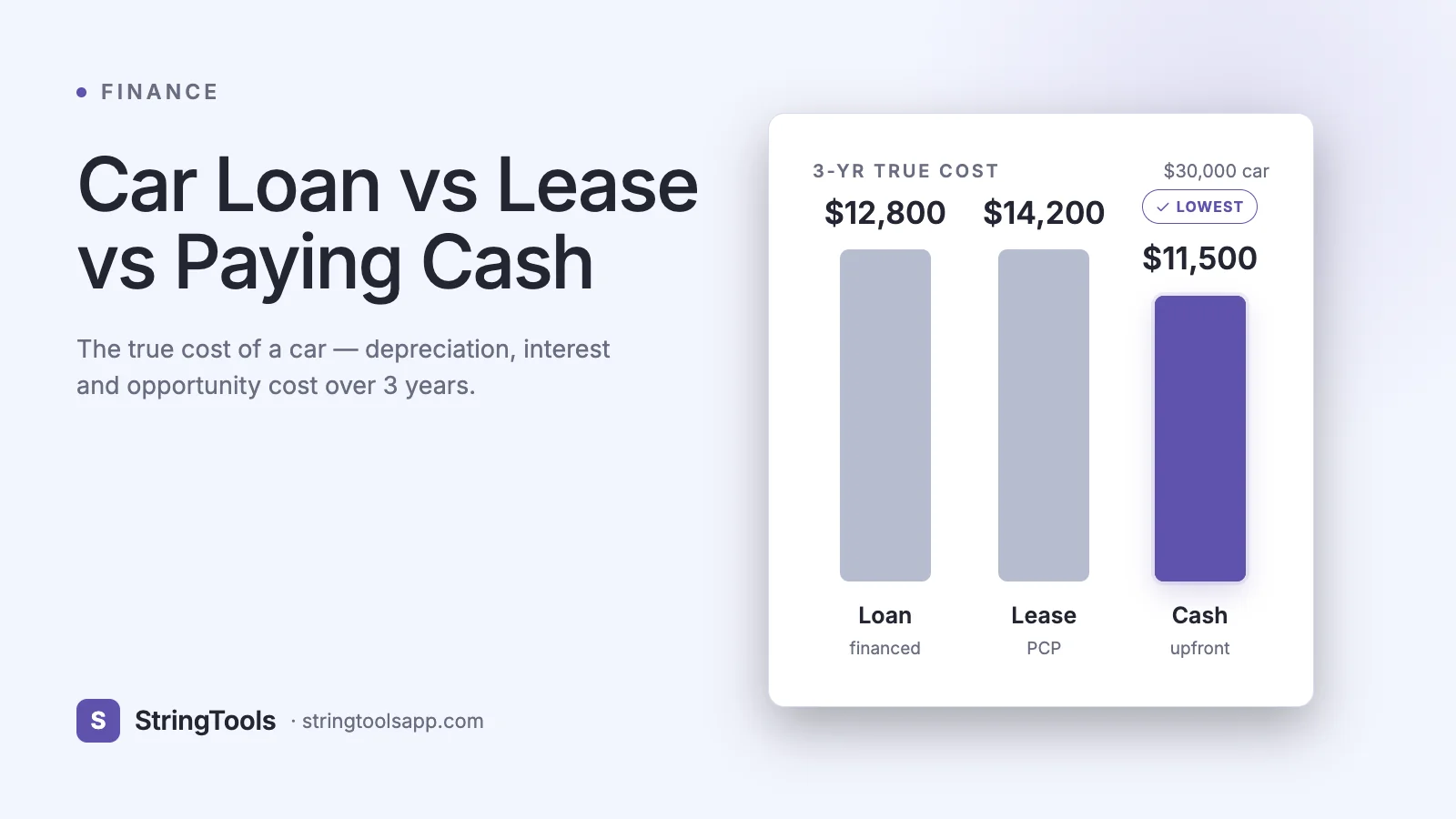
An illustrative 3-year comparison (all figures illustrative)
Let’s put numbers to it. Every figure below is illustrative and rounded to show the mechanics — not a quote, prediction or guarantee. Real deals vary by lender, credit profile, deposit, region and vehicle. We’ll use a car with a purchase price of 30,000 (in your currency) and compare three routes over 3 years, holding the running costs (insurance, fuel, servicing, tax) equal so we can focus on how each route treats the car’s value.
Assumptions (illustrative): the car is worth about 17,000 after 3 years (roughly a 43% fall). The loan is a 3-year term at an illustrative interest cost of about 2,800 total. The lease/PCP finances the depreciation gap plus an illustrative interest charge. Cash forgoes an illustrative 2,400 of investment return over the three years (what the 30,000 might have earned elsewhere).
| Factor | Loan / HP (buy) | Lease / PCP | Pay cash |
|---|---|---|---|
| Do you own it? | Yes, once repaid | US lease: no. PCP: only if you pay the balloon | Yes, from day one |
| Upfront outlay | Deposit (e.g. 3,000) | Small initial rental / deposit | Full 30,000 |
| Monthly cost | Higher (finances full value) | Lower (finances depreciation + interest) | None |
| Net 3-yr cost of the car | ~30,000 − 17,000 resale + 2,800 interest ≈ 15,800 | ≈ depreciation (~13,000) + interest — you keep no asset unless you buy it | ~30,000 − 17,000 resale + 2,400 opportunity cost ≈ 15,400 |
| Mileage limits? | No | Yes — excess-mileage fees | No |
| Flexibility to sell early | Yes (settle finance) | Limited / costly | Yes, anytime |
| End of term | Car is yours, no payment | Hand back, buy, or part-exchange (PCP) | You already own it |
| Best suits | High-mileage keepers | Predictable payments, always-newer car | Idle cash, dislike debt |
Net cost = what the car actually cost you = money paid, minus what you get back (resale value), plus the finance interest or the opportunity cost of the cash. Running costs are excluded here because they’re similar across routes.
What the table shows
Buying with a loan and paying cash land close on net cost of the car in this illustration — the difference is mostly interest paid (loan) versus return forgone (cash). The lease/PCP typically shows the lowest monthly payment but leaves you owning nothing at the end unless you pay the balloon, so you can’t subtract a resale value — you were renting the depreciation. If you plan to keep the car for many years beyond this window, buying pulls further ahead because those later, cheaper years are all yours. If you swap cars every 3 years and value low, predictable payments, leasing/PCP’s convenience may be worth the premium.
So which should you choose?
There’s no single winner — there’s a best fit for your pattern.
Lean toward a loan / HP (buying) if…
You keep cars for many years, drive high mileage (mileage caps would hurt you), want to build equity and own an asset, and are comfortable carrying depreciation risk. Buying a lightly used car and keeping it well is one of the most cost-effective long-run strategies. Shorten the term and add extra payments where you can to cut interest.
Lean toward a lease / PCP if…
You like driving a newer car every few years, value low and predictable monthly payments, drive within a set mileage, and don’t care about owning the vehicle long-term. A PCP additionally suits people who want to keep the door open to buying (via the balloon) without committing upfront. Just watch mileage and condition charges, and be honest that perpetual leasing means perpetual payments.
Lean toward cash if…
You have the money sitting idle earning little, you dislike debt and monthly commitments, and paying outright won’t wipe out your emergency fund. If a loan’s APR is higher than what you’d safely earn on the cash, paying cash (or a large deposit) is usually the financially cleaner move. If you can access genuine 0% finance and invest the cash for more, financing can edge ahead — run both numbers.
A practical middle path
Many buyers do best with a large deposit plus a short loan on a 1–3 year-old car: you dodge the steepest depreciation, minimise interest, keep some cash invested for emergencies, and still own the car outright at the end. Model the monthly payment and total interest for any scenario with our loan calculator before you commit.
This article is general education, not financial advice; finance rates, PCP terms, and running costs vary by lender and vehicle, so confirm the exact figures in any agreement before you sign.
Frequently Asked Questions
Is it cheaper to lease or buy a car?
Over a single short term, a lease or PCP usually has a lower monthly payment because you’re financing mainly the depreciation rather than the whole car. But buying with a loan is typically cheaper over the long run, because once the loan is repaid you own an asset and stop paying, while a serial leaser keeps paying forever. The crossover depends on how long you keep the car: the longer you hold it, the more buying wins. If you always want a newer car every few years, leasing’s convenience can be worth the premium even if it costs more overall.
What’s the difference between a lease and a PCP?
A US lease is a “use it and hand it back” product — at the end you generally return the car and own nothing, though some leases offer a purchase option at the residual value. A UK PCP is a financing product with three end-of-term choices: hand the car back, pay the optional final (balloon) payment to own it, or part-exchange any equity into a new deal. Both keep monthly payments low by financing the depreciation plus interest rather than the full price, and both come with mileage limits. The key distinction is that a PCP has a built-in ownership option, whereas a standard lease’s default outcome is handing the car back.
Should I pay cash for a car or take finance?
Pay cash if the money would otherwise sit idle earning little, you dislike debt, and buying outright won’t drain your emergency fund. Take finance if you can get a low or 0% APR and could realistically earn more by keeping the cash invested — that’s the opportunity-cost trade-off. As a rule of thumb, compare the loan’s APR with the return you’d safely earn on savings: if the APR is higher, cash (or a big deposit) usually wins. Whatever you choose, keep a cash buffer for emergencies rather than spending your last penny to avoid a small interest bill.
Why is depreciation the biggest cost of owning a car?
Depreciation is the fall in your car’s market value over time, and it’s usually larger than interest, fuel or servicing — it just doesn’t arrive as a monthly bill, so people overlook it. As an illustrative pattern, many new cars lose a large share of their value in the first three years (often around 40–60%, varying widely by model) before the loss slows down. That’s exactly why leasing/PCP payments can seem attractive — you’re paying for that steep early drop and returning the car before the curve flattens. Buying a one-to-three-year-old car lets someone else absorb the worst of the depreciation.
What is the opportunity cost of paying cash for a car?
Opportunity cost is the return you give up by spending a lump sum instead of keeping it invested or in savings. If you pay, say, 30,000 in cash, that money can no longer earn interest or investment growth, so the forgone return is a real (if invisible) cost of paying cash. Over several years, and because of compounding, that missed growth can add up meaningfully. It doesn’t make cash a bad choice — it just means you should compare the interest you’d avoid on finance against the return you’d realistically earn on the money.
What does total cost of ownership include?
Total cost of ownership (TCO) is everything a car costs you over the years you keep it, not just the purchase price or monthly payment. It includes depreciation (or the finance cost that stands in for it), interest or finance charges, insurance, fuel or EV charging, servicing, maintenance and tyres, and road tax or registration — minus the resale value if you own the car. A cheaper car to buy can be more expensive to own if it’s thirsty, pricey to insure, or unreliable. Comparing TCO, rather than sticker price, is the honest way to judge which car and which route is actually cheapest for you.