
Key Takeaways
Key Takeaways
- The debt avalanche attacks the debt with the highest interest rate first. It is mathematically the cheapest and, given the same budget, usually the fastest route to zero.
- The debt snowball attacks the smallest balance first. It costs a little more in interest but delivers an early, motivating “win” that keeps many people going.
- Both methods follow the same rule: pay the minimum on every debt, then throw every spare pound, dollar, or euro at one target debt until it is gone, then roll that payment onto the next.
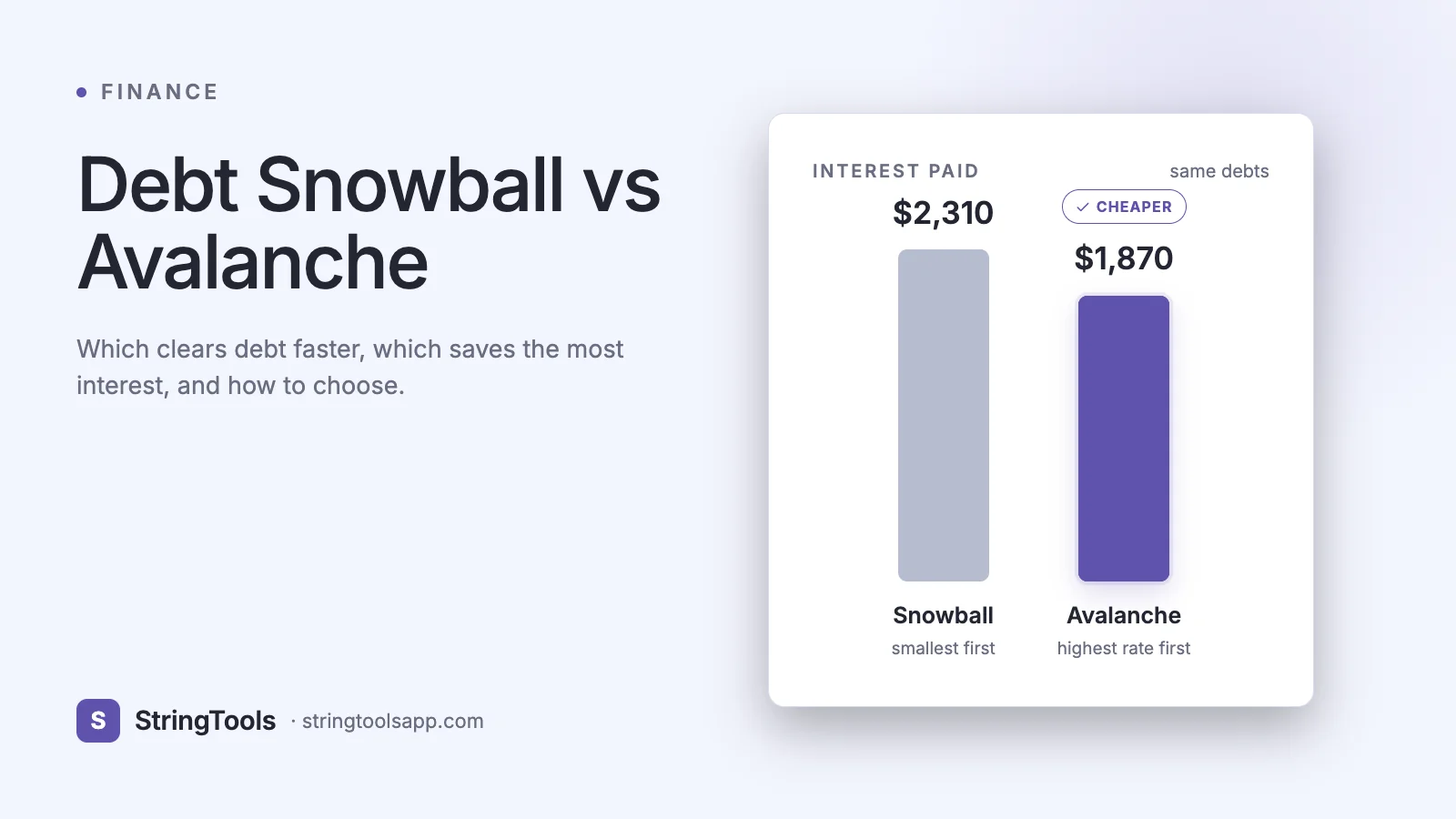
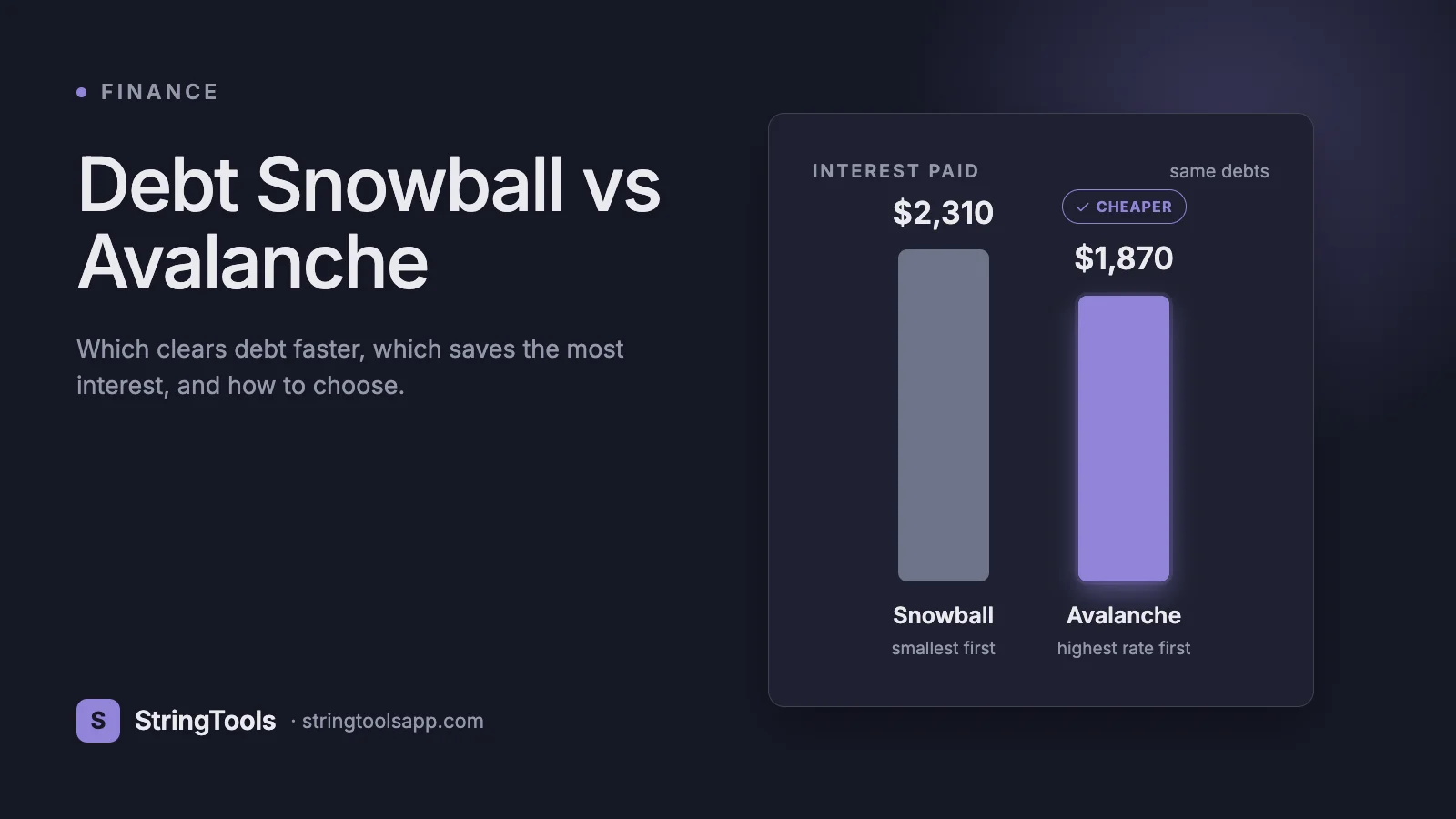
- In our illustrative example below (three debts, £/$/€8,100 total), avalanche saves about $483 in interest and finishes one month sooner — but snowball clears its first debt in month 4 instead of month 19.
- Behavioural research suggests the snowball’s early wins can beat the avalanche in practice, because the plan people actually stick to is worth more than the one that looks best on a spreadsheet.
- A hybrid approach — one quick snowball win, then switch to avalanche — captures most of the motivation and most of the savings.
- Balance transfers (0% intro cards) and consolidation loans can slash interest, but only if the fees, intro window, and post-offer APR genuinely work in your favour.
The two methods, in plain English
If you owe money on more than one card or loan, the maths of getting out is simpler than it feels. You keep making the minimum payment on every account so nothing goes into default, and then you take whatever extra you can afford each month and pour it onto a single “target” debt. When that target is cleared, its whole payment — minimum plus your extra — rolls onto the next target. That rolling, compounding payment is what accelerates everything. The only real question is: which debt do you target first?
The avalanche: highest interest rate first
The debt avalanche tells you to rank your debts by interest rate (APR), ignore the balances entirely, and hammer the highest-rate debt first. Interest is charged on the balance you carry, so the highest-APR debt is the one growing fastest against you. Kill it first and you starve the most expensive interest. Mathematically, for a fixed monthly budget, the avalanche always pays the least total interest and reaches zero at least as fast as any other order — often faster.
The snowball: smallest balance first
The debt snowball, popularised by US personal-finance author Dave Ramsey, tells you to ignore interest rates and rank by balance, smallest first. You clear the tiniest debt as fast as possible, cross it off, feel the win, and let that momentum (the “snowball” rolling downhill) carry you to the next. It usually costs a bit more in interest, because you might be leaving a high-rate card untouched while you knock out a small low-rate one. The bet is behavioural: a plan you finish beats a cheaper plan you abandon.
Both work with US dollars and credit-card APR, UK pounds and representative APR, and euros across the Eurozone — the arithmetic of interest is identical everywhere. If you want to see how a single balance melts under a fixed payment, our loan calculator and our explainer on how loan amortization works show the mechanics.
A sample debt list to work from
Numbers make this concrete. Imagine three debts. To keep it currency-neutral, read the figures as dollars, pounds, or euros — the method does not change. All figures below are ILLUSTRATIVE and rounded for clarity; your own rates and minimums will differ.
| Debt | Balance | APR | Minimum payment |
|---|---|---|---|
| Store card | 800 | 15% | 25 |
| Credit card | 4,800 | 24% | 120 |
| Personal loan | 2,500 | 9% | 60 |
| Total | 8,100 | — | 205 |
Notice the trap this example is built to expose: the smallest balance (the store card) is not the most expensive one. The credit card, at 24% APR, is the debt doing the most damage, but it also has the biggest balance. That tension is exactly where snowball and avalanche disagree — and where most real people find themselves.
Assume you can afford 200 extra per month on top of the 205 in combined minimums, for a total debt budget of 405 per month. Now let us run both plans.
Side-by-side: which one actually wins
With the same 405 monthly budget, here is how the two orders play out. (Interest is accrued monthly on each remaining balance; minimums are held constant to keep the comparison clean.)
Avalanche attacks the 24% credit card first, then the 15% store card, then the 9% loan. Snowball attacks the 800 store card first, then the 2,500 loan, then the 4,800 card.
| Method | Order of attack | Time to debt-free | Total interest paid | First debt cleared |
|---|---|---|---|---|
| Avalanche | 24% → 15% → 9% | 24 months | ~1,460 | Month 19 (credit card) |
| Snowball | 800 → 2,500 → 4,800 | 25 months | ~1,943 | Month 4 (store card) |
Read that carefully, because it captures the whole debate in one row each:
- Avalanche is cheaper and slightly faster. It pays about 1,460 in total interest versus 1,943 for the snowball — a saving of roughly 483 — and reaches zero one month sooner. On a bigger debt with a wider spread of rates, that gap can run into thousands.
- Snowball delivers the first win far sooner. It clears an entire account in month 4. The avalanche, busy grinding down the big 24% card, does not fully clear anything until month 19. For fifteen months, the avalanche follower has three open debts and no visible progress; the snowball follower has already crossed one off.
That is the trade-off in a nutshell: the avalanche wins on the spreadsheet, the snowball wins on the calendar of small victories. Neither is “wrong.” The right one is the one whose downside you can live with — a little extra interest, or a longer wait for your first cleared account.
What the behavioural research actually says
Here is the uncomfortable truth the maths alone hides: the best method is the one you finish. A plan that saves 483 in theory saves nothing if you quit in month 6.
Behavioural-finance research has looked at real repayment behaviour and repeatedly found that concentrating payments on one account — and especially clearing a small balance early — boosts motivation and follow-through. A widely cited study in the Journal of Marketing Research (Kettle, Trudel, Blanchard and Häubl) found that people who focus on wiping out individual accounts, rather than spreading effort evenly, feel more in control and are more likely to stay the course. Writing in Harvard Business Review, researcher Remi Trudel summarised the practical upshot bluntly: for many people, paying off the smallest balance first is the most effective strategy, precisely because the sense of progress keeps them engaged.
This does not repeal arithmetic. The avalanche still pays less interest — that is a mathematical fact, not an opinion. What the research adds is that adherence has a dollar value too. If the early snowball win is the difference between finishing and giving up, then for that person the snowball is genuinely the cheaper plan, because the avalanche they abandon costs them everything.
So be honest with yourself. If you are the kind of person who is energised by data and can grind for over a year without a visible reward, the avalanche will save you the most money. If you have tried and stalled before, or you know that a quick win keeps you honest, the snowball’s psychology is not a weakness to apologise for — it is the whole point.
The hybrid: get the best of both
You do not have to pick a pure strategy. A hybrid approach is often the smartest real-world play, and it is simple:
Step 1 — take one quick snowball win
If you have a genuinely tiny balance — a 200 store card, a small overdraft, a buy-now-pay-later balance — clear it first, even if it is not the highest rate. You get the motivation hit, you free up that minimum payment, and you simplify your life by having one fewer account to track. The interest cost of one small detour is usually trivial.
Step 2 — switch to avalanche for the heavy lifting
Once that first win is banked, re-rank the remaining debts by APR and go full avalanche. This is where the real money is: your biggest, highest-rate balances are where interest savings compound. In our example, that means turning the rolled-up payment onto the 24% credit card and keeping it there until it is gone.
A prerequisite either way: a small buffer
Before you throw every spare penny at debt, park a starter emergency fund — even a few hundred — somewhere separate. Without it, the first unexpected car repair or vet bill goes straight back onto the card you just cleared, and the snowball rolls backwards. Our guide on how to build an emergency fund covers how much to hold while you are still in repayment. The same “roll the freed-up payment forward” logic also works on a single big loan; see pay off your car loan faster for that variation.
When to consider consolidation or a balance transfer
Both snowball and avalanche assume your interest rates are fixed. Sometimes the bigger win is to change the rate itself. Two common tools, with their traps.
0% balance-transfer cards
Many UK and US card issuers offer 0% interest for an introductory period — often 12 to 24 months — when you move existing card debt across. During that window, every payment attacks the principal, which can dramatically shorten payoff. The catches: there is almost always a transfer fee of roughly 2%–5% of the balance moved, the 0% rate reverts to a much higher representative/APR when the intro period ends, and missing a payment can void the offer. A balance transfer only wins if you can realistically clear most of the balance before the promotional rate expires. Note that 0% balance-transfer offers are widespread in the US and UK but far less common across much of the Eurozone, where rules and products vary by country.
Debt consolidation loans
A consolidation loan rolls several debts into one fixed-rate personal loan with a single monthly payment. Done right, it lowers your blended interest rate and makes budgeting easier. Done wrong, it stretches the term so long that you pay more in total interest despite the lower rate, or it frees up cards you then run back up. Compare the loan’s total cost — not just the monthly payment — against your current path; our personal loan vs credit card breakdown walks through that comparison.
Whichever tool you use, the discipline is the same as the snowball and avalanche: do not treat freed-up credit as spending money. The goal is a smaller balance, not a bigger limit.
This article is general education, not financial advice; rates, fees, and your best strategy depend on your circumstances, so consider speaking to a regulated debt adviser or nonprofit credit counsellor before consolidating or borrowing. In the US you can find accredited nonprofit counsellors via the National Foundation for Credit Counseling (https://www.nfcc.org); in the UK, free impartial help is available from the government-backed MoneyHelper (https://www.moneyhelper.org.uk).
Frequently Asked Questions
Which is better, debt snowball or debt avalanche?
It depends on what you optimise for. The avalanche (highest interest rate first) always pays the least total interest and, for a fixed budget, is usually the fastest to zero — so it is the “better” answer on pure maths. The snowball (smallest balance first) costs a little more but gives you an early cleared account, which behavioural research links to sticking with the plan. If you have stalled on debt before, the snowball’s motivation may make it the better real-world choice for you.
Does the debt snowball really cost more than the avalanche?
Yes, but usually not by a huge amount on typical consumer debts. In our illustrative three-debt example the snowball paid about 1,943 in interest versus 1,460 for the avalanche — roughly 483 more — and took one extra month. The gap grows when you have a high-rate debt with a large balance sitting untouched while you clear small low-rate ones. The wider the spread between your highest and lowest APRs, the more the avalanche saves.
What is the fastest way to pay off multiple debts?
The fastest mathematical route is the avalanche: pay minimums on everything, then throw all spare money at your highest-APR debt until it is gone, and roll that payment onto the next-highest rate. Speed also depends on your total monthly budget — even a small increase in the extra amount shortens the timeline sharply because more of each payment attacks principal. Raising your payment and lowering your rate (via a transfer or consolidation) usually beats agonising over snowball versus avalanche.
Should I pay off debt or build savings first?
Do a little of both, in order. First set aside a small starter emergency fund — even a few hundred — so a surprise bill does not send you straight back to the cards. Then focus hard on debt, especially anything above roughly 15%–20% APR, which almost certainly costs more than any savings account earns. Once high-interest debt is cleared, redirect those freed-up payments into a fuller emergency fund and longer-term savings.
Is a balance transfer or consolidation loan worth it?
It can be, if the numbers genuinely work. A 0% balance-transfer card wins only if you can clear most of the balance before the intro period ends and the transfer fee (about 2%–5%) is smaller than the interest you would otherwise pay. A consolidation loan helps if it lowers your blended rate without stretching the term so far that total interest rises. Always compare the total cost to your current plan, and never treat the freed-up credit limit as spending money.
Do I keep paying the minimum on other debts while using snowball or avalanche?
Yes — this is essential. You always pay at least the minimum on every debt to avoid late fees, penalty rates, and damage to your credit file. The strategy only governs where your extra money goes: one target debt at a time. When that target is cleared, you roll its entire payment (minimum plus extra) onto the next debt, which is why progress accelerates as you go.