

The retirement number in one page
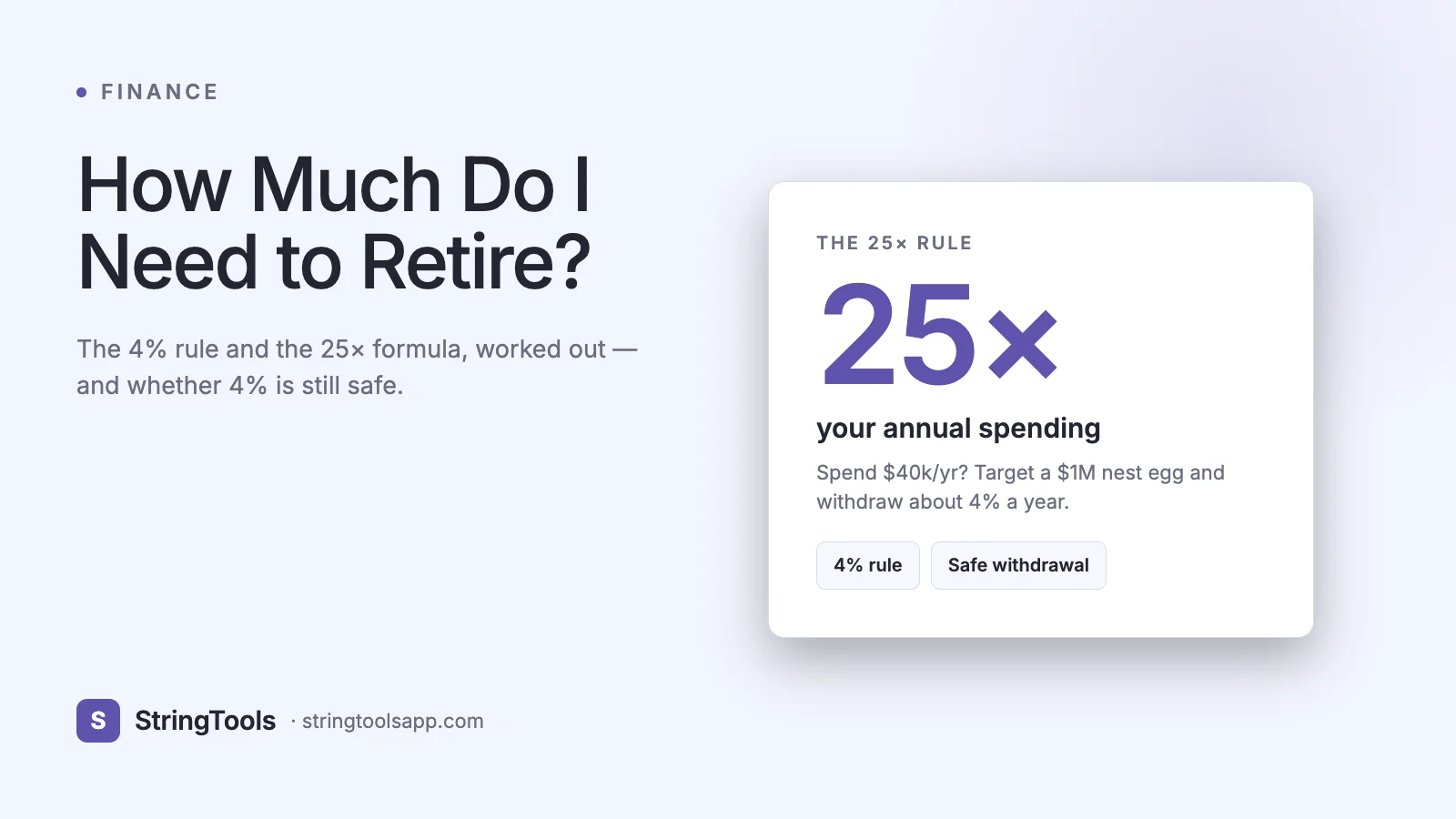
“How much do I need to retire?” has a surprisingly clean starting answer: roughly 25 times what you spend in a year. Spend $40,000 a year and your target pot is about $1,000,000. That single multiplier — and the 4% withdrawal rate it comes from — is the backbone of nearly every retirement plan you have read about, from mainstream advisers to the FIRE (Financial Independence, Retire Early) community.
But a rule of thumb is only useful if you understand where it breaks. This guide walks through the maths, works examples in dollars and pounds so US, UK and Eurozone readers are all served, and then does what most articles skip: it explains honestly why serious researchers now argue the safe number might be closer to 3.3% than 4%.
Key Takeaways
- The 25x rule estimates your target pot: annual spending × 25. This is just the inverse of a 4% withdrawal rate (1 ÷ 0.04 = 25).
- The 4% rule comes from Bill Bengen (1994) and the Trinity study — historically, drawing 4% of a balanced portfolio in year one and rising with inflation lasted at least 30 years in nearly every US scenario tested.
- Use your spending, not your salary. Retirement cost is driven by what you spend, minus any state pension or Social Security you will receive.
- Inflation is the silent tax. At 3% inflation, £30,000 of spending today needs about £54,000 a year in 20 years, which is why your withdrawals must rise each year.
- Sequence-of-returns risk — a crash in your first few retirement years — is far more dangerous than the same crash later, even with identical average returns.
- 4% is debated. Longer retirements, lower expected bond yields and non-US markets have pushed many researchers toward 3.3%–3.5% as a more cautious rate.
- This is an estimate, not a promise. Every figure here is illustrative; real returns are never guaranteed.
What your retirement number actually means
Your retirement number is the size of invested pot that can fund your lifestyle without a pay cheque. The elegant shortcut is the 25x rule: multiply your desired annual retirement spending by 25.
The logic is pure arithmetic. If you plan to withdraw 4% of your pot in the first year, then the pot must be 25 times that withdrawal, because 100% ÷ 4% = 25. Flip a 4% withdrawal rate upside down and you get a 25x savings target. They are the same idea viewed from two ends.
Spending, not salary
The most common mistake is anchoring to your income. What matters is your spending, and specifically your spending in retirement, which is often lower than during your working years — the mortgage may be gone, the kids independent, commuting and pension contributions finished.
Equally important, your investments do not have to cover your entire cost of living. In the US, Social Security might replace a meaningful slice; in the UK, the full new State Pension is worth over £11,000 a year per person; across the Eurozone, state schemes vary but are often substantial. Your invested pot only needs to fund the gap between total spending and guaranteed income.
A worked example: suppose you want €45,000 a year and expect €15,000 from a state pension. The gap your own savings must cover is €30,000, so your target is roughly €30,000 × 25 = €750,000 — not €45,000 × 25.
Where the 4% rule comes from
The 4% rule is not a marketing slogan; it is the headline finding of decades of research into how long a retirement pot survives.
In 1994, financial adviser William Bengen tested every 30-year retirement window in US market history. He asked: what is the highest first-year withdrawal rate, then increased annually for inflation, that never ran out of money across a 50/50 stock-and-bond portfolio? His answer was about 4% — he later called the more precise historical figure “SAFEMAX.”
A few years later, three professors at Trinity University ran a related study that became famous as the Trinity study. They measured portfolio “success rates” — the percentage of historical periods in which the money lasted — for various withdrawal rates and stock/bond mixes. A 4% inflation-adjusted withdrawal from a balanced portfolio succeeded in the large majority of 30-year windows they examined.
Two caveats are baked into that research and often forgotten. First, it was based on US market history, which was one of the strongest of the 20th century — other countries fared worse. Second, “success” meant simply not hitting zero; in many scenarios you ended with a huge surplus, and in the worst ones you scraped through with very little. The rule is a planning benchmark, not a guarantee. You can read a plain-language overview of the underlying research via Investopedia’s Trinity study explainer.
Your number in dollars and pounds
Because the 25x rule is just multiplication, it travels across currencies unchanged. Here is the target pot for a range of annual spending levels at the classic 4% rate.
| Annual spending (your money covers) | Retirement number (25×) |
|---|---|
| $30,000 / £30,000 / €30,000 | $750,000 / £750,000 / €750,000 |
| $40,000 / £40,000 / €40,000 | $1,000,000 |
| $50,000 | $1,250,000 |
| $60,000 | $1,500,000 |
| $80,000 | $2,000,000 |
| $100,000 | $2,500,000 |
The currency symbol does not change the maths — £30,000 a year points to a £750,000 pot exactly as $30,000 points to $750,000.
The same pot at different withdrawal rates
The multiplier is sensitive to the rate you choose. Drop from 4% to a more cautious 3.3% and your target jumps by more than a fifth. This table shows the pot needed to fund $50,000 a year at several withdrawal rates.
| Withdrawal rate | Multiplier (1 ÷ rate) | Pot for $50,000/yr |
|---|---|---|
| 5.0% | 20.0× | $1,000,000 |
| 4.0% | 25.0× | $1,250,000 |
| 3.5% | 28.6× | $1,428,571 |
| 3.3% | 30.3× | $1,515,152 |
| 3.0% | 33.3× | $1,666,667 |
The gap between the top and bottom rows — two-thirds of a million dollars for the same lifestyle — is exactly why the safe-withdrawal-rate debate matters so much. All of these figures are illustrative; they assume your investments broadly keep pace with the historical patterns the research relied on.
Inflation and compound growth: the two forces pulling against each other
Two engines shape your journey to the number, and they pull in opposite directions.
Inflation erodes the target
The pot you need is a moving target because prices rise. At 3% annual inflation, the future value of today’s spending follows FV = PV × (1 + 0.03)ⁿ. So £30,000 of spending today becomes about £30,000 × (1.03)²⁰ ≈ £54,000 a year in 20 years. Your 4% withdrawals have to climb each year to keep buying the same groceries — which is precisely why Bengen’s rule increases the first-year figure with inflation rather than holding it flat.
Compounding builds the pot
The good news is that the same exponential maths works powerfully in your favour while you save. Using the future value of a regular contribution:
- Investing $500 a month for 30 years at a 7% illustrative annual return grows to roughly $610,000 — of which only $180,000 is money you actually contributed. The rest is compounding.
- A single $100,000 lump sum left for 20 years at a 5% illustrative real return becomes about $265,000.
Those numbers are not promises — 7% is a round illustrative figure, not a guaranteed rate — but they show why starting early beats saving harder later. To run your own scenarios, use our compound interest calculator, and for the intuition behind the curve see compound interest explained. It also pays to understand APR vs APY vs interest rate so you compare account and fund figures on a like-for-like basis.
Sequence-of-returns risk: why timing beats averages
Here is the danger that a simple 25x number hides. Two retirees can experience the exact same average return over 30 years and yet one runs out of money while the other dies rich. The difference is the order in which the good and bad years arrive. This is sequence-of-returns risk.
Why does order matter if you are just saving? It does not, much. But once you are withdrawing, a market crash in your first few retirement years forces you to sell more units of a falling investment to fund the same spending. Those sold units are gone — they cannot recover when the market rebounds. A crash of identical size ten years later, when your pot is larger and you have already banked years of growth, does far less damage.
This is the real reason the 4% rule includes a bond allocation and a margin of safety, and why cautious planners hold one to three years of spending in cash or short bonds as a buffer to avoid selling shares into a downturn. It is also why many people “glide” more conservative in the five years either side of their retirement date. The 25x number tells you the size of the mountain; sequence risk is the weather on the day you start climbing down. A healthy cash buffer sits alongside your everyday reserve — see how to build an emergency fund for the foundations.
Is 4% still safe? The honest debate
The 4% rule has aged, and reasonable experts now disagree about it. You should know the arguments on both sides before you bet a retirement on either.
The case for a lower rate (3.3%–3.5%)
- Longer retirements. Bengen tested 30 years. Someone retiring at 55, or an early-retiree in the FIRE movement, may need 40–50 years of income, which historically supports a lower safe rate.
- Lower expected returns. The original studies covered an era of higher bond yields. When starting valuations are high and yields are low, some models suggest a more cautious withdrawal rate. Researcher Wade Pfau has published widely on rates nearer 3%–3.5% under such conditions.
- Non-US markets. A landmark study of 20+ developed countries found that a US-calibrated 4% would have failed in several of them. UK and European retirees should not assume the rosy US history applies to them.
The case that 4% is fine — or even conservative
- Bengen’s own updates. In later work, incorporating a broader asset mix, Bengen argued the safe rate was often higher than 4% — he has floated figures well above it for many historical periods.
- Nobody spends on autopilot. The rule assumes you blindly raise spending with inflation even as your portfolio craters. Real retirees cut back in bad years; this flexibility dramatically improves outcomes, and “guardrail” strategies formalise it.
- You will likely have other income. State pensions, Social Security, part-time work and downsizing all reduce reliance on the 4% withdrawal itself.
The pragmatic takeaway: treat 4% as an optimistic ceiling and 3.3%–3.5% as a cautious floor. If you are retiring early or want to sleep well, plan nearer the lower end (a larger pot); if you have a shorter horizon and flexible spending, 4% is defensible.
How to actually reach your number
Knowing the target is step one. Getting there is about consistent contributions into tax-efficient accounts and letting compounding do the heavy lifting.
Use the right accounts for your country
- United States: Prioritise a 401(k) up to any employer match (free money), then an IRA. A Roth account is funded with after-tax money and grows tax-free; a Traditional account gives you a deduction now and is taxed on withdrawal.
- United Kingdom: Capture your workplace pension match first, then consider a SIPP for extra control. A Stocks & Shares ISA grows completely tax-free and, unlike a pension, is accessible before retirement age — useful for bridging early retirement.
- Eurozone/EU: Options vary by country, but most have tax-advantaged occupational pensions and personal plans (for example Germany’s Riester/Rürup, or PEA/PER in France). Capture employer contributions first wherever they exist.
A simple sequence that works
1. Estimate your annual retirement spending, then subtract expected state pension or Social Security to find the gap. 2. Multiply the gap by 25 (optimistic) to 30 (cautious) to bracket your target pot. 3. Automate monthly investing into low-cost, diversified funds, and increase contributions with every pay rise. 4. Revisit the plan yearly — your spending, returns and life will all change.
Use a calculator to see how a monthly amount grows toward your bracket, and adjust the contribution until the projected pot lands in range.
This article is general education, not financial advice; investment returns are never guaranteed, withdrawal-rate research is debated, and your own numbers depend on your circumstances, so consult a regulated financial adviser before making retirement decisions.
Frequently Asked Questions
How much do I need to retire at 65?
There is no single figure — it depends on your annual spending, not your age. The common estimate is 25 times the yearly spending your own savings must cover, after subtracting any state pension or Social Security. For example, if you need $50,000 a year and expect $20,000 from Social Security, your pot must fund the $30,000 gap, pointing to roughly $750,000. Retiring at 65 with a normal 25–30 year horizon fits the classic 4% research well, so 25x is a reasonable starting target.
What is the 4% rule in retirement?
The 4% rule says you can withdraw 4% of your portfolio in your first year of retirement, then increase that dollar (or pound) amount each year for inflation, with a strong historical chance the money lasts at least 30 years. It comes from William Bengen’s 1994 research and the later Trinity study, both based on US market history and a balanced stock/bond portfolio. Withdrawing 4% is the mirror image of saving 25 times your spending. It is a planning benchmark, not a guarantee, and many researchers now favour a slightly lower rate for safety.
Is the 4% rule still valid in 2026?
It remains a useful benchmark, but it is genuinely debated. Critics point to longer retirements, historically low bond yields in recent years, and weaker returns outside the US as reasons to use a more cautious 3.3%–3.5% rate. Defenders — including Bengen himself in later work — argue that flexible spending and additional income sources often make 4% safe or even conservative. A sensible approach is to treat 4% as an optimistic ceiling and around 3.3% as a cautious floor, then plan nearer the lower end if you are retiring early.
How do I calculate my retirement number?
Start with your expected annual spending in retirement, in today’s money. Subtract any guaranteed income such as a state pension or Social Security to find the gap your own savings must cover. Multiply that gap by 25 for an optimistic target or by about 30 for a cautious one. For instance, a £24,000 gap gives a range of roughly £600,000 to £720,000, and you can then use a compound interest calculator to see what monthly contribution reaches it.
How much is £30,000 a year in retirement savings?
Using the 25x rule, funding £30,000 a year entirely from your own investments implies a pot of about £750,000 (£30,000 × 25). If part of that £30,000 comes from the UK State Pension — worth over £11,000 a year at the full new rate — your own savings only need to cover the remainder, sharply reducing the target. At a more cautious 3.3% withdrawal rate the pot rises to roughly £909,000 for the full £30,000. Remember these are illustrative estimates, and inflation means £30,000 today will cost more in future years.
What is sequence-of-returns risk?
It is the risk that the order of your investment returns, not just their average, sinks your retirement. A market crash in your first few years of withdrawals is far more damaging than the same crash later, because you are forced to sell more units of a falling investment, and those units never recover in the rebound. Two retirees with identical average returns can have very different outcomes purely because of timing. Holding one to three years of spending in cash and using flexible “guardrail” withdrawals are common ways to manage it.
Sources and references
Investopedia’s Trinity study explainer (investopedia.com). Content was reviewed against these sources as of the last-updated date above; external figures and rules may change after publication.