
The uncomfortable truth about your "strong" password
You probably learned the rules a decade ago: mix uppercase, lowercase, a number, and a symbol, and you are safe. So you landed on something like P@ssw0rd1! and felt clever. The problem is that attackers learned those exact rules too, and their cracking tools now expect the tricks.
Here is the counterintuitive part. Four random words strung into a passphrase, like velvet anchor moss trumpet, can be dramatically harder to crack than a short, symbol-heavy password, and far easier to remember. This is not a gimmick. It comes down to a single measurable property called entropy, and once you understand it, the whole "add a symbol" advice starts to look outdated.
This guide explains the real difference between a passphrase and a password, where each one belongs, and the two mistakes that actually get people breached, which have nothing to do with symbols.
What entropy actually measures
Password strength is not about how weird a password looks to a human. It is about how many guesses an attacker must make, on average, to land on yours. That number is called entropy, measured in bits. Each extra bit doubles the number of possible combinations, so more bits means an exponentially larger haystack.
Two things drive entropy: how many possible symbols you draw from, and how long the secret is. Crucially, length multiplies far faster than complexity. Adding one more character to a password does more for entropy than swapping an a for an @ in a short one.
The catch is that entropy only counts if your choices are genuinely random. If a human picked the words or the pattern, the real entropy is far lower than the math suggests, because attackers guess in the same predictable order humans think.
A fair head-to-head comparison
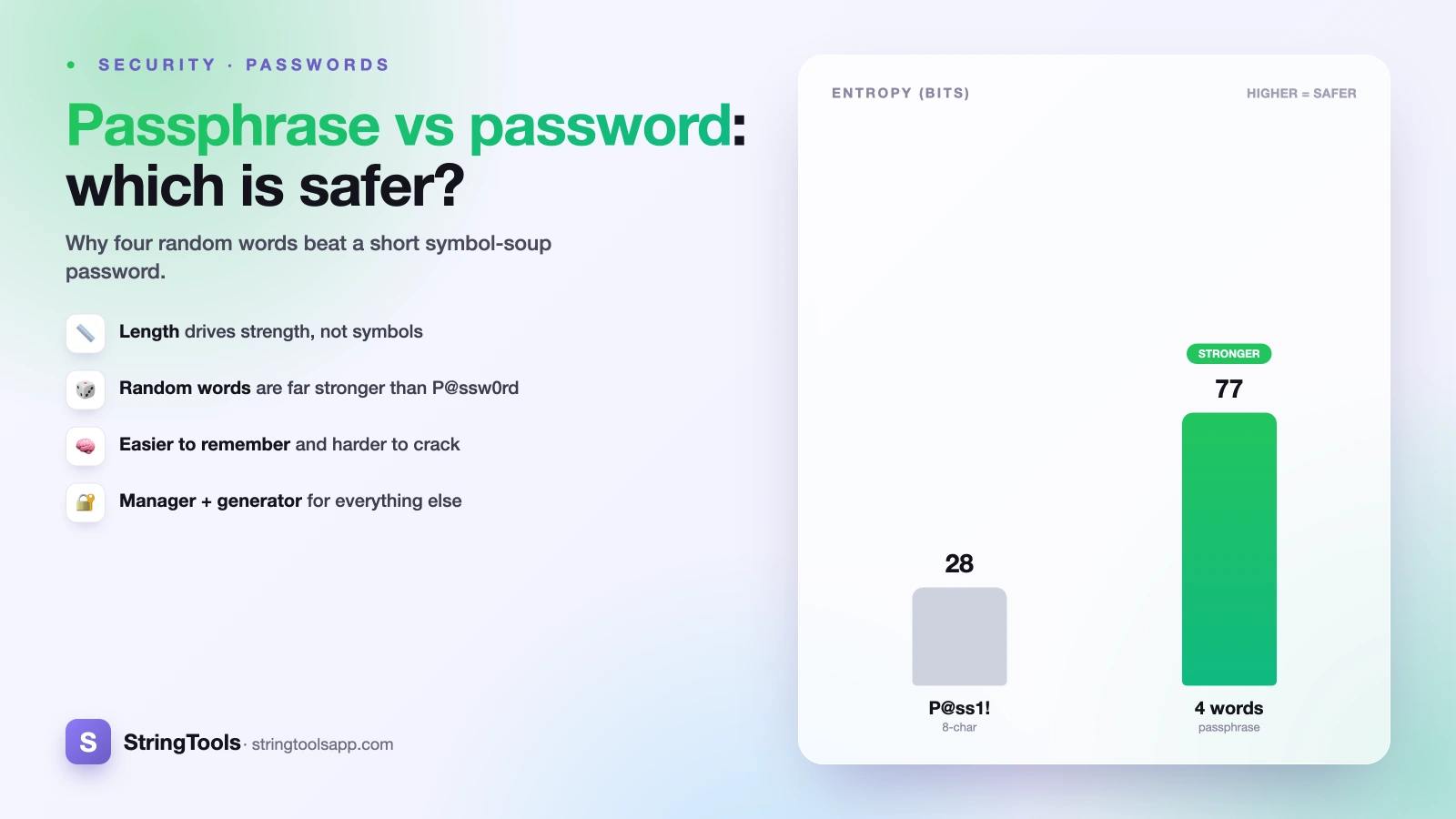
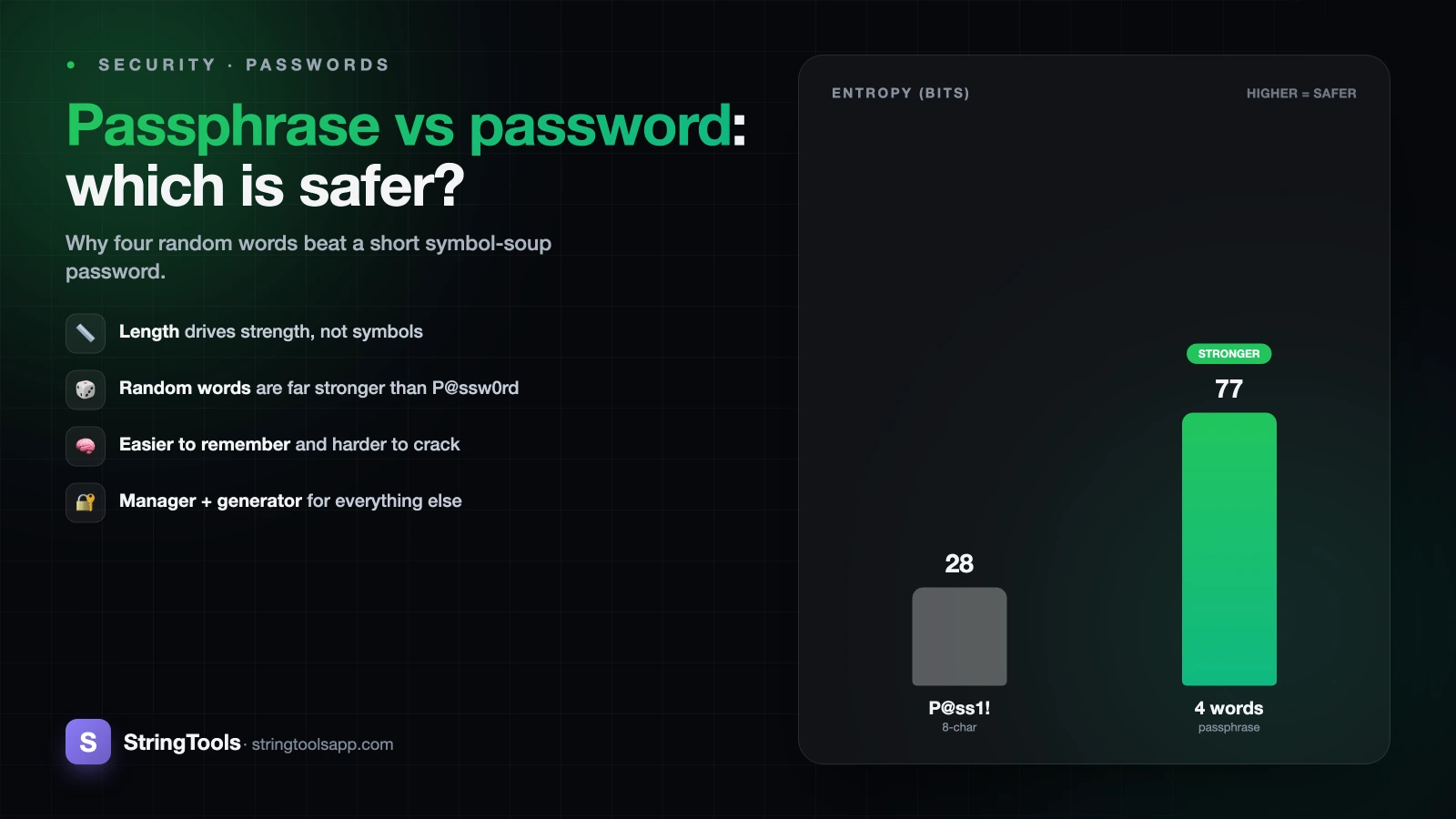
Consider a short complex password of 8 characters drawn from the full keyboard set, roughly 94 possible characters per slot. That is about 8 x 6.5, or roughly 52 bits of entropy, and only if all 8 characters were chosen randomly, which they almost never are.
Now consider a passphrase of 5 words chosen at random from a 7,776-word list (the standard Diceware list). Each word contributes about 12.9 bits, so five words give roughly 64 bits, comfortably ahead of the 8-character password, and the passphrase is something you can actually picture and recall.
Push it to 6 or 7 random words and you clear 77 to 90 bits, territory that resists offline cracking for a very long time. The exact crack-time depends on the attacker's hardware, whether the site hashed passwords properly, and luck, so treat any single "it would take X years" figure with suspicion. The principle is what matters: length beats symbol soup.
Why "random" is the word that does all the work
The famous correct horse battery staple example works because those four words were picked at random. Swap in a phrase you already know and the strength collapses.
A line from a song, a movie quote, a Bible verse, or to be or not to be feels long, but attackers feed dictionaries of quotes, lyrics, and common phrases straight into their tools. A memorable sentence you composed yourself is only slightly better, because human word choice clusters around common vocabulary and grammar. my dog loves the beach in summer looks like a passphrase but has a fraction of the entropy of four truly random words.
The fix is to let a machine roll the dice. A generator, physical dice with a Diceware list, or a good password manager will pick words with no story connecting them. The result feels slightly awkward, and that awkwardness is exactly the point.
Predictable tricks that barely help
The classic substitutions, a becomes @, s becomes $, o becomes 0, 1 for i, add almost nothing. Cracking software applies these mangling rules automatically, so P@ssw0rd is treated as barely different from password. Capitalizing the first letter and tacking 1! on the end is the single most predicted pattern there is.
Appending the current year, your favorite team, or a keyboard walk like qwerty falls the same way. These patterns live at the very front of every attacker's guess list because millions of people reach for them.
None of this means symbols are useless. In a genuinely random string they add entropy per character. The point is that a symbol bolted onto a human-chosen word does not rescue a weak base. Randomness and length do the heavy lifting; decoration does not.
The two mistakes that actually get people breached
Symbols are a distraction from the real killers. The first is reuse. When one site suffers a breach, attackers take those email-and-password pairs and try them everywhere else, a technique called credential stuffing. If your brilliant passphrase protects ten accounts, one leak exposes all ten. A unique secret per site is more important than any complexity rule.
The second is using a password that has already appeared in a past breach. Attackers guess from lists of hundreds of millions of real leaked passwords first, so a "complex" password that someone else already used is weak no matter how it looks. You can check exposure with a tool like Have I Been Pwned, and many password managers flag reused or breached entries automatically.
Want to sanity-check a candidate before you commit? Read how strong is my password to see how length and randomness change the math, and how to create a strong password for a repeatable method.
A practical system you can adopt today
You do not have to choose between passphrases and passwords, because they solve different problems. Use each where it fits.
For the handful of secrets you must type from memory, your device login, your phone unlock, and above all your password manager's master credential, use a long, unique, random-word passphrase of five or more words. These are the keys to the kingdom, and they need to be both strong and memorable.
For everything else, the dozens of forgettable logins for shops, forums, and apps, do not memorize anything. Let a password manager store them, and generate a long random string per site. You never see or type them, so complexity costs you nothing. A free password generator creates them instantly, entirely in your browser, so the value never touches a server.
Layer two-factor authentication on top wherever it is offered. Even a perfect passphrase can be phished, and a second factor blocks most account takeovers even when the password leaks.
The bottom line, and your next step
A passphrase of several truly random words usually wins over a short symbol-heavy password on both fronts that matter: it packs more entropy and it is easier to remember. But the label is less important than the habits. Randomness beats cleverness, length beats symbols, and unique-per-site beats every complexity rule combined.
So memorize a small number of long random passphrases, let a manager handle the rest, and stop reusing anything. That single change does more for your security than a lifetime of adding exclamation points.
Ready to build one? Open the free, browser-based password generator to create a strong random-word passphrase or a long unique password in seconds, no account, no upload, nothing leaves your device.
Frequently Asked Questions
Is a passphrase really safer than a password?
It can be, when the words are chosen at random. Because strength grows fastest with length, a long random-word passphrase often has more entropy than a short symbol-heavy password while being far easier to remember. The key condition is randomness. A famous quote or a sentence you invented is predictable and much weaker than four dice-chosen words.
How many random words make a strong passphrase?
Aim for at least five randomly chosen words from a large word list, which lands around 64 bits of entropy. Six or seven words push you well past 77 bits and resist offline cracking for a very long time. The words must be selected by a machine or dice, not picked by you, since human choices cluster around predictable vocabulary.
Do symbols and numbers still matter?
In a genuinely random string, every extra character type adds entropy, so generated passwords benefit from them. But bolting a symbol onto a human-chosen word, like turning password into P@ssw0rd, barely helps, because cracking tools apply those exact substitutions automatically. Length and true randomness matter far more than decoration on a weak base.
What actually gets people hacked?
Reuse and breached passwords, not a lack of symbols. When one site is breached, attackers try the same email and password everywhere else, so reusing a secret exposes every account. Using a password that already appeared in a past leak is also weak by definition. Unique credentials per site matter more than any complexity rule.
Should I memorize all my passwords as passphrases?
No. Memorize only the few you must type by hand, such as your device login and your password manager's master credential, using long random passphrases. For every other account, let a password manager store a unique generated string per site. You never type those, so complexity is free, and you avoid the temptation to reuse.