
The 4% rule, stated plainly
The 4% rule is a planning heuristic: withdraw 4% of your retirement pot in year one, then increase that amount with inflation each year after. It came from US historical data covering 30-year retirements. It is a starting estimate, not a guarantee, and it carries well-documented limits.
Key Takeaways
- The rule sets the first year's withdrawal only. Every later withdrawal is that starting figure adjusted for inflation, not 4% of whatever the pot is worth that year.
- It was derived by backtesting one country's market history over 30-year windows, with a stock-and-bond portfolio and no fees or taxes modelled.
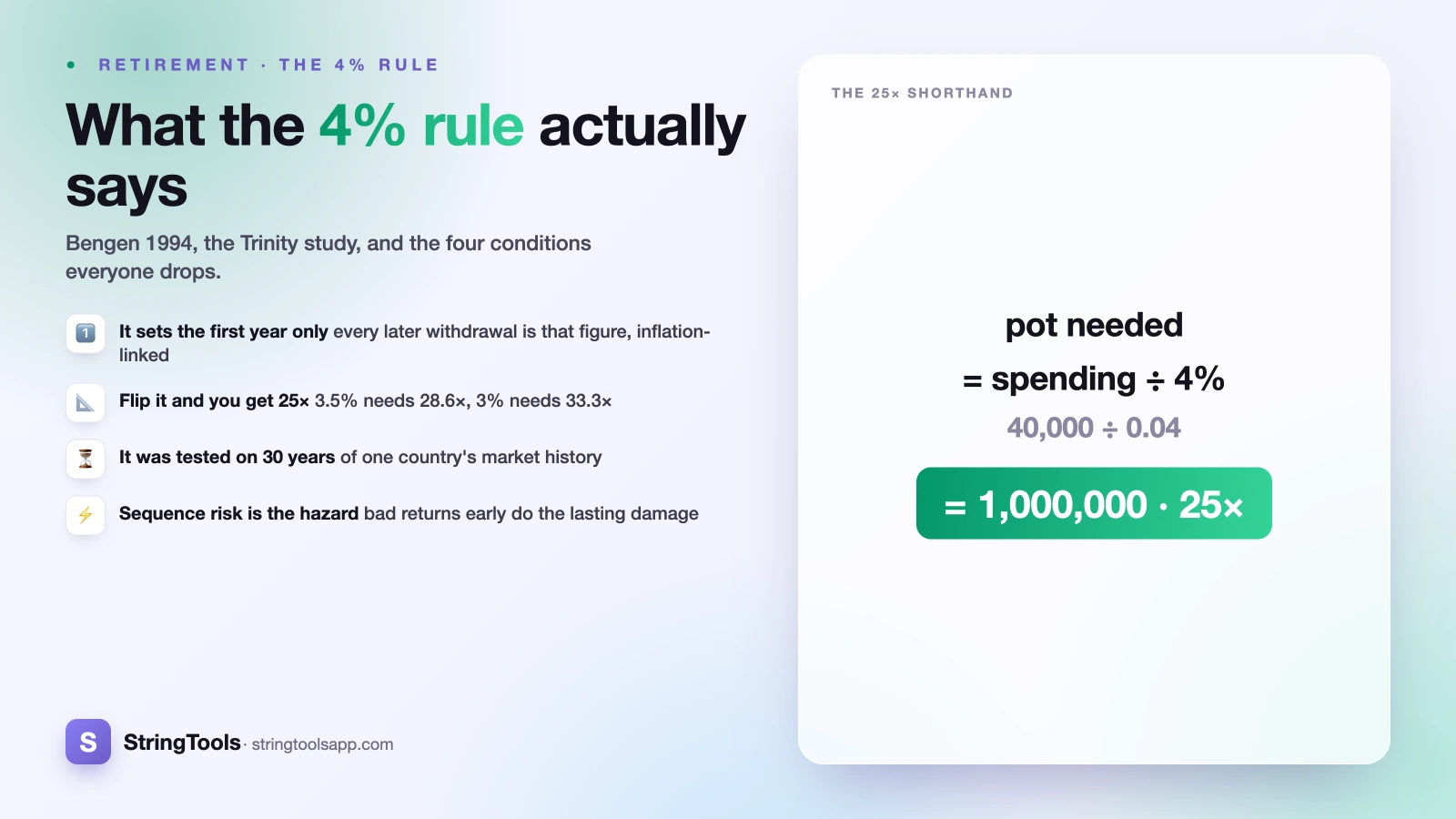
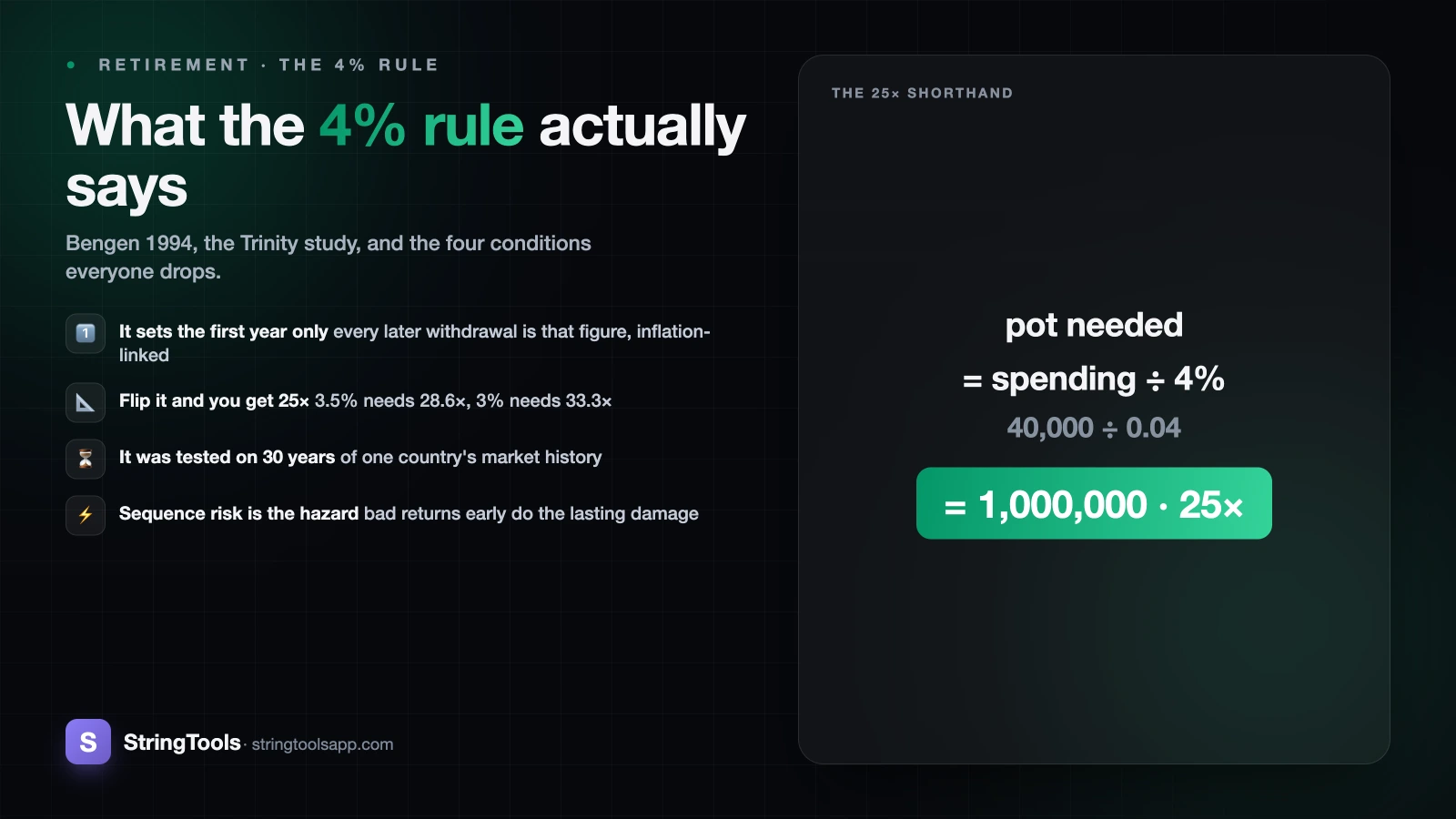
- Divide 1 by the withdrawal rate to get the multiple of annual spending you need: 4% implies 25x, 3.5% implies about 28.6x, 3% implies about 33.3x.
- Sequence-of-returns risk is the real hazard. Poor returns in the first few years of drawdown do far more damage than the same returns later.
- Longer retirements, non-US market history, and platform and fund charges all push the sustainable rate down from 4%.
- This is general information, not financial advice. A regulated adviser is the right person for a decision about your own money.
The attraction of the rule is that it turns an unanswerable question — how much is enough? — into arithmetic you can do on the back of an envelope. That is also its danger. A single number, repeated often enough, starts to sound like a law of nature. It is the output of one particular backtest, and it is worth knowing what went into it before you lean on it.
Where the number came from
Two pieces of work put the 4% figure into circulation.
The first was by the US financial planner William Bengen, published in the Journal of Financial Planning in 1994. Bengen objected that planners were projecting retirement income using average returns, which quietly assumes a retiree experiences the average every year. Real markets do not work that way. So he took US historical returns for stocks and government bonds, ran a hypothetical retiree through every 30-year window the data allowed, and asked one question: what starting withdrawal rate, increased with inflation each year, would have survived even the worst window? His answer was in the region of 4%, using a portfolio with a substantial equity weighting. He later coined the term SAFEMAX for that worst-case sustainable rate, and he has revisited and revised his own estimate in subsequent work as he added more asset classes.
The second was the Trinity study — properly, a 1998 paper by Philip Cooley, Carl Hubbard and Daniel Walz, three finance professors at Trinity University in Texas. They ran a similar exercise across US stock and corporate bond returns, but reported the results as success rates: for each combination of withdrawal rate, portfolio mix and time horizon, what percentage of the historical windows ended with money left over. For a 30-year horizon and a stock-heavy portfolio, a 4% inflation-adjusted withdrawal succeeded in the large majority of historical periods, which is where the rule's reputation was made.
Notice what neither paper said. Neither claimed 4% was safe everywhere, forever, or for every retirement length. Both described what had happened in one market's recorded history. The word "rule" was added later, by everyone else.
What the rule actually claims
Strip away the folklore and the original claim has four specific conditions attached. Break any one of them and you are no longer testing the thing that was tested.
| Condition in the original work | What people often assume instead |
|---|---|
| A 30-year retirement horizon | The money lasts indefinitely |
| A diversified US stock and bond portfolio | Any portfolio, any country, cash included |
| Withdrawals fixed in real terms — set once, then inflation-linked | 4% of the current balance, recalculated yearly |
| Gross index returns, before fees and taxes | Returns you actually receive after charges |
The third row is the one most often mangled in conversation. "Take 4% a year" and "take 4% of the starting pot, then raise it with inflation" are different strategies with different risks. Withdrawing 4% of the current balance can never mathematically exhaust the pot, but your income falls in every bad year, sometimes sharply. The inflation-linked version protects your spending and puts all the risk on the portfolio instead. The studies tested the second one.
The fourth row matters more than it looks. The backtests used index returns with no platform fee, no fund charge and no tax. Every basis point you pay comes out of the margin of safety the rule was measuring.
The 25x shorthand and what each rate demands
Flip the rule over and you get the target that FIRE communities quote constantly: if 4% of the pot covers a year's spending, the pot needs to be 25 times annual spending. The general form is simply pot = annual spending / withdrawal rate, and the multiple is 1 / withdrawal rate.
The table below works that arithmetic for two illustrative income levels. Figures are currency-neutral — read them as dollars, pounds or euros — and they are round numbers chosen to make the maths legible, not a target anyone should adopt.
| Withdrawal rate | Multiple of annual spending | Pot for 40,000 a year | Pot for 60,000 a year |
|---|---|---|---|
| 3.0% | 33.3x | 1,333,333 | 2,000,000 |
| 3.5% | 28.6x | 1,142,857 | 1,714,286 |
| 4.0% | 25.0x | 1,000,000 | 1,500,000 |
| 4.5% | 22.2x | 888,889 | 1,333,333 |
| 5.0% | 20.0x | 800,000 | 1,200,000 |
Two things jump out. First, the relationship is not linear: dropping from 4% to 3% does not raise the target by a quarter, it raises it by a third, because you are dividing by a smaller number. Second, the gap is enormous in absolute terms. On a 40,000 income, the difference between planning at 5% and at 3% is more than half a million.
That sensitivity is the real lesson of the table. Small changes in the assumed rate move the finish line by years of saving, which is why it is worth running your own numbers with your own horizon. The retirement calculator will do the arithmetic against your actual pot, contributions and timescale. If you want the target-setting side of the problem in more depth, how much do I need to retire works through it properly, and retirement savings by age covers whether you are on track along the way.
One caveat worth stating early: the multiple assumes the pot is doing all the work. State or workplace pensions, rental income and part-time earnings all reduce what the pot must cover, and are usually the difference between an intimidating number and a reachable one.
Sequence-of-returns risk, the thing that actually breaks plans
While you are saving, the order of your returns is irrelevant — only the compounded total matters. Once you are withdrawing, order becomes decisive. A bad year early forces you to sell more units to fund the same withdrawal, and those units are never there for the recovery.
Here is the effect in isolation. Take a 500,000 pot, withdraw 20,000 at the start of each year, and apply the same five annual returns in two different orders.
| Year | Sequence A | Sequence B |
|---|---|---|
| 1 | -15% | +10% |
| 2 | -10% | +20% |
| 3 | +25% | +25% |
| 4 | +20% | -10% |
| 5 | +10% | -15% |
| Balance after 5 years | 494,780 | 531,505 |
Same returns, same withdrawals, same total compounded growth. The only difference is which years came first, and it costs 36,725 — around 7% of the starting pot — in five years. With no withdrawals at all, both sequences land on exactly the same 631,125, which is the point: the damage is done by selling into falls, not by the falls themselves.
This is why a plan can look fine on average and still fail: averages are not what you live through. The returns above are illustrative, chosen to show the mechanism; they are not a forecast, and past performance does not predict future results. The SEC's investor education site covers how volatility and compounding interact.
Four reasons 4% may be too generous
The criticisms of the rule are not fringe objections. They are well-rehearsed in the planning literature, and each one eats into the same margin of safety.
The horizon is only 30 years
Thirty years fits a retirement starting in the mid-sixties. It does not fit someone retiring at 45, or a healthy 60-year-old couple where one partner may well see 95. Extend the horizon and the sustainable rate falls: more years for a bad sequence to arrive, less time to recover from it. Anyone planning for 40 or 50 years is outside the range the original studies tested.
It is one country's history
The backtests used US data, and US equities had an exceptional twentieth century by global standards. Researchers applying the same method to other developed markets have generally found lower sustainable rates, with 4% failing outright in a number of countries over comparable periods. Long-run studies of global market history make the same point: picking the best-performing large market as your data set is hindsight, and no one knew in 1926 which market that would be.
Fees come straight off the top
The studies modelled gross index returns. If your platform charges 0.25% and your funds charge 0.5%, that 0.75% a year is subtracted from the return the backtest assumed. It does not reduce the safe rate by exactly the same amount, but it reduces it, and it does so relentlessly in every single year rather than only in bad ones.
Taxes and rigidity were not modelled
Withdrawals from tax-deferred accounts are usually taxable income, so the gross withdrawal and the money that reaches your bank account are different numbers. And the model assumes a retiree mechanically takes the inflation-adjusted amount through a 40% market fall without blinking — behaviour almost nobody exhibits, for better and for worse.
And one reason it is often too cautious
The honest version of the criticism runs both ways. Because 4% was calibrated against the worst historical window, the median outcome in those backtests was not "the money just lasted". In a large share of historical periods the retiree died with substantially more than they started with. A rule tuned to survive the worst case will, most of the time, leave you having underspent a decade of your life.
There is also the assumption of flat real spending. Studies of retiree spending tend to find it is not flat: higher in the early active years, drifting down through the seventies, often rising again late on with care costs. A plan that lets you spend more early and adjust later is closer to how people actually live than a straight inflation-linked line.
And real retirees are not robots. Skipping one inflation increase after a bad year, or trimming discretionary spending, materially improves survival odds — which is the entire idea behind the guardrail approaches that have grown up around the rule.
How to use it without being misled by it
Treat 4% as a sanity check, not a settlement. A few practical ways to hold it:
- Use it to size the problem, not to authorise the spending. Multiplying your target income by 25 tells you roughly what league you are in. That is genuinely useful while you are still accumulating.
- Subtract guaranteed income first. Work out what your state or workplace pension is expected to cover, and apply the multiple only to the shortfall the pot has to fund. In the UK, MoneyHelper publishes impartial guidance on pension income; in the US, the Consumer Financial Protection Bureau covers retirement decisions including when to claim Social Security.
- Adjust the rate for your horizon. A 30-year retirement and a 50-year retirement are not the same problem, and the same rate should not be applied to both.
- Net off your costs. Whatever rate you plan around, know your total annual charges and treat them as a deduction from the assumption, not a rounding error.
- Decide your rule for bad years in advance. "If the pot falls more than X, I skip the inflation increase" is a decision far better made now than in the middle of a crash.
- Re-run it annually. A withdrawal rate is a live measurement of spending against a portfolio, not a number you set once at 65 and never look at again.
What the rule is genuinely good at is making trade-offs visible: another year of work, a slightly lower income, a longer horizon, a cheaper portfolio — the arithmetic shows what each one buys. What it cannot do is tell you your money is safe, because no backtest of the past can make a promise about the future. Returns are not guaranteed.
Nothing here recommends any particular withdrawal rate, and none of it is financial advice. If you are within a few years of drawing on a pension, a regulated adviser who can see your whole position — tax, guaranteed income, health, dependants — is worth considerably more than any rule of thumb, including this one.
Frequently Asked Questions
Does the 4% rule still work in today's markets?
There is no consensus, and anyone claiming certainty either way is overreaching. The case against it is that the original studies assumed a 30-year horizon, US market history and no fees, and that valuations and bond yields at the start of a retirement affect what follows. The case for it is that 4% was deliberately calibrated to survive the worst historical window, including retirements beginning just before major crashes, so it already has a large safety margin built in. What is not disputed is that it is a heuristic, not a guarantee. Treat it as a planning input to be tested against your own horizon and costs.
Is the 4% rule 4% of the starting pot or 4% of the balance each year?
The rule as tested means 4% of the pot in year one only, with that cash amount then increased by inflation each year regardless of what the portfolio does. Taking 4% of the current balance every year is a different strategy: it can never fully exhaust the pot mathematically, but your income drops in every bad year, potentially by a lot. Both are legitimate approaches to drawdown. They are just not the same thing, and the historical success rates attached to the rule apply to the first one.
Why is it 25 times my annual expenses?
Because 25 is 1 divided by 0.04. If 4% of the pot has to cover a year's spending, the pot must be 25 times that spending. The same arithmetic gives roughly 28.6x at a 3.5% rate and 33.3x at 3%. One important adjustment: apply the multiple to the income the pot has to produce, not your total spending. If a state or workplace pension covers part of it, only the remainder needs the multiple, which usually shrinks the target considerably.
What is sequence-of-returns risk in plain English?
It is the risk that bad returns arrive early in your retirement rather than late. When you are withdrawing, a fall forces you to sell more units to fund the same income, and those units are gone before the recovery arrives. Two retirees can experience identical returns over identical periods and end up with very different balances purely because of the order the returns came in. It is the main reason a plan that looks healthy on average returns can still run out of money.
Does the 4% rule apply outside the United States?
It was derived from US data, and it should not be assumed to transfer. Research applying the same method to other developed markets has generally produced lower sustainable rates, and in several countries a 4% inflation-adjusted withdrawal would have failed over comparable historical periods. Currency, tax treatment, the structure of state pensions and typical retirement ages all differ too. If you are outside the US, the rule is best used as a rough frame while you look for guidance based on your own country's data and rules.
What withdrawal rate should I use?
That is not a question an article can answer, and it would be wrong to try. The right rate depends on your retirement length, how much guaranteed income you already have, your total portfolio charges, your tax position, how much flexibility you have in spending and how much risk of shortfall you are willing to carry. What you can do here is model the options: run several rates against your own numbers, see what each demands of your pot, and take the shortlist to a regulated adviser who can see your full picture.
Sources and references
SEC's investor education site (investor.gov) · MoneyHelper (moneyhelper.org.uk) · Consumer Financial Protection Bureau (consumerfinance.gov). Content was reviewed against these sources as of the last-updated date above; external figures and rules may change after publication.