
What does the payoff order actually save?
Paying order changes what a debt costs, but only by a computable amount. On the three cards simulated below, the cheapest order beats the most motivating one by 527.54 over two years. Widen the rate spread and the gap reaches 858.58. Make every rate equal and it is exactly zero.
Key Takeaways
- With a fixed total budget, every month's principal repayment equals budget minus total interest. Order changes the interest, and nothing else, so the whole question is worth one number.
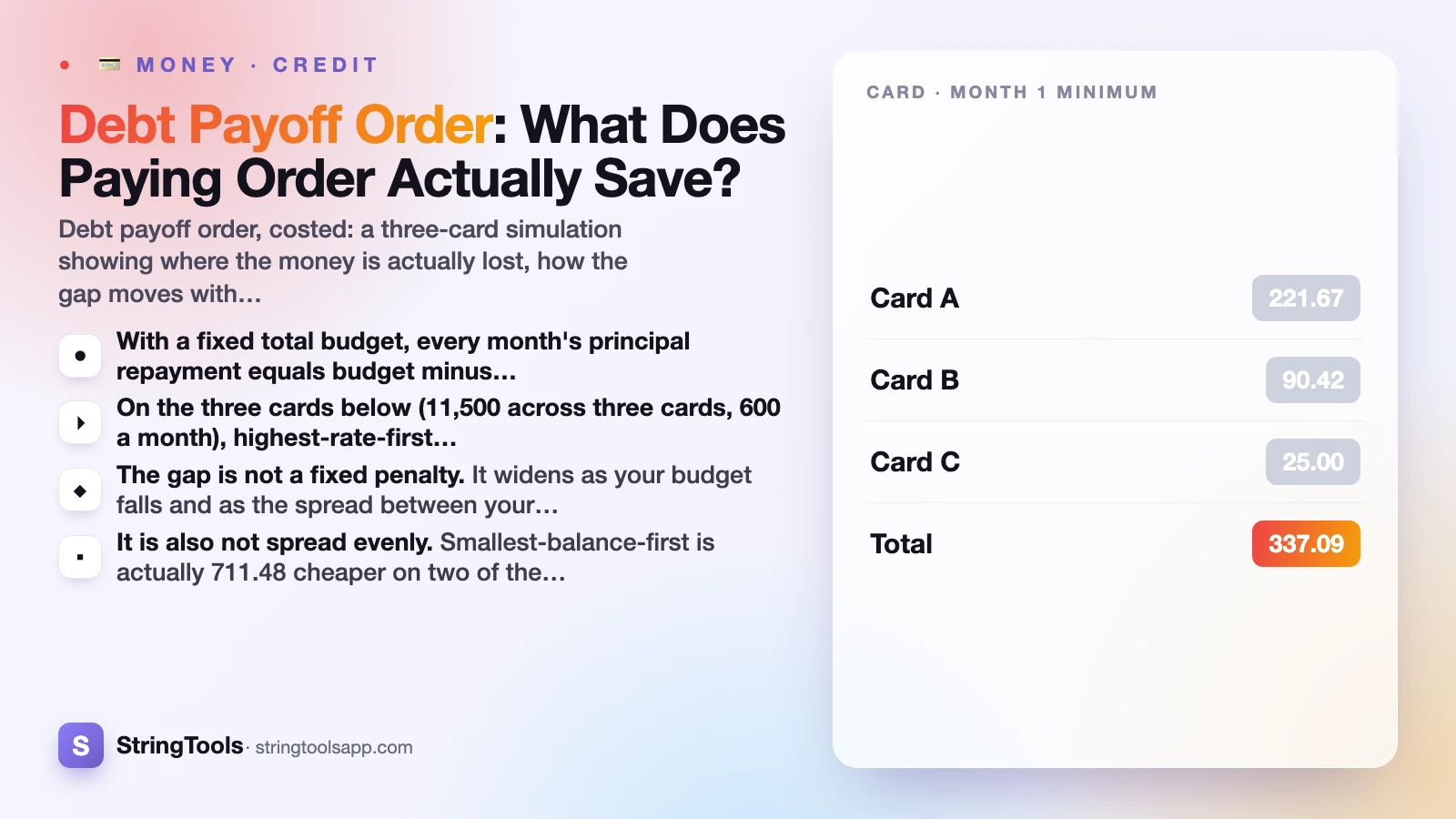
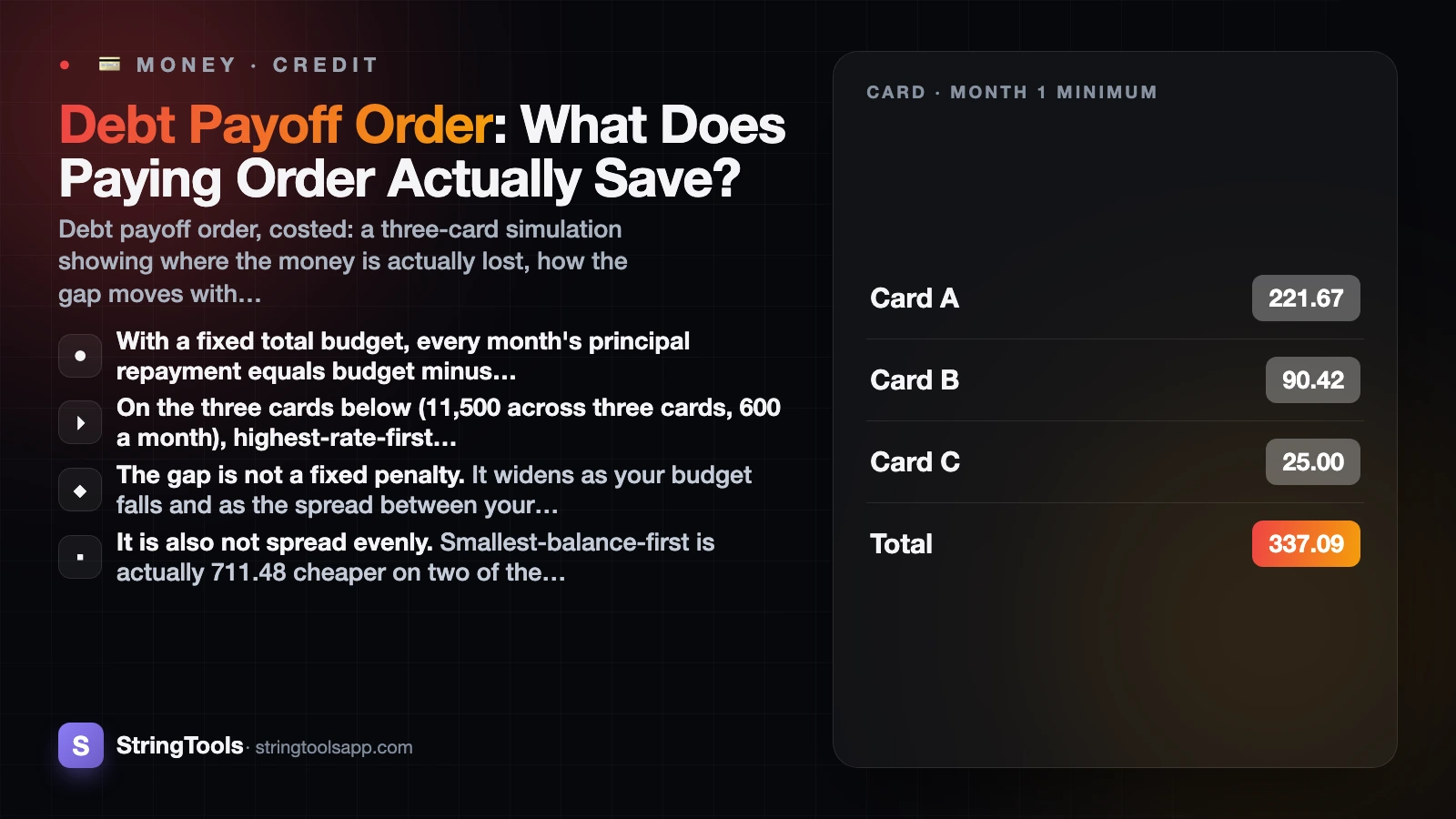
- On the three cards below (11,500 across three cards, 600 a month), highest-rate-first clears in 24 months for 2,678.13 of interest. Smallest-balance-first takes 25 months and 3,205.67. The gap is 527.54.
- The gap is not a fixed penalty. It widens as your budget falls and as the spread between your rates widens, and it vanishes entirely when all your rates are equal.
- It is also not spread evenly. Smallest-balance-first is actually 711.48 cheaper on two of the three cards, and loses 1,239.02 on the third.
- Taking one early win first and then switching to rate order costs 243.38 here, about half the full penalty.
- If your smallest balance also carries your highest rate, the two orders give identical instructions and there is nothing to decide.
The two orders have names, and the case for each — including the behavioural evidence for starting with a small balance — is set out in debt snowball vs avalanche. Read that first if you want the argument. This post assumes you have already had it, and answers the question it leaves open: what is the decision actually worth on your cards? It is general information, not financial advice.
Why order changes the total at all
The arithmetic is provable in one line, and it is worth seeing because it tells you when the decision matters and when it does not.
Both orders spend the same total each month. The budget does not change depending on which target you pick.
In any given month, then:
- total interest charged = the sum of each card's balance times its monthly rate
- total principal repaid = the fixed budget minus total interest charged
That second line is the whole argument. Because the budget is fixed, the only way to repay more principal is to be charged less interest. And the only way to be charged less interest next month is to have removed balance from the most expensive card this month, because interest is balance times rate.
So paying the highest rate first is not merely a tendency. For the same budget and the same minimum rules, it is the order that minimises total interest, and therefore the order that clears the debt in the fewest months. Any other order is a deliberate decision to accept a known cost in exchange for something else — usually an earlier visible win.
Knowing that, the useful question is how large that known cost is for your particular set of cards. It is a number, and the rest of this post computes it five different ways.
The three-card example
Three cards, all figures illustrative and currency-neutral — read them as dollars, pounds or euros.
| Card | Balance | APR (illustrative) | Month 1 interest | Month 1 minimum |
|---|---|---|---|---|
| Card A | 7,000 | 26% | 151.67 | 221.67 |
| Card B | 3,500 | 19% | 55.42 | 90.42 |
| Card C | 1,000 | 11% | 9.17 | 25.00 |
| Total | 11,500 | — | 216.26 | 337.09 |
The minimum here is the greater of a 25 floor or this month's interest plus 1% of the balance. Issuers differ; that is one common shape, not a universal rule, and it is the editable default in the credit card payoff calculator.
Assume a total budget of 600 a month. The minimums take 337.09 of that, leaving a surplus of 262.91 to aim at one card. Note the total principal repaid in month one is 600 minus 216.26, which is 383.74 — and that figure is the same whichever card you aim at. What differs is which balance the 383.74 comes out of, and therefore what next month's interest bill looks like.
This example is built to create the conflict deliberately: the smallest balance carries the lowest rate, and the largest balance carries the highest. Rate order says attack Card A. Balance order says attack Card C. They disagree about every card.
Both orders, simulated month by month
Each order run to zero, interest accruing on opening balances, minimums recalculated every month, surplus cascading to the next target when a card clears mid-month.
| Order | Cards attacked | Months | Total interest | Total paid |
|---|---|---|---|---|
| Highest rate first | A then B then C | 24 | 2,678.13 | 14,178.13 |
| Smallest balance first | C then B then A | 25 | 3,205.67 | 14,705.67 |
Rate order is 527.54 cheaper and one month faster. Now the part that a headline total hides completely — where that 527.54 actually comes from, card by card.
| Card | Rate order: cleared | Rate order: interest | Balance order: cleared | Balance order: interest |
|---|---|---|---|---|
| Card A (7,000 at 26%) | Month 18 | 1,471.07 | Month 25 | 2,710.09 |
| Card B (3,500 at 19%) | Month 23 | 1,031.97 | Month 13 | 474.46 |
| Card C (1,000 at 11%) | Month 24 | 175.09 | Month 4 | 21.12 |
| Total | 24 months | 2,678.13 | 25 months | 3,205.67 |
Balance order is not uniformly worse. It pays 557.51 less interest on Card B and 153.97 less on Card C, because it clears both of them years earlier. It loses the argument entirely on Card A, where leaving 7,000 sitting at 26% for twenty-five months instead of eighteen costs an extra 1,239.02.
Net: 1,239.02 lost on one card, 711.48 saved on the other two, for a 527.54 difference. The expensive card dominates because it is the biggest balance at the highest rate, which is precisely the combination balance order leaves until last.
The counterweight sits in the "cleared" columns. Balance order has closed an account by month 4 and a second by month 13. Rate order spends seventeen months with three open accounts and nothing crossed off. That is what the 527.54 buys.
How big the gap gets, and when it disappears
The 527.54 is not a universal figure. It is a function of two things you can check before choosing.
The gap widens as your budget falls
Same three cards, varying only the monthly budget:
| Monthly budget | Highest rate first | Smallest balance first | Order costs you |
|---|---|---|---|
| 400 | 42 months, 4,953.45 | 44 months, 5,731.50 | 778.05 |
| 500 | 30 months, 3,457.08 | 32 months, 4,103.42 | 646.34 |
| 600 | 24 months, 2,678.13 | 25 months, 3,205.67 | 527.54 |
| 800 | 17 months, 1,867.77 | 18 months, 2,245.22 | 377.45 |
| 1,000 | 13 months, 1,447.26 | 14 months, 1,740.21 | 292.95 |
A tight budget means the expensive card sits untouched for longer, so the order matters more. Anyone who can only just cover the minimums plus a little is exactly the person for whom the order is worth the most — and, awkwardly, often the person who most needs an early win.
The gap widens with the spread between your rates
Same balances, same 600 budget, varying only the rates:
| Rates on A, B, C | Highest rate first | Smallest balance first | Order costs you |
|---|---|---|---|
| 26% / 19% / 11% | 24 months, 2,678.13 | 25 months, 3,205.67 | 527.54 |
| 24% / 21% / 18% | 24 months, 2,796.63 | 25 months, 3,020.87 | 224.24 |
| 29% / 16% / 8% | 24 months, 2,654.52 | 26 months, 3,513.10 | 858.58 |
| 20% / 20% / 20% | 24 months, 2,470.61 | 24 months, 2,470.61 | 0.00 |
The last row is the honest headline. If every card carries the same rate, the two orders cost exactly the same and the choice is free. Cluster your rates tightly and the argument is close to academic. Spread them widely and the order is worth real money.
There is a second case where the decision evaporates. If your smallest balance also carries your highest rate, both orders name the same card and the instructions are identical. Swapping the rates in the example so that the 1,000 card is at 26% and the 7,000 card at 11% gives both orders 22 months and 1,427.36 of interest — the same number twice.
So before you agonise, sort your cards by balance and by rate. If the two lists match, you have nothing to decide.
What one early win costs
The usual compromise is to clear one small balance for the motivation, then switch to strict rate order. It is good advice, and it is not free. Here is the price, on the same three cards and the same 600 budget.
Run Card C first, clear it in month 4, then attack by rate: Card A, then Card B.
| Order | Months | Total interest | First card cleared |
|---|---|---|---|
| Highest rate first | 24 | 2,678.13 | Month 18 |
| One win first, then rate order | 25 | 2,921.51 | Month 4 |
| Smallest balance first | 25 | 3,205.67 | Month 4 |
That middle row costs 243.38 more than strict rate order and saves 284.16 against pure balance order. It recovers roughly half the penalty while delivering the identical month-4 win — but it finishes in 25 months, the same as pure balance order and one month behind strict rate order, because the four months spent on Card C let Card A keep compounding at an illustrative 26%.
That is a fair trade for most people, and it is worth stating in those terms rather than pretending the compromise is free. You are buying a cleared account in month 4 for 243.38 on this debt. Whether that is good value depends entirely on whether the win is what keeps you paying.
For comparison, doing nothing but minimums on all three cards would take 271 months on Card A alone and cost 18,814.73 in interest across the three. Against that, every plan on this page is a rounding error apart. The order matters far less than getting a surplus into the fight at all, and why minimum payments keep you in debt for decades shows why.
How to price the decision on your own cards
The arithmetic above took a simulator. Yours will too, because minimums recalculate every month and surpluses cascade. Doing it by hand on a spreadsheet is possible and painful.
The steps are the same either way.
List every card with its balance, its APR and its minimum rule. The rule is in your terms and it is usually a floor and a percentage. Use your real ones, not the illustrative 25 and 1% used here.
Set a total monthly budget you can actually sustain, and check it covers every minimum combined with room to spare. If the budget is below the sum of the minimums, no strategy applies and the problem is a cash-flow one.
Run both orders and look at three numbers: total interest, months to zero, and the month your first card clears. The difference between the two interest totals is the price of the decision, and it is the only figure you need in order to make it. Enter the cards into the credit card payoff calculator, which simulates both strategies side by side, shows the per-card clear dates, and lets you download the schedule.
Then choose on the size of that gap, not on the principle. If the difference is 50, take the early win without guilt. If it is 800, rate order is buying you something substantial and it is worth finding another motivation device.
Whichever you pick, the rules are the same: minimums on everything so nothing goes into default, the full surplus on one target, and the freed-up payment rolled onto the next card the moment a target clears. For free regulated help if the minimums are a stretch, the Consumer Financial Protection Bureau covers US options, accredited nonprofit counsellors are listed by the National Foundation for Credit Counseling, and in the UK the Financial Conduct Authority sets out what your lender should offer.
Frequently Asked Questions
Does the order I pay my debts in really change the total?
Yes, and by a computable amount. With a fixed monthly budget, the principal you repay in a month equals the budget minus that month's total interest, so the order that minimises interest is the one that clears the debt soonest. Paying the highest rate first minimises interest by construction. The difference shrinks to zero when every card carries the same rate, or when the smallest balance is also the highest rate.
How much does paying the smallest balance first cost me?
It depends on your budget and your rate spread, not on the label. On the three cards here — 7,000 at an illustrative 26%, 3,500 at 19% and 1,000 at 11%, with 600 a month — it costs 527.54 more and takes one extra month. Cutting the budget to 400 widens that to 778.05. Tightening the rates to 24%, 21% and 18% narrows it to 224.24. Making all three rates equal reduces it to zero.
Which card does the wrong order actually cost me money on?
Almost entirely one of them. In the worked example, balance order pays 557.51 less interest on Card B and 153.97 less on Card C, because it clears both far earlier. But it pays 1,239.02 more on Card A, because 7,000 sits at an illustrative 26% for twenty-five months instead of eighteen. The net is 527.54. The largest balance at the highest rate dominates the total.
What does taking one early win first cost me?
Clearing the small card first and then switching to strict rate order costs 243.38 more than rate order throughout on this debt, and saves 284.16 against clearing by balance all the way, while delivering the same cleared account in month 4. It finishes in 25 months rather than 24. You are buying an early win for roughly 260. If that win is what keeps you paying, it is cheap.
What if my smallest debt is also my highest interest rate?
Then there is no decision to price. Both orders name the same card and the resulting schedules are identical. Swapping the rates in the example so the 1,000 balance carries 26% and the 7,000 balance carries 11% gives both orders 22 months and 1,427.36 in interest. Before comparing anything, sort your cards by balance and by rate; if the two lists match, pick either and start.
Does the order matter more than the amount I pay?
No, by a wide margin. On the same three cards, moving the budget from 400 to 1,000 a month takes the cheapest order from 42 months and 4,953.45 of interest to 13 months and 1,447.26 — a saving of about 3,506. Choosing the cheapest order at a 600 budget saves 527.54. Both are worth having, but the budget is the larger lever by roughly seven to one here.
Sources and references
Consumer Financial Protection Bureau (consumerfinance.gov) · National Foundation for Credit Counseling (nfcc.org) · Financial Conduct Authority (fca.org.uk). Content was reviewed against these sources as of the last-updated date above; external figures and rules may change after publication.