
Is a balance transfer worth it?
A balance transfer is worth it when the interest you avoid exceeds the fee you pay, and you clear the balance before the promotional rate ends. The fee is usually a percentage of the amount moved. Compare it against one or two months of your current interest charge and the answer is usually obvious.
Key Takeaways
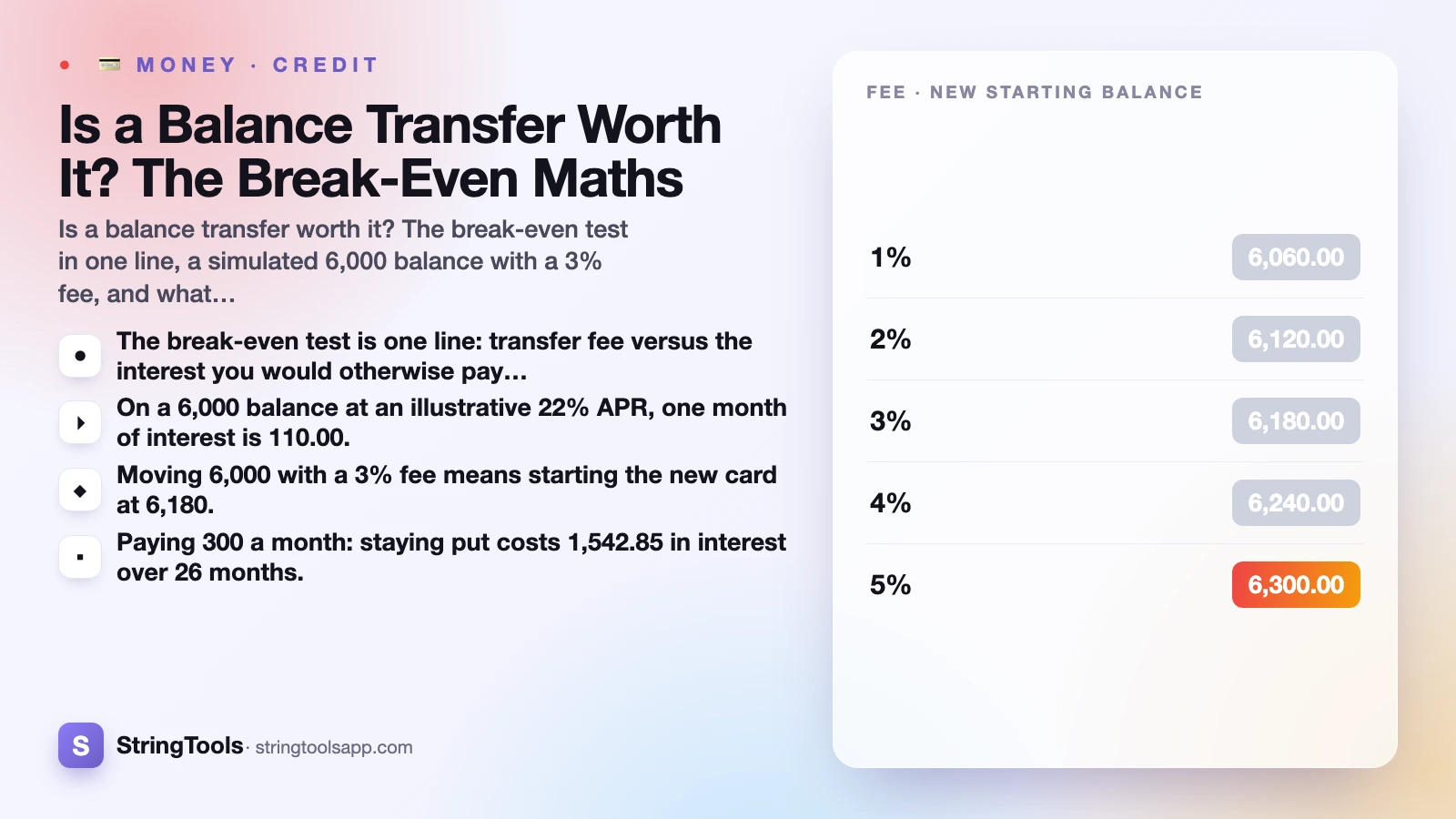
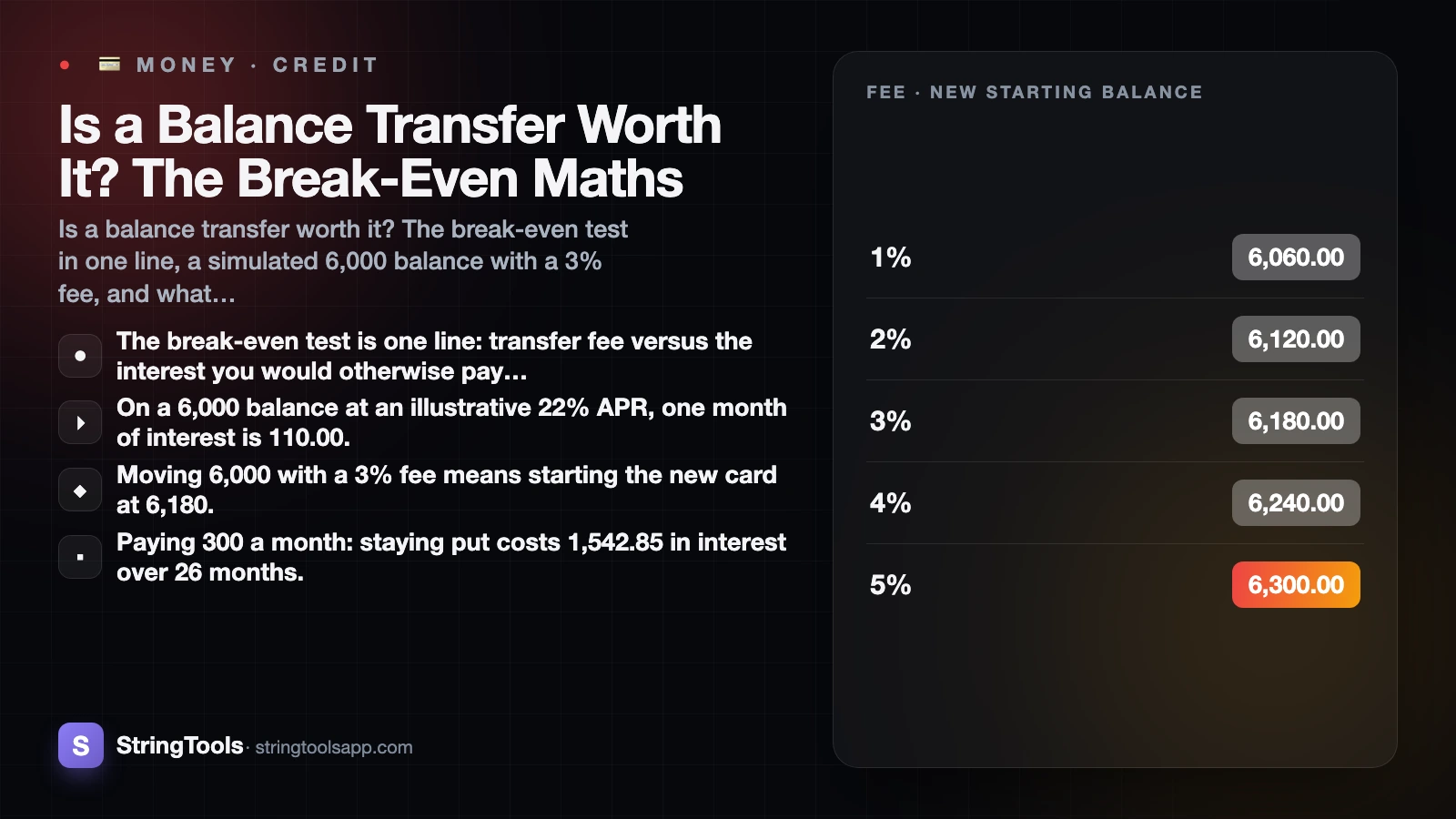
- The break-even test is one line: transfer fee versus the interest you would otherwise pay over the same period.
- On a 6,000 balance at an illustrative 22% APR, one month of interest is 110.00. A 3% transfer fee is 180.00 — under two months of interest, recovered almost immediately.
- Moving 6,000 with a 3% fee means starting the new card at 6,180. Clearing that within an 18-month promotional window takes 343.34 a month.
- Paying 300 a month: staying put costs 1,542.85 in interest over 26 months. Transferring costs 180.00 in fee plus 27.09 of post-promotional interest, a total of 207.09 over 21 months. The saving is 1,335.76.
- The failure mode is not the fee. It is paying the minimum during the promotional window and arriving at the end still owing 5,157.31.
- A transfer changes the rate, not the habit. If the payment falls when the rate does, you can end up slower and no better off.
Availability, promotional lengths and fees differ by country and issuer. This is general information, not financial advice, and no product is recommended here.
What actually changes when you transfer
A balance transfer moves debt from one card to another. Three things change and one thing does not.
The rate changes, usually to 0% for a fixed introductory window. That is the point of the exercise: during the window, every unit you pay reduces the balance instead of part of it going to interest.
The balance changes, upward. Almost every offer charges a fee calculated as a percentage of the amount moved, and that fee is normally added to the transferred balance rather than billed separately. Move 6,000 with a 3% fee and you start the new card owing 6,180.
The deadline changes. Promotional windows have an end date, after which the balance reverts to the card's standard rate. That date is the single most important number in the whole decision.
What does not change is the debt itself. You still owe roughly what you owed. A transfer is a refinancing, not a repayment, and the temptation it creates — an old card now sitting at zero with its limit intact — is the reason many transfers end with more total debt than they started with.
The fee, in context
Fees are quoted as a percentage. On a 6,000 balance:
| Fee | Cost on 6,000 | New starting balance |
|---|---|---|
| 1% | 60.00 | 6,060.00 |
| 2% | 120.00 | 6,120.00 |
| 3% | 180.00 | 6,180.00 |
| 4% | 240.00 | 6,240.00 |
| 5% | 300.00 | 6,300.00 |
Now put that against what the debt is costing you now. At an illustrative 22% APR, the first month's interest on 6,000 is 6,000 times 22 divided by 12 divided by 100, which is 110.00. A 3% fee is therefore about 1.6 months of interest. If the promotional window is a year or more, the fee is recovered almost at once and everything after that is saved.
The break-even test, in one line
You do not need a spreadsheet for the first pass. Ask two questions.
What does the fee cost? Balance times the fee percentage. On 6,000 at 3%, that is 180.00.
What does a month of your current interest cost? Balance times APR divided by 1,200. On 6,000 at an illustrative 22%, that is 110.00.
Divide the first by the second and you get the number of months of interest the fee is equivalent to: 180 divided by 110 is about 1.6 months. If you will still be carrying this balance in two months' time, and the promotional window is longer than that, the transfer is ahead before the third statement arrives.
That test is rough because your balance falls as you pay, so the interest you avoid falls too. It errs on the side of caution, which is the right direction for a rule of thumb. For anything marginal — a short window, a high fee, or a balance you expect to clear quickly anyway — run it properly, which is what the next section does.
The test also tells you when a transfer is not worth the paperwork. If you are two months from clearing the balance anyway, you would pay 180 to avoid roughly 200 of interest. That is not a win worth a new credit application.
The full comparison, simulated
A 6,000 balance. Option one: stay where you are at an illustrative 22% APR. Option two: transfer with a 3% fee to a card offering 0% for 18 months, reverting to an illustrative 22% afterwards. Same monthly payment in both columns, no new spending, simulated month by month.
| Monthly payment | Stay: months | Stay: interest | Transfer: months | Transfer: fee plus interest | Saving |
|---|---|---|---|---|---|
| 250 | 32 | 1,979.05 | 26 | 309.66 | 1,669.39 |
| 300 | 26 | 1,542.85 | 21 | 207.09 | 1,335.76 |
| 350 | 21 | 1,269.30 | 18 | 180.00 | 1,089.30 |
| 400 | 18 | 1,081.25 | 16 | 180.00 | 901.25 |
| 500 | 14 | 839.12 | 13 | 180.00 | 659.12 |
Three readings.
At 350 a month and above, the balance clears inside the window, so the entire cost of the transfer is the 180 fee and nothing else. The 22% column never gets to charge anything.
At 300 a month the balance does not quite clear in time. Roughly 780 is still outstanding when the promotional rate ends, and it picks up 27.09 of interest over the final three months. The transfer still saves 1,335.76.
The saving shrinks as the payment rises, because a larger payment means less time at 22% in the stay-put column. The transfer is worth most to the person who will take longest to clear the debt — which is also the person least likely to clear it inside the window. That tension is the whole risk.
The exact figure to clear 6,180 in 18 flat months is 343.34. It is worth rounding that up rather than down: at 343.33 the schedule runs to 19 months, because a few cents survive the final payment and tip into a nineteenth statement carrying the reverted rate.
The way this goes wrong
The fee is not what hurts people. The promotional window is.
Consider the same 6,180 transferred balance, but the cardholder pays only the minimum during the 0% period — the greater of a 25 floor or 1% of the balance, since there is no interest to add. At 0%, a 1% minimum removes 1% of the balance a month.
After 18 months of minimums, the balance stands at 5,157.31. Almost the entire debt survives the window intact, and on the first day of month 19 it starts accruing at an illustrative 22%.
| What happens after the transfer | Months to clear | Fee plus interest |
|---|---|---|
| 343.34 a month throughout | 18 | 180.00 |
| 300 a month throughout | 21 | 207.09 |
| Minimums for 18 months, then 300 a month | 39 | 1,274.66 |
| Minimums throughout | 251 | 8,568.17 |
The third row is instructive because it is not a disaster and it is not a win either. Drifting through the window on minimums and then getting serious still costs less than never transferring at all — 1,274.66 against the 1,542.85 that 300 a month would have cost on the original card — but it takes 39 months instead of 26. Thirteen extra months for a 268.19 saving is a poor trade for something that required a credit application.
The fourth row is the genuine failure. Minimums for the whole run, before and after the window, and the debt lasts 251 months at a cost of 8,568.17. The 0% period bought eighteen months of grace and nothing was done with it. The mechanism behind that number is set out in why minimum payments keep you in debt for decades.
The other three traps
Missing a payment can end the promotional rate early on many offers, which converts a good plan into the fourth row overnight. Set the payment as a standing instruction.
New purchases on the transfer card may not share the 0% rate, and payment allocation rules vary by country, so a mixed balance can be harder to clear than it looks. The clean approach is to treat the transfer card as closed to spending.
The old card is now empty with its limit intact. Running it back up leaves you with two balances instead of one.
Whether to transfer, in the right order
Work through these before applying, because an application is a real event on your credit file whether the offer is useful or not.
Work out what the debt costs you now. Balance times APR divided by 1,200 gives one month of interest. Multiply by how many months you realistically need to clear it.
Work out the fee. Balance times the fee percentage. Add it to the balance, because that is where it will land.
Work out the payment that clears the new balance inside the window. New balance divided by the number of promotional months, rounded up to the next cent. On 6,180 over 18 months that is 343.34 (rounding up from 343.33 recurring). If that figure is affordable, the transfer is close to free money. If it is not, you are betting on a second transfer later, and there is no guarantee one will be available to you.
Compare total cost, not the monthly payment. This is the same discipline that applies to any refinancing, and it is where most comparisons go wrong; how long it takes to pay off a credit card shows how sharply total cost moves with the payment.
Then run your own numbers rather than these. Put the balance, the rate and the payment into the credit card payoff calculator to see what staying put costs, and compare it against the fee plus whatever survives the promotional window.
If you hold several cards, a transfer is one lever among a few, and the order you attack the rest still matters — avalanche vs snowball works that through with three cards. And if the payments are unaffordable rather than merely uncomfortable, a transfer is the wrong tool. Free regulated help exists: the Consumer Financial Protection Bureau covers US options, the National Foundation for Credit Counseling lists accredited nonprofit counsellors, and in the UK the Financial Conduct Authority sets out what forbearance lenders should offer.
Frequently Asked Questions
How do I know if a balance transfer is worth the fee?
Compare the fee with the interest you would otherwise pay. On a 6,000 balance at an illustrative 22% APR, one month of interest is 110.00 and a 3% fee is 180.00 — about 1.6 months of interest. If you will still be carrying the balance in two months and the promotional window is longer than that, the fee is recovered almost immediately. If you are about to clear the balance anyway, the fee buys you very little.
What happens if I do not clear the balance before the 0% period ends?
Whatever is left starts accruing at the card's standard rate. It is not a penalty, just the end of the offer. On a 6,180 transferred balance paid at 300 a month, roughly 780 survives an 18-month window and picks up 27.09 of interest — trivial. Paying only the minimum through the same window leaves 5,157.31 outstanding, which is a very different outcome. The payment you set matters far more than the window length.
How much do I need to pay each month to clear a balance transfer in time?
Divide the transferred balance, including the fee, by the number of promotional months, and round up. Moving 6,000 with a 3% fee gives 6,180; over 18 months that is 343.34 a month. Round up rather than down — at 343.33 a few cents survive the final payment and tip the balance into a nineteenth month at the reverted rate.
Does a balance transfer hurt my credit score?
It depends on the scoring model and your country, so no single answer is reliable. In general, applying opens a new account and produces a credit check, while the total amount you owe does not change. Some people see their overall credit use fall because total available limit rises. Closing the old card afterwards can work the other way. Your national consumer-finance regulator publishes better guidance on this than any calculator can.
Is it better to transfer a balance or take a personal loan?
They solve the same problem differently. A transfer gives a temporary rate of 0% with a deadline and a fee; a loan gives a fixed rate, a fixed term and a payment that ends on a known date. A transfer usually wins on cost if you can clear it inside the window. A loan usually wins on discipline, because the term is imposed rather than chosen. Compare total cost over the full repayment period for both, not the monthly payment.
Can I transfer a balance more than once?
Sometimes, and it is not a plan you can rely on. Each transfer means a new application, a new fee on the amount moved, and an approval decision that depends on your circumstances at that moment. Building a payoff plan on the assumption that another offer will be available in eighteen months is a bet, not a calculation. Size the payment so the balance clears inside the window you actually have.
Sources and references
Consumer Financial Protection Bureau (consumerfinance.gov) · National Foundation for Credit Counseling (nfcc.org) · Financial Conduct Authority (fca.org.uk). Content was reviewed against these sources as of the last-updated date above; external figures and rules may change after publication.