
Why minimum payments keep you in debt for decades
A minimum payment is designed to cover the month's interest plus a thin slice of the balance, so it falls as the balance falls. Progress therefore slows every single month instead of speeding up. Under one common formula, a 5,000 balance at an illustrative 22% APR takes 230 months to clear.
Key Takeaways
- A typical minimum is the greater of a small flat floor or this month's interest plus roughly 1% of the balance. Issuers differ, so treat that as one common shape rather than a universal rule.
- Because the percentage slice is taken from a shrinking balance, the payment shrinks too. The plan decelerates by design.
- On a 5,000 balance at an illustrative 22% APR under that formula: 230 months to clear, 8,099.76 in interest, 13,099.76 paid in total.
- Simply freezing the first minimum of 141.67 and paying that same amount every month cuts the payoff to 58 months and the interest to 3,121.34.
- The last 57 months of the minimum-payment schedule are spent clearing a balance under 900, at the flat floor, paying 544.17 in interest for the privilege.
- The percentage in the formula matters enormously: raising it from 1% to 2% on the same balance cuts the term from 230 months to 137.
This is general information, not financial advice.
What a minimum payment actually is
Card issuers do not pick the minimum arbitrarily. The usual shape is a formula with two parts, and the customer pays whichever is larger:
- a flat floor, so tiny balances do not produce absurd payments
- this month's interest, plus a small percentage of the balance
The percentage is the important half. It is what guarantees the balance falls at all, and it is deliberately thin. The exact floor and percentage vary between issuers and between countries, and regulators in some markets set rules about what a minimum must at least cover, so the only authoritative source for your card is your own statement and terms. For the worked example below, this post uses a floor of 25 and a percentage of 1%, which is a common shape and the default that this site's credit card payoff calculator starts with. Both numbers are editable there, because yours will differ.
Take a 5,000 balance at an illustrative 22% APR. The monthly rate is 22 divided by 12 divided by 100, or 0.018333. So:
- this month's interest is 5,000 times 0.018333, which is 91.67
- 1% of the balance is 50.00
- the minimum due is 141.67, of which exactly 50.00 reduces what you owe
Roughly 65% of that first payment is rent on money you already borrowed. Next month the balance is 4,950 and the minimum drops to 140.25. The month after, 138.85. The payment falls every month for fourteen years.
The full simulation: 5,000 at an illustrative 22% APR
Simulated month by month, interest accruing on the opening balance and the payment applied afterwards, the schedule looks like this.
| Month | Opening balance | Payment | Interest | Principal | Closing balance |
|---|---|---|---|---|---|
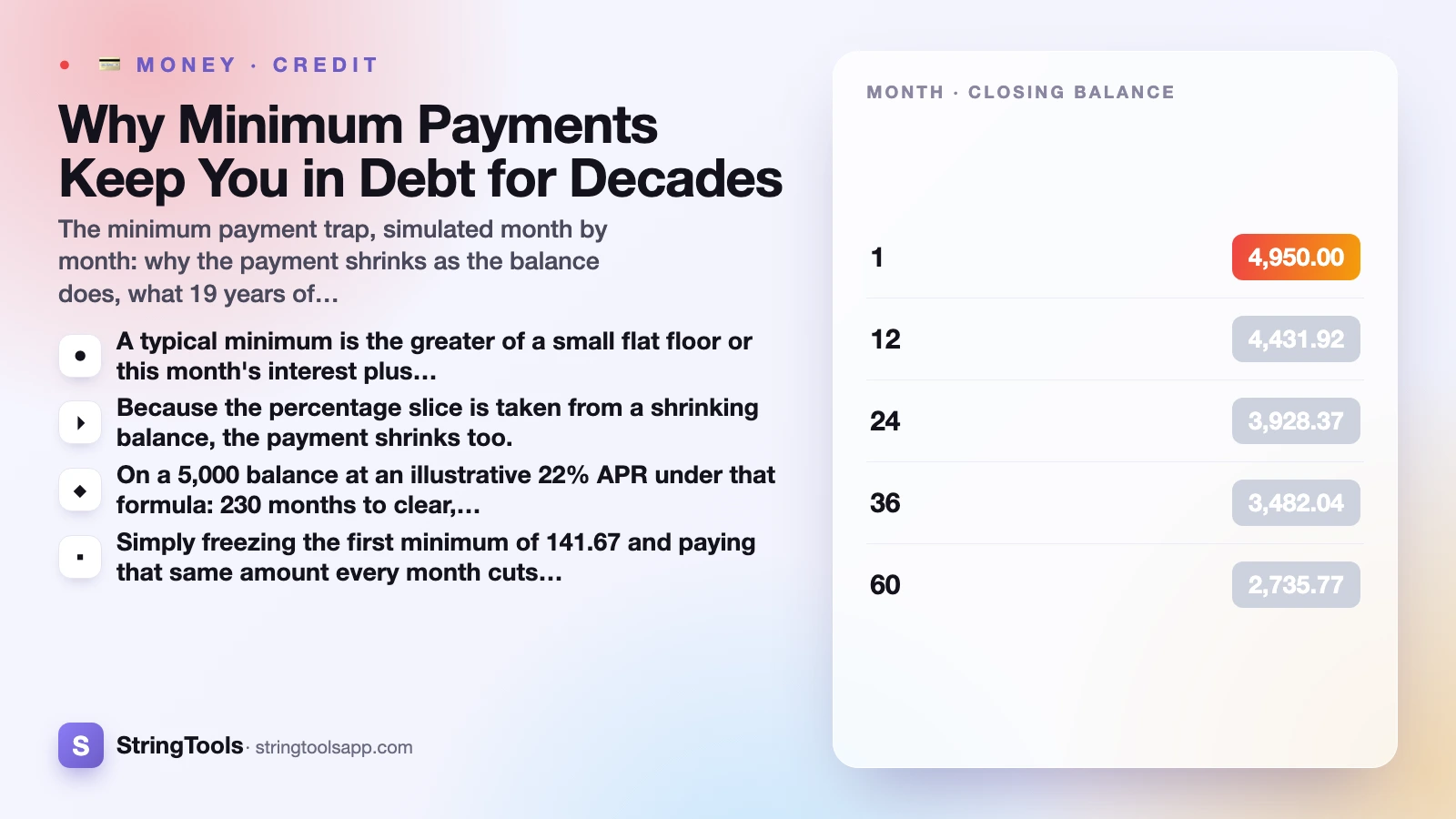
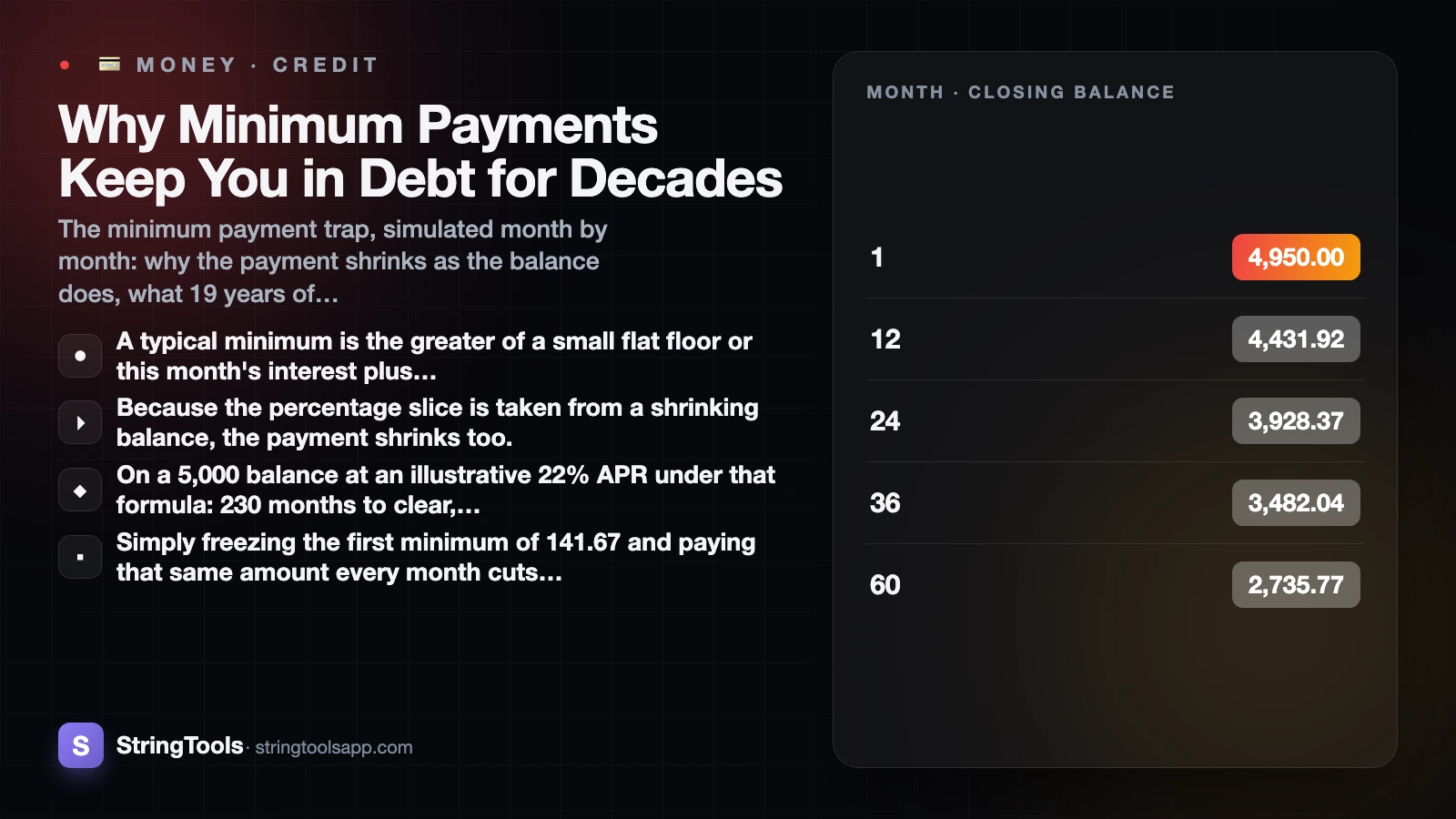
| 1 | 5,000.00 | 141.67 | 91.67 | 50.00 | 4,950.00 |
| 12 | 4,476.69 | 126.84 | 82.07 | 44.77 | 4,431.92 |
| 24 | 3,968.05 | 112.43 | 72.75 | 39.68 | 3,928.37 |
| 36 | 3,517.21 | 99.65 | 64.48 | 35.17 | 3,482.04 |
| 60 | 2,763.40 | 78.29 | 50.66 | 27.63 | 2,735.77 |
| 120 | 1,512.02 | 42.84 | 27.72 | 15.12 | 1,496.90 |
| 180 | 822.91 | 25.00 | 15.09 | 9.91 | 813.00 |
| 230 | 22.51 | 22.92 | 0.41 | 22.51 | 0.00 |
Totals: 230 months, which is 19 years and 2 months. Interest of 8,099.76. Total paid of 13,099.76 to clear a 5,000 debt.
Read the first year on its own. Twelve payments totalling 1,609.54 go out. Of that, 1,041.46 is interest and 568.08 reduces the balance. After a full year of never missing a payment, the balance has fallen from 5,000 to 4,431.92 — about 11%.
After five years, 6,415.24 has left the account, more than the original debt, and 2,735.77 is still owed. The balance does not fall below half its starting size until month 69.
The tail is the part nobody warns you about
There is a second, sharper trap hiding in the same formula, and it only shows up in the final third of the schedule.
Once the balance falls far enough, the interest-plus-1% calculation produces a number smaller than the flat floor, so the floor takes over. With a 25 floor and an illustrative 22% APR, that crossover happens when the balance drops to about 878.75 — which in this schedule is month 174.
From month 174 to month 229 the payment is a flat 25, and month 230 takes only the 22.92 left to clear. That is 57 payments, nearly five years, spent clearing a balance of under 900 and paying 544.17 in interest along the way. The percentage slice, the only thing that made the schedule accelerate at all, has stopped applying.
The wider point is that a minimum payment is not a repayment plan. It is the smallest amount that keeps the account in good standing. It is doing its job perfectly when it takes nineteen years.
The one-line fix
Freeze the payment. Take whatever the first minimum is and keep paying exactly that figure every month, ignoring the lower number the statement asks for. On this balance that means paying 141.67 every month rather than letting it drift down. The result is 58 months instead of 230, and 3,121.34 in interest instead of 8,099.76 — a saving of 4,978.42 for no extra money in month one at all.
What each option on the same balance actually costs
Same 5,000 balance, same illustrative 22% APR, five different approaches.
| Approach | Months | Total interest | Total paid |
|---|---|---|---|
| Issuer minimum each month | 230 | 8,099.76 | 13,099.76 |
| Freeze the first minimum at 141.67 | 58 | 3,121.34 | 8,121.34 |
| 191.67 a month (first minimum plus 50) | 36 | 1,864.00 | 6,864.00 |
| 200 a month | 34 | 1,749.90 | 6,749.90 |
| 300 a month | 21 | 1,021.61 | 6,021.61 |
The second row costs nothing extra in month one. It is the identical payment; the only change is refusing to let it fall. That alone removes fourteen years and about 61% of the interest.
The third row adds 50 a month to that and removes another 22 months. Compare the first row with the last: paying a flat 300 instead of whatever the issuer asks removes 209 months and 7,078.15 of interest. Against the frozen 141.67 in row two — 158.33 a month less — the same 300 is worth 37 months and 2,099.73.
For a fuller set of payment levels on the same balance, how long it takes to pay off a credit card runs the same simulation across eight payments and six rates.
Why the percentage in the formula matters more than the floor
If you want to know why two people with the same balance and the same rate can be on wildly different timelines, look at the percentage their issuer applies.
Same 5,000, same illustrative 22% APR, varying only the percentage-of-balance component:
| Percentage slice | First minimum | Months to clear | Total interest |
|---|---|---|---|
| 1% | 141.67 | 230 | 8,099.76 |
| 1.5% | 166.67 | 170 | 5,543.30 |
| 2% | 191.67 | 137 | 4,228.61 |
| 2.5% | 216.67 | 116 | 3,423.61 |
Moving from 1% to 2% costs 50 more in the first month and saves 93 months and 3,871.15. This is why regulators have taken an interest in how minimums are set, and why the percentage is worth finding in your own terms rather than assuming.
There is also a degenerate case worth naming. If a minimum rule had no percentage component at all — just a flat floor — and that floor were below the monthly interest, the balance would never fall. On this balance the interest alone is 91.67 in month one, so a flat 25 with nothing added would leave the debt growing forever. The percentage slice is the only thing guaranteeing an end date exists.
Breaking the cycle, in order of effect
The practical steps are unglamorous and they work.
Find your own two numbers. Your statement will state the minimum due and your terms will state how it is calculated. Put your real balance, APR, floor and percentage into the credit card payoff calculator and look at the minimum-payment simulation next to a fixed payment you could actually sustain. The gap is usually larger than people expect.
Set a standing payment rather than paying the statement amount. A fixed transfer on payday that never falls is the entire intervention. It converts a decelerating schedule into a constant one.
Stop adding to the balance while you do it. Every projection assumes no new spending. New purchases reset the clock quietly and the statement will not flag it.
If you hold several cards, decide where the surplus goes rather than spreading it. Minimums on everything, then the whole surplus on one target card, is the standard approach; avalanche vs snowball works through which target to choose, with the full three-card arithmetic.
And if the minimums themselves are a stretch, that is not a budgeting problem to solve alone. In the United States, the Consumer Financial Protection Bureau explains your options and the Federal Reserve publishes consumer credit material; in the UK, the Financial Conduct Authority sets out the forbearance lenders are expected to offer. Free, regulated debt advice exists in most countries, and using it early is far cheaper than a nineteen-year schedule.
Frequently Asked Questions
How long does it take to pay off a credit card with minimum payments?
Far longer than most people assume. Under a common minimum formula of the greater of 25 or this month's interest plus 1% of the balance, a 5,000 balance at an illustrative 22% APR takes 230 months — 19 years and 2 months — and costs 8,099.76 in interest, for 13,099.76 paid in total. Your issuer's floor and percentage will differ, and both change the answer significantly.
Why does my minimum payment go down every month?
Because part of it is a percentage of the balance, and the balance is falling. If the minimum is interest plus 1% of what you owe, then as the balance drops the 1% drops with it and so does the interest component. On a 5,000 balance at an illustrative 22% APR the minimum starts at 141.67, is 126.84 by month 12 and 78.29 by month 60. The plan slows down exactly when you want it to speed up.
Is it bad to only pay the minimum on a credit card?
It protects your account standing, which matters, but it is an extremely expensive way to borrow. It is not a missed payment and it is not a default. What it is is the slowest permitted repayment. On the example above it turns a 5,000 debt into 13,099.76 paid over nineteen years. If the minimum is all you can manage right now, pay it and seek free debt advice rather than treating it as a plan.
How much extra should I pay above the minimum?
The highest-value move is not extra money at all: it is refusing to let the payment fall. Paying a frozen 141.67 rather than the declining minimum takes the same 5,000 balance from 230 months to 58 and saves 4,978.42 in interest. Beyond that, each addition helps but with diminishing returns — adding 50 to make it 191.67 saves a further 22 months, while the step from 200 to 300 saves 13.
Can a minimum payment ever fail to clear the card at all?
Yes, if the formula has no percentage component and the flat floor is below the monthly interest. On a 5,000 balance at an illustrative 22% APR the interest alone is 91.67 in the first month, so a flat 25 with nothing added would leave the balance growing every month forever. Real minimum formulas include a percentage slice precisely to prevent that, but the same trap catches anyone who sets their own fixed payment too low.
Why am I still paying years later on a small balance?
Because of the floor. Once the balance falls far enough, interest plus 1% comes to less than the flat floor, so the payment freezes at the floor and the percentage slice stops accelerating anything. In the worked example that crossover happens at a balance of about 878.75, in month 174, and the remaining 57 months are spent at a flat 25 a month, costing another 544.17 in interest.
Sources and references
Consumer Financial Protection Bureau (consumerfinance.gov) · Federal Reserve (federalreserve.gov) · Financial Conduct Authority (fca.org.uk). Content was reviewed against these sources as of the last-updated date above; external figures and rules may change after publication.