
How credit card interest is actually calculated
Most card issuers convert the APR into a daily periodic rate, work out the average balance across every day of the statement cycle, and multiply the two together by the number of days. Interest is charged per day on what you actually owed that day, not once a month on a single figure.
Key Takeaways
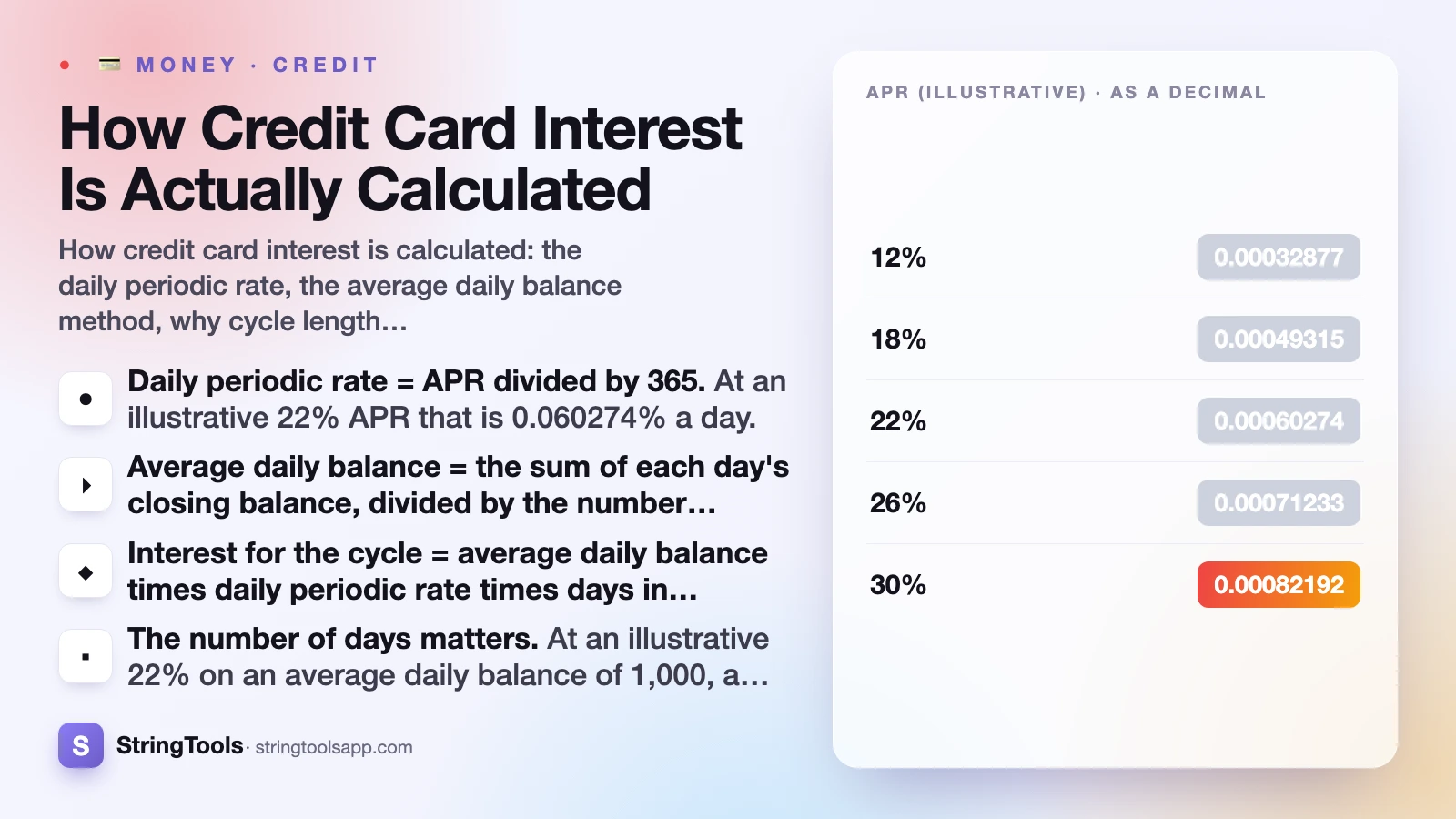
- Daily periodic rate = APR divided by 365. At an illustrative 22% APR that is 0.060274% a day.
- Average daily balance = the sum of each day's closing balance, divided by the number of days in the cycle.
- Interest for the cycle = average daily balance times daily periodic rate times days in the cycle.
- The number of days matters. At an illustrative 22% on an average daily balance of 1,000, a 28-day cycle costs 16.88 and a 31-day cycle costs 18.68.
- Paying earlier in the cycle lowers the average daily balance and therefore the interest. On the worked example below, the same 400 payment saves 4.82 by arriving on day 5 instead of day 25.
- A grace period means new purchases are interest-free only if you paid the previous statement in full. Carry a balance and that protection usually disappears until you clear it.
Rates, grace-period rules and cycle lengths differ by issuer and by country. Every figure here is illustrative, and this is general information rather than financial advice.
Step one: the daily periodic rate
The APR on your statement is an annual figure, but interest is applied daily. The conversion is a plain division:
daily periodic rate = APR divided by 365
At an illustrative 22% APR, that is 22 divided by 365, or 0.060274% per day. As a decimal for calculation, 0.00060274.
| APR (illustrative) | Daily periodic rate | As a decimal |
|---|---|---|
| 12% | 0.032877% | 0.00032877 |
| 18% | 0.049315% | 0.00049315 |
| 22% | 0.060274% | 0.00060274 |
| 26% | 0.071233% | 0.00071233 |
| 30% | 0.082192% | 0.00082192 |
Two footnotes that matter for tallying your own statement. Some issuers divide by 360 rather than 365, which produces a slightly higher daily rate. And in a leap year, dividing by 365 across 366 days produces marginally more interest than the headline APR implies. Neither changes the method; both change the last cent or two, which is why a hand calculation rarely matches a statement exactly.
There is a related quirk worth understanding. If interest is charged daily and then charged again on that interest, the effective annual cost exceeds the quoted APR. At an illustrative 22% nominal compounded daily, the effective annual rate works out at about 24.60%. Whether your issuer compounds within a cycle or simply totals the daily charges varies, and the difference is small over one month: on an average daily balance of 1,000 across 30 days, simple daily interest is 18.08 while daily compounding gives 18.24.
Step two: the average daily balance
This is the part people get wrong, because they assume interest is charged on the balance printed on the statement. Usually it is not. It is charged on the average of every day's balance during the cycle.
The method: take the closing balance for each day of the statement cycle, add them all up, divide by the number of days.
Take a 30-day cycle. You start owing 1,000. On day 11 you make a 500 purchase and nothing else happens.
- days 1 to 10: balance 1,000, so 10 times 1,000 equals 10,000
- days 11 to 30: balance 1,500, so 20 times 1,500 equals 30,000
- total 40,000, divided by 30 days, gives an average daily balance of 1,333.33
At an illustrative 22% APR, interest for the cycle is 1,333.33 times 0.00060274 times 30, which comes to 24.11.
Now see how much the method matters. On exactly the same month:
| Balance the issuer charges on | Figure used | Interest for the cycle |
|---|---|---|
| Opening balance | 1,000.00 | 18.08 |
| Average daily balance | 1,333.33 | 24.11 |
| Closing balance | 1,500.00 | 27.12 |
Same debt, same rate, same month, three different bills. The average daily balance method sits between the two extremes, which is why it is the common approach and why you cannot reproduce a statement by taking one number and multiplying it.
Your card terms will name the method. Look for a phrase like "average daily balance" or "daily balance" in the interest-charges section.
Step three: the number of days
Because the calculation multiplies by the days in the cycle, two identical months can cost different amounts.
At an illustrative 22% APR on an average daily balance of 1,000:
| Cycle length | Interest charged |
|---|---|
| 28 days | 16.88 |
| 30 days | 18.08 |
| 31 days | 18.68 |
That is a spread of 1.80 on a 1,000 balance for doing absolutely nothing differently. February is cheap and the long months are dear.
It also explains a small discrepancy between real statements and the simplified model used by most payoff calculators, including this site's. A monthly model charges APR divided by 12 on the opening balance: on 1,000 at an illustrative 22%, that is 18.33. The daily method on a 30-day cycle gives 18.08, and on a 31-day cycle 18.68.
Over one month the difference is cents. Over a long payoff it accumulates, and it does not always run the same way, because the daily method is sensitive to when your payments and purchases land. The practical guidance is that a payoff projection is an estimate accurate to within a few percent, not a quotation. How long it takes to pay off a credit card sets out what else those projections leave out.
Why the date you pay changes the bill
This is the one piece of practical leverage the daily method gives you, and almost nobody uses it.
If interest is charged on the average daily balance, then money that arrives early in the cycle reduces the balance for more days than the same money arriving late.
Start a 30-day cycle owing 2,000 at an illustrative 22% APR and make one 400 payment.
- Paid on day 5: balance is 2,000 for 4 days and 1,600 for 26 days. Average daily balance 1,653.33. Interest 29.90.
- Paid on day 25: balance is 2,000 for 24 days and 1,600 for 6 days. Average daily balance 1,920.00. Interest 34.72.
The same 400 saves 4.82 simply by arriving twenty days earlier. Repeat that every month for two years and it is worth over 100 on this balance, for no extra money at all.
The same logic is why splitting one monthly payment into two smaller mid-cycle payments shaves a little more off. The effect is genuine but modest, and it is nowhere near as powerful as raising the payment. Treat it as a free extra rather than a strategy.
One caution: pay at least the minimum by the due date regardless. Paying early is only an advantage if the required payment still lands on time.
The grace period, and why it vanishes
New purchases are often interest-free between the transaction date and the payment due date. That window is the grace period, and it comes with a condition that catches people out.
The grace period generally applies only if you paid the previous statement balance in full. Once you carry a balance from one month into the next, many issuers begin charging interest on new purchases from the day of purchase, with no interest-free window at all — and that treatment usually continues until you have cleared the balance in full and served a clean cycle.
That is the real cost of "I will just pay most of it this month". You do not only pay interest on the leftover. You also lose the free financing on everything you buy next month.
Two more things that surprise people
Cash advances typically have no grace period at all and often a higher rate, so interest starts the day you take the money.
Residual interest, sometimes called trailing interest, is why a card can show a balance after you have paid it off. Interest accrued between the statement date and the day your payment cleared has not been billed yet, so it lands on the following statement. Paying the exact statement balance clears the statement, not the account. Ask for a payoff figure if you want the account at zero.
For the interest-charge rules that apply where you live, and for what your issuer must disclose, go to the source rather than a summary: the Consumer Financial Protection Bureau covers US card rules in plain English, the Federal Reserve publishes consumer credit material, and the Financial Conduct Authority covers UK consumer credit.
Checking your own statement
You can reconstruct most of a statement with a calculator and about ten minutes. Doing it once is worth more than reading about it.
Find the APR that applies to the balance type you are carrying. Cards often run several: purchases, cash advances and promotional balances can each have their own rate and their own calculation.
Divide it by 365 to get the daily periodic rate.
Work out the average daily balance across the cycle. If nothing moved, it is just the balance. If a payment or purchase landed, weight each balance by the number of days it stood.
Multiply average daily balance by the daily rate by the number of days in the cycle.
Compare your answer with the interest line on the statement. Expect to be a little out. A gap of a few cents is rounding or a 360-day divisor. A gap of several units usually means a second balance type at a different rate, a fee you have not counted, or a grace period you assumed applied and did not.
Then use the number for something. If you want to see what a given payment does to the balance over months rather than days, the credit card payoff calculator runs the monthly model month by month and shows the interest and principal split for each payment, with a schedule you can download. It is an estimate, and now you know precisely in which direction and why.
If the interest charge is large enough that the payment barely dents the balance, the arithmetic of that trap is set out in why minimum payments keep you in debt for decades, and free regulated debt advice is available in most countries through bodies such as the National Foundation for Credit Counseling in the United States.
Frequently Asked Questions
How is credit card interest calculated each month?
Most issuers divide the APR by 365 to get a daily periodic rate, work out the average of your balance across every day of the statement cycle, then multiply the two together by the number of days in the cycle. At an illustrative 22% APR the daily rate is 0.060274%. On an average daily balance of 1,000 across a 30-day cycle, that comes to 18.08 for the month.
What is the average daily balance method?
It charges interest on the average of each day's balance rather than on a single figure. Start a 30-day cycle owing 1,000 and make a 500 purchase on day 11, and the average daily balance is 1,333.33, not 1,000 or 1,500. At an illustrative 22% APR that produces 24.11 of interest for the cycle, against 18.08 if the opening balance were used and 27.12 if the closing balance were used.
Does paying my credit card early reduce interest?
Yes, slightly, because it lowers your average daily balance. On a 2,000 balance at an illustrative 22% APR in a 30-day cycle, a 400 payment made on day 5 produces 29.90 of interest while the same payment on day 25 produces 34.72 — a saving of 4.82 for the same money. The effect is real but small. Paying more matters far more than paying earlier.
Why is my interest charge different every month even though my balance is the same?
Usually the length of the statement cycle. Because interest is charged per day, a 28-day cycle and a 31-day cycle cost different amounts. At an illustrative 22% APR on an average daily balance of 1,000, that is 16.88 against 18.68 — a 1.80 spread for identical behaviour. Purchases and payments landing on different days of the cycle will move it too, by changing the average daily balance.
What is a grace period on a credit card?
It is an interest-free window on new purchases, running from the purchase date to the payment due date. The catch is that it normally applies only when you paid the previous statement in full. Once you carry a balance forward, many issuers charge interest on new purchases from the day of purchase, and keep doing so until you have cleared the balance entirely. Partial payment costs you the leftover interest and the free financing.
Why do I still owe interest after paying off my card in full?
This is residual or trailing interest. Interest carries on accruing between the statement date and the day your payment actually clears, and that amount has not been billed yet, so it appears on the next statement. Paying the exact statement balance settles the statement rather than the account. If you want a genuine zero, ask the issuer for a payoff figure good to a specific date and pay that instead.
Sources and references
Consumer Financial Protection Bureau (consumerfinance.gov) · Federal Reserve (federalreserve.gov) · Financial Conduct Authority (fca.org.uk) · National Foundation for Credit Counseling (nfcc.org). Content was reviewed against these sources as of the last-updated date above; external figures and rules may change after publication.