
How long will it take to pay off my credit card?
A credit card is paid off when your monthly payment has covered every month's interest and eaten through the balance underneath. Divide the balance by the payment and you get a floor, not an answer: interest stretches it. The bigger the gap between payment and interest, the shorter the debt.
Key Takeaways
- Only the part of your payment above this month's interest reduces the balance. That surplus is the whole story.
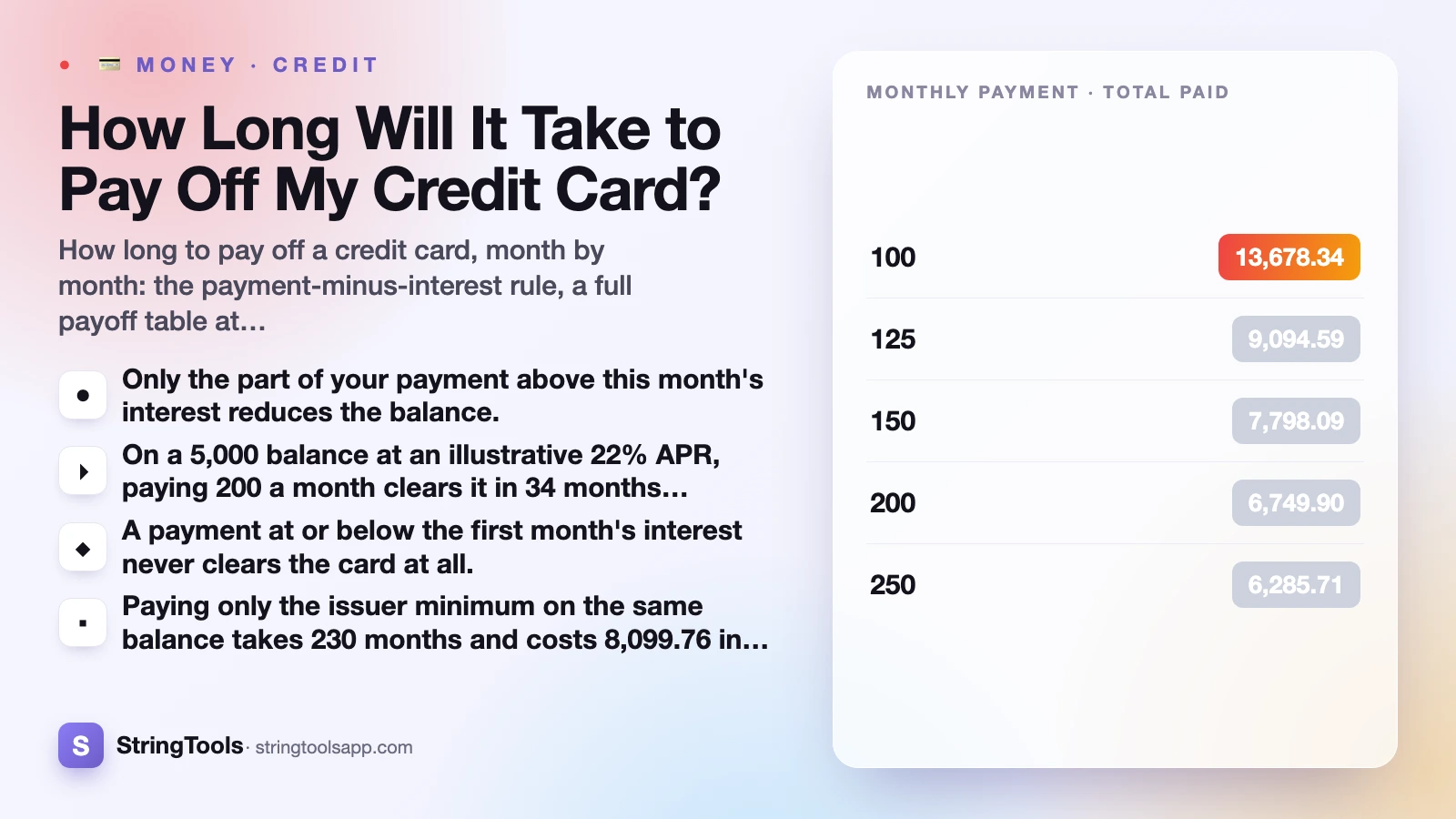
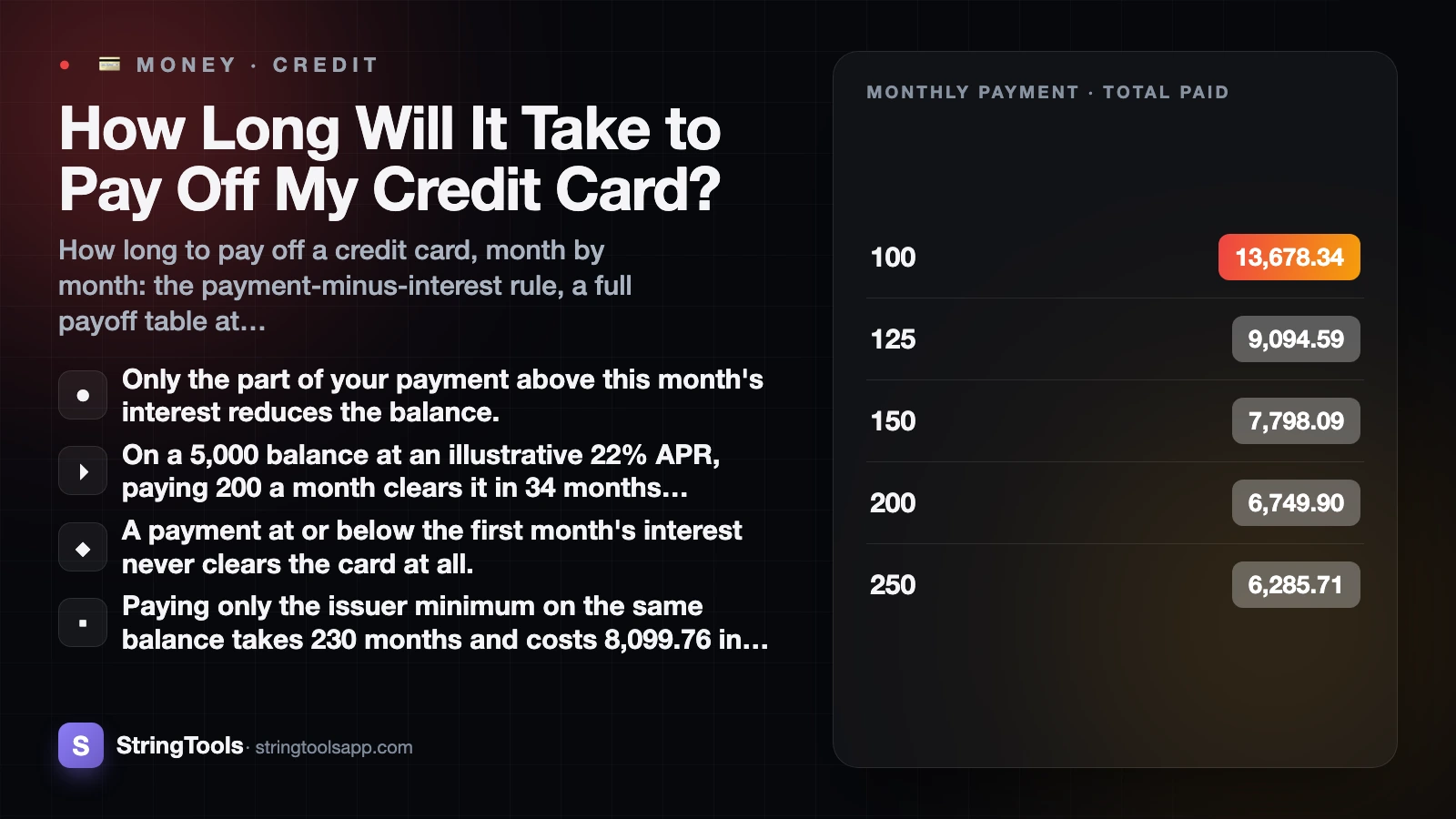
- On a 5,000 balance at an illustrative 22% APR, paying 200 a month clears it in 34 months and costs 1,749.90 in interest. Paying 300 clears it in 21 months for 1,021.61.
- A payment at or below the first month's interest never clears the card at all. On that balance the dividing line sits at 91.67 a month.
- Paying only the issuer minimum on the same balance takes 230 months and costs 8,099.76 in interest under one common minimum formula.
- Raising the payment shortens the debt far more than it raises the cost, because the surplus over interest grows faster than the payment does.
- You can also work backwards: pick a date, and the required payment falls out of the arithmetic.
Everything below is arithmetic on illustrative figures, not a quoted rate and not financial advice.
The only number that matters is payment minus interest
Credit-card maths looks complicated and is not. Each month the issuer works out interest on what you owe, adds it to the balance, then subtracts your payment. Whatever is left rolls into next month and the cycle repeats.
The arithmetic for one month, using the monthly-rate model that this site's credit card payoff calculator uses:
- monthly rate = APR divided by 12, divided by 100
- interest = opening balance times the monthly rate
- principal repaid = payment minus interest
- new balance = opening balance minus principal repaid
Take a 5,000 balance at an illustrative 22% APR. The monthly rate is 22 divided by 12 divided by 100, or 0.018333. The first month's interest is 5,000 times 0.018333, which is 91.67.
Now look at what different payments actually achieve in that first month. A 100 payment repays 8.33 of principal. A 200 payment repays 108.33 — thirteen times as much principal for twice the money. A 300 payment repays 208.33, or twenty-five times the principal of the 100 payment.
That is the whole reason payoff times collapse so sharply when you raise the payment. The interest charge is fixed by the balance and the rate. Every extra unit you add goes entirely to principal. Doubling your payment does not halve the term; it does far better than that.
It also explains the cliff edge at the bottom. A payment of exactly 91.67 on that balance covers the interest and repays nothing. Anything below it leaves the balance higher than it started, and higher balances generate more interest, so the debt grows forever. Card debt has a floor below which no amount of patience helps.
How long a 5,000 balance takes at an illustrative 22% APR
Here is the same balance and the same rate under eight different monthly payments, simulated month by month with the last payment trimmed to whatever is actually owed.
| Monthly payment | Months to clear | Total interest | Total paid |
|---|---|---|---|
| 100 | 137 | 8,678.34 | 13,678.34 |
| 125 | 73 | 4,094.59 | 9,094.59 |
| 150 | 52 | 2,798.09 | 7,798.09 |
| 200 | 34 | 1,749.90 | 6,749.90 |
| 250 | 26 | 1,285.71 | 6,285.71 |
| 300 | 21 | 1,021.61 | 6,021.61 |
| 400 | 15 | 731.62 | 5,731.62 |
| 500 | 12 | 574.44 | 5,574.44 |
Three things in that table are worth sitting with.
The move from 100 to 125 a month is 25 extra. It cuts the term from 137 months to 73 and the interest from 8,678.34 to 4,094.59. That single adjustment saves 4,583.75 and more than five years, because at 100 a month almost the entire payment is being swallowed by interest.
The move from 400 to 500 is also 100 extra, the same as the move from 100 to 200. It saves three months and 157.18. The early increases are worth enormously more than the later ones, which is the opposite of what most people assume.
And the total-paid column is the one to judge a plan by. At 100 a month you hand over 13,678.34 to clear 5,000. At 500 a month you hand over 5,574.44. Same debt, same rate, same person — the only variable is the size of the monthly payment.
The same balance at different rates
Rate matters, but less than payment size. Holding the payment at 200 a month on the same 5,000 balance and varying only the APR:
| APR (illustrative) | Months to clear | Total interest |
|---|---|---|
| 0% | 25 | 0.00 |
| 12% | 29 | 782.45 |
| 18% | 32 | 1,313.97 |
| 22% | 34 | 1,749.90 |
| 26% | 37 | 2,279.69 |
| 30% | 40 | 2,944.78 |
Going from 12% to 30% — a huge spread — adds eleven months and about 2,162 of interest. Going from a 200 payment to a 300 payment at a fixed 22% saves thirteen months and about 728. Rate and payment are both levers, but the payment is the one you control directly and immediately, and at typical card rates it moves the answer more.
This is also why moving a balance to a cheaper rate only pays off if you keep the payment up. A lower rate with a smaller payment can easily be slower and dearer than the debt you started with. The balance transfer break-even maths works through exactly that trap.
Working backwards from a date instead of a payment
Sometimes the useful question is reversed: you want the card gone before a particular month, and you need to know what that costs. The standard annuity formula gives it directly.
payment = balance times r, divided by 1 minus (1 plus r) to the power of minus n
where r is the monthly rate and n is the number of months. For the same 5,000 at an illustrative 22% APR:
| Target | Required monthly payment | Total interest | Total paid |
|---|---|---|---|
| 12 months | 467.98 | 615.65 | 5,615.65 |
| 18 months | 328.65 | 915.54 | 5,915.54 |
| 24 months | 259.40 | 1,225.30 | 6,225.30 |
| 36 months | 190.96 | 1,874.14 | 6,874.14 |
| 48 months | 157.54 | 2,561.22 | 7,561.22 |
Note the shape of that column. Halving the term from 48 months to 24 does not double the payment; it raises it from 157.54 to 259.40, about 65% more, and saves 1,335.92 in interest. Shortening a term is cheaper than it looks, and lengthening one is dearer than it looks.
One practical caution: the formula assumes unrounded arithmetic, and real payments land in whole cents. A payment worked out to the exact cent can leave a few cents outstanding and push you into one extra month. Round the required payment up rather than down.
What every payoff estimate leaves out
Any figure of this kind is a model, and it is worth knowing which way the model is wrong.
It assumes you stop spending on the card
Every projection here treats the balance as closed to new purchases. Put 150 of shopping on the card each month while paying 200 and your real surplus is 50, not 108. This is the single biggest reason people find their card taking far longer than the calculator said. If you cannot stop using it, the honest step is to take the card out of your wallet for the duration.
It compounds monthly, while most issuers compound daily
The monthly model charges interest once, on the opening balance. Most card issuers apply a daily periodic rate to an average daily balance, which produces slightly more interest over a year. The gap is small on a single cycle and real over a long payoff. How credit card interest is actually calculated sets out the daily method properly.
It ignores fees, penalty rates and promotional periods
Annual fees, late fees, cash-advance charges and a penalty rate triggered by a missed payment all sit outside the model. So do introductory rates that revert. Treat the estimate as the best case for a clean, undisturbed run.
It assumes a fixed payment
If your payment is the issuer minimum, it is not fixed — it falls every month as the balance falls, which is exactly why minimum payments drag on. That mechanism is worth understanding before you assume you are on track; see why minimum payments keep you in debt for decades.
Shortening the answer, in order of effect
If you do not like the number your own balance produces, these are the levers, roughly in order of how much they move it.
Fix the payment at a number and hold it there. The most common quiet failure is paying the minimum, which shrinks as the balance shrinks so that progress decelerates just when it should accelerate. Choosing a flat figure and keeping it there converts a decelerating plan into a constant one. On a 5,000 balance the first minimum under one common formula is 141.67; simply holding that same 141.67 flat, rather than letting it fall, cuts the payoff from 230 months to 58.
Add whatever is genuinely spare, then stop tinkering. The table above shows the first increments are worth the most. An extra 50 a month on a 200 payment saves about eight months on this balance.
Lower the rate if you can, but only alongside the payment. A cheaper rate with the same payment is pure gain. A cheaper rate with a smaller payment often is not.
Deal with the highest-rate balance first when you have several cards. With a fixed total budget, interest is minimised by killing the most expensive balance first — see avalanche vs snowball for the worked three-card version.
Keep a small buffer so surprises do not land back on the card. Emergencies charged to the card you are clearing undo months of work; how to build an emergency fund covers sizing a starter buffer while you are still repaying.
If the payments are genuinely unaffordable rather than merely uncomfortable, that is a different problem and free help exists for it. In the United States, the Consumer Financial Protection Bureau publishes plain-English guidance on card debt and complaint routes, and accredited nonprofit counsellors can be found through the National Foundation for Credit Counseling. In the UK, the Financial Conduct Authority sets out what forbearance your lender is expected to offer. Speaking to a regulated adviser early is cheaper than any payoff strategy.
Frequently Asked Questions
How long does it take to pay off 5,000 in credit card debt?
It depends entirely on the payment. At an illustrative 22% APR with no new spending, 200 a month clears a 5,000 balance in 34 months at a cost of 1,749.90 in interest. Raise it to 300 and the same balance is gone in 21 months for 1,021.61. Pay only the issuer minimum under one common formula and it takes 230 months, or roughly 19 years, costing 8,099.76.
What is the minimum payment that will actually clear my card?
Anything above the first month's interest will eventually clear it, but only just. On a 5,000 balance at an illustrative 22% APR the first month's interest is 91.67, so a payment of 92 technically works and would take decades. A payment at or below 91.67 never clears the card, because the balance stops falling and then starts to grow. Treat that figure as the floor, not the target.
Does paying twice a month pay off a credit card faster?
Slightly, and for a reason the monthly model does not capture. Most issuers charge interest on an average daily balance, so money that arrives on the 1st reduces the balance for more days of the cycle than the same money arriving on the 28th. Splitting one payment into two mid-month payments lowers the average daily balance a little. The effect is real but small. Paying more each month matters far more than paying more often.
Should I pay off my credit card or save first?
Most guidance suggests holding a small starter buffer, then attacking the card hard. Card interest at typical rates costs considerably more than a savings account pays, so every unit thrown at the balance avoids a cost equal to the APR. But with no buffer at all, the next unexpected bill goes straight back on the card. A modest cushion first, then everything spare at the debt, is the usual order.
Why does my balance barely move even though I pay every month?
Because most of the payment is being absorbed by interest. On a 5,000 balance at an illustrative 22% APR, a 100 payment leaves only 8.33 to reduce the balance after 91.67 of interest. That is why the same balance takes 137 months at 100 a month but only 34 months at 200. If your payment sits close to the monthly interest charge, progress will feel invisible because it very nearly is.
Does closing the card once I have paid it off help?
It stops you running the balance back up, which is the practical argument for it. It does not reduce what you already owe, and closing a long-held account can change how your overall credit use is measured, so it is not automatically the right move. Many people leave the account open and remove the card from their wallet and their saved payment details instead, which gets the behavioural benefit without the side effects.
Sources and references
Consumer Financial Protection Bureau (consumerfinance.gov) · National Foundation for Credit Counseling (nfcc.org) · Financial Conduct Authority (fca.org.uk). Content was reviewed against these sources as of the last-updated date above; external figures and rules may change after publication.