
What owning a home actually costs every month
The recurring costs of owning a home are maintenance, insurance, property taxes, service or condominium charges, and utilities. Together they commonly run between 1% and 4% of the property's value each year. Unlike a fixed mortgage payment, every one of them rises with inflation for as long as you own the place.
Key Takeaways
- The one-off costs of buying are the ones people research. The recurring costs are the ones that quietly reshape a household budget for decades.
- Maintenance is not optional spending you can defer forever. Roofs, boilers, windows and kitchens have finite lives, so the cost is certain even when the timing is not.
- A sinking fund turns an unpredictable expense into a predictable one: set aside
replacement cost / (expected life in years x 12)every month, per component. - Maintenance restores what you had. Improvement makes the property better than it was. The distinction matters for budgeting and, in some countries, for tax.
- A fixed mortgage payment shrinks in real terms over time. Insurance, taxes and service charges do the opposite, which is why year fifteen of ownership feels tighter than year one.
- This is general information, not financial advice. A regulated adviser is the right person to talk to about your own decision.
The one-off costs of getting the keys in your hand are covered in the true cost of buying a home. This post starts the day after you move in.
Maintenance is a certainty dressed up as a surprise
Almost nobody budgets for a new roof. Then the roof leaks, and it becomes an emergency, a loan, or a year of postponed holidays.
The framing is wrong. A roof is not a surprise. It is a component with a known service life that you started consuming the day you moved in. If an asphalt shingle roof lasts 15 to 30 years and yours was laid twelve years ago, you are not waiting to find out whether you will pay for a roof. You are already partway through paying for one, and you have simply not been putting the money aside.
Every major part of a house works like this: the boiler, the water heater, the windows, the exterior paint, the kitchen, the flooring, the guttering. Each will need replacing on a timetable you can estimate today.
The usual rules of thumb are the 1% rule (1% of the property's value per year) and the square-foot rule (roughly one unit of currency per square foot per year). Both are crude, because they ignore the building's age, its climate and whether the previous owner replaced anything. Read 1% as a floor, not an average.
Why the range is so wide
- Age. A ten-year-old house is in its cheap years. A sixty-year-old house is likely to have several components arriving at end of life at once.
- Climate. Freeze-thaw cycles, salt air, heavy rainfall, intense sun and humidity all shorten the life of roofing, render, paintwork and external timber.
- Build and material quality. A slate roof can outlast several asphalt ones, and a budget boiler and a premium one do the same job for very different numbers of years.
- Use and inherited backlog. A family of five wears out kitchens and bathrooms faster than a single occupant, and a seller who deferred everything for fifteen years sold you their backlog with the house.
The sinking-fund method, and the numbers behind it
A sinking fund is money set aside steadily for a known future expense: the idea a landlord or building management company uses, applied to your own house. The arithmetic is deliberately simple:
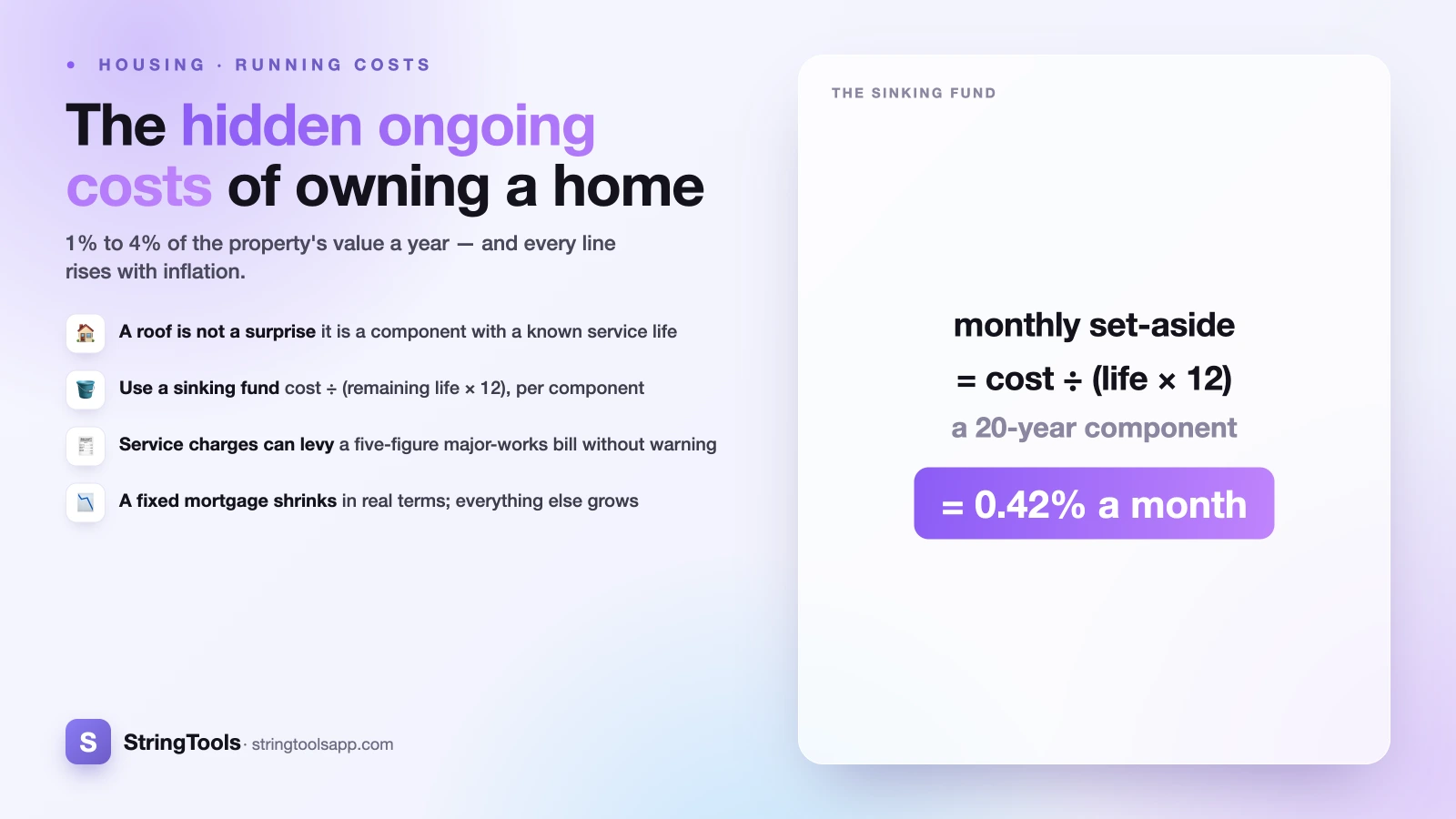
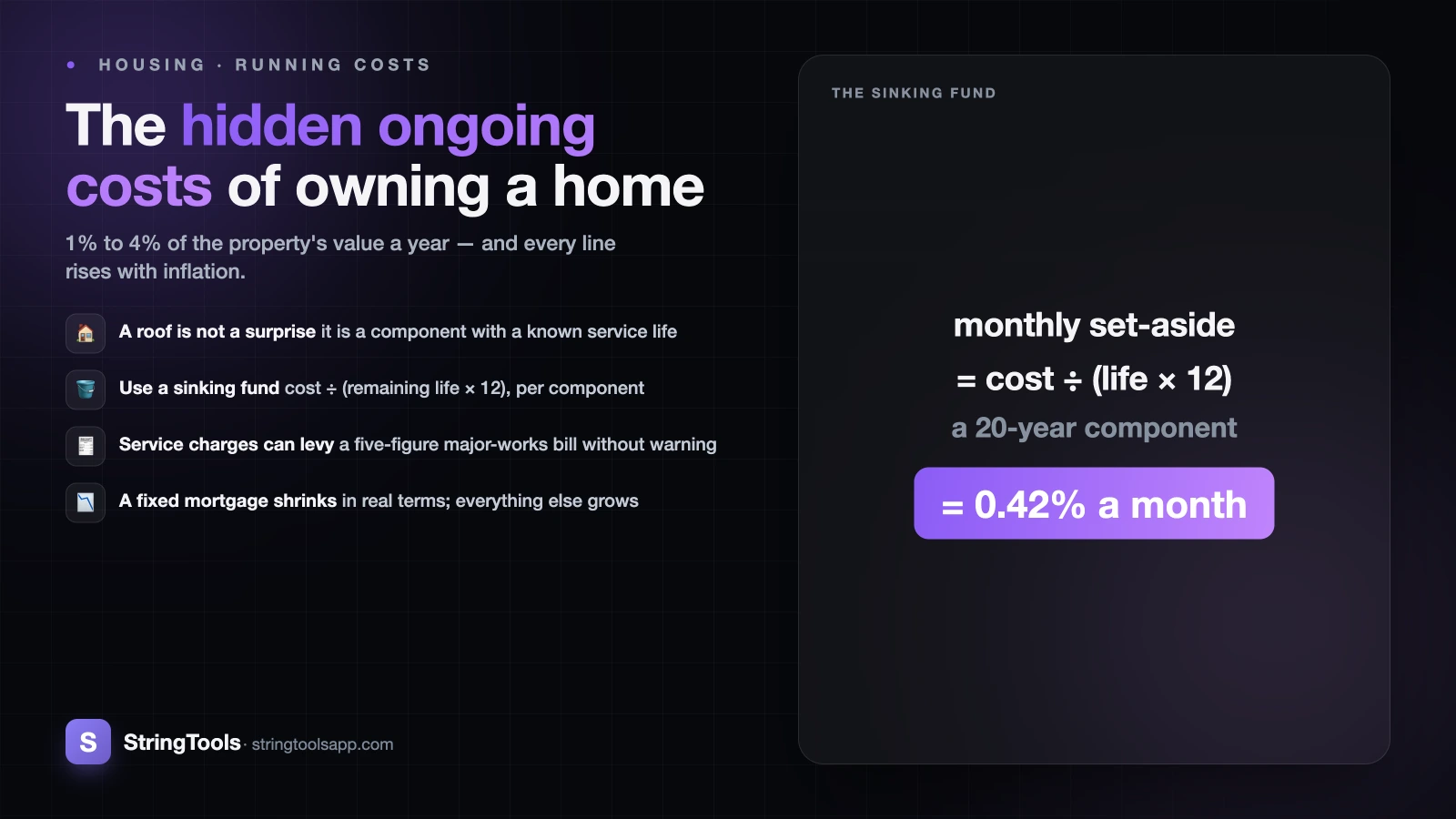
monthly set-aside = replacement cost / (expected remaining life in years x 12)
A component you expect to replace in twenty years needs 1/240th of its replacement cost each month, about 0.42%. One with a ten-year life needs 1/120th, about 0.83%. The shorter the life, the heavier the monthly weight, which is why cheap short-lived items can cost more per month than expensive long-lived ones.
The table gives typical service-life ranges and what each implies as a monthly contribution, as a percentage of that component's own replacement cost. Percentages keep it useful whatever your currency or local labour rates.
| Component | Typical service life | Monthly set-aside (% of its replacement cost) | What drives the range |
|---|---|---|---|
| Asphalt or composition shingle roof | 15-30 years | 0.28% - 0.56% | Sun exposure, ventilation, storm and hail frequency |
| Slate, clay tile or metal roof | 40-80 years | 0.10% - 0.21% | Material grade, fixings, freeze-thaw cycles |
| Gas boiler or furnace | 15-25 years | 0.33% - 0.56% | Annual servicing, water hardness, run hours |
| Heat pump or AC condenser | 12-20 years | 0.42% - 0.69% | Climate load, coastal corrosion, servicing |
| Water heater or hot water cylinder | 8-15 years | 0.56% - 1.04% | Water hardness, anode replacement, tank vs tankless |
| Double-glazed window units (whole house) | 20-35 years | 0.24% - 0.42% | Frame material, seal quality, sun and damp exposure |
| Exterior paint or render finish | 5-12 years | 0.69% - 1.67% | Rainfall, UV, quality of surface preparation |
| Kitchen (full refit) | 15-25 years | 0.33% - 0.56% | Carcass quality, worktop material, household size |
| Bathroom (full refit) | 15-25 years | 0.33% - 0.56% | Ventilation, waterproofing quality, use |
| Carpet and soft flooring | 8-12 years | 0.69% - 1.04% | Traffic, pets, fibre grade |
| Gutters and rainwater goods | 20-30 years | 0.28% - 0.42% | Material, leaf load, cleaning frequency |
| Consumer unit or electrical panel | 25-40 years | 0.21% - 0.33% | Original capacity, regulation changes |
Read it as a planning aid, not a prophecy. A boiler serviced every year in a soft-water area reaches the long end of its service life, so the monthly set-aside sits at the bottom of its percentage range; the same model, never serviced, in a hard-water area does the opposite.
Turning the table into one monthly number
Work through the components you actually have. For each, estimate the local replacement cost and how many years of life are left rather than the full life, then divide by the months remaining. Add them up, and round up, because you will have forgotten something.
Most people who do this honestly land above 1% of property value per year. That is not a reason to abandon the exercise; it is the exercise working.
Maintenance versus improvement, and why the difference matters
These two words get used interchangeably in conversation and mean quite different things in a budget.
Maintenance returns a property to the condition it was already in: replacing a failed boiler with an equivalent one, repainting, re-roofing with the same material, fixing a leak. It preserves value rather than adding it, and it is unavoidable.
Improvement makes the property materially better or different: adding a bathroom, converting a loft, extending the kitchen, fitting double glazing for the first time. It is discretionary, and it may add value, though rarely all of what it cost.
Three reasons the line matters:
- Budgeting. Maintenance belongs in the sinking fund as a fixed monthly obligation; improvement belongs in a separate, genuinely optional pot. Blending them is how maintenance money quietly gets spent on a nicer kitchen, leaving nothing for the roof.
- Expectations of return. Maintenance does not raise the sale price, it stops the sale price falling. Treating a new boiler as an investment sets you up for disappointment.
- Tax treatment. In several countries improvements can be added to the property's cost basis and reduce a future capital gain, while routine repairs on a main home generally cannot. The rules are country-specific and they change, so check with your own tax authority: the IRS covers what counts as an improvement for basis purposes in the US, and GOV.UK the equivalent capital gains position.
Keep receipts and dated photographs, filed by year. It costs nothing now and is invaluable for warranty claims and for whatever the rules turn out to be when you sell.
Insurance, property taxes and service charges
These arrive whether or not anything breaks, and they are the easiest to underestimate at purchase, because the buyer only ever sees one year's figure.
Buildings and contents insurance
Buildings insurance covers the structure, and lenders normally require it while there is a mortgage. Two things push the premium up: rebuild costs track construction inflation rather than general inflation, and insurers reprice as they reassess risk. Properties exposed to flood, wildfire, storm or subsidence have seen the sharpest movements, and in some places cover is now hard to obtain at any price. Check the rebuild sum insured every few years; underinsuring it is a common and expensive mistake.
Property taxes
Property tax, council tax, rates or their local equivalent are set by local government and rise with local budgets, revaluations and rate changes. You cannot negotiate them, and they do not stop when the mortgage does. In the UK, GOV.UK explains how council tax bands work; in the US, rates and assessment practices differ by state and county, so the only reliable figure is the local assessor's for that property. Check the current bill rather than a national average, and ask whether your purchase triggers a reassessment.
Service charges, ground rent and HOA fees
If you buy a flat or a house in a managed development, you pay a recurring charge towards communal costs. These can rise faster than general inflation, because they track building insurance and contractor labour directly. They can also be supplemented by a special assessment or major works levy: a one-off demand for your share of a big communal project such as a roof, a lift or a facade, sometimes five figures with limited notice. Ask for several years of accounts, the reserve fund balance and recent meeting minutes. A healthy reserve is one of the strongest signals that a building is well run.
Utilities and everything else
Utilities usually rise when you move from a flat to a house, and the step up is often larger than expected because heated volume, not floor area, drives the bill. Add whatever else your property demands on top: garden upkeep, chimney sweeping, septic emptying, alarm monitoring.
The inflation asymmetry nobody mentions at the viewing
This is the most misunderstood part of long-run homeownership, and it cuts both ways.
A fixed-rate mortgage payment does not rise, which means in real terms it falls every year, because incomes and prices generally rise around it. Twenty years in, the same payment is a much smaller share of a typical income than it was at the start. This is the genuine and underrated advantage of buying with fixed-rate debt.
Everything else moves the other way. Insurance premiums, property taxes, service charges, tradespeople's rates and materials all rise, and construction costs have their own inflation path that can run ahead of general consumer inflation. The US Bureau of Labor Statistics publishes the Consumer Price Index, including shelter and household maintenance components, if you want to see how these categories have behaved historically.
So the shape of homeownership over decades is a shrinking real mortgage payment and a growing real everything-else. Early on it feels like a housing cost; late on, the mortgage is small and it feels like a maintenance and tax cost. Owners who have cleared the mortgage still face a bill that rises every year and never goes away. Two consequences are worth planning for:
- Retirement. "Mortgage-free" is not "housing-cost-free". If you are modelling retirement spending, include taxes, insurance, service charges and a maintenance allowance that grows with inflation. That feeds directly into the numbers in how much do I need to retire.
- Comparisons with renting. Rent already includes the landlord's maintenance, buildings insurance and often the property tax, so comparing it against a mortgage payment alone flatters buying. Rent vs buy: which is actually cheaper works through that properly, and the rent vs buy calculator lets you enter your own recurring-cost assumptions rather than accepting a default.
None of this is a forecast. Costs and rates change, past performance does not predict future results, and the sensible response is a budget with room in it rather than a precisely guessed number.
Building a sinking fund that survives contact with real life
The method fails for predictable, human reasons. Here is how to make it stick.
- Automate it, separately, and name it. A standing order into a savings account called "House repairs" on payday. Money left in a current account gets spent; that is not a character flaw, it is how current accounts work, and a labelled pot is noticeably harder to raid for a holiday.
- Start with a floor and build up. If the full component-by-component figure is unaffordable today, start at 1% of the property's value per year and raise it whenever your income rises. Something consistent beats a perfect plan abandoned in month three.
- Keep it separate from the emergency fund. The emergency fund covers income shocks, such as losing a job. The sinking fund covers asset shocks, such as losing a boiler. Merging them means one bad month wipes out both.
- Raise it yearly, and refill it after every withdrawal. A figure set five years ago is already short. Replacing the water heater resets that component's clock, so restart its contribution on the new expected life rather than treating the job as done.
- Do the cheap preventive work. Annual boiler servicing, gutter clearing, roof inspections after storms, sealing and repointing. These small, dull expenses push components towards the top of their service-life range instead of the bottom, and they are the highest-return maintenance spending available.
Once a year, walk the property, note the age of each major component and adjust. Where the money sits matters less than that it exists at all: it must be reachable at short notice, because boilers do not fail conveniently. Any return it earns is a bonus, and no return is guaranteed.
How to pressure-test a property before you commit
Ongoing costs are far easier to influence before you buy than after, and the survey is where most of the information lives. Use it as a budgeting document rather than a pass/fail test: for every component the surveyor flags, ask how many years of life are left and what replacement costs locally. That turns a vague list of concerns into a number you can put into an offer or a monthly plan.
The rest of the due-diligence list:
- Ages, in writing. The age of the roof, heating system, water heater, windows and electrical panel, plus service records.
- The actual bills. Twelve months of utilities, the current property tax bill and insurance premium, and the service charge with several years of accounts.
- A real insurance quote before you exchange. In some locations it is the deciding factor, and finding that out afterwards is expensive. Ask about flood, wildfire, subsidence and coastal corrosion while you are there.
- A worked monthly total. Mortgage plus taxes plus insurance plus service charges plus utilities plus your sinking-fund figure. That number, not the mortgage payment, is what you are committing to.
If that total is uncomfortable, the useful conclusion is not that buying is wrong. It is that this property, at this price, is a stretch, and a cheaper, newer or smaller one may not be. The rent vs buy calculator takes those recurring figures as inputs, so the comparison reflects your property rather than an average one.
The Consumer Financial Protection Bureau publishes free, non-commercial guidance on mortgages and the costs of owning. This article is general information and not financial, tax or legal advice; for a decision this size, a regulated adviser who knows your circumstances is the right person to ask.
Frequently Asked Questions
How much should I budget for home maintenance each year?
The common rules of thumb are 1% of the property's value per year, or roughly one unit of currency per square foot per year. Treat 1% as a floor rather than an average. Older properties, harsher climates, larger footprints and inherited deferred work all push the real figure higher, and 2-4% is not unusual for an older house. The more accurate method is to build it component by component: for each major item, divide its local replacement cost by the number of months of life you think it has left, then add the results together.
What is a sinking fund for a house?
A sinking fund is money set aside steadily for a known future expense, rather than borrowed for in a hurry when the expense arrives. For a home the calculation is replacement cost / (expected remaining life in years x 12) per component, per month. A roof with fifteen years left needs about 1/180th, or 0.56%, of its replacement cost each month. Keep it in a separate, clearly named, easily accessible savings account, and keep it apart from your emergency fund so one bad month does not empty both.
What is the difference between maintenance and an improvement?
Maintenance restores a property to the condition it was already in: replacing a failed boiler with an equivalent one, repainting, fixing a leak. Improvement makes it materially better or different: adding a bathroom, converting a loft, extending. Maintenance is unavoidable and preserves value rather than adding it. Improvement is discretionary and may add value, though rarely all of what it cost. The distinction also matters for tax in several countries, where improvements can affect the property's cost basis while routine repairs on a main home generally cannot. The rules are country-specific, so check with your own tax authority.
Do ongoing costs stop when the mortgage is paid off?
No. Property taxes, buildings insurance, service charges, utilities and maintenance all continue for as long as you own the property, and all of them tend to rise with inflation. Only the mortgage payment ends. This is why "mortgage-free" and "housing-cost-free" are different things, and why retirement planning should include a housing budget that grows over time rather than assuming it drops to zero once the loan is cleared.
Why do homeowners say costs feel worse after ten or fifteen years?
Two things happen at once. A fixed mortgage payment stays flat in nominal terms, so it shrinks in real terms as incomes and prices rise around it, which makes the early years feel comparatively easy. Meanwhile insurance, taxes, service charges and tradespeople's rates all rise. On top of that, components installed around the time of purchase reach the end of their service life together in roughly years ten to twenty, so several large replacements cluster. The costs did not appear suddenly; the fund for them simply was not there.
How do ongoing costs change a rent versus buy comparison?
Substantially, because they are the costs a tenant does not pay. Rent typically includes the landlord's maintenance, buildings insurance and often the property tax, so comparing rent against a mortgage payment alone flatters buying. A fair comparison puts mortgage interest, property tax, insurance, service charges and a maintenance allowance on the ownership side, and the renter's opportunity cost on the other. Running that with your own figures gives a far more honest answer than any national rule of thumb.
Sources and references
IRS (irs.gov) · GOV.UK (gov.uk) · GOV.UK explains how council tax bands work (gov.uk) · publishes the Consumer Price Index (bls.gov) · Consumer Financial Protection Bureau (consumerfinance.gov). Content was reviewed against these sources as of the last-updated date above; external figures and rules may change after publication.