

What buying a home really costs
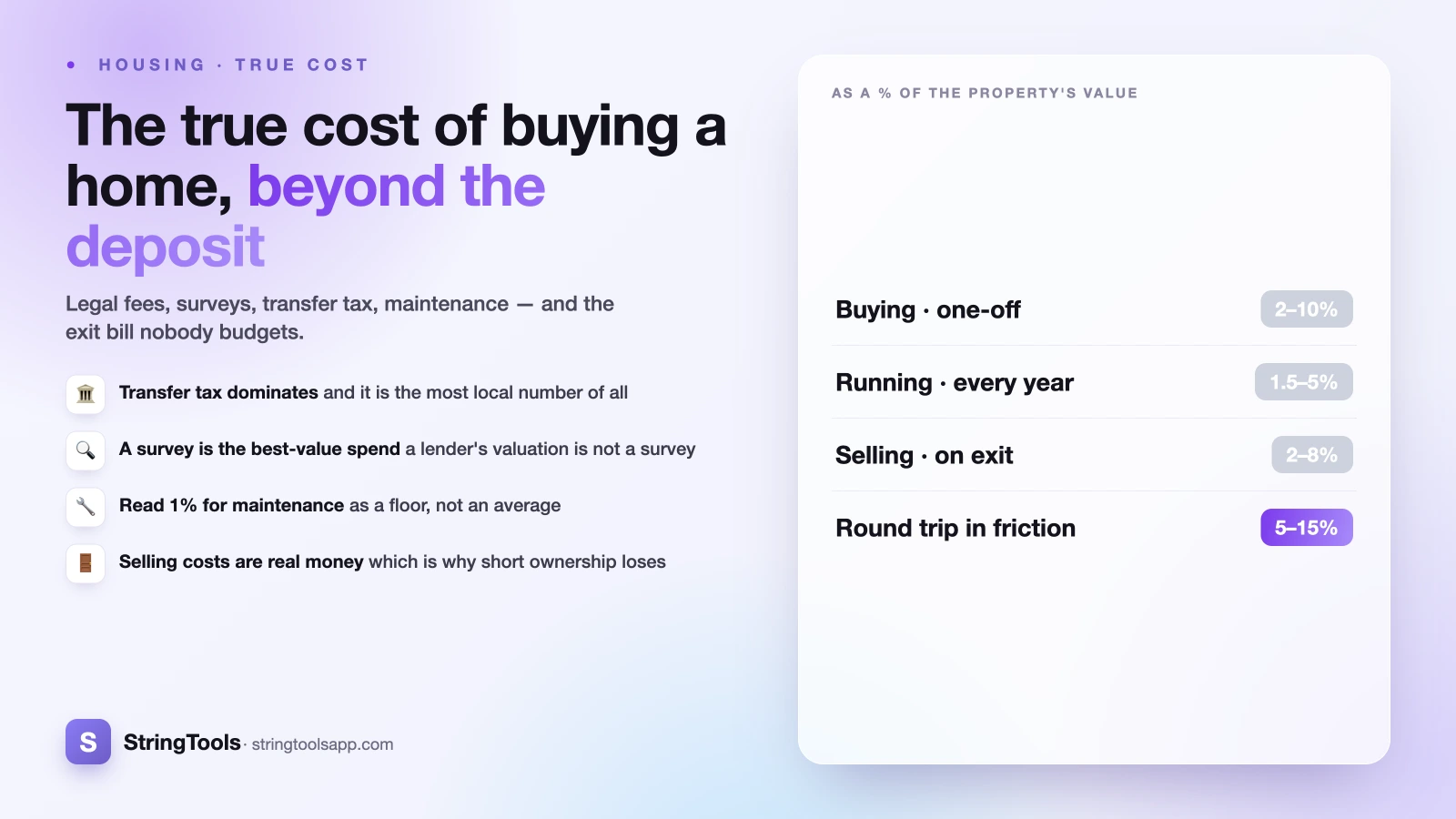
Beyond the deposit, buying a home costs roughly 2% to 10% of the purchase price in one-off fees: legal work, surveys, transfer taxes, lender charges and moving. It then costs somewhere around 1.5% to 5% of the property's value every year to run, and another 2% to 8% to sell when you leave.
Key Takeaways
- The deposit is the number everyone saves for, and it is usually the only one they plan for properly.
- One-off buying costs are dominated by transfer tax, which varies enormously by country, state or province, and by whether you are a first-time buyer.
- Running costs are the ones that quietly reshape a household budget: maintenance, insurance, property tax and any service charge or HOA fee.
- The popular "budget 1% of the property's value a year for maintenance" rule is a starting point, not a forecast, and it under-reads for older homes.
- Selling costs are real money too, and leaving them out of the sums is what makes short ownership periods lose money.
- Add the round trip together and buying, holding for a few years, then selling can cost 5% to 15% of the property's value in pure friction.
The one-off costs of getting the keys
These land in the weeks either side of completion, mostly in cash, and mostly at the exact moment your savings are lowest. In the United States they are bundled together as closing costs; elsewhere they arrive as separate bills from separate people. Either way they cannot normally be added to the mortgage, which is what catches buyers out.
Legal and conveyancing work
Someone has to check the title, run the local searches, handle the money and register the transfer. Depending on the country this is a solicitor, a conveyancer, a notary or a title company. Expect a fixed fee plus a stack of disbursements — search fees, registration fees, bank transfer charges — that can add up to as much as the fee itself. Always ask for a quote that lists them separately, because the headline number rarely includes them.
Surveys and inspections
A lender's valuation is not a survey. It confirms the property is worth roughly what the lender is lending against; it tells you nothing about the roof. A proper building survey or home inspection is optional, feels expensive, and is the single best-value spend in the whole process. On an older property it routinely finds five figures of work, which is either a renegotiation or a reason to walk.
Specialist follow-ups get added on top: damp, timber, drains, electrics, and in some regions pest, radon or septic checks.
Mortgage and lender fees
Arrangement or origination fees, booking fees, valuation fees, and in some markets mortgage insurance where the deposit is small. Some lenders let you add the arrangement fee to the loan, which is convenient and expensive: you then pay interest on it for the full term.
Moving and the first month
Removals, storage, cleaning, a locksmith, connecting utilities, and the unglamorous first-week spend on curtains, a fridge and whatever the previous owner took with them. It is small next to the price of the house and large next to what is left in your account.
Transfer taxes: the biggest and most local number
In most one-off cost breakdowns, the tax on the transaction is the largest line by a wide margin — and it is the one you cannot generalise about at all.
It goes by different names and sits with different authorities:
- United Kingdom: Stamp Duty Land Tax in England and Northern Ireland, Land and Buildings Transaction Tax in Scotland, Land Transaction Tax in Wales. Rates, thresholds and first-time-buyer relief are set separately and change with budgets. GOV.UK publishes the current bands and a calculator.
- United States: there is no national transfer tax. Instead you get state and sometimes county or city transfer or recording taxes, plus title insurance and escrow charges, all bundled into what is called closing costs. The Consumer Financial Protection Bureau explains the Loan Estimate and Closing Disclosure that must set these out for you in writing.
- Canada: provincial land transfer tax, with a second municipal layer in some cities, and rebates for first-time buyers in several provinces.
- Australia: stamp duty set by each state and territory revenue office, with concessions that differ state by state.
The practical rule: before you offer, find your own jurisdiction's official calculator and run the exact purchase price through it. A surcharge for second homes, non-residents or company purchases can move this number by several percent on its own. Never rely on a figure quoted for another country, or on last year's thresholds.
One-off, recurring and exit costs at a glance
Everything below is expressed as a percentage of the property's value rather than a currency amount, so it travels between countries and does not go stale. Treat the ranges as typical rather than universal, and replace each line with a real quote as you get one. Two things to be straight about: these bands are our own consolidated planning ranges, assembled from the fee structures buyers commonly meet rather than lifted from any single published source; and each subtotal is a typical total, not the sum of every row's worst case, because the extremes almost never arrive together. A first-time buyer in a nil-rate transfer-tax band can come in under 1% on the one-off column, while an older flat carrying a large service charge and a high local property tax can run past 5% on the recurring one.
| Cost | When | Typical scale (% of property value) |
|---|---|---|
| Transfer tax / stamp duty / recording tax | One-off | 0% – 8%+ (0% for many first-time buyers; higher for second homes) |
| Legal, conveyancing or title and escrow | One-off | 0.2% – 1% |
| Survey or home inspection (plus specialists) | One-off | 0.05% – 0.5% |
| Lender arrangement, origination and valuation fees | One-off | 0% – 1.5% |
| Moving, connections and immediate setup | One-off | 0.1% – 0.5% |
| One-off subtotal | At purchase | ~2% – 10% |
| Maintenance and repairs | Yearly | 1% – 4% (see the caveats below) |
| Property tax, council tax or municipal rates | Yearly | 0.2% – 2.5% |
| Buildings and contents insurance | Yearly | 0.1% – 0.5% |
| Service charge, HOA dues or ground rent | Yearly | 0% – 1.5% (flats and managed estates only) |
| Recurring subtotal | Every year | ~1.5% – 5% |
| Estate agent or realtor commission | On sale | 1% – 6% |
| Legal work on the sale | On sale | 0.1% – 0.5% |
| Pre-sale repairs, staging and photography | On sale | 0.3% – 2% |
| Early repayment charge on the mortgage | On sale | 0% – 5% of the outstanding loan, not the value |
| Exit subtotal | When you leave | ~2% – 8% |
None of those lines include the mortgage payment itself, which is a separate exercise — put your own numbers through the mortgage calculator for that part.
The 1% maintenance rule, and where it breaks
The most widely repeated rule of thumb in homeownership is to set aside 1% of the property's value each year for maintenance and repairs. On a home worth 400,000 in your currency, that is 4,000 a year, or a little over 330 a month into a separate pot.
It is a reasonable default for one reason: it forces you to treat maintenance as a standing cost rather than an emergency. Roofs, boilers, water heaters, windows and exterior paint all have finite lives. You are not avoiding those costs, only choosing whether you meet them from a fund or from a card.
Where the rule under-reads
- Old houses. An older property has more components at or past end of life, so its maintenance bill tends to run above 1%. We have not found a reliable published figure for how much above, and it would vary by construction and climate anyway; owners of period homes commonly budget 2% to 4% and still get surprised.
- High land values. In an expensive city, a large share of the price is the land. The building might be modest, so 1% of the total value overstates the job; in a cheap area with an expensive-to-heat house, 1% understates it badly.
- Deferred maintenance. If the seller skipped ten years of upkeep, you have inherited the bill. This is exactly what a survey is for.
- Lumpy timing. Maintenance does not arrive smoothly. Three quiet years, then a roof.
A better version of the rule
Use the square-footage or square-metre sanity check alongside it, and take whichever is higher. Then adjust for age: newer build, stay near 1%; anything pre-war, plan closer to 2% to 3%. Put the money somewhere separate and boring so it is still there when the boiler goes. If you want the full breakdown of what falls into this bucket, the hidden costs of homeownership covers it line by line.
The other running costs
Maintenance gets the attention, but three other recurring lines decide whether the monthly numbers work.
Property tax, council tax or municipal rates. Set locally and reassessed periodically, so it can rise independently of anything you do. In some jurisdictions it is a percentage of assessed value; in others a band. Check the actual bill for the specific address before you offer — neighbouring streets can differ.
Insurance. Buildings insurance is usually a mortgage condition. Flood, storm, subsidence and wildfire exposure now move premiums sharply in some regions, and in a few places cover has become hard to obtain at all. Get a real quote for the specific property, not a generic one, especially near water.
Service charges, HOA dues and ground rent. For flats and managed estates this is the line that most often breaks a budget. It covers building insurance, communal repairs, lifts and grounds, and it can be raised. Worse, a major works bill — a new roof, new lift, new cladding — can arrive as a separate demand running to tens of thousands. Before buying a leasehold or HOA property, read the last three years of accounts and the reserve fund balance, and ask directly whether major works are planned.
Utilities. Moving from a flat to a house often doubles heating costs. If the property has an energy rating or efficiency certificate, read it. If not, ask for twelve months of actual bills.
The costs at the other end: selling
Almost nobody counts these when deciding whether to buy, because they sit years in the future and feel like someone else's problem. They are the reason a short ownership period so often loses money even when prices rise.
When you sell, you typically pay:
- Agent commission, which in some markets is a low single-digit percentage and in others — notably the United States, where the seller has traditionally covered both sides — has been substantially higher. Commission is negotiable and market practice is changing, so ask rather than assume.
- Legal work on the sale, plus any deed or discharge fees to release the mortgage.
- Getting it ready: repairs the inspection throws up, decorating, staging, photography.
- An early repayment charge if you leave a fixed-rate deal before it ends. Note this is a percentage of the outstanding loan, not of the property's value, so on a large remaining balance it is significant.
- Capital gains tax in some circumstances. Many countries exempt a main residence in whole or part, but second homes, rentals and short holding periods are often treated differently. Ask your tax authority or an accountant.
The break-even horizon
Put the three subtotals together. If buying costs roughly 2% to 10% and selling costs roughly 2% to 8%, then the round trip is somewhere around 5% to 15% of the property's value in friction alone, with many markets landing near 8% to 10%. That has to be recovered from price growth, from the rent you are not paying, or from the equity you build, before ownership is ahead of renting. House prices are not guaranteed to rise, and past price growth does not predict future growth.
This is why the standard advice is to buy only if you expect to stay put for several years. Rent vs buy: which is actually cheaper works through that comparison in detail, and you can run your own figures — including the exit costs — through the rent vs buy calculator.
Building your own number before you offer
Do this once, on paper, before you are attached to a specific house.
1. Start with the price you would realistically offer, not the asking price. 2. Run the official transfer-tax calculator for your jurisdiction at that price, including any surcharge you would pay. 3. Get three quotes for legal work and one for a full survey. Ask for disbursements in writing. 4. Add the lender's fees from the mortgage illustration you have been given. 5. Add moving and setup honestly. It is always more than the estimate. 6. Total that column. That is the cash you need on top of the deposit, and it should be sitting in an account, not on credit. 7. Then build the yearly column: maintenance at 1% or more depending on age, the actual property tax bill for the address, a real insurance quote, and the actual service charge. 8. Sanity-check affordability against the yearly column, not just the mortgage payment. How much house can I afford covers the income side of that test.
One last habit worth keeping: whatever you calculate, keep a separate reserve on top of the maintenance fund. The first year of ownership reliably produces costs that were nobody's fault and nobody's plan.
This is general information, not financial or tax advice. Rules, rates and reliefs differ by country and region and change over time. For a decision this size, a regulated mortgage adviser, a solicitor or conveyancer, and an accountant are the right people to ask — and the relevant tax authority is the only reliable source for what you will actually owe.
Frequently Asked Questions
How much should I budget for closing costs on top of the deposit?
A reasonable planning figure is 2% to 10% of the purchase price, and the spread is almost entirely down to transfer tax. If you are a first-time buyer in a jurisdiction with generous relief, you may land near the bottom of that range. If you are buying a second home, buying as a non-resident, or buying above a high tax threshold, you can exceed the top of it. Get the number from your own tax authority's calculator rather than from a rule of thumb — see the GOV.UK or CFPB guidance depending on where you are.
Is the 1% rule for home maintenance actually accurate?
It is a useful default rather than an accurate forecast. Setting aside 1% of the property's value a year works well for a relatively new home in an area where the building is a large share of the total price. It tends to under-read for older properties, where 2% to 4% is a safer plan, and for homes the previous owner neglected. It can over-read where land makes up most of the value. The point of the rule is the habit, not the precision: maintenance is a standing cost, so fund it monthly.
Can I add buying costs to my mortgage?
Usually not the fees themselves. Lenders size the loan against the property's value, so legal fees, surveys, transfer tax and moving generally have to come from cash. The common exception is the lender's own arrangement or origination fee, which many lenders will let you add to the balance. That is convenient but expensive, because you then pay interest on it for the whole term. Running both versions through a mortgage calculator shows the difference clearly.
What does it cost to sell a house?
Typically somewhere around 2% to 8% of the property's value, made up of agent commission, legal work on the sale, and pre-sale repairs or staging. On top of that, an early repayment charge may apply if you leave a fixed-rate mortgage before it ends, calculated as a percentage of the outstanding loan rather than the property's value. Capital gains tax may apply in some situations, though many countries relieve a main residence. Commission is negotiable, so ask.
How long do I need to own a home before buying beats renting?
Long enough to recover the round-trip transaction costs, which sit at roughly 5% to 15% of the property's value once buying and selling are combined. Below that, price growth and the rent you avoid have not yet covered the friction. The honest answer depends on your local transfer tax, your commission rate, and what renting the same property would cost, which is why it is worth modelling rather than guessing. Rent vs buy: which is actually cheaper walks through the comparison.
What is the most commonly forgotten cost when buying a home?
For flats and managed estates, the service charge or HOA dues — and specifically the risk of a major works demand for a roof, a lift or external repairs, which arrives separately and can run to tens of thousands. Before committing, read the last three years of accounts, check the reserve fund balance, and ask in writing whether major works are planned. For houses, the most commonly forgotten cost is deferred maintenance the seller never did, which a full survey is designed to find.
Sources and references
closing costs (investopedia.com) · GOV.UK (gov.uk) · Consumer Financial Protection Bureau (consumerfinance.gov). Content was reviewed against these sources as of the last-updated date above; external figures and rules may change after publication.