
The short answer, and the number that changes it
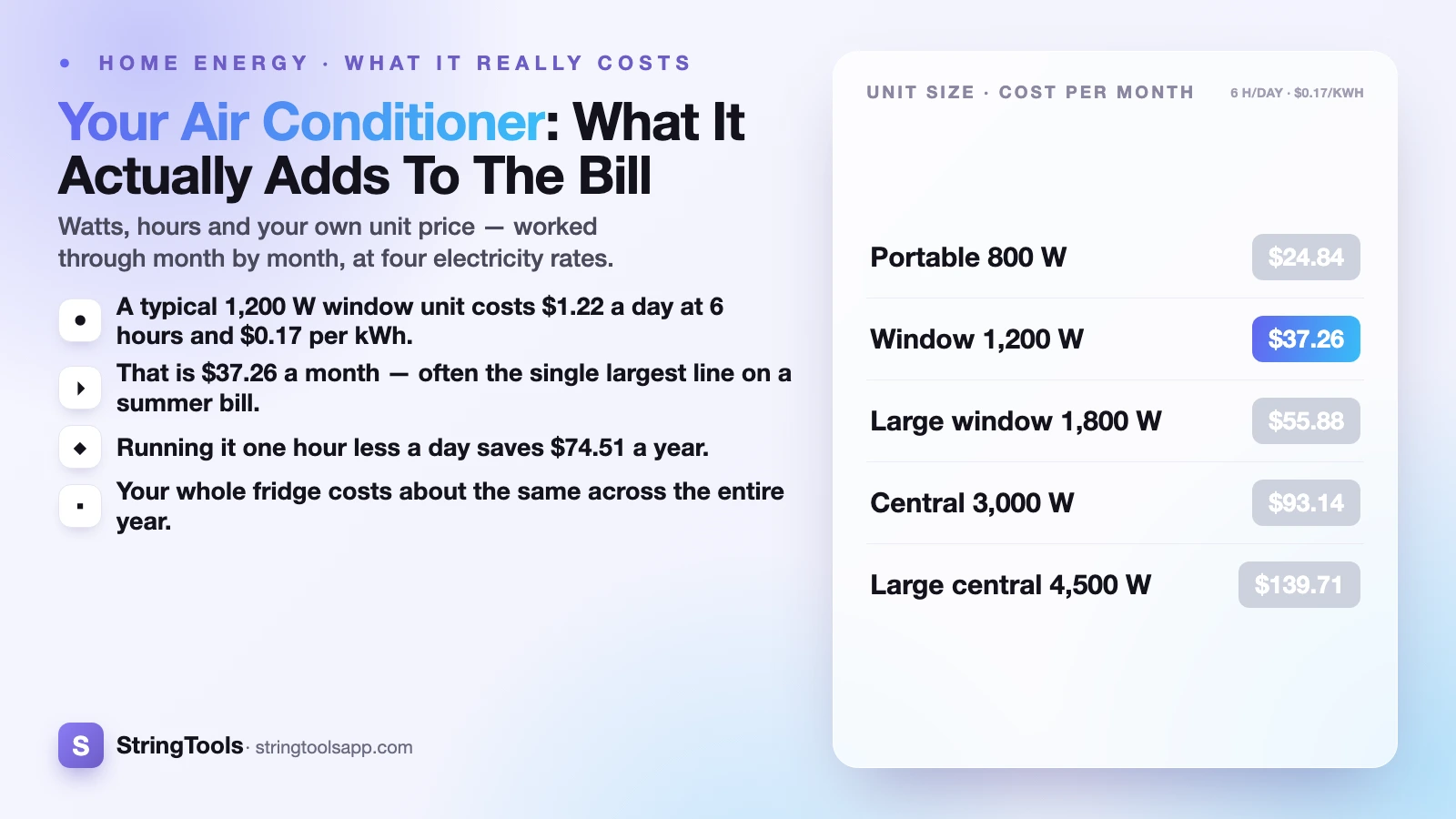
A typical window air conditioner draws about 1,200 watts, so at 17 cents per kilowatt-hour it costs roughly 20 cents an hour, about $1.22 a day if it runs six hours, and around $37 a month. A central system drawing 3,000 watts is closer to $3.06 a day and $93 a month on the same usage.
Those are real numbers, and they are also the least useful part of this article, because the figure that moves them most is not the air conditioner. It is the price you pay per unit of electricity, which varies by a factor of three or more between regions and suppliers. The same 1,200W window unit running the same six hours costs $21.91 a month at 10 cents a unit and $76.70 a month at 35 cents. Nothing about the appliance changed. Only the tariff did.
So the honest answer to "how much does it cost to run an air conditioner" is that it depends on three numbers, and you can find all three in under a minute: the wattage on the unit's rating plate, the hours it actually runs, and the price per kWh on your electricity bill. The electricity cost calculator will do the arithmetic once you have them.
The rest of this article is about the second of those three numbers, because it is the one almost everybody gets wrong, usually by a factor of two.
What it costs by unit size
Here is the full picture at four unit prices, assuming six equivalent hours of running a day. Find the column nearest your own rate rather than reading the middle one and assuming it applies.
| Unit | Power | At $0.10 | At $0.17 | At $0.25 | At $0.35 |
|---|---|---|---|---|---|
| Portable or small window | 800 W | $14.61/mo | $24.84/mo | $36.53/mo | $51.14/mo |
| Window unit, typical | 1,200 W | $21.91/mo | $37.26/mo | $54.79/mo | $76.70/mo |
| Large window or small split | 1,800 W | $32.87/mo | $55.88/mo | $82.18/mo | $115.05/mo |
| Central or large split | 3,000 W | $54.79/mo | $93.14/mo | $136.97/mo | $191.76/mo |
| Large central system | 4,500 W | $82.18/mo | $139.71/mo | $205.45/mo | $287.63/mo |
Two things are worth noticing. The first is the spread across a row: the same appliance costs three and a half times as much in an expensive market as a cheap one, which is why national averages are close to useless for budgeting your own bill.
The second is the spread down a column. A large central system costs roughly five times what a portable unit costs to run. If you are cooling one room and you are using central air to do it, that ratio is the entire argument for a window unit, and it is a much larger saving than anything you can achieve by adjusting how you use the central system.
The mistake almost everyone makes: on-hours are not running-hours
An air conditioner has a thermostat. It does not draw its rated power for every minute it is switched on. It runs the compressor until the room reaches the set temperature, shuts the compressor off, waits for the room to drift back up, and starts again. The fan may keep turning throughout, but the fan is a small fraction of the power.
This means the hours figure you want is equivalent hours at full power, not the hours the unit was switched on. If your air conditioner is on for ten hours but the compressor is actually running about 60 per cent of that time, the number to use is six, not ten.
The difference is not small. For the same 1,200W window unit at 17 cents:
| Equivalent hours a day | Per month | Per year |
|---|---|---|
| 10 hours | $62.09 | $745.11 |
| 8 hours | $49.67 | $596.09 |
| 6 hours | $37.26 | $447.07 |
| 4 hours | $24.84 | $298.04 |
Entering on-hours instead of running-hours will typically overstate your cost by somewhere between 40 and 100 per cent. This is the single biggest source of error in every air conditioning cost estimate, including the ones that tell you your AC is bankrupting you.
How do you find the real figure? The honest answer is that you estimate it, and you can estimate it well by paying attention for an evening. Listen for the compressor cutting in and out, and judge roughly what fraction of the time it is running. A unit that is correctly sized for the room typically runs somewhere between 50 and 80 per cent of the time on a hot day, and much less on a mild one. A unit that runs continuously without ever cycling is undersized for the space, which is its own problem.
If you want to stop estimating, a plug-in energy monitor measures actual consumption over days and costs very little. For a window unit this is easy. For a hardwired central system it is not, and the practical alternative is to compare your summer bill against a shoulder-season month.
A whole cooling season, not a month
Monthly figures understate the decision, because air conditioning is seasonal and the season is what you are actually buying. A 1,200W window unit running six equivalent hours a day across a 120-day cooling season uses 864 kWh:
| Price per kWh | Season cost |
|---|---|
| $0.10 | $86.40 |
| $0.17 | $146.88 |
| $0.25 | $216.00 |
| $0.35 | $302.40 |
Seeing it as one seasonal number rather than a monthly trickle changes how people think about it. Three hundred dollars for a summer of comfort is a purchase you can evaluate against other purchases. Seventy-six dollars a month buried inside a larger bill is not.
It also puts the efficiency upgrades in context. If your season costs $147, a more efficient unit that cuts consumption by a quarter saves about $37 a year, and a $400 replacement takes roughly eleven years to pay for itself on energy alone. If your season costs $302 the same upgrade saves $75 a year and pays back in five. Neither answer is universal, and the only way to know which one is yours is to run your own figures.
What actually reduces the bill
Ranked by how much they are worth, with the arithmetic rather than the folklore.
Running it fewer hours. This is the big one, and it scales with unit size. One hour a day less, over a year, at 17 cents:
| Unit | Power | Saving a year |
|---|---|---|
| Portable or small window | 800 W | $49.67 |
| Window unit, typical | 1,200 W | $74.51 |
| Large window or small split | 1,800 W | $111.77 |
| Central or large split | 3,000 W | $186.28 |
| Large central system | 4,500 W | $279.42 |
For context, $74.51 is almost exactly what a typical refrigerator costs to run for an entire year. One hour a day off a window unit is worth more than unplugging your fridge permanently, which is a thing you cannot do and which would not help if you could.
Raising the thermostat setpoint. This works by reducing running hours rather than by reducing power draw, which is why it shows up in the table above rather than as a separate line. A higher setpoint means the room reaches temperature sooner and the compressor cycles off for longer. The saving is real but it is not a separate lever.
Cooling fewer rooms. Closing off unused space, or using a window unit where you are instead of cooling the whole house, is the largest structural saving available, as the five-to-one ratio in the first table shows.
Cleaning the filter. A clogged filter makes the unit work longer to reach the same temperature. It is genuinely worth doing and it is free, though the size of the saving depends entirely on how dirty the filter was.
What is not worth your time: the fan speed setting, unplugging the unit overnight to avoid standby, and most of the advice aimed at electronics. An air conditioner's standby draw is typically one or two watts, which is well under a dollar a year. The compressor is the whole story.
Window, portable, or central
The three common types differ in cost more than most people expect, and not only because of their power draw.
Window units are the cheapest to run per room cooled, because they put all their cooling into one space and lose nothing to ductwork. At 800 to 1,500 watts they are affordable to run for long stretches.
Portable units look like the flexible choice and are usually the worst value. They draw similar power to a window unit but exhaust through a hose, and single-hose models pull already-cooled air out of the room to do it, which drags warm air in from elsewhere to replace it. You pay window-unit running costs for noticeably less cooling.
Central and split systems cool the whole space and draw 1,500 to 5,000 watts to do it. Per room they are expensive; for cooling an entire home they can be more efficient than running five window units. The question is not which type is cheaper in the abstract but how much space you actually need cooled at once.
One caution on comparing units by their rating plates: a more efficient unit delivers more cooling per watt, so two units at the same wattage are not necessarily doing the same job. Wattage tells you what it costs to run, not what you get for it. For a like-for-like comparison you need the efficiency rating as well, which is where the official guidance from the US Department of Energy and the ENERGY STAR programme is worth reading before you buy.
Working out your own number
Three steps, and none of them needs a technician.
Find the wattage. It is on the rating plate on the back or side of the unit, usually near the serial number. If it only gives amps and volts, multiply them: 9 amps at 115 volts is about 1,035 watts. If the unit is rated in BTU rather than watts, that is a cooling output rather than an electrical input, so you cannot convert it directly without knowing the efficiency rating.
Estimate running hours honestly. Not the hours it is switched on. The hours the compressor actually runs, which on a correctly sized unit is usually 50 to 80 per cent of the on-hours on a hot day.
Get your price per kWh from the bill, not from an average. This is the number people most often substitute with something they half-remember, and it is the one with the widest spread. Your bill states it. If your tariff has separate day and night rates, use the one that covers when you actually run the air conditioner, which for most households is the expensive daytime rate.
Then put all three into the electricity cost calculator, which will also show you where the air conditioner sits against everything else you run. That ranking is usually more useful than the air conditioner figure on its own, because in most homes with air conditioning it turns out to be the dominant load by a wide margin, and knowing that tells you where any effort is worth spending.
Frequently Asked Questions
How much does it cost to run an air conditioner for 8 hours?
For a typical 1,200W window unit at 17 cents per kWh, eight equivalent hours of running costs about $1.63 a day, or roughly $50 a month. A 3,000W central system on the same usage is about $4.08 a day. The important qualifier is equivalent hours: an air conditioner cycles with its thermostat rather than running continuously, so eight hours switched on usually means five or six hours of actual compressor running, and costs proportionally less.
Is it cheaper to leave the AC on all day or turn it off when out?
Turning it off is cheaper in almost every case. The idea that cooling a warm room back down costs more than maintaining it is a persistent myth. Heat flows into your home faster the hotter the outside air is relative to the inside, so a warmer house during the day actually gains heat more slowly, and the energy to cool it back down is less than the energy you would have spent holding the temperature all day. The genuine exception is humidity control in very humid climates, where letting the house warm up can let moisture build to a level that is slow and uncomfortable to remove.
Does raising the thermostat by one degree really save money?
Yes, and the mechanism is worth understanding because it explains how much. A higher setpoint does not reduce the power the compressor draws; it reduces how long the compressor needs to run before the room reaches temperature, and lengthens the gap before it starts again. So the saving appears as fewer running hours. On a 1,200W window unit, cutting one equivalent hour a day saves about $74.51 a year. Whether a one-degree change buys you a full hour depends on your insulation, the outside temperature and how long you run it.
Why is my AC costing more than these figures?
The three usual reasons are an underestimate of running hours, a higher unit price than assumed, and a larger unit than assumed. Beyond that, an air conditioner that never cycles off is undersized or struggling, and will cost far more than a correctly sized one because it is effectively running at full power continuously. A clogged filter, blocked condenser or low refrigerant all have the same effect. If your figures are well above the table on this page and your inputs are right, the unit itself is worth looking at.
How many kWh does an air conditioner use per hour?
Divide the wattage by 1,000. A 1,200W window unit uses 1.2 kWh for each hour the compressor runs, a 3,000W central system uses 3 kWh. Across a 120-day cooling season at six equivalent hours a day, that 1,200W unit uses 864 kWh. Comparing that figure against your total annual consumption, which is on your bill, is the quickest way to see what share of your electricity goes on cooling.
Does a portable air conditioner cost less to run than a window unit?
Usually not, and it is often worse value despite similar power draw. A portable unit exhausts hot air through a hose, and single-hose designs do this by pulling air out of the room they are cooling, which draws warm outside air in through gaps to replace it. You end up paying similar running costs for noticeably less effective cooling. Portables earn their place where a window unit cannot be fitted or is not permitted, not on running cost.
Sources and references
US Department of Energy (energy.gov) · ENERGY STAR programme (energystar.gov). Content was reviewed against these sources as of the last-updated date above; external figures and rules may change after publication.