
The pattern, and the four reasons behind it
When a budget falls apart it is usually by the third month, and the reasons are structural rather than personal: the plan was built on a calm month, the annual costs were never written into it, there was no buffer line for small surprises, and the first overspend was read as proof of failure.
Key Takeaways
- Month one succeeds because it was planned. Month three fails because it contains the costs month one did not have.
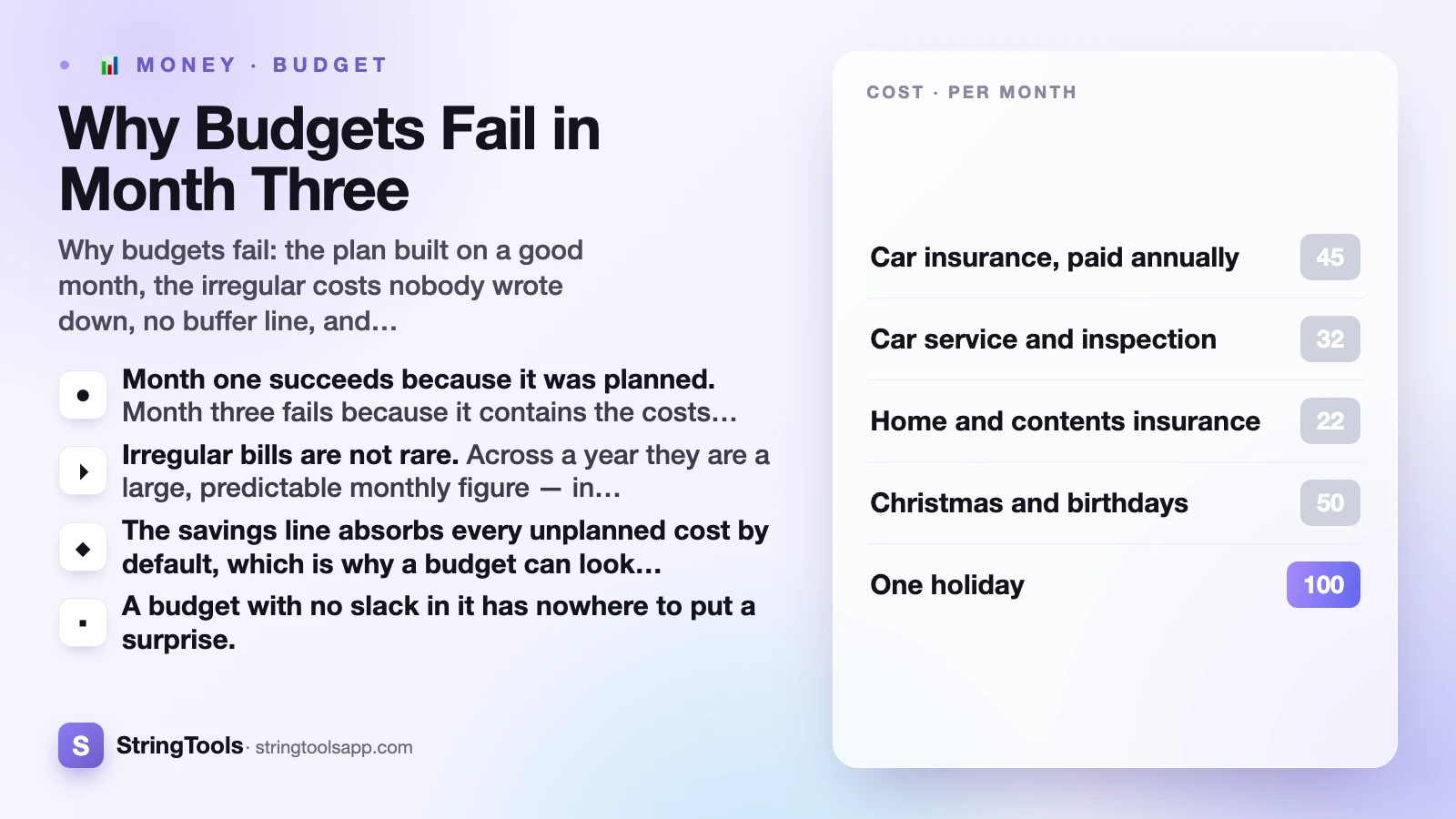
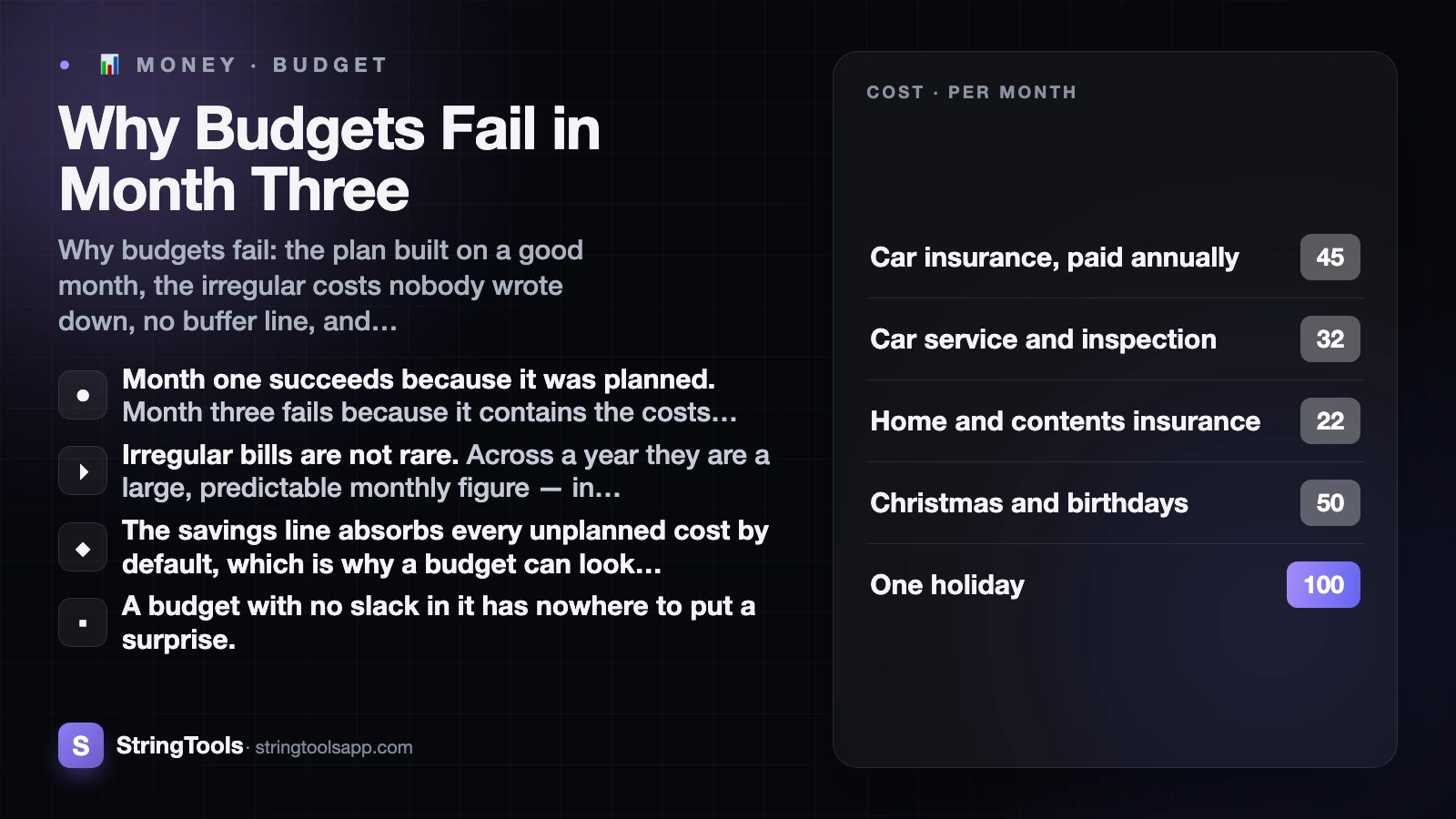
- Irregular bills are not rare. Across a year they are a large, predictable monthly figure — in the example below, 349 a month — and leaving them out guarantees an overspend.
- The savings line absorbs every unplanned cost by default, which is why a budget can look almost on target while saving nothing.
- A budget with no slack in it has nowhere to put a surprise. One named buffer line prevents most abandonments.
- All-or-nothing thinking does more damage than any overspend. A budget missed by 90 is a budget working; a budget abandoned is not.
- The fix is nearly always structural, and nearly always concerns a small number of large fixed costs.
This is general information rather than personal financial advice.
Reason one: the plan was built on a calm month
Most budgets are written on a Sunday afternoon, from last month's statement, in a month that happened to contain nothing unusual. No car repair, no dentist, no wedding, no boiler. That month is used as the template, and the template is quietly optimistic from the start.
The result is a plan whose needs figure sits below the real running cost of the household, which is not obvious in month one and is impossible to ignore by month three.
Two habits fix it before anything else.
- Build from three months, not one. Take the average of three consecutive months, including the awkward one. If you only have one, add a deliberate margin to the variable lines rather than trusting them.
- Use the highest grocery and fuel figures you can find, not the lowest. These are the two lines people are most consistently optimistic about, and being wrong on them by 60 a month is enough to sink a plan on its own.
The same applies to income. A month with overtime or a bonus in it is not your baseline. Plan on the pay you can count on and treat everything above it as surplus to assign deliberately, which is the approach set out in budgeting on an irregular income.
Reason two: the irregular costs were never in the plan
This is the largest of the four and the easiest to fix. Annual and occasional bills feel exceptional because each one is, but collectively they arrive constantly.
Here is a fairly ordinary household's irregular costs for a year, with each one divided by twelve.
| Cost | Per year | Per month |
|---|---|---|
| Car insurance, paid annually | 540 | 45 |
| Car service and inspection | 384 | 32 |
| Home and contents insurance | 264 | 22 |
| Christmas and birthdays | 600 | 50 |
| One holiday | 1,200 | 100 |
| Dentist and optician | 180 | 15 |
| Vehicle tax | 180 | 15 |
| Annually billed subscriptions | 120 | 10 |
| Phone or laptop replacement fund | 480 | 40 |
| School uniform and trips | 240 | 20 |
| Total | 4,188 | 349 |
On a take-home income of 4,000 a month, that is 8.72% of everything you earn, and in most budgets not one line of it appears. The plan therefore has 349 a month of real, foreseeable cost that it does not know about.
It has to come from somewhere, and in practice it comes out of the savings line — which is how a household can follow its budget reasonably well and still finish the year with nothing saved. The savings bucket is not being raided by weakness. It is being used as the default overflow for costs nobody wrote down.
The fix is a line per category and a twelfth of the annual figure in it every month. That is what a sinking fund is, and zero-based budgeting builds them in as standard.
Watching it happen over three months
Take a household on 4,000 take-home following a 50/30/20 plan, with targets of 2,000 for needs, 1,200 for wants and 800 for savings and debt. Each month below totals exactly 4,000, because it has to — the money goes somewhere whether or not it was assigned.
| Bucket | Plan | Month 1 | Month 2 | Month 3 |
|---|---|---|---|---|
| Needs | 2,000 | 2,050 | 2,180 | 2,540 |
| Wants | 1,200 | 1,190 | 1,360 | 1,460 |
| Savings and debt | 800 | 760 | 460 | 0 |
Month 1 is almost perfect. Needs are 50 over, wants are 10 under, savings are 40 short. Anyone would call that a success, and it is one.
Month 2 brings the vehicle tax, a single annual bill of 180 from the table above. Needs rise to 2,180, which is the plan plus exactly that one bill. Wants also rise, because month one felt restrictive and month two relaxed. Savings drop to 460 without a single decision being made about savings.
Month 3 brings the car insurance, 540 in one payment. Needs reach 2,540 — the plan plus that bill — which is 63.5% of take-home. Wants rise again on a birthday, because nobody lowers a want line voluntarily in a month that already feels expensive. Savings reach zero.
Over the quarter, savings came to 1,220 against a plan of 2,400 — a shortfall of 1,180. Of that, 770 is needs overspend, and 720 of the 770 is the two annual bills that had no line in the plan. The remaining 410 is the wants bucket drifting upward once month one had felt tight. Spread evenly, the 4,188 of annual irregular costs would be 1,047 a quarter, but they do not arrive evenly: this quarter carried 720 of them in two single payments, and a quieter quarter would carry none.
Nothing dramatic happened in those three months. Nobody overspent recklessly. The plan simply did not contain the costs, so the only elastic line took the strain, and by the end of month three the budget looked like something that had failed.
Reason three: no buffer, so every surprise is a crisis
A plan that assigns every unit with no slack has nowhere to put a 40 prescription or a 25 school trip. Technically the money should be moved from another line, and in practice what happens is that the person stops updating the plan, because the plan now says something untrue and fixing it feels like admitting failure.
One named flexible line prevents most of this. Somewhere between 50 and 150 a month, called a buffer, existing specifically to absorb the small unpredictable things. Spending it is a success, not a slip.
Note that this is a different thing from both an emergency fund and a sinking fund, and mixing them is common:
| Pot | Absorbs | Typical size | Replenished |
|---|---|---|---|
| Buffer line | Small in-month surprises | A monthly line, spent or not | Every month from income |
| Sinking fund | Known irregular bills | A twelfth of each annual cost | Every month, drawn when billed |
| Emergency fund | Job loss, illness, major repair | Months of essential expenses | Slowly, and only after use |
A budget with all three is remarkably hard to break, because each kind of shock has a place to land. A budget with none of them fails at the first unexpected 80.
Reason four: all-or-nothing thinking
This is the one that actually ends budgets. The mechanics above create the overspend; this is what turns the overspend into abandonment.
The sequence is recognisable. A line goes over. The plan is now wrong. Rather than adjusting it, the plan gets ignored for a week, then two, and by the time anyone looks again it bears no relation to reality and the rational move seems to be to start again next month. Next month does not come.
Three things help, and none of them are about willpower.
- Treat the plan as a measurement, not a promise. You are not failing a test; you are finding out what a month costs. A line that was wrong is data, and next month's figure should be the real one rather than the aspirational one.
- Change one thing at a time. A budget that demands six simultaneous changes achieves none. Pick the largest single line you can actually move and leave everything else alone for a quarter.
- Keep a want line with real money in it. A plan with no pleasure in it is abandoned by March regardless of how sound the arithmetic is. This is not a moral point, it is an observation about which plans survive to month six.
There is also a version of failure that is not a budgeting problem at all. If committed costs genuinely exceed income, no method fixes it and no amount of discipline will. That is the point to get free, impartial help early rather than late: GOV.UK lists free debt advice in the UK, and MyMoney.gov covers the basics in the US, neither with a product attached.
What a budget that survives looks like
The durable version has six properties, and none of them concern discipline.
- It is built from three real months, including a bad one, rather than from one calm month.
- It contains a sinking-fund line for every annual cost, at a twelfth of the annual figure. In the example above, that is 349 a month that would otherwise have quietly come out of savings.
- It has a flexible buffer line so small surprises have somewhere to land.
- Its split matches the life being lived. If needs are structurally 63% of take-home, the plan says 60 or 70, not 50. The 50/30/20 budget explained sets out the alternative splits and when each fits.
- It gets sorted monthly and decided quarterly. One month is noise. Three months is a trend, and a trend is what you act on.
- It has fewer than twenty-five lines, so the monthly update takes twenty minutes rather than two hours.
Running the numbers matters less than running them again. The budget calculator totals your lines into needs, wants and savings, compares each with your chosen split, and shows anything left unassigned; your figures stay in your browser on that device, so the next month is an edit rather than a rebuild. If the tagging is where you get stuck, needs vs wants works through the cases that cause most of the argument.
A budget that survives month three is almost never the tightest one. It is the one whose numbers were honest enough to be boring.
Frequently Asked Questions
Why do budgets fail after a couple of months?
Because the plan was usually built from a calm month and does not contain the costs the following months bring. Annual bills, servicing, gifts, holidays and replacements are all foreseeable and almost never written down, so they land on whichever line has the most give, which is savings. By month three the plan looks broken, and the most common response is to abandon it rather than to add the missing lines.
How much should I budget for irregular expenses?
Add up every annual and occasional cost you can identify and divide the total by twelve. In the worked example in this article, ten such costs come to 4,188 across a year, which is 349 a month, or 8.72% of a 4,000 take-home income. Your own figure will differ, but it is rarely small. Give each category its own line and fund a twelfth of it every month.
Why do I keep overspending even when I follow my budget?
Usually because the plan is missing categories rather than because the spending is out of control. If a budget has no line for car servicing and the car is serviced, the plan is exceeded by definition. Check three things before adjusting behaviour: whether annual costs have monthly lines, whether groceries and fuel were set from your highest recent months, and whether there is a flexible buffer line for small surprises.
What is a buffer line and how big should it be?
A named monthly line, commonly somewhere between 50 and 150, that exists to absorb small unpredictable costs within the month — a prescription, a school trip, a birthday you forgot. It is distinct from a sinking fund, which saves for known irregular bills, and from an emergency fund, which covers job loss or a major repair. Spending the buffer is the plan working, not a slip.
Should I start again when I blow my budget?
No. Move the overspend from another line so the plan still balances, and record what you moved. Starting again discards the most useful thing the month produced, which is evidence that one of your figures was wrong. A line that was consistently optimistic should simply be larger next month, funded by one that was consistently pessimistic.
What if my budget shows that my income does not cover my costs?
Then the problem is structural, and no budgeting method will resolve it. Check first that mixed lines have not all been pushed into needs, since honest splitting can move a surprising amount. If the shortfall is real, the levers are the few large fixed costs, in the order housing, debt, insurance and transport. Free, impartial debt advice is worth taking early rather than after months of covering the gap with credit.
Sources and references
GOV.UK lists free debt advice (gov.uk) · MyMoney.gov (mymoney.gov). Content was reviewed against these sources as of the last-updated date above; external figures and rules may change after publication.