
The test that settles most arguments
A need is any cost you would still be paying in a month where you were being careful but still employed: housing, utilities, basic food, insurance, transport to work, childcare, medicine and the minimum payment on every debt. A want is the part of a line you chose rather than had to buy.
Key Takeaways
- The budgeting test is a careful month, not a crisis. You are sorting normal spending so you can set targets, which is a different question from what you would abandon if income stopped.
- Most real lines are partly both. A phone bill, a food budget and a car are each a need with a want sitting on top, and splitting them is more honest than forcing the whole line into one bucket.
- Minimum debt payments are needs; overpayments are savings. Debt is the only category that routinely lands in two different buckets for the same account.
- The two failure modes are opposite and equally common: calling everything a need so the budget looks unfixable, and calling everything a want so the budget looks achievable and then collapses.
- Tag the same thing the same way every month. Consistency is what makes the month-to-month comparison mean anything.
- Nothing in the wants bucket is a moral failing. The label describes flexibility, not virtue.
This is general information rather than personal financial advice.
How this differs from sorting for an emergency fund
If you have already read what counts as an essential expense, you have met a stricter, two-column version of this question: if my income stopped, would I still pay this? That test sizes an emergency fund, so it is deliberately harsh — it strips out everything you could suspend, including your own savings contributions, and produces the smallest number you could survive on.
This article asks a different question for a different purpose. You are not modelling a crisis; you are allocating a normal month. So the sorting here has three buckets rather than two, savings is a destination rather than something you cut, and lines get split across buckets rather than pushed entirely into one. The same household will produce a larger needs figure here than in the emergency-fund exercise, and that is correct — the two numbers answer different questions.
Why three buckets, and what changes
A budget sorts into needs, wants and savings. The third bucket is what makes budgeting different from crisis planning, and it changes two classifications immediately.
- Your own savings and pension contributions are their own bucket. In an emergency-fund exercise they are the first thing paused, which puts them on the optional side. In a budget they are the point of the whole exercise, and money in the savings bucket is money that improves your net worth rather than money you have spent.
- Debt repayment splits. The minimum payment on a card or loan is a need, because missing it brings fees and a credit-file mark. Everything above the minimum is savings, because it is buying down a liability. The same account therefore appears in two buckets. If your minimum is 65 and you pay 160, that is 65 tagged need and 95 tagged saving.
The budget calculator uses exactly these three tags. Each line you add carries one of them, and the totals per bucket are set against your chosen split so you can see which bucket is out of shape. What it does not do is decide the tags for you, which is why getting them right matters.
22 common expenses, sorted
Treat this as a default rather than a verdict. Several lines depend on circumstances and are marked as such.
| Expense | Bucket | Why |
|---|---|---|
| Rent or mortgage payment | Need | The roof is the obligation everything else sits under |
| Council tax or property tax | Need | A legal charge with penalties attached |
| Electricity, gas, water | Need | Not reducible to zero without real harm |
| Groceries, basic | Need | Food is a need; see the split-line section for the rest |
| Transport to work | Need | The thing that protects the income |
| Basic mobile and broadband | Need | Required for work, banking and access to services |
| Home, car and health insurance | Need | Uninsured losses are what turn a bad month into a bad decade |
| Childcare that enables work | Need | Removing it removes the income |
| Prescriptions and medical costs | Need | Health is not a deferrable purchase |
| Minimum payment on a loan or card | Need | Missing it costs fees, interest and credit standing |
| Basic clothing replacement | Need | Replacing worn-out items, not refreshing a wardrobe |
| School costs and uniform | Need | Non-optional where children are in school |
| Extra payment above the minimum | Saving | It reduces a liability, so it builds net worth |
| Pension or retirement contribution you make | Saving | Deferred spending, not current spending |
| Emergency fund transfer | Saving | Future security, not consumption |
| Restaurants, takeaways and coffee | Want | Food is the need; service and convenience are the choice |
| Streaming and app subscriptions | Want | Cancellable in a minute with no consequence |
| Gym membership | Want | Worthwhile, but flexible — unless clinically prescribed |
| Holidays and travel | Want | Plan for them deliberately rather than pretending they are needs |
| Hobbies, nights out, gaming | Want | The part of the budget that keeps you doing it |
| Gifts and celebrations | Want | Real and recurring, so give them a line rather than an overdraft |
| Alcohol and tobacco | Want | Flexible spending regardless of how routine it feels |
Two rows deserve a note. Gifts end up as an unbudgeted overspend in more households than almost anything else, because they are treated as exceptional when they arrive every year. Insurance is a need at the level of cover you would still buy if money were tight; anything beyond that is a want you have chosen, and there is nothing wrong with choosing it.
Splitting a single line across two buckets
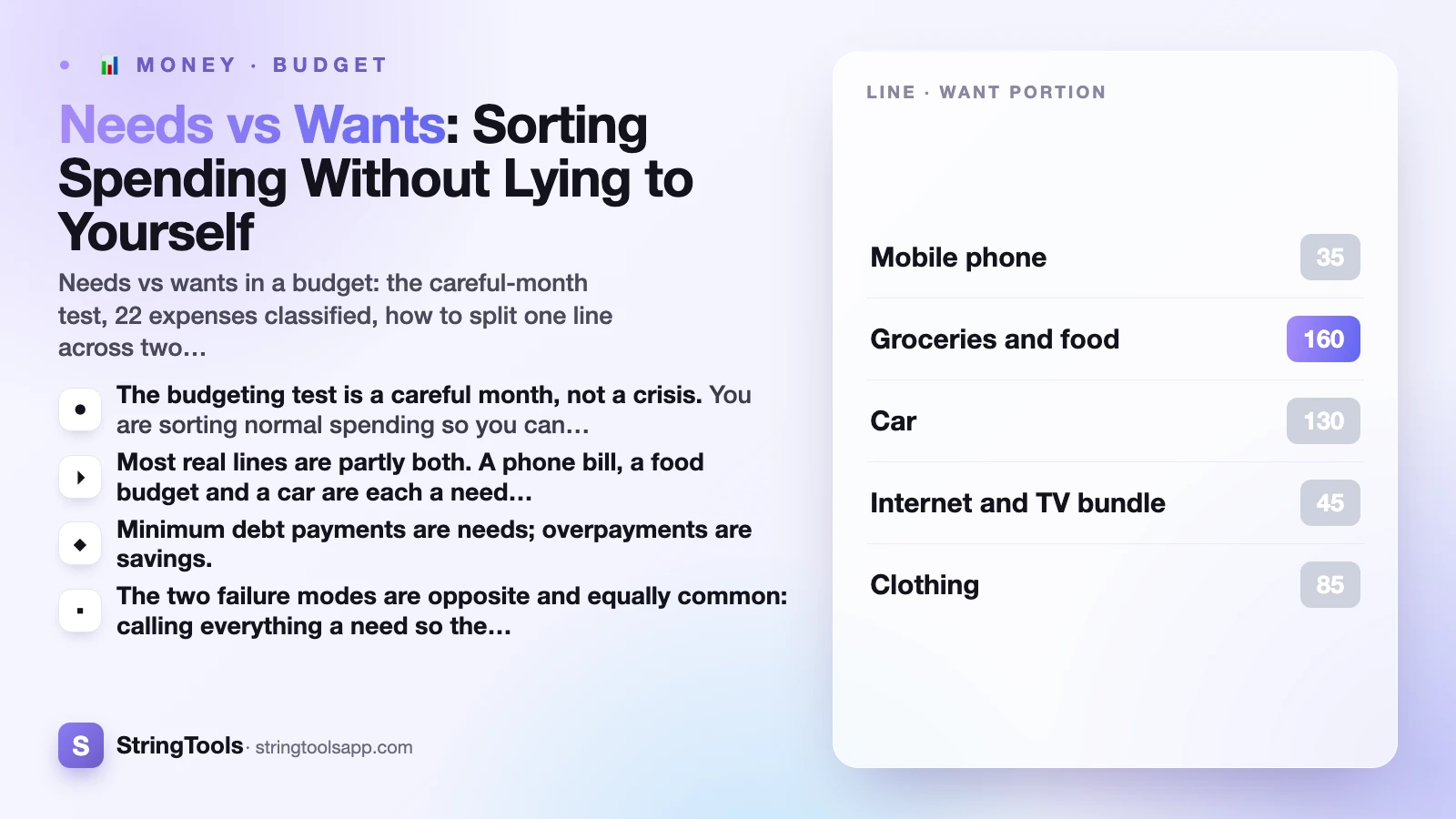
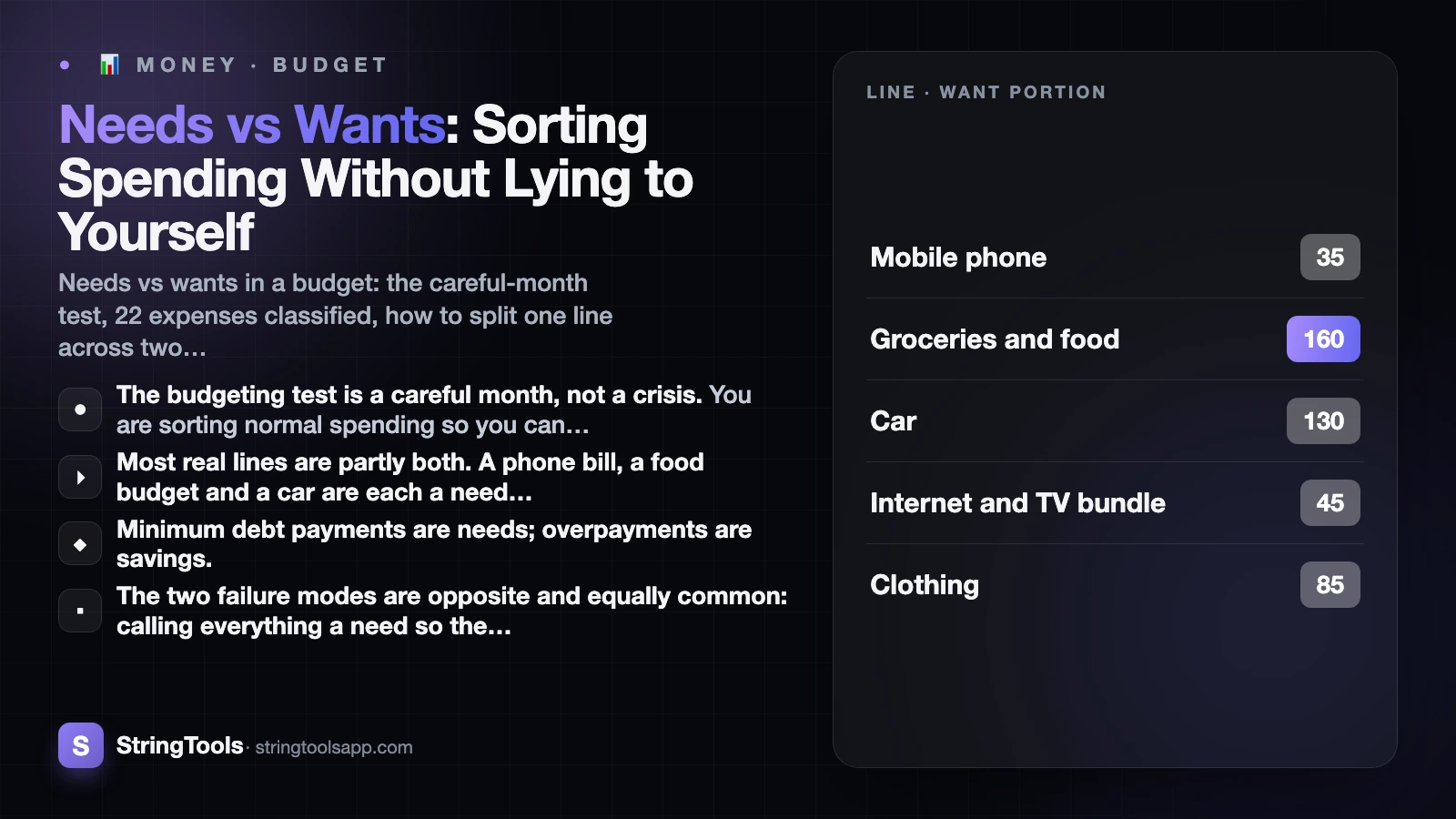
The classification argument usually comes from trying to force a mixed line into one bucket. A mobile phone is not a want, and a 55-a-month contract with the newest handset bundled in is not entirely a need either.
The fix is to split the line. Ask what the honest floor version of this cost would be, put that in needs, and put the difference in wants.
| Line | Monthly total | Need portion | Want portion |
|---|---|---|---|
| Mobile phone | 55 | 20 | 35 |
| Groceries and food | 560 | 400 | 160 |
| Car | 430 | 300 | 130 |
| Internet and TV bundle | 85 | 40 | 45 |
| Clothing | 120 | 35 | 85 |
| Total | 1,250 | 795 | 455 |
The grocery split is the one people resist. The reasoning: 400 buys the food a household of that size needs, and 160 is the branded, convenience and premium layer on top. Both are fine. Only one of them is fixed.
Now watch what splitting does to the picture. Take a household on 3,500 take-home with 1,150 of other clearly-need costs and 210 of other clearly-want costs.
| Sorting method | Needs | Needs as share | Wants | Wants as share |
|---|---|---|---|---|
| Whole lines pushed into needs | 2,400 | 68.57% | 210 | 6.00% |
| Lines split honestly | 1,945 | 55.57% | 665 | 19.00% |
The same household, the same spending, and a thirteen-point difference in the needs figure. The first version says the budget is beyond saving and there is nothing to cut. The second says there is 665 a month of flexible spending, which is a completely different set of options. The spending did not change; the honesty did.
The four traps
Calling everything a need. This is the defensive sort. Every line arrives with a reason it could not have been otherwise, the needs bucket ends up at 80% of take-home, and the conclusion is that budgeting does not work for you. It produces a tidy sense of helplessness and no information.
Calling everything a want. The opposite failure, and it looks like discipline. Groceries at a number nobody could actually feed a family on, no line for gifts, no line for car repairs. Month one is glorious, month three is an overdraft. The costs you refused to write down are the ones that break the plan, which is the mechanism behind why budgets fail in month three.
Need-creep. A want that becomes routine slowly reclassifies itself. The weekly delivery, the second subscription, the upgraded plan. None of them were needs when they started and nothing about them changed except familiarity. A useful annual habit: take every line currently tagged need and ask when it first appeared in your life. Anything younger than two years deserves a second look.
Re-tagging to win. If groceries were a need in January and a want in February because you overspent on them, the comparison between the two months tells you nothing. Fix the tags once, write them down, and change them only when the underlying purchase genuinely changes.
When the honest answer is that the needs do not fit
Sometimes the sort is correct and the number is still impossible. Needs at 70% or more of take-home is not a categorisation error; it is usually housing, and occasionally debt.
Two things follow.
The first is to stop aiming at a target you cannot hit. A 50% needs figure is barely reachable when rent alone is 40% of your take-home, and continuing to measure against it just generates monthly failure. Move to a 60/20/20 or 70/20/10 split so the plan reflects the life you are living — the 50/30/20 budget explained sets out each alternative split with the numbers.
The second is to direct effort at the right size of problem. When needs dominate, the fix is in three or four large fixed costs, not thirty small ones. Housing, debt, insurance and transport, in that order. Each takes months, and each is worth more than every subscription you could cancel put together.
If the shortfall is structural rather than discretionary, there is usually help that has nothing to do with budgeting technique: USA.gov lists assistance programmes for bills, and in the UK Citizens Advice covers budgeting and debt together with no product attached. Free debt advice is a need, not a want.
A twenty-minute sort you will repeat
Print or export a full month of bank and card transactions. Work down the list once, tagging each line need, want or saving. Split the mixed lines using the floor-version question. Do not edit your life while you are doing it; sorting and deciding are separate jobs, and trying to do both at once is why people stop after one month.
Three habits make the result usable:
- Keep a written tag list. Twenty lines, each with its bucket. Next month you sort against the list instead of re-arguing every decision.
- Split annual costs into twelfths and tag each twelfth. Car insurance at 540 a year is 45 a month in needs. It does not become a need only in the month it is charged.
- Review the need column once a year, not monthly. Life changes — a baby, a new commute, a cleared loan — genuinely move lines between buckets, and those are the changes worth reacting to.
Enter the tagged lines in the budget calculator and it totals each bucket, compares them with your chosen split, and shows the difference in both money and percentage points, along with anything left unassigned. Figures stay in your browser on that device, with no account and nothing uploaded.
The sort is the whole exercise. A budget is only as good as its categories, and categories are only as good as your willingness to be unflattering about them for twenty minutes a month.
Frequently Asked Questions
What is the difference between a need and a want in budgeting?
A need is a cost you would still be paying in a careful month while employed: housing, utilities, basic food, insurance, transport to work, childcare, medicine and minimum debt payments. A want is the discretionary layer: restaurants, subscriptions, hobbies, holidays and upgrades. The label describes how flexible the spending is, not whether it is sensible. A gym membership is a want even when it is the best money you spend all month.
Is a mobile phone a need or a want?
Both, which is why splitting the line works better than choosing one bucket. A basic plan that lets you work, bank and be contacted is a need. The premium tariff with a bundled handset is a want sitting on top of it. In the worked example in this article, a 55-a-month contract is split as 20 need and 35 want. Apply the same question to broadband, the car and the food budget.
Are groceries a need or a want?
Food is a need, but not every unit of a supermarket bill is. The practical split is to estimate what a plain, adequate shop for your household costs and tag that as a need, then tag the branded, convenience and premium layer as a want. In this article a 560 food budget splits as 400 need and 160 want. Restaurants and takeaways are wants in full, because the need is the food, not the service.
Are minimum credit card payments a need or a saving?
The minimum payment is a need, because missing it brings fees, extra interest and a mark on your credit record. Anything you pay above the minimum is a saving, because it reduces a liability and improves your net worth. The same card therefore appears in two buckets: if the minimum is 65 and you pay 160, tag 65 as a need and 95 as a saving. This is the split people most often get wrong.
What if my needs come to more than 70% of my income?
First check you have not pushed mixed lines wholly into needs, since honest splitting often moves ten points or more. If the figure survives that check, it is real, and it is almost always housing or debt rather than daily spending. Change the target split to something you can meet, such as 60/20/20 or 70/20/10, keep a small savings line alive, and direct your effort at the few large fixed costs. Free debt advice is worth taking early rather than late.
Should savings be treated as a need so I do not skip it?
Many people do treat it that way in practice by automating a transfer on payday, and it works. In the categories themselves, keep savings as its own bucket so you can see your real savings rate as a percentage. Tagging savings as a need hides it inside the needs figure and makes it impossible to tell whether a high needs number is caused by rent or by your own good habits.
Sources and references
USA.gov lists assistance programmes for bills (usa.gov) · Citizens Advice covers budgeting and debt together (citizensadvice.org.uk). Content was reviewed against these sources as of the last-updated date above; external figures and rules may change after publication.