
The one question that separates essential from optional
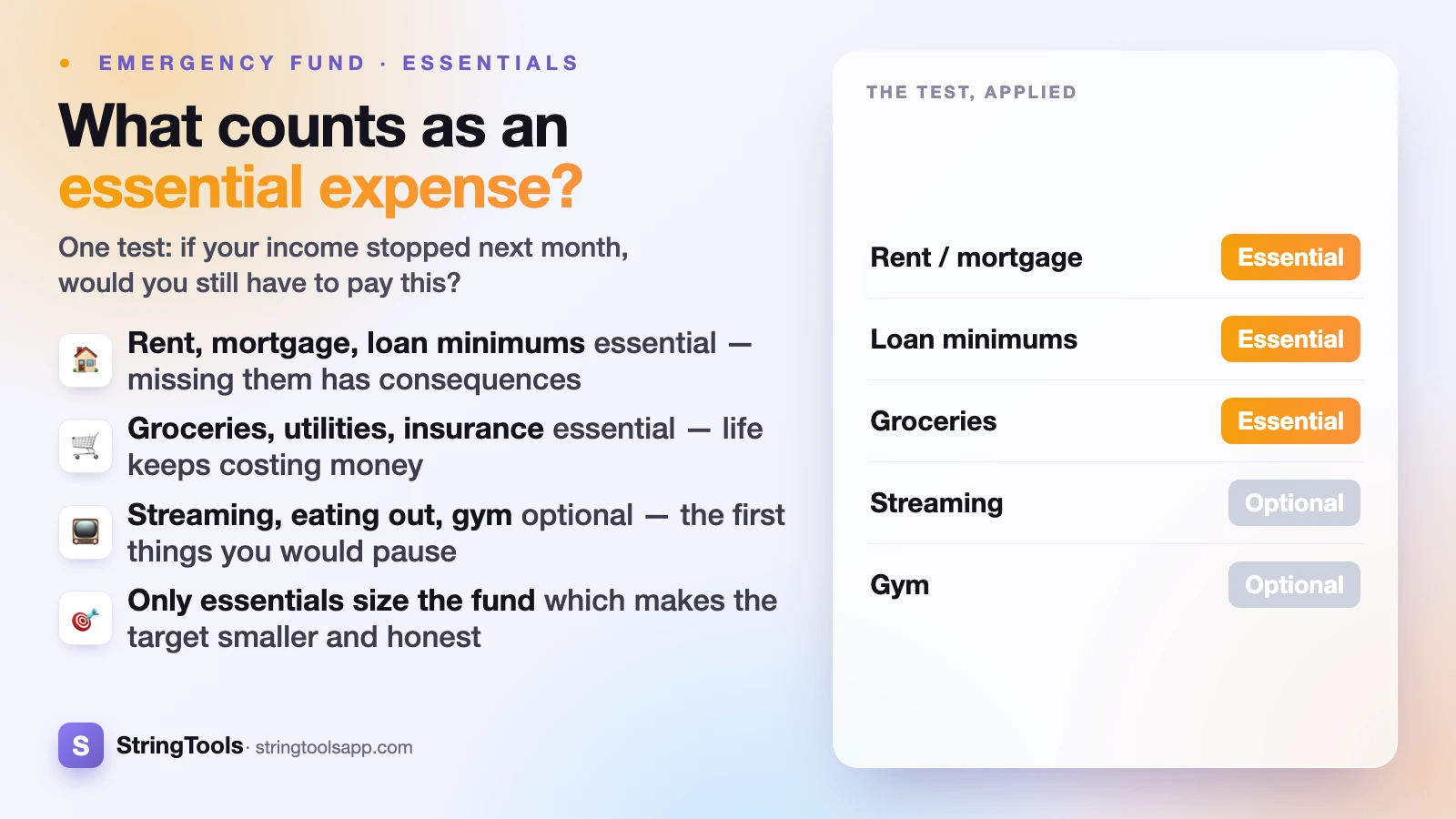
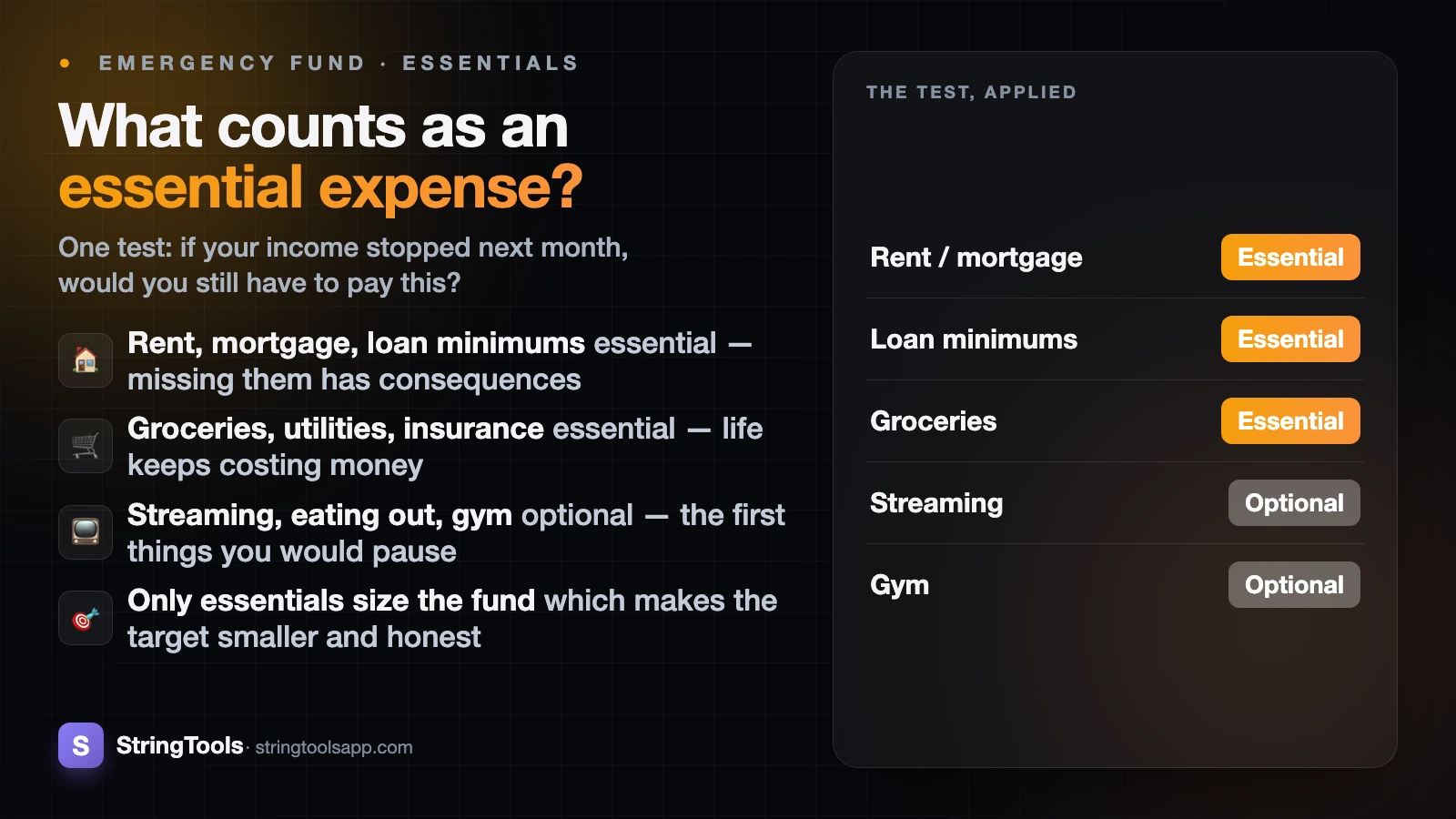
An essential expense is any cost you would still have to pay if your income stopped tomorrow: rent or mortgage, utilities, groceries, insurance, minimum debt payments, commuting, childcare and medicine. Anything you could pause for a few months without losing your home, health or credit rating is optional.
Key Takeaways
- The test is simple: "If my income stopped this month, would I still pay this?" If yes, it is essential. If you could cancel or pause it without real harm, it is optional.
- Essential does not mean cheap or virtuous, and optional does not mean wasteful. A gym membership is a good habit and still optional. A minimum credit-card payment is annoying and still essential.
- Widely used guidance from consumer-finance bodies such as the CFPB and MoneyHelper is to hold three to six months of essential expenses, not three to six months of total spending.
- Counting optional costs as essential inflates your target and makes the fund look further away than it is. Counting essential costs as optional does the opposite and leaves you short in a real emergency.
- Some costs split. Part of the phone bill is essential, the premium plan is not. Put the floor in one column and the extra in the other.
- This is general information, not personal financial advice. For a decision about your own money, a regulated adviser is the right person to ask.
The reason the distinction matters so much is arithmetic. If you spend 3,200 a month in total but only 2,400 of it is essential, a six-month fund is 14,400 rather than 19,200. That is 4,800 you never needed to save. The reverse error is worse: if you file childcare or a car loan under "optional" because you would rather not think about them, the fund you build will not cover the month you actually need it for.
Why the emergency fund calculator asks you to sort every expense
When you list your monthly outgoings in the emergency fund calculator, each line gets a toggle: essential or optional. The runway figure it shows you is accessible savings divided by the total of the essential lines only. The optional lines are still recorded and appear in the expense breakdown, but they do not shrink your runway.
That design is deliberate. An emergency is, by definition, a period when you have already cut back. Nobody who has just lost their job keeps paying for three streaming services, a weekly takeaway and a subscription box while they look for work. Sizing the fund from total spending assumes you would carry on exactly as before, which is not how anyone behaves.
It also produces a more honest status band. The calculator labels runway as Critical below one month, Building from one to three, Solid from three to six and Strong at six or more. If your savings of 8,000 sit against total spending of 3,200, you look like you are in the Building band at 2.5 months. Against essentials of 2,400, the same 8,000 is 3.3 months and you are Solid. Same money, different picture, and the second one is the true one because it reflects what an emergency actually costs.
The sorting is worth doing carefully rather than quickly. Most people find that two or three lines are genuinely hard to place, and those lines are where the size of the fund is really decided. The sections below walk through them.
The stopped-income test, applied line by line
Work through your bank statement and ask each recurring payment the same question: if no money came in for the next three months, would this still leave my account?
There are three possible answers.
- Yes, and there is nothing I can do about it. Rent, mortgage, council tax or property tax, loan minimums, insurance premiums, prescription costs. Essential.
- Yes, but only the floor. You must eat, but you do not have to eat out. You must have a phone, but not the premium plan with the newest handset bundled in. You must heat the house, but you can turn the thermostat down. For these, the floor is essential and the rest is optional. Estimate the floor honestly, not aspirationally.
- No, I could pause or cancel it. Streaming, gym, hobbies, holidays, gifts, new clothes beyond replacement, the second car if one would do. Optional.
A few habits make this easier:
- Use a real month's statement, not a budget you wrote once and never checked. Budgets record intentions. Statements record behaviour.
- Convert annual and quarterly bills into monthly amounts. Car insurance paid once a year is still an essential monthly cost of one twelfth of the premium.
- Include irregular essentials such as prescriptions, school costs and vehicle maintenance at a sensible monthly average rather than leaving them out because they did not happen this month.
- Be honest about the difference between "I would hate to lose this" and "I could not function without this." The fund exists for the second category.
The point is not to design an austere life. You will spend on optional things every ordinary month and should. The essential column simply describes the minimum the fund has to cover when the ordinary months stop.
20 common expenses, classified
The table below sorts twenty everyday costs the way most planners would, with a one-line reason. Treat it as a starting point rather than a verdict; a handful depend on your circumstances and are marked as such.
| Expense | Classification | Reason |
|---|---|---|
| Rent or mortgage payment | Essential | Losing your home is the outcome the fund exists to prevent |
| Council tax / property tax | Essential | A legal obligation with penalties for non-payment |
| Electricity, gas, water | Essential | You cannot pause utilities without real harm |
| Groceries (basic) | Essential | Food is non-negotiable; restaurants and takeaways are not |
| Minimum debt payments | Essential | Missing them damages your credit record and adds fees |
| Home, car and health insurance | Essential | Cancelling insurance during an emergency compounds the emergency |
| Childcare | Usually essential | Needed to keep working or to job-hunt; may drop if a parent is at home |
| Prescriptions and medical costs | Essential | Health costs do not pause when income does |
| Commuting to work | Essential | Required to keep or find a job; adjust if working from home |
| Phone (basic plan) | Essential | Needed for work, job applications and emergencies |
| Internet | Usually essential | Job hunting and remote work depend on it; the premium tier does not |
| Car payment | Essential if the car is | A finance agreement is a debt; a genuinely spare car is optional |
| School fees or student loan minimum | Essential | Contractual or income-linked payments you cannot simply skip |
| Pet food and routine vet care | Essential | An animal in your care is an obligation, not a hobby |
| Gym membership | Optional | Good for you and still cancellable for a few months |
| Streaming and subscriptions | Optional | The first things most people cut, and rightly |
| Restaurants and takeaways | Optional | The groceries line already covers eating |
| Holidays and travel | Optional | Postponable; also better served by a separate savings pot |
| Clothing beyond replacement | Optional | Replacing worn-out work shoes is essential; a new wardrobe is not |
| Savings and investment contributions | Optional (during an emergency) | Pausing contributions is exactly what the fund allows you to do |
Two lines in that table surprise people. Savings contributions are optional in this context because an emergency is precisely the time you stop adding to the pension or investment account and let the fund do its job. And pet costs are essential because the alternative is not a spending cut; it is giving up an animal you are responsible for.
If you want a longer view of how these monthly figures turn into a target, how much emergency fund do I need works through four illustrative households from itemised bills to a runway in months.
The grey areas, and how to decide them
Most of the argument happens over a small number of lines. Here is how to settle each one.
Minimum debt payments are essential. Overpayments are not.
If you are paying 400 a month towards a credit card whose minimum is 90, the 90 is essential and the 310 is optional. In an emergency you drop to the minimum, protect your credit record and resume overpaying when income returns. Sizing the fund on the full 400 would overstate your target by a wide margin. If you are following a payoff method, debt snowball vs avalanche explains why the extra payment is a choice you can pause.
Childcare is usually essential, but it depends on why you need it.
If childcare lets you work, it is essential: losing it makes it harder to keep the job or find the next one. If the emergency is that one parent has lost their job and would be at home anyway, some of that cost might fall away. The honest approach is to count it as essential unless you are confident you would cut it, because the alternative is a fund that assumes the best case.
The gym is optional even if it is good for you.
Optional is not a moral judgement. Exercise matters, and a gym can be part of managing a health condition. But a membership can be paused or replaced with running shoes for a few months. If a specific fitness programme is medically prescribed, move it to the medical line and count it.
The car: count the finance, question the second one.
A car loan is a debt, so its minimum payment is essential. Fuel and insurance for the car you need to get to work are essential. A second vehicle that exists for convenience is optional, along with its fuel, insurance and parking, as long as the household could manage with one.
Phone and internet: the floor is essential, the tier is not.
Nobody job-hunts without a phone and a connection. But the difference between the basic package and the one with unlimited data, the sports channels and a new handset is optional. Put the basic cost in the essential column and the difference in optional.
Food: groceries yes, restaurants no.
A realistic grocery figure for your household is essential. Delivery apps, coffees and eating out are optional, however habitual. If your statement shows 700 on food but 250 of it was restaurants, the essential line is 450.
When you genuinely cannot decide, count it as essential. The cost of a slightly larger target is a few extra months of saving. The cost of a fund that turns out to be too small is described in what happens without an emergency fund, and it is considerably higher.
A worked example: same household, two different funds
Take a two-adult household with a real monthly statement that adds up to 3,200. Sorted by the stopped-income test, it looks like this.
| Line | Amount | Column |
|---|---|---|
| Rent | 1,100 | Essential |
| Utilities and council tax | 260 | Essential |
| Groceries | 450 | Essential |
| Car finance minimum | 180 | Essential |
| Fuel and commuting | 120 | Essential |
| Insurance (home, car, health) | 140 | Essential |
| Phone and internet (basic) | 60 | Essential |
| Credit card minimum | 90 | Essential |
| Restaurants and takeaways | 250 | Optional |
| Credit card overpayment | 310 | Optional |
| Streaming, gym, subscriptions | 90 | Optional |
| Clothing, gifts, hobbies | 150 | Optional |
| Total | 3,200 |
The essential column adds up to 2,400; the optional column to 800. Now compare the two targets.
| Target | Based on total spend (3,200) | Based on essentials (2,400) | Difference |
|---|---|---|---|
| 3 months | 9,600 | 7,200 | 2,400 |
| 6 months | 19,200 | 14,400 | 4,800 |
| 9 months | 28,800 | 21,600 | 7,200 |
| 12 months | 38,400 | 28,800 | 9,600 |
At the widely used six-month benchmark, sorting properly reduces the target by 4,800. If this household can put aside 400 a month, that is a year of saving they do not need to do. With 8,000 already in an instant-access account, their runway is 3.3 months against essentials (Solid) rather than 2.5 months against total spending (Building).
None of this changes how much they spend in an ordinary month. It changes only the size of the cushion they are aiming for, and it makes that cushion reachable.
Essential is not fixed: revisit the list when life changes
The essential column moves. A new baby moves childcare and a larger grocery bill into it. Paying off the car finance takes 180 out of it. Moving closer to work shrinks the commuting line; a new mortgage enlarges the housing line. Each change alters the runway the same savings balance provides.
A few triggers that should send you back to the list:
- A change in housing costs. Rent reviews, a new fixed-rate mortgage period, moving house.
- A debt paid off or taken on. Every new minimum payment is a new essential; every cleared balance removes one.
- A change in who depends on you. Children, an elderly parent, a partner who stops working.
- A change in how you work. Going self-employed, moving to remote work, taking a job with a longer commute. Freelancers in particular should read the case for a bigger target in emergency fund for freelancers and single-income households.
- Annual renewals. Insurance premiums and subscription prices rarely go down; update the monthly equivalents when they change.
Because the calculator keeps your figures in the browser on that device, a review takes a few minutes: adjust the lines that changed, check the toggle on anything new, and read the runway again. Most people find that a quarterly look is enough, with an extra pass whenever one of the triggers above happens.
A last practical point. The list you build here is also the first draft of your emergency budget. If income does stop, the essential column is the spending plan you switch to on day one, and the optional column is the list of things you pause without having to think about it while you are already under strain. Having decided it in advance, calmly, is worth almost as much as the money itself.
Frequently Asked Questions
What is the difference between essential and non-essential expenses?
Essential expenses are the costs you must keep paying even if your income stops: housing, utilities, basic groceries, insurance, minimum debt payments, transport to work, childcare and medical costs. Non-essential (optional) expenses are everything you could pause or cancel for a few months without losing your home, your health or your credit standing, such as subscriptions, eating out, gym membership and holidays. The label is about necessity in a crisis, not about whether the spending is sensible.
Are minimum debt payments an essential expense?
Yes. Missing a minimum payment adds fees, interest and a mark on your credit record, so the minimum on every loan and card belongs in the essential column. Anything you pay above the minimum is optional in this context: in an emergency you drop to the minimum, and you resume overpaying when income returns. Size your fund on the minimums, not on your current accelerated payments.
Is a gym membership an essential expense?
No, in the sense that matters for an emergency fund. A membership can be frozen or cancelled for a few months and replaced with free exercise. That does not make it a bad use of money in ordinary months. The exception is a programme prescribed for a medical condition, which you would treat as a medical cost and count as essential.
Should I include savings contributions in my essential expenses?
Not when sizing an emergency fund. Pension, investment and general savings contributions are exactly the payments you pause during an emergency so that the fund can cover the essentials. Include them in your ordinary budget, but leave them in the optional column when you calculate runway. The fund is there to protect your obligations, not your savings rate.
Is childcare an essential expense?
Usually, yes. If childcare is what lets you work or look for work, losing it makes the emergency worse, so count it in full. It can become partly optional if the emergency itself means a parent will be at home, but you should only reduce it if you are confident that would happen. When in doubt, count it as essential and accept a slightly larger target.
How much emergency fund do I need if I only count essential expenses?
Widely used guidance from consumer-finance bodies such as the CFPB and MoneyHelper is three to six months of essential expenses. Add up your essential column from a real month's statement, then multiply by the number of months that fits your situation. In the example in this article, essentials of 2,400 a month give a target of 7,200 at three months and 14,400 at six. The emergency fund calculator does the same arithmetic and shows the gap between your accessible savings and each target.
Sources and references
CFPB (consumerfinance.gov) · MoneyHelper (moneyhelper.org.uk). Content was reviewed against these sources as of the last-updated date above; external figures and rules may change after publication.