
Why six months is the floor, not the target
Freelancers, the self-employed and single-income households should hold at least six months of essential expenses in instant-access savings, not the three months often quoted for salaried workers. Irregular income, no sick pay, lumpy tax bills and late-paying clients each stretch a bad patch, and a single pay cheque has nothing to fall back on.
Key Takeaways
- The widely used guidance from bodies such as the CFPB and MoneyHelper is three to six months of essential expenses. With irregular income or one earner, start at the six-month end and treat it as the floor.
- Size the fund from what you must pay each month, not from what you earn. Income is the thing that disappears; essentials are the thing that does not.
- With irregular income, save a percentage of every payment that arrives rather than a fixed sum on a fixed date. The fixed sum fails in the first quiet month.
- Keep three pots apart: a tax set-aside, a smoothing buffer that turns lumpy income into a steady monthly pay, and the emergency fund itself. Only the last one counts as runway.
- A smoothing buffer for a normal year is much smaller than an emergency fund: in the example below its balance falls no lower than 1,500 across a 36,000 year.
- This is general information, not personal financial advice. A regulated adviser is the right person for a decision about your own money.
The three-month figure assumes redundancy pay or notice, sick pay, an employer handling tax at source, and a second income while you look for work. Remove those and the arithmetic changes. Nothing about six months is magic; it is simply the point at which the extra risks below have room to play out without you borrowing to cover rent.
The four risks a salaried worker does not carry
Each of these adds weeks or months to how long a bad patch lasts, which is why the target moves.
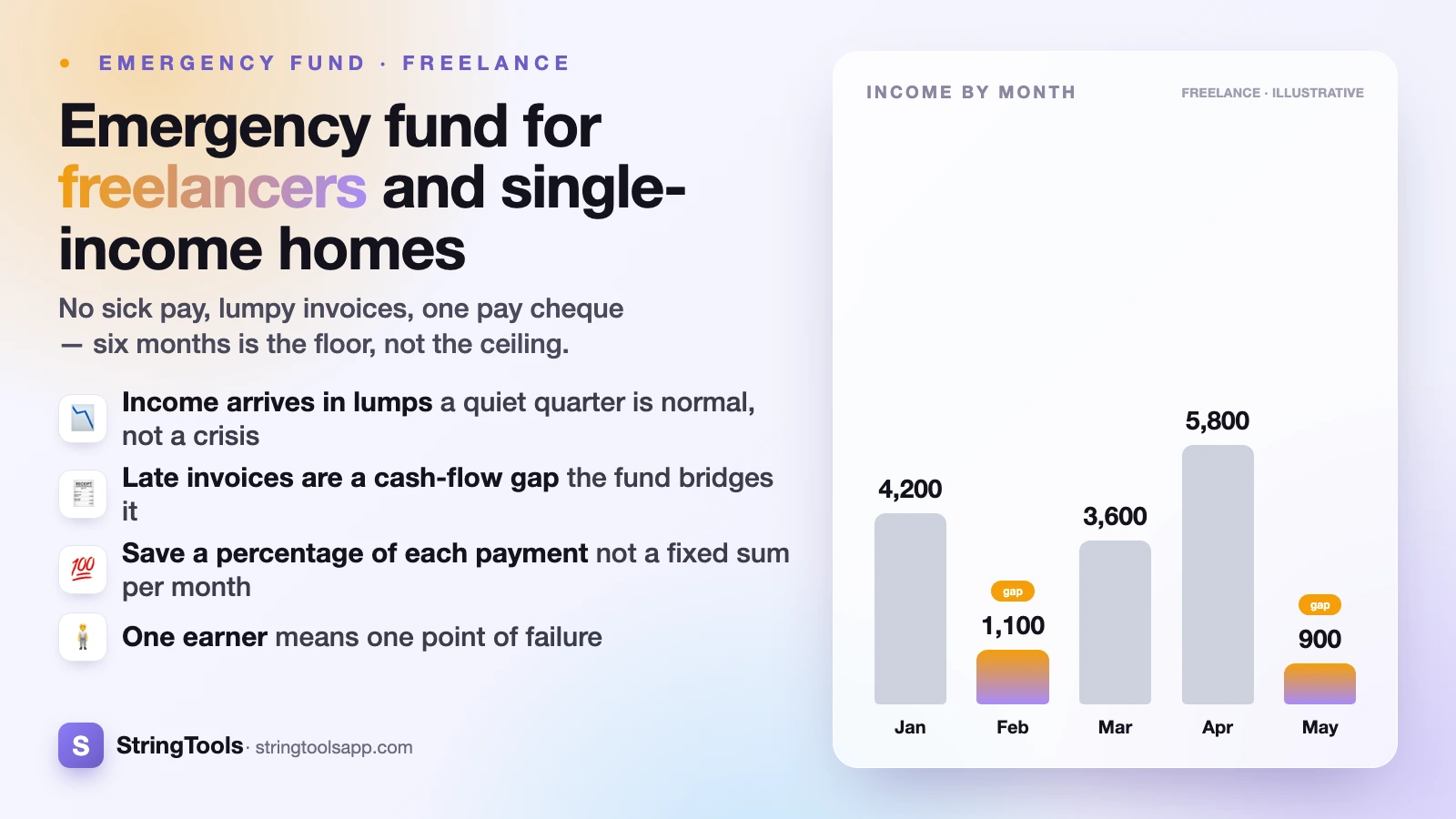
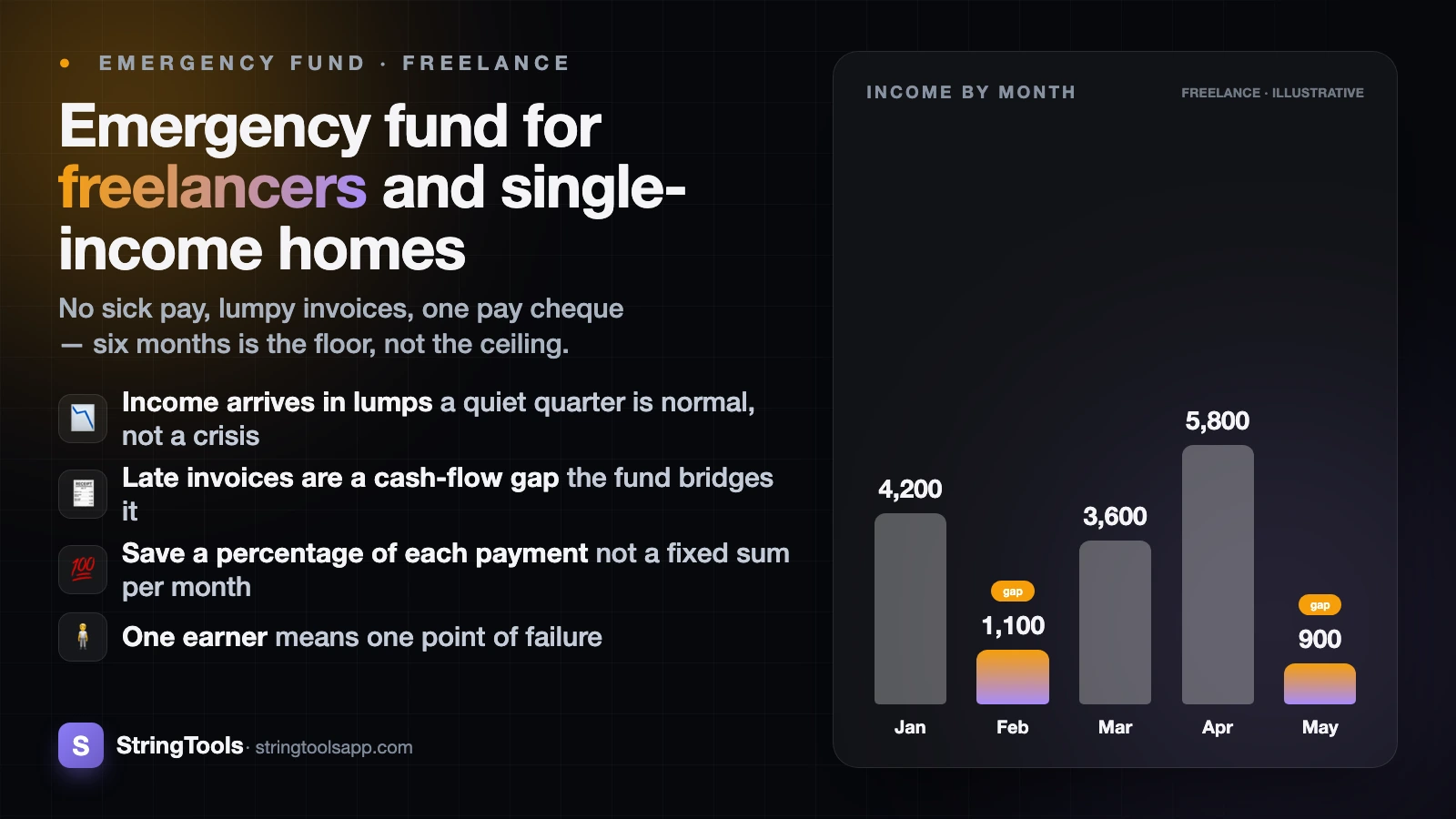
Income that arrives in lumps. Yours is a series of invoices, some large, some small, some late. Two quiet months in a row is not an emergency; it is a normal year. The problem is that a quiet stretch and a real emergency can land in the same quarter, and the fund has to cover both.
No sick pay. If you cannot work, you do not earn. A fortnight with flu or six weeks after an operation is a direct hole in income with no employer topping it up, and possibly a lost client or two.
Tax bills that arrive as a lump. In most cases no one deducts tax from a freelance payment before it reaches you, although some countries withhold a portion at source, so check your authority's rules. You must set aside a share of every payment for tax as your local authority advises and pay it on their dates. If that pot is empty when the bill arrives, the emergency fund is the next thing people reach for.
Clients who pay late. A 30-day invoice that slips to 60 or 90 days delays your income without reducing it, and something has to bridge the gap. Our guide to invoice payment terms covers how to shorten that lag; the fund covers the lag you cannot shorten.
The single-income household shares the last feature with the freelancer: when the income stops, nothing else is coming in.
Size it from your essentials, not your income
The mistake that costs freelancers most is sizing the fund from a good year's turnover. Turnover vanishes; bills remain. Work from the bills.
List every monthly outgoing and mark each one essential or optional. Essential means you would still pay it if no money came in: rent or mortgage, utilities, groceries, insurance, minimum debt payments, transport you need to work, childcare you cannot drop. Add up the essentials only. Say that comes to 2,400 a month. That figure sets every target.
| Target | Months of essentials | Amount needed at 2,400 a month |
|---|---|---|
| Salaried, two incomes, stable | 3 | 7,200 |
| Freelancer or single income (the floor) | 6 | 14,400 |
| Freelancer with seasonal work or dependants | 9 | 21,600 |
| Sole earner, specialist field, long rehire time | 12 | 28,800 |
The emergency fund calculator does this arithmetic for you. You list each savings account with its balance, marked instant access or locked, and each monthly expense, marked essential or optional. It divides accessible savings by essential expenses to give runway in months, shows the gap to a 3-month, 6-month or custom target, and lays out what to save per month over 6, 12 or 24 months to close it. Figures stay in your browser on that device; nothing is uploaded and there is no account.
Two behaviours matter for freelancers. It excludes locked savings from the runway figure, because a fixed-term deposit that matures next year cannot pay next week's rent, and shows that locked figure separately. And it counts only essentials, so you can see how much of your spending is optional. That optional total is the first lever you would pull in a quiet quarter.
If you are unsure whether six or nine months is right for you, 3 months or 6 months walks through job stability, dependants and income volatility one at a time.
Save a percentage of every payment, not a fixed sum each month
Standing orders work for salaries because the salary lands on the same day for the same amount. A freelancer who sets up a fixed 400 a month will cancel it in the first month that only 900 arrives, and forget to restart it in the month that 5,100 does.
The fix is to change the trigger from a date to a payment arriving. Every time a client pays, the same three moves happen in order, before you spend anything:
- Tax set-aside first. Move the percentage your local tax authority advises for someone in your position into a separate account you do not touch. In the US the IRS publishes guidance for the self-employed; in the UK, GOV.UK explains self-assessment and payments on account. Use their figures, not a guess.
- Emergency fund second. Move a fixed percentage of what remains to the emergency fund. Ten per cent is a common starting point; twenty closes the gap twice as fast. It should be the same on a 900 payment as on a 5,100 one.
- The rest to your operating account. This is the account you pay yourself from, and where the smoothing buffer in the next section lives.
Because the percentage is fixed, good months build the fund faster and quiet months do not break the habit. Across the illustrative year below, which totals 36,000 after the tax set-aside, a 10% slice adds 3,600 to the fund, which is 300 a month on average. Against a 14,400 target that is 48 months from a standing start. A 20% slice is 7,200 a year, or 600 a month, and closes the same gap in 24 months. Neither is fast, which is why freelancers need to start earlier than salaried workers, not later.
Smoothing a lumpy year: the buffer table
The smoothing buffer is the part most guides skip, and its absence is why freelancers dip into emergency funds in years when nothing went wrong. Its job is to turn twelve uneven payments into twelve identical pay days.
The method: decide a fixed monthly pay you will take from the operating account, set at roughly your average month, and take exactly that amount every month. Surplus stays in the account; shortfalls are drawn from it. As long as the balance never hits zero, your personal finances feel salaried even though the business is not.
Here is an illustrative year. The income column is what reaches the operating account after the tax set-aside has been taken off the top; the 10% emergency-fund slice (300 a month on average) then comes out of the fixed pay. Fixed pay is 3,000 (2,400 of essentials plus 600 optional), and the buffer starts the year at 3,000.
| Month | Income to operating account | Fixed pay taken | Change to buffer | Buffer balance |
|---|---|---|---|---|
| Start | 3,000 | |||
| Jan | 4,200 | 3,000 | +1,200 | 4,200 |
| Feb | 2,100 | 3,000 | -900 | 3,300 |
| Mar | 3,600 | 3,000 | +600 | 3,900 |
| Apr | 1,500 | 3,000 | -1,500 | 2,400 |
| May | 4,800 | 3,000 | +1,800 | 4,200 |
| Jun | 3,000 | 3,000 | 0 | 4,200 |
| Jul | 900 | 3,000 | -2,100 | 2,100 |
| Aug | 2,400 | 3,000 | -600 | 1,500 |
| Sep | 5,100 | 3,000 | +2,100 | 3,600 |
| Oct | 3,900 | 3,000 | +900 | 4,500 |
| Nov | 2,700 | 3,000 | -300 | 4,200 |
| Dec | 1,800 | 3,000 | -1,200 | 3,000 |
| Year | 36,000 | 36,000 | 0 | 3,000 |
Three things to read from the table. First, the year balances: 36,000 in, 36,000 out, and the buffer ends where it started. That is what a correctly set pay looks like. If the balance drifts down year on year, the pay is too high; if it only ever climbs, raise the pay or move the excess to the emergency fund.
Second, the lowest point is 1,500 in August, after the July and August dip. Starting with 3,000 gave 1,500 of headroom; starting with 1,500 would have worked, just, and anything less would have forced a draw on the emergency fund in a year with no emergency in it. One month's pay is a reasonable buffer for most freelancers; two if your quiet season is long.
Third, notice how small the buffer is compared with the 14,400 emergency fund. The buffer handles the normal shape of a freelance year. The emergency fund handles the year that is not normal: the client who folds owing you three invoices, the two months you cannot work, the boiler that fails in the same week. Separate accounts mean you can always see which one you are spending.
Single-income households: the one pay cheque risk
A household with one salary has a different pattern but the same exposure. The income is steady right up until the day it is not, and on that day there is no partial income and no second earner to lean on.
Three questions size the fund for a single-income home.
How long would it take to replace the income? Not any job, but one that covers the essentials. In a specialist field, a senior role or a small town, that can be six months or more. Notice periods and redundancy pay shorten the gap; a non-compete clause or a relocation lengthens it.
What would stop the second adult from earning quickly? Childcare costs, a career break, caring responsibilities or a visa condition can all mean the second adult cannot step in fast enough to matter. If a second income would take months to arrange and barely cover childcare, plan as if there is none.
What if the earner is ill rather than unemployed? Check what your employer pays in sick leave, for how long, and what any income protection policy covers, before assuming either fills the gap.
For most single-income households these answers point to six months as the floor and nine as a comfortable target, on the same essentials-only figure: 14,400 to 21,600 at 2,400 a month.
The CFPB has plain guidance on starting an emergency fund from a low base, and the broad version of how much, where and how fast is in our emergency fund guide. If one income is all you have, the buffer has to be big enough that losing it is a problem and not a crisis.
Keep the tax pot out of the emergency fund
This is the rule freelancers break most. The tax set-aside sits in an account, the balance looks healthy, and it gets counted as savings. Then the bill arrives and the fund is half the size it appeared to be.
The tax pot is not yours. It is money you are holding for someone else until a due date. Practical rules that hold in most countries:
- Keep it in a separate account with a name that says what it is for.
- Move the set-aside on the day each payment arrives, not at month end.
- Never count it in your runway. In the emergency fund calculator, leave the tax account out, or mark it locked so it shows in the separate figure and not in the months of runway.
The same logic applies to money set aside for annual costs you know are coming, such as insurance renewals or equipment. Those belong in a sinking fund. The emergency fund is only for what you did not see coming, and it stays the right size only if nothing else lives in it.
The order to build it in, starting from zero
Trying to fund all three pots at once stalls all three. Build them in this order.
First, the tax pot, from the next payment onwards. This is the one that turns into a penalty if it is missing. Start the set-aside now, even if the emergency fund has to wait a month.
Second, one month of essentials in instant access. On 2,400 of essentials that is 2,400. It is the difference between a late client payment being an irritation and being a missed rent. The calculator's status band moves from Critical to Building here.
Third, the smoothing buffer, at one month of pay. Set the fixed monthly pay and stop letting good months raise your spending. This is what makes the emergency-fund percentage survive the quiet months.
Fourth, the emergency fund to three months, then six. Use the fixed percentage of each payment. At three months the calculator shows Solid; at six, Strong. For a freelancer, Strong is the floor, not the finish, so keep the percentage running until you reach the target you set on the slider.
Then review twice a year. Rent rises, a child starts school, a loan is paid off. Re-enter the bills and check the runway against the target. A fund sized on last year's rent is smaller than it looks.
None of this requires a windfall, only a fixed percentage, a fixed pay and three accounts with clear names. The freelancers who get through a bad year without debt are rarely the ones who earned the most. They are the ones whose money was in the right pots before it started.
Frequently Asked Questions
How many months of expenses should a freelancer have in an emergency fund?
Six months of essential expenses is the sensible floor for anyone self-employed, and nine to twelve is reasonable if your work is seasonal, your field is specialised, or you have dependants. The three-month figure widely quoted for salaried workers assumes sick pay, notice periods and tax deducted at source, none of which a freelancer has. Size it from your essential monthly bills, not from your turnover.
Should I save a percentage of each payment or a fixed amount each month?
A percentage of each payment. A fixed monthly sum fails in the first quiet month and is rarely restarted. Taking the same percentage from every payment, on the day it arrives, means good months build the fund faster and quiet months keep the habit alive. Ten per cent is a common starting point; twenty closes the gap twice as fast.
Does my tax set-aside count towards my emergency fund?
No. Money set aside for tax is owed to your tax authority on a fixed date and will leave the account whether or not you have an emergency. Keep it in a separate, clearly named account, move it on the day each payment lands, and leave it out of your runway figure. If a quiet year leaves a surplus after the bill is paid, that surplus can move to the emergency fund then.
What is the difference between a smoothing buffer and an emergency fund?
A smoothing buffer turns irregular income into a fixed monthly pay: surplus months top it up, quiet months draw it down, and over a normal year it ends where it started. It only needs to be about one to two months of pay. The emergency fund covers the abnormal year, such as a client folding or an illness that stops you working, and needs to be six or more months of essentials. Keep them in separate accounts.
How much emergency fund does a single-income family need?
Six months of essential expenses as a floor, nine if the earner works in a field where a replacement job would take a long time to find or the second adult could not start earning quickly. Check what your employer pays for sick leave and how long any notice or redundancy pay would cover, and plan the fund to cover what is left. Any side income should be treated as a bonus, not as a reason to lower the target.
What should I do first if I am self-employed with no savings at all?
Start the tax set-aside from the next payment, because a missing tax pot becomes a penalty. Then build one month of essentials in an instant-access account, then a one-month smoothing buffer so you can pay yourself a fixed amount. Only then push the emergency fund to three months and on to six, using a fixed percentage of every payment. Trying to fill all three pots at once usually stalls all three.
Sources and references
IRS (irs.gov) · GOV.UK (gov.uk) · CFPB (consumerfinance.gov). Content was reviewed against these sources as of the last-updated date above; external figures and rules may change after publication.