
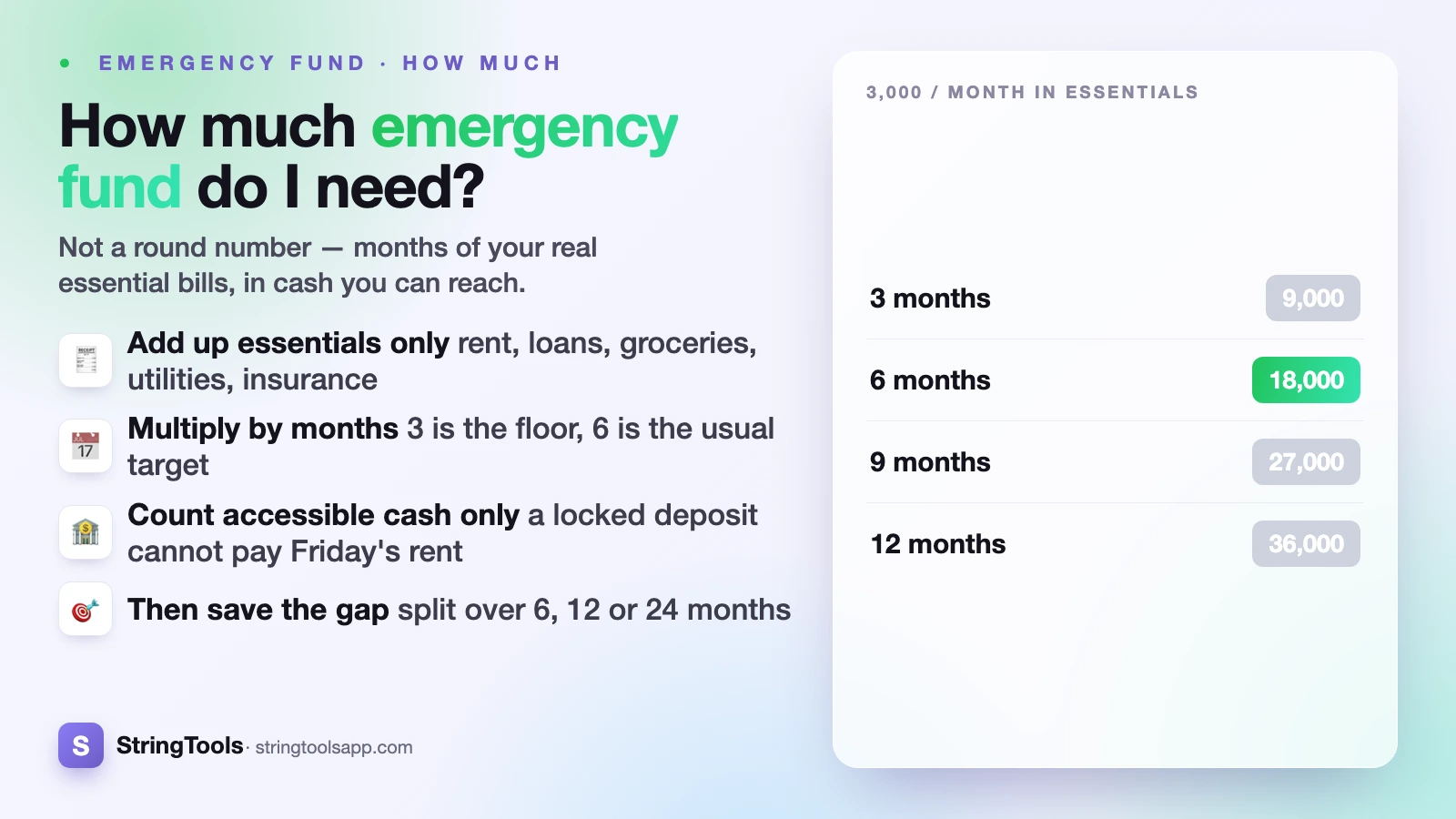
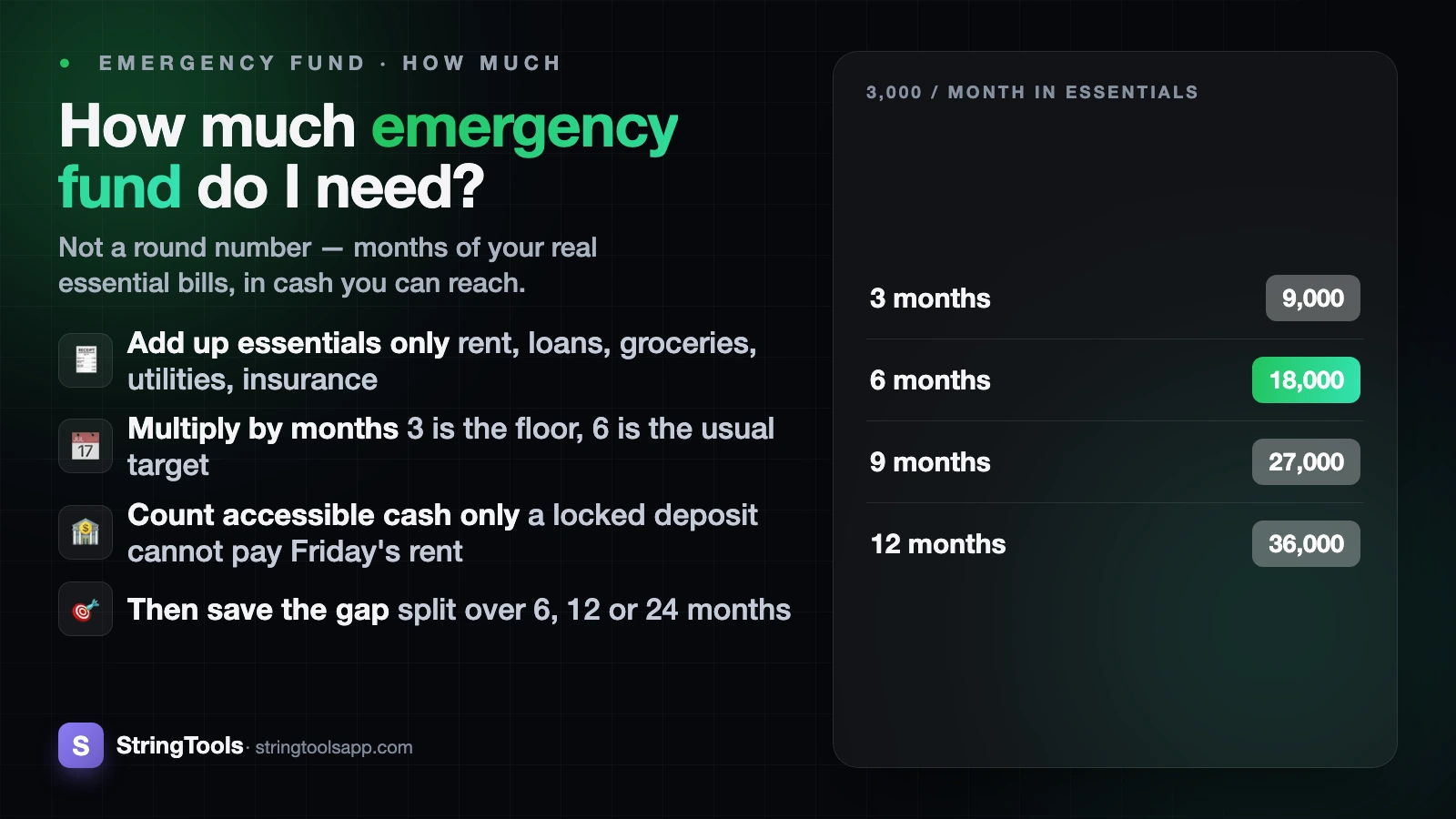
How much emergency fund do you need? The short answer
You need enough instant-access savings to cover three to six months of your essential monthly expenses: rent or mortgage, food, utilities, transport, insurance and minimum debt payments. Add up those bills, multiply by your target months, and that is your number. The right figure is a runway in months, not a round lump sum.
Key Takeaways
- The widely used benchmark from consumer-finance bodies such as the CFPB and MoneyHelper is three to six months of essential expenses, not of income and not of total spending.
- A fixed lump-sum target (say, 10,000) is the wrong unit because it ignores how much you actually spend each month.
- Only money you can withdraw within a day or two counts. Fixed-term deposits, pensions and investments do not.
- Runway in months = accessible savings ÷ essential monthly expenses. That single division tells you where you stand today.
- Your target should sit higher in the range if you have one income, dependants, irregular earnings or no sick pay.
- Once you know the gap, split it over 6, 12 or 24 months to get a monthly saving you can actually keep.
This is general information, not personal financial advice. If you are making a decision that depends on your own circumstances, a regulated adviser is the right person to talk to.
Why a lump-sum rule of thumb fails
Most people carry a number in their head. Five thousand. Ten thousand. A month's salary. It usually came from a headline or a colleague, and a lump sum says nothing about how long it would actually keep you afloat.
Take two households that both hold 10,000 in savings. One pays 1,500 a month for everything it cannot cancel. The other pays 4,000. The first has more than six months of breathing room; the second has two and a half. Same savings, entirely different level of safety. The lump sum hid that.
The rule fails in the other direction too. Someone with modest outgoings can be told they are "behind" when three months of their real bills is a far smaller, far more reachable target than they feared.
Lump sums are also set once and never revisited. Rent rises, a child arrives, a car loan starts, and the number in your head stays the same. A target expressed in months of expenses updates itself the moment you update your bills.
So the first move is to stop asking "how much money" and start asking "how many months". The money follows from the months, not the other way round. The broader guide at how to build an emergency fund covers where to keep it and how fast to fill it; this post is about getting the number right.
Runway in months: the unit that actually means something
Your financial runway is the number of months you could pay every essential bill if your income stopped tomorrow. It is one division:
Runway (months) = accessible savings ÷ essential monthly expenses
Accessible savings
Count only money you could have in your current account within a day or two without a penalty: your current account balance, instant-access savings, cash. Do not count fixed-term deposits, notice accounts you would have to wait on, pensions, shares or property. They may be valuable, but they cannot pay a landlord on Friday. The emergency fund calculator makes this explicit by asking you to mark each balance as instant access or locked, then excluding the locked money from the runway figure while still showing what it would add if you could reach it.
Essential monthly expenses
Count only what you would still have to pay if your income vanished. The test is simple: if you lost your job this month, would this payment still go out? Rent, groceries, energy, water, phone and broadband, transport to interviews or work, insurance premiums and the minimum payment on any debt all pass that test. Streaming, gym, eating out, holidays and hobbies do not. They are not wasteful, they are simply what you would pause first, so they do not belong in the target.
The status bands
The calculator reads the result against four bands: Critical under one month, Building from one to three, Solid from three to six and Strong at six or more. The bands exist so you can see the next one, not the last one.
A worked example built from real accounts and real bills
Here is the method applied to one illustrative household, using the same steps the calculator follows. All figures are made up to keep the arithmetic clean; the point is the process, not the numbers.
Step 1: list every savings balance and mark it accessible or locked
| Account | Balance | Access |
|---|---|---|
| Current account (after this month's bills) | 900 | Instant |
| Instant-access savings | 4,200 | Instant |
| Fixed-term deposit (matures in 14 months) | 6,000 | Locked |
| Investment account | 3,500 | Locked |
Accessible savings: 5,100. Savings including locked money: 14,600.
Step 2: list every monthly expense and mark it essential or optional
| Expense | Monthly | Type |
|---|---|---|
| Rent | 1,200 | Essential |
| Groceries | 400 | Essential |
| Energy and water | 180 | Essential |
| Phone and broadband | 60 | Essential |
| Transport | 150 | Essential |
| Insurance | 90 | Essential |
| Minimum debt payment | 120 | Essential |
| Streaming and subscriptions | 30 | Optional |
| Gym | 45 | Optional |
| Eating out | 200 | Optional |
| Holiday saving | 150 | Optional |
Essential expenses: 2,200 a month. Optional: 425. Total spending: 2,625.
Step 3: divide
5,100 ÷ 2,200 = 2.3 months of runway. That lands in the Building band.
If you counted the locked money too, 14,600 ÷ 2,200 would show 6.6 months, which looks like Strong. It is not. The deposit cannot be broken without a penalty and the investments could be down on the day they are needed. This is exactly the note the calculator surfaces: the locked figure is shown, but it is not your runway.
Step 4: set the target and find the gap
At a six-month target, this household needs 6 × 2,200 = 13,200 in accessible savings. The gap is 13,200 − 5,100 = 8,100. At a three-month target the need is 6,600 and the gap is only 1,500, which is a very different-feeling goal. Which of those two targets is right for you is the subject of 3 months or 6 months? How to set your emergency fund target.
Emergency fund targets for four illustrative households
The same method, applied across a range of essential spending levels. Find the row closest to your own essentials and read across. Every figure is simply essentials multiplied by months, so you can check any cell by hand.
| Essential monthly expenses | 3 months | 6 months | 9 months | 12 months |
|---|---|---|---|---|
| 1,500 (single renter, low fixed costs) | 4,500 | 9,000 | 13,500 | 18,000 |
| 2,200 (the worked example above) | 6,600 | 13,200 | 19,800 | 26,400 |
| 3,500 (couple with a mortgage) | 10,500 | 21,000 | 31,500 | 42,000 |
| 5,000 (family, two cars, childcare) | 15,000 | 30,000 | 45,000 | 60,000 |
Two things stand out. The spread is enormous: a 12-month fund for the family is more than thirteen times the 3-month fund for the single renter, so no universal lump sum could serve both. And the six-month column for the lowest-cost household is smaller than the three-month column for the highest. Cutting essential fixed costs does double duty: it lowers the target and lengthens the runway of whatever you already have.
The columns beyond six months are not there to shame anyone. They are relevant if you are self-employed, the sole earner, in a sector with long hiring cycles, or supporting family members who depend on your income. The CFPB's guide to building an emergency fund makes the same point in different words: the right amount depends on your situation, and any amount is better than none.
How to work out your own number in fifteen minutes
You do not need a spreadsheet, but you do need real figures rather than guesses.
- Open every account you hold. Write down the balance and whether you could withdraw it tomorrow. If there is a notice period or penalty, it is locked.
- Pull the last two or three months of statements. Recurring payments are what you are after: housing, utilities, insurance, debt minimums, transport, groceries. Average anything that varies.
- Apply the test to each line. Would this still be paid if income stopped? If yes, it is essential. If you would pause it, it is optional. When unsure, treat it as essential for now; a slightly high target is safer than a slightly low one.
- Add up essentials and divide accessible savings by that total. That is your runway today.
- Pick a target between three and six months as a starting point, and move it up if any of the higher-risk factors apply to you.
- Subtract what you have from what you need. That is the gap, and the gap is what you will actually be saving towards.
If you would rather not do the arithmetic by hand, the emergency fund calculator follows exactly these steps: a savings column with an instant-access or locked marker on each balance, an expenses column with an essential or optional marker on each bill, an optional income figure, and a target slider from one to twelve months. It returns the runway, the status band, the gap to three months, six months and your chosen target, and a plan table. Your figures stay in your browser's local storage on that device; nothing is uploaded and there is no account. A currency selector formats the numbers the way you are used to reading them; it never converts between currencies.
Turning the gap into a monthly figure you can keep
A gap of 8,100 is not a plan. A standing order of 675 on payday is. The only decision is how many months you give yourself, and the trade-off is sharp.
Using the worked example, with a monthly take-home income of 3,400 to keep the percentages simple:
| Timeline | Monthly saving needed | Share of a 3,400 income |
|---|---|---|
| 6 months | 1,350 | 40% |
| 12 months | 675 | 20% |
| 24 months | 338 | 10% |
The six-month plan looks admirable and is almost certainly abandoned by month three; forty per cent of income is not a rate most households can hold. The 24-month plan is slow but survivable, and a plan you keep beats one you quit. The calculator produces this table and, if you enter an income, adds the percentage column, and the point of three rows is that the unrealistic one sits next to the realistic ones.
A staged approach often works better than a single deadline. Aim for the three-month line first: in the example that is a gap of 1,500, or 250 a month for six months. Reaching Solid is a real milestone and it removes the sharpest risks. Then keep the standing order running and let it carry you towards six.
Two levers move the timeline without touching the standing order. Anything from the optional column that you choose to pause goes straight to the gap: dropping the 200 eating-out line alone shortens the 24-month plan to about fifteen months. And any lump sum such as a tax refund, bonus or the fixed-term deposit when it matures can close a large piece of the gap in one move. In the example, the 6,000 deposit maturing in 14 months would, if moved into instant-access savings, close whatever remains of the gap by then on its own.
If your income is irregular, a fixed monthly sum is the wrong shape; a percentage of each payment is more robust. The guide to how much of your paycheck to save covers the broader savings-rate question, of which the emergency fund is the first slice.
What to do once the fund is full, and when to use it
Once the fund reaches your target, two questions remain and each has its own guide. Where the money should sit — instant access, not locked, and not the account your card is linked to — is covered in where to keep your emergency fund. When it is right to spend it, and how to rebuild afterwards, is covered in the broader guide to building an emergency fund. If you are outside the UK and US, your own consumer-finance regulator will publish similar guidance; in the US the CFPB and in the UK MoneyHelper both frame the target in months of essential spending. The short version: the fund is for the unexpected and the unavoidable, and any withdrawal is followed by the same monthly plan that filled it in the first place. This is general information, not personal financial advice.
Frequently Asked Questions
How much emergency fund do I need if I earn 3,000 a month?
Income is the wrong starting point. Work from your essential monthly expenses instead: housing, food, utilities, transport, insurance and minimum debt payments. If those come to 2,200 a month, a three-month fund is 6,600 and a six-month fund is 13,200, regardless of whether you earn 3,000 or 5,000. Two people on the same salary can need very different funds.
Should my emergency fund be based on income or expenses?
Expenses, and specifically essential expenses. The fund exists to keep the bills paid when income stops, so the size of the bills is what matters. Using income overstates the target for careful spenders and understates it for anyone whose fixed costs eat most of their pay. Runway in months = accessible savings ÷ essential monthly expenses.
Does my fixed-term savings account count towards my emergency fund?
Not for the runway figure. Money you cannot withdraw within a day or two without a penalty cannot pay next week's rent, so it should be excluded from the calculation. It is still worth tracking; the emergency fund calculator shows what your runway would be with locked money included, but reports the accessible-only figure as your real position.
Is 3 months of expenses enough for an emergency fund?
Three months is the lower end of the widely used three-to-six-month guidance and is a sensible first milestone for a household with two incomes, stable jobs and no dependants. It is on the thin side if you are the sole earner, self-employed, have children, or work in a sector where finding the next role can take a long time. In those situations six months is a better floor.
How do I calculate how many months of expenses I have saved?
Add up every balance you could access within a day or two, then add up every monthly bill you would still have to pay if your income stopped. Divide the first by the second. Savings of 5,100 against essential bills of 2,200 gives 2.3 months. You can do it on paper or enter the itemised figures into the emergency fund calculator, which also shows the gap to your target and a monthly plan to close it.
What should I do if my emergency fund is far below the target?
Set a nearer milestone first. If the six-month figure is out of reach, aim for one month, then three. Divide the gap to that milestone by 12 or 24 to get a monthly saving you can hold, set it up as an automatic transfer on payday, and direct any windfall or paused optional spending at the gap. A small standing order that runs for two years beats a large one that stops after two months.
Sources and references
CFPB's guide to building an emergency fund (consumerfinance.gov) · CFPB (consumerfinance.gov) · MoneyHelper (moneyhelper.org.uk). Content was reviewed against these sources as of the last-updated date above; external figures and rules may change after publication.