
Where should an emergency fund live?
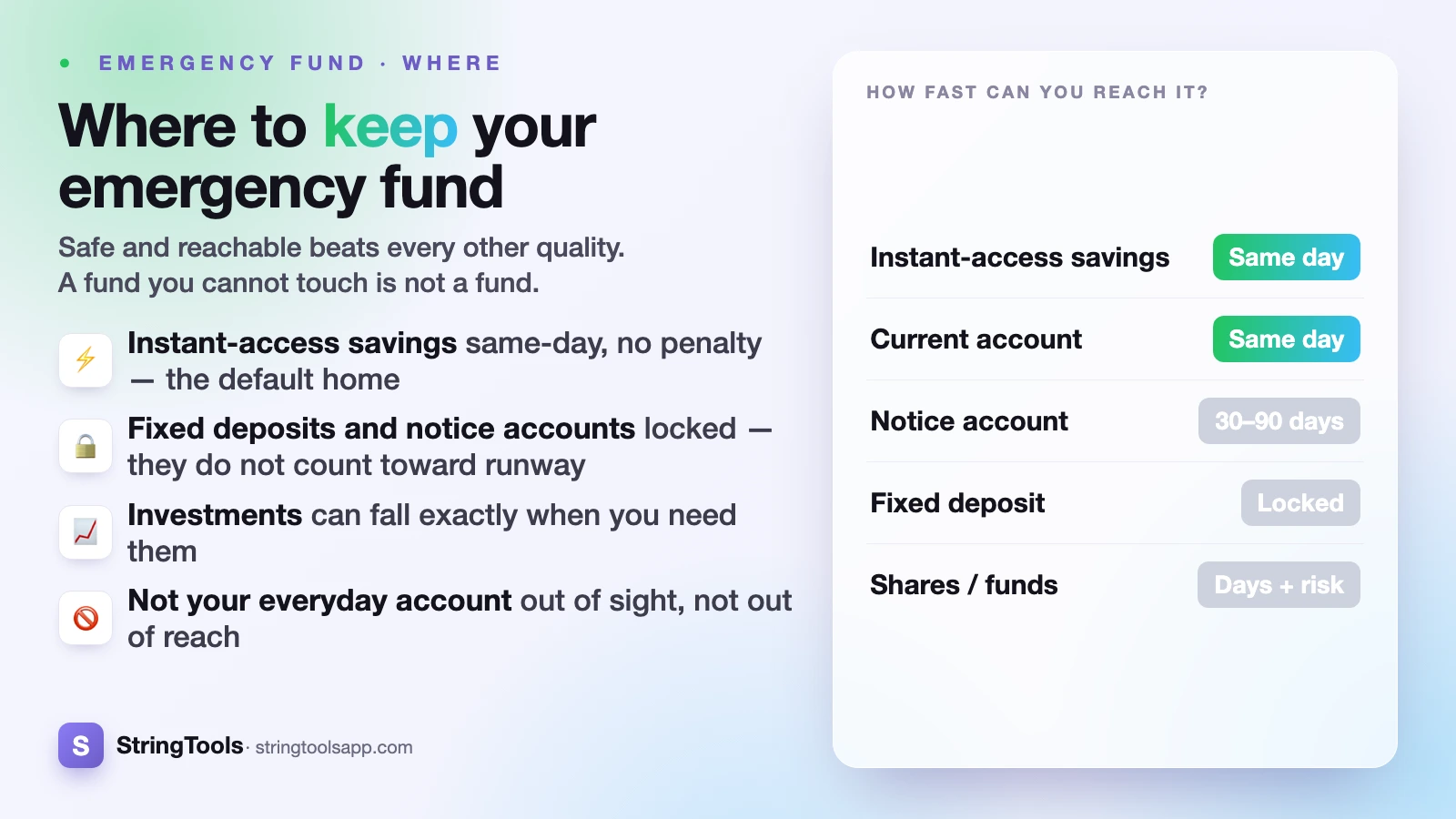
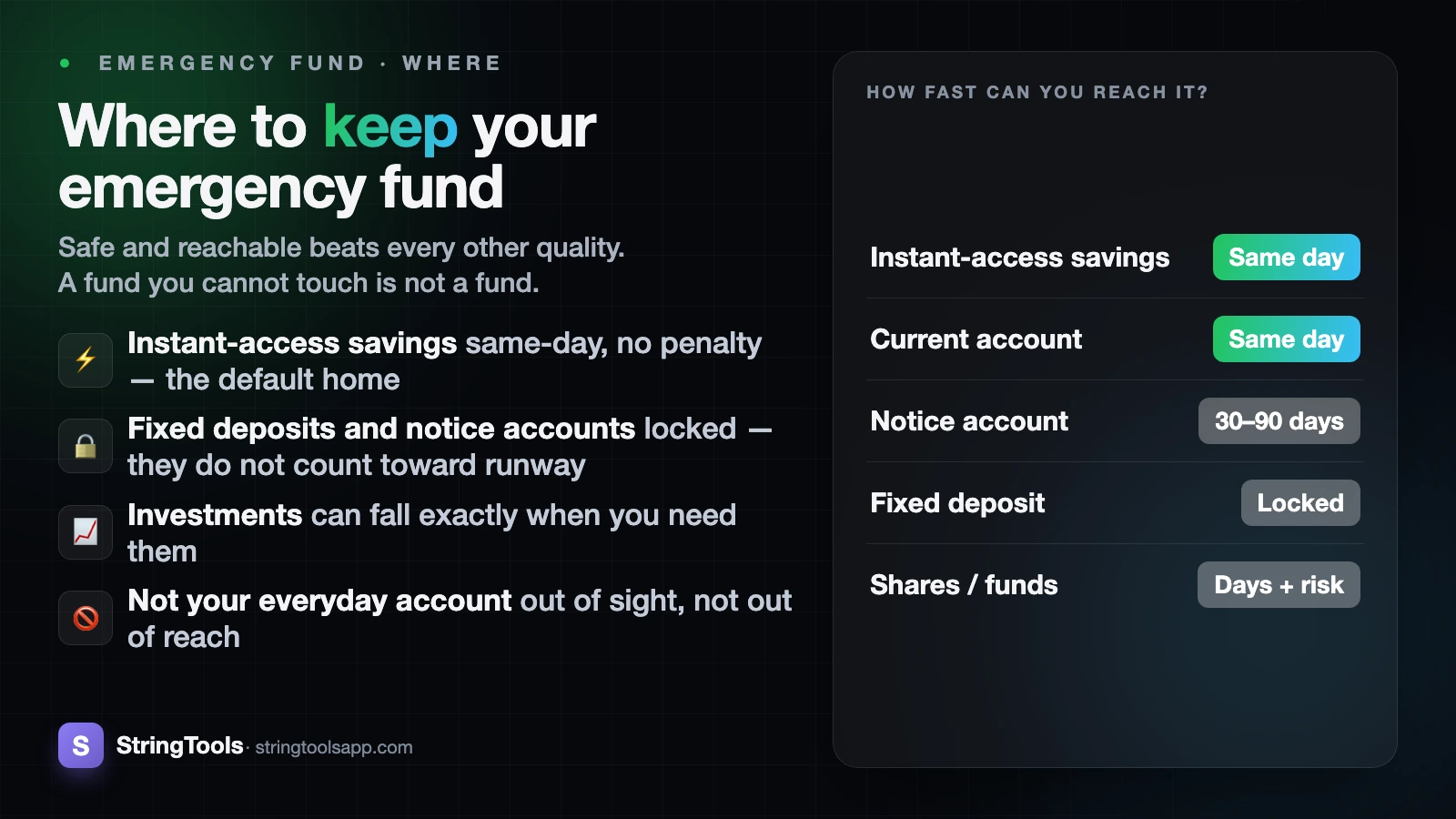
Keep your emergency fund in an instant-access savings account, separate from your everyday current account, at an institution covered by a deposit-protection scheme. You need to reach the money within a day or two, with no penalty, no selling, and no market risk. Locked or invested money is a backup, not the fund.
Key Takeaways
- The test for an emergency fund home is access, not return. If you cannot get the cash out within a couple of days, it is not your emergency fund.
- Instant-access savings accounts are the standard choice: separate from daily spending, no penalty, protected by a deposit scheme in most countries.
- Notice accounts, fixed-term deposits (CDs) and investments are fine for a second layer, but they should not be counted in your core runway.
- Your current account is too accessible: money there gets spent. Physical cash is too exposed: it can be lost, stolen or destroyed.
- The emergency fund calculator lets you mark each balance as instant access or locked, and only counts the accessible money toward your runway.
- This is general information, not personal financial advice. A regulated adviser can help with a decision that depends on your circumstances.
The one question that decides it: how fast can I get the money out?
People spend a long time comparing rates and almost no time asking the question that matters for an emergency fund: if the boiler fails on a Friday night, or a redundancy letter arrives on Monday, how quickly can this money reach my current account?
An emergency fund has one job: to turn a sudden bill or a gap in income into an inconvenience rather than a crisis. A slightly better return is worth very little if, to get at it, you must give 90 days' notice, pay a penalty, or sell an investment on a day when it happens to be down.
So sort every possible home for the fund by three things, in this order:
- Access time. Same day, next working day, a few days, weeks, or months.
- Cost of getting out. None, a penalty, lost interest, or a possible loss of capital.
- Protection. Is the balance covered by a deposit-protection scheme if the institution fails?
Return comes fourth. A fund that earns nothing does lose ground to inflation over the years, but return is the tie-breaker between accounts that already pass the first three tests, never a reason to fail them.
The broad hub on how to build an emergency fund covers how much to save and how fast. This post goes deeper on the single question of where the money sits once you have it.
Account types compared: access, penalty, protection, return
The names differ between countries, but the categories are the same almost everywhere. UK and US terms are shown together where they differ.
| Account type | Typical access time | Cost of withdrawing | Deposit protection | Counts toward the fund? |
|---|---|---|---|---|
| Instant-access savings (easy-access / high-yield savings) | Same day to next working day | None | Usually yes, within the scheme limit | Yes, this is the core |
| Current account (checking account) | Instant | None | Usually yes | Technically yes, but see below |
| Notice account | The notice period, often 30 to 120 days | None if you wait; often a penalty if you do not | Usually yes | No, until the notice has been served |
| Fixed-term deposit (fixed-rate bond / CD) | At maturity, months to years | Interest penalty, sometimes closure only | Usually yes | No |
| Money-market fund | Two to three working days after selling | None, but the value can move slightly | No, it is an investment, not a deposit | Partial, as a second layer (mark it locked in the calculator) |
| Stocks, shares, bonds, funds | Days to settle, and only during market hours | Possible loss of capital, possible tax | Not against market falls | No |
| Retirement account (pension, 401(k), IRA) | Restricted, often with age rules | Penalties and tax in most cases | Not against market falls | No |
| Physical cash at home | Instant | None | None at all | A small float only |
| Credit card limit | Instant | Interest from day one unless cleared in full | Not applicable | No, it is debt, not savings |
Only the top row does everything an emergency fund needs. Several rows that feel like savings (a fixed-term bond, a pension, a credit limit) either cannot be reached in time or cost something painful to reach.
Protection limits vary by country and change from time to time, so check the current figure with your national scheme. In the US that is the FDIC for banks and the NCUA for credit unions; in the UK it is the FSCS. If your fund is larger than the limit, split it across two institutions.
Instant-access savings: the default, and why it works
An instant-access savings account (called easy-access in the UK, and often a high-yield or online savings account in the US) is the standard answer for good reasons.
- It is separate. The money is not in the account your card is linked to, so it is not quietly absorbed by an expensive month. You have to make a deliberate transfer to spend it, and that friction is a feature.
- It is fast. A transfer to your current account lands the same day or the next working day. A garage will accept a payment on Monday for a problem that happened on Saturday.
- It has no penalty. You can take out some or all of the balance without losing interest already earned.
- It is protected. At a licensed bank, building society or credit union, the balance is covered by the deposit-protection scheme up to its limit.
- It earns something. Not much, and rates move, but more than a current account, and it does not fall in value.
Two practical points. Some instant-access accounts cap the number of withdrawals a year or drop the rate after a certain number; read the terms and know what they are. And a tax-advantaged wrapper (a cash ISA in the UK, for instance) does not change the access test. An instant-access account inside a wrapper is still instant access; a fixed-term one is still locked.
The locked layer: notice accounts, fixed deposits and investments
None of these are bad places for money. They are bad places for emergency money, and the distinction matters.
Notice accounts pay a bit more in exchange for a waiting period, commonly 30 to 120 days, between asking for your money and getting it. Serve notice today on a 90-day account and the money arrives in three months. Useful for a planned expense; useless for a cracked windscreen.
Fixed-term deposits (fixed-rate bonds in the UK, certificates of deposit in the US) lock the money until maturity. Withdrawing early usually costs a chunk of interest, and some products do not allow it at all. A laddered set, where one matures every few months, is a reasonable second layer. It is not the fund.
Money-market funds hold very short-dated, high-quality debt and aim to keep their value stable. Selling takes a couple of working days to settle, and the value, though it rarely moves much, is neither guaranteed nor covered by a deposit scheme. Suitable for part of a larger fund; not for the first month's rent.
Stocks, bonds and funds can lose value, and the moments when many people need their emergency fund (a recession, widespread job losses) are exactly when markets tend to be down. Selling into a fall to pay a bill turns a paper loss into a real one. Returns are not guaranteed and past performance does not predict future results. The US SEC's investor education site explains the risks in plain language.
Retirement accounts are the most locked of all. Early access, where allowed, typically means tax and a penalty. Treat them as unreachable for this purpose.
Think of it as three layers: instant access for the first three to six months of essential expenses (the fund itself); notice or laddered fixed deposits for anything beyond that you still want kept safe; and invested money you do not expect to touch for years. Only layer one counts toward your runway, which is the point of the next section.
Why the calculator excludes locked money, and shows it separately
When you enter your accounts in the emergency fund calculator, each balance gets a toggle: instant access or locked. The runway figure at the top only uses the instant-access balances:
runway in months = accessible savings ÷ essential monthly expenses
A worked example. Say you have three pots:
| Account | Balance | Access |
|---|---|---|
| Instant-access savings | 6,000 | Instant access |
| 90-day notice account | 4,500 | Locked |
| 1-year fixed deposit | 9,000 | Locked |
and your essential expenses (rent, utilities, food, insurance, minimum debt payments, transport) come to 3,000 a month.
Your total savings are 19,500, which sounds like 6.5 months of cover. But if you lost your income tomorrow, the money you could actually use next week is 6,000, which is 2 months. The calculator shows 2 months as your runway and puts you in the Building band (1 to 3 months), not Strong (6 months or more). It adds a note along the lines of "your locked savings would show 6.5 months but cannot pay next week's rent", so the bigger number is visible but not mistaken for the real one.
That separation is deliberate. Many people feel safer than they are because they add every balance together. The 90-day notice money would arrive in the fourth month of a job search; the fixed deposit might not arrive at all during the crisis. Neither helps with the first three months, and the first three months are when most emergencies are decided.
The gap the calculator reports is also based on accessible money only. Here the gap to a 6-month target is 18,000 minus 6,000, or 12,000. You then have two choices: save the difference over 6, 12 or 24 months (2,000, 1,000 or 500 a month, which the plan table shows), or wait for the locked pots to mature and move them into instant access, which closes most of the gap without any new saving. The second is often the better option. The money already exists; it is just in the wrong place.
Two places that feel right but are not
Your current account. It passes the access test with a perfect score, and that is the problem. Money that sits alongside day-to-day spending is spent. Not deliberately, but a card payment here and a subscription there, and the 4,000 you meant to keep untouched is 3,100 by the end of the quarter. The friction of a separate account, even at the same bank in the same app, is what keeps the fund intact. A savings pot or vault inside a current account can work, provided it is a genuinely separate balance and not just a label.
Cash at home. Instant, private, and immune to a bank outage. Also uninsured, exposed to fire, flood and theft, and earning nothing. A small float, enough for a taxi, a meal and a night in a hotel if the cards stop working, is sensible. Months of expenses in a drawer is not.
A related question: is a credit card an emergency fund? No. Using it creates a debt that charges interest from the day you swipe unless you clear the statement in full. A card is a useful bridge for the two days a savings transfer takes to land, not a substitute for the savings. The CFPB explains how card interest accrues if you want the mechanism from a regulator rather than a card issuer.
The same logic applies to a sinking fund, the pot for predictable costs like car insurance or a new laptop. It can live in the same instant-access account, but it is not emergency money. The post on sinking funds vs emergency funds explains how mixing the two makes your fund look bigger than it is.
A quick checklist for your emergency fund account
Run the account you are using, or considering, through these questions. A "no" on any of the first four means it is not the right home for the core fund.
- Can I withdraw the full balance within two working days, with no notice?
- Is there no penalty and no lost interest for withdrawing?
- Is the balance covered by a deposit-protection scheme, and is it under the limit?
- Does the balance stay fixed in currency terms, rather than moving with a market?
- Is it separate from the account I spend from day to day?
- If the fund is large, is it split across two institutions?
- Have I marked it as instant access in the emergency fund calculator, so the runway it shows is the runway I really have?
And one that people forget: have I told someone? If you are the one in hospital, a partner or trusted family member needs to know the account exists and how to reach it.
After that the work is boring in the best way: a standing order on payday, and a moment every few months to update the balances in the calculator and watch the runway number tick up.
This is general information, not personal financial advice. Rules on deposit protection, tax treatment of savings and account types differ between countries and change over time; check with your national scheme or a regulated adviser for anything that depends on your situation.
Frequently Asked Questions
Where is the best place to keep an emergency fund?
For most people, an instant-access savings account that is separate from your current account and held at an institution covered by a deposit-protection scheme. It passes the tests that matter: you can get the money within a day or two, there is no penalty, the balance does not fall in value, and it is not sitting where you spend from. Return matters less than access for this particular pot of money.
Should I keep my emergency fund in a fixed deposit or CD to earn more?
Not the core fund. A fixed-term deposit locks the money until maturity and usually charges an interest penalty for early withdrawal, so it fails the access test. If your instant-access fund already covers three to six months of essentials, a laddered set of fixed deposits is a reasonable second layer for money beyond that. In the emergency fund calculator, mark fixed deposits as locked so they are shown separately rather than counted in your runway.
Does money in a notice account count toward my emergency fund?
Only once the notice has been served and the money is on its way. Until then it cannot pay a bill this week, so mark it as locked in the calculator. In the worked example above, 4,500 in a 90-day notice account added nothing to the 2-month runway, even though it made the total savings look like 6.5 months of cover. If you know a period of risk is coming, serving notice early moves that money back into the accessible column.
Is it safe to keep an emergency fund in a money-market fund?
It is safer than shares, but it is an investment rather than a deposit. The value aims to stay stable but is not guaranteed, it is not covered by a deposit-protection scheme, and selling takes a couple of working days to settle. It can be a sensible home for part of a larger fund, behind an instant-access account that covers at least the first few months. Investor.gov and the CFPB both explain the difference between deposits and investments in plain terms.
Why not just keep the emergency fund in my current account?
Because it gets spent. Money that sits next to your everyday balance is absorbed by ordinary spending without any decision being made. A separate instant-access savings account, even at the same bank, adds enough friction to keep the fund intact while still letting you move money in a day when you genuinely need it. A separate savings pot or vault inside a current account can work if it is a genuinely distinct balance.
What if my emergency fund is bigger than the deposit-protection limit?
Split it across two or more institutions so each balance stays under the limit. The limits differ by country and are revised from time to time, so check the current figure with your national scheme, such as the FDIC or NCUA in the US or the FSCS in the UK, rather than relying on an older number. Splitting also protects you from being locked out entirely if one bank has an outage or freezes your login.
Sources and references
FDIC (fdic.gov) · FSCS (fscs.org.uk) · US SEC's investor education site (investor.gov) · CFPB (consumerfinance.gov). Content was reviewed against these sources as of the last-updated date above; external figures and rules may change after publication.