
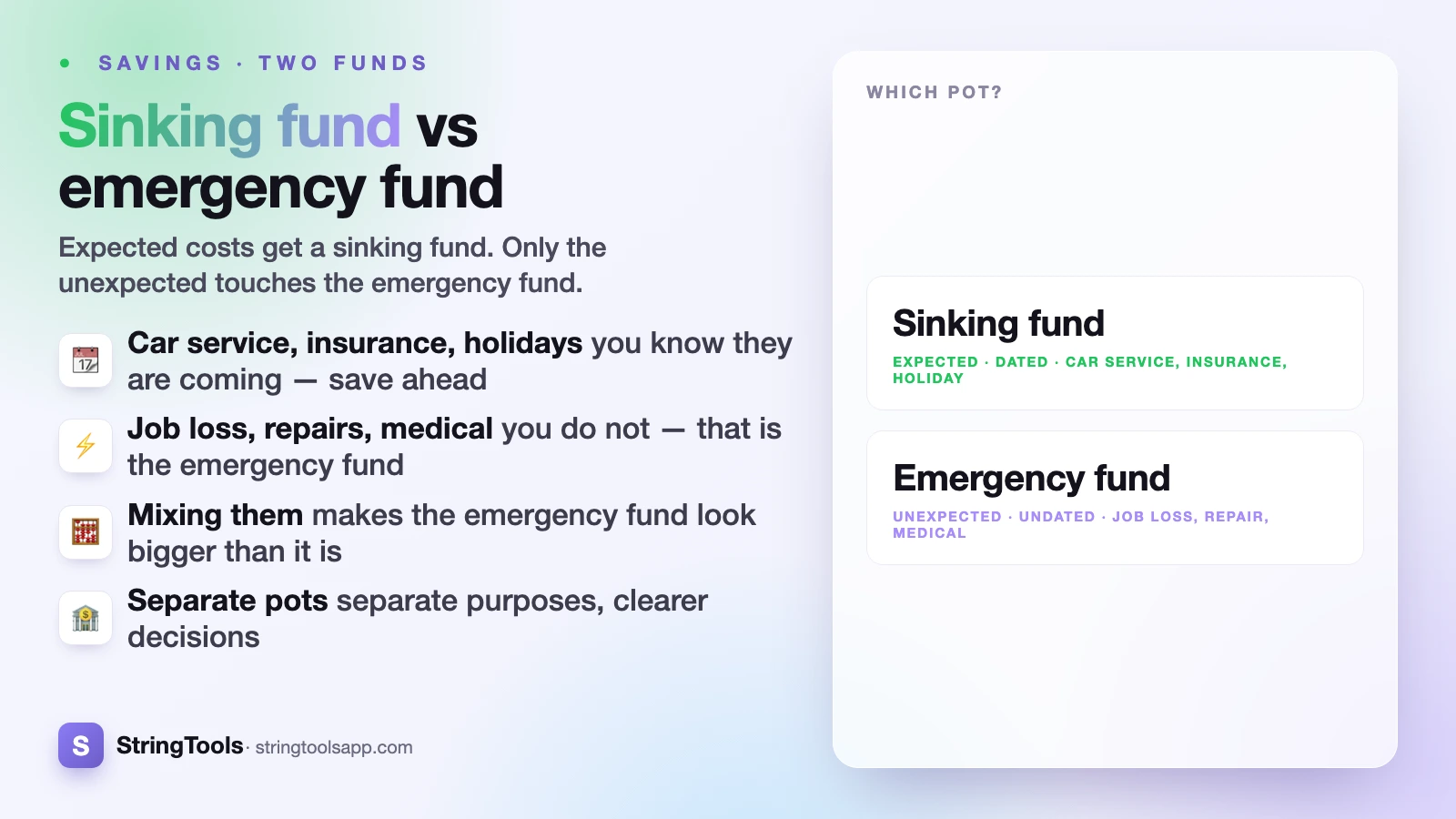
Sinking fund vs emergency fund: the short answer
A sinking fund is money set aside monthly for a cost you know is coming, such as car insurance or a holiday. An emergency fund is for costs you cannot predict, such as job loss or a broken boiler. Most households need both, kept separate, because mixing them makes your emergency cover look bigger than it is.
Key Takeaways
- The test is predictability, not size. If you can name the bill and roughly when it lands, it belongs in a sinking fund.
- A sinking fund is a spending plan spread over time. An emergency fund is insurance you pay yourself.
- Keeping them in one pot inflates your apparent runway. In the worked example below, a 15,000 balance that looks like six months of cover is really 3.6 months once earmarked money is removed.
- Sinking funds protect your emergency fund by catching the "surprises" that were never really surprises.
- Build the emergency fund to a starter level first, then run both in parallel.
- This is general information, not personal financial advice. For a decision about your own money, a regulated adviser is the right person to ask.
What a sinking fund actually is
The name comes from corporate finance, where a company puts money aside over years to repay a bond when it matures. Investopedia has the formal definition. The household version is simpler: you take a cost that arrives once or twice a year, divide it by the number of months until it is due, and move that amount into a labelled pot every month.
Say your car insurance renews each March at 900. Instead of finding 900 in one month, you move 75 a month into a pot called "car insurance". When March comes, the money is already there. Nothing is borrowed, nothing is squeezed from the grocery budget, and your emergency savings are never touched.
The important feature is that a sinking fund is meant to be spent. It fills up, it empties on schedule, and it starts filling again. It is a budgeting device for lumpy costs, not a savings goal in the usual sense. You can run as many as you like: one for the car, one for holidays, one for school costs, one for the annual home bills. Some people keep them as separate savings accounts; others keep one account and track the split on paper or in a spreadsheet. Either works, as long as you know how much of the balance belongs to which future bill.
What an emergency fund is for, and what it is not for
An emergency fund covers the costs you genuinely could not see coming: losing your job, a medical bill, a car that fails on the motorway, a boiler that dies in January, a family emergency that means unpaid time off. The widely used benchmark from consumer-finance bodies such as the CFPB in the US and MoneyHelper in the UK, and from most financial planners, is three to six months of essential expenses. That is guidance, not a rule, and the right figure for you depends on how stable your income is and who depends on it.
The emergency fund is measured in months of runway, not in a currency amount. That is why the emergency fund calculator asks you to list your monthly expenses and mark each one as essential or optional, then divides your instant-access savings by the essential total. A balance of 9,000 against 2,500 of essential monthly costs gives 3.6 months. The same 9,000 against 4,500 of essentials gives two months. The number on the account is meaningless until you know what it has to cover.
What the emergency fund is not for: anything with a date. Car insurance is not an emergency; it renews on the same day every year. Christmas is not an emergency; it has been on the same date for a very long time. A holiday you booked is not an emergency. When these are paid from the emergency fund, the fund gets treated as a general float, it drains steadily, and it is half-empty on the day a real emergency arrives.
The predictability test: one question that sorts every cost
Ask of any expense: can I name the bill and roughly when it will land?
- Yes to both (car service every October, insurance every March, school uniform every August): sinking fund.
- Yes to what, no to when (tyres will wear out, the washing machine will fail eventually, the cat will need the vet): still a sinking fund, sized on the typical replacement cycle. You know the cost is coming even if you cannot circle a date.
- No to both (redundancy, an accident, a sudden move, a family crisis): emergency fund.
The second category is where most people go wrong. Because the exact month is unknown, it feels like an emergency when it arrives. But a car that is eight years old will need work; a boiler that is fifteen years old will need replacing. Treating these as shocks means your emergency fund is quietly financing routine wear and tear.
Here is how ten common costs sort under that test.
| Cost | Sinking or emergency? | Why |
|---|---|---|
| Annual car insurance renewal | Sinking | Known amount, known date, every year |
| Car service and annual inspection | Sinking | Predictable date; cost varies but within a known range |
| Replacement tyres | Sinking | Wear is gradual; you can see it coming |
| Holiday or trip you plan to take | Sinking | You choose the date and the budget |
| Christmas, birthdays, gifts | Sinking | The dates never move |
| School fees, uniform, trips | Sinking | Term dates are published a year ahead |
| Annual home costs (boiler service, home insurance) | Sinking | Renews on schedule each year |
| Job loss or a cut in hours | Emergency | No date, no warning, open-ended duration |
| Major car breakdown or accident repair | Emergency | Unplanned, immediate, often large |
| Boiler or furnace failure, urgent home repair | Emergency | Cannot be scheduled, cannot be delayed |
Two rows deserve a note. Routine vet costs and a modest "car repairs" pot are sinking funds; a serious accident or illness that blows past what you set aside is an emergency, and it is fine for the emergency fund to cover the excess. The sinking fund takes the first hit; the emergency fund takes the overflow.
How mixing the two makes your fund look bigger than it is
This is the part that catches people out, and it is easiest to see with numbers. Assume a household with essential monthly expenses of 2,500 and 15,000 sitting in an instant-access savings account. On paper that is 15,000 ÷ 2,500 = six months of runway, which lands in the calculator's "Strong" band.
Now list what that 15,000 is already promised to over the coming year.
| Upcoming cost | Annual amount | Monthly set-aside |
|---|---|---|
| Car insurance | 900 | 75 |
| Car service and inspection | 600 | 50 |
| Holiday | 2,400 | 200 |
| Christmas and birthdays | 900 | 75 |
| Annual home costs (boiler service, home insurance) | 1,200 | 100 |
| Total earmarked | 6,000 | 500 |
Of the 15,000, 6,000 is not emergency money at all. It is next year's known bills, sitting in the same account. The true emergency fund is 15,000 − 6,000 = 9,000, which is 9,000 ÷ 2,500 = 3.6 months. That is still a reasonable position, and it sits in the calculator's "Solid" band, but it is not the six months the headline balance suggested. If a job loss arrived in February, the household would spend its first weeks discovering that the holiday, the insurance and the car service still needed paying, from a fund that was shrinking faster than the runway figure promised.
The fix is not to save more. The fix is to label the money honestly. Move the 6,000 into a separate sinking-fund account, or at least record it as spoken for, and put only the 9,000 into the emergency fund calculator. The tool then shows a truthful 3.6 months and a realistic gap to a six-month target (15,000 − 9,000 = 6,000, or 250 a month over 24 months). A plan built on the wrong starting number is a plan that fails on the day it is needed.
Why sinking funds protect your emergency fund
A sinking fund does two jobs beyond paying the bill it was named for.
First, it keeps the emergency fund untouched. Every time a known cost is paid from a sinking fund, the emergency fund stays whole, and the runway figure you rely on stays true. Households that run sinking funds are far less likely to need their emergency savings, simply because most of the "emergencies" in a typical year were dated bills all along.
Second, it converts lumpy spending into a flat monthly number that fits inside a budget. In the example above, 6,000 of annual costs becomes a 500 monthly transfer. That 500 can be treated like rent: fixed, automated on payday, and not available for anything else. The emergency fund calculator lets you enter this 500 as a monthly expense and mark it essential if you want your runway to reflect the fact that those bills keep arriving even when income stops. That is a conservative choice, and it is the honest one for costs like insurance that cannot be skipped.
There is also a quieter benefit. Because sinking funds are meant to be spent, spending from them carries no guilt and no sense of setback. Spending from an emergency fund on a non-emergency, by contrast, tends to feel like a failure, and the fund often never gets rebuilt. Separating the two keeps the emergency fund psychologically off-limits, which is exactly what it needs to be.
Where each pot should live
Both funds need to be reachable, but not equally fast.
An emergency fund must be instant access. If the car dies on Tuesday, the money has to be there by Wednesday. That rules out fixed-term deposits, notice accounts and anything invested. This is why the calculator asks you to mark each savings balance as instant access or locked and counts only the accessible money toward runway, showing the "with locked savings" figure separately as a note. The full comparison of account types is in where to keep your emergency fund.
A sinking fund has more room. Because you know when each bill is due, a pot that matures a week before the insurance renewal is perfectly fine, and a small return on money that would otherwise sit idle is welcome. In practice most people keep sinking funds in one or more instant-access savings accounts too, because the amounts are modest and the convenience of a labelled pot outweighs a slightly better rate elsewhere. The one thing to avoid is a sinking fund in an account with a withdrawal penalty that lands before the bill does.
Whatever you choose, keep the emergency fund in an account you do not see every day. The sinking funds can sit next to your current account; the emergency fund is better one step removed, so that moving money out of it is a deliberate act rather than a tap on a screen.
Which to build first, and how to run both
If you are starting from nothing, build a small emergency fund first: one month of essential expenses, or enough to cover the most likely single shock in your life (for most people, a car repair or an insurance excess). In the example household that is 2,500. Without that buffer, the first surprise goes on a credit card, and interest on the card will outrun anything a sinking fund saves you.
Once the starter fund exists, run both in parallel:
- List every dated cost for the next twelve months. Insurance renewals, services, holidays, school costs, gifts, subscriptions billed annually. Total them and divide by twelve. In the example that is 6,000 ÷ 12 = 500 a month.
- Set the sinking-fund transfer first, because those bills are certain. Automate it on payday.
- Put whatever remains of your savings capacity toward the emergency fund until it reaches your target in months. The calculator's plan table shows the monthly figure for closing the gap over 6, 12 or 24 months and, if you enter your income, what percentage of it that represents. Plans that need more than roughly a fifth of take-home pay rarely survive contact with real life, so the 24-month line is often the honest one. The method for turning any target into a monthly number is in how to set a savings goal and hit it.
- Review twice a year. Bills change, cars age, children start school. Add a new sinking fund when a new dated cost appears, and retire one when the cost goes away.
If money is tight and you can only do one thing this month, do this: open the emergency fund calculator, enter your real accounts and your real bills, and subtract anything already earmarked before you read the runway figure. Knowing the true number, even if it is smaller than you hoped, is the step that makes every later decision easier. The figures stay in your browser on that device; nothing is uploaded and there is no account to create.
Frequently Asked Questions
Is a sinking fund the same as an emergency fund?
No. A sinking fund is money set aside monthly for a cost you can predict, such as car insurance or a holiday. An emergency fund is for costs you cannot predict, such as job loss or an urgent repair. The first is a spending plan spread over time; the second is a reserve you hope not to use. Keeping them in one account makes the emergency reserve look larger than it is.
Should I have a sinking fund or an emergency fund first?
Build a small emergency fund first, roughly one month of essential expenses or enough to cover your most likely single shock. Then set up sinking funds for your dated bills and keep growing the emergency fund alongside them. The starter emergency fund stops the first surprise going onto a credit card; the sinking funds stop the predictable bills from draining it afterwards.
How many sinking funds should I have?
As many as you have distinct dated costs, and no more than you will actually track. Common ones are car (insurance, service, tyres), home (annual insurance, boiler service), holidays, gifts, and school costs. Some people run five or six separate pots; others keep one account and a simple list of what each portion is for. The number matters less than knowing that the money is spoken for.
Does money in a sinking fund count toward my emergency fund?
It should not. In the worked example, a 15,000 balance with 6,000 earmarked for next year's bills is really a 9,000 emergency fund, which is 3.6 months against 2,500 of essential monthly costs rather than six. When you use the emergency fund calculator, enter only the money that is genuinely free to cover an emergency, so the runway and the gap to your target are truthful.
Can I use my emergency fund for a sinking-fund cost if I run short?
You can, and occasionally you will, but treat it as a signal that the sinking fund was undersized rather than as normal practice. Repay the emergency fund first from the next few months of surplus, then increase the monthly sinking-fund transfer so the shortfall does not repeat. A pattern of borrowing from the emergency fund for dated bills is the main way runway figures drift out of line with reality.
Where should a sinking fund be kept?
Usually in an instant-access savings account, separate from your day-to-day current account so the money is not spent by accident. Because you know when each bill is due, a sinking fund can tolerate an account that takes a few days to pay out, as long as it will not charge a penalty before the bill lands. The emergency fund is stricter: it needs to be instant access, which is why the calculator counts only accessible savings toward your runway.
Sources and references
Investopedia (investopedia.com) · CFPB (consumerfinance.gov) · MoneyHelper (moneyhelper.org.uk). Content was reviewed against these sources as of the last-updated date above; external figures and rules may change after publication.