
The only savings formula you need: gap divided by months
To set a savings goal you will actually hit, divide the amount you still need (the gap) by the months you are willing to wait: that is your monthly figure. Then check it against income. Plans needing more than about 20% of take-home pay tend to be abandoned, so stretch the months, not the budget.
Key Takeaways
- Every savings goal reduces to one line: gap ÷ months = monthly amount. If you cannot say all three numbers, you do not have a plan yet.
- The gap is the target minus what you already have set aside for that goal, not your whole balance.
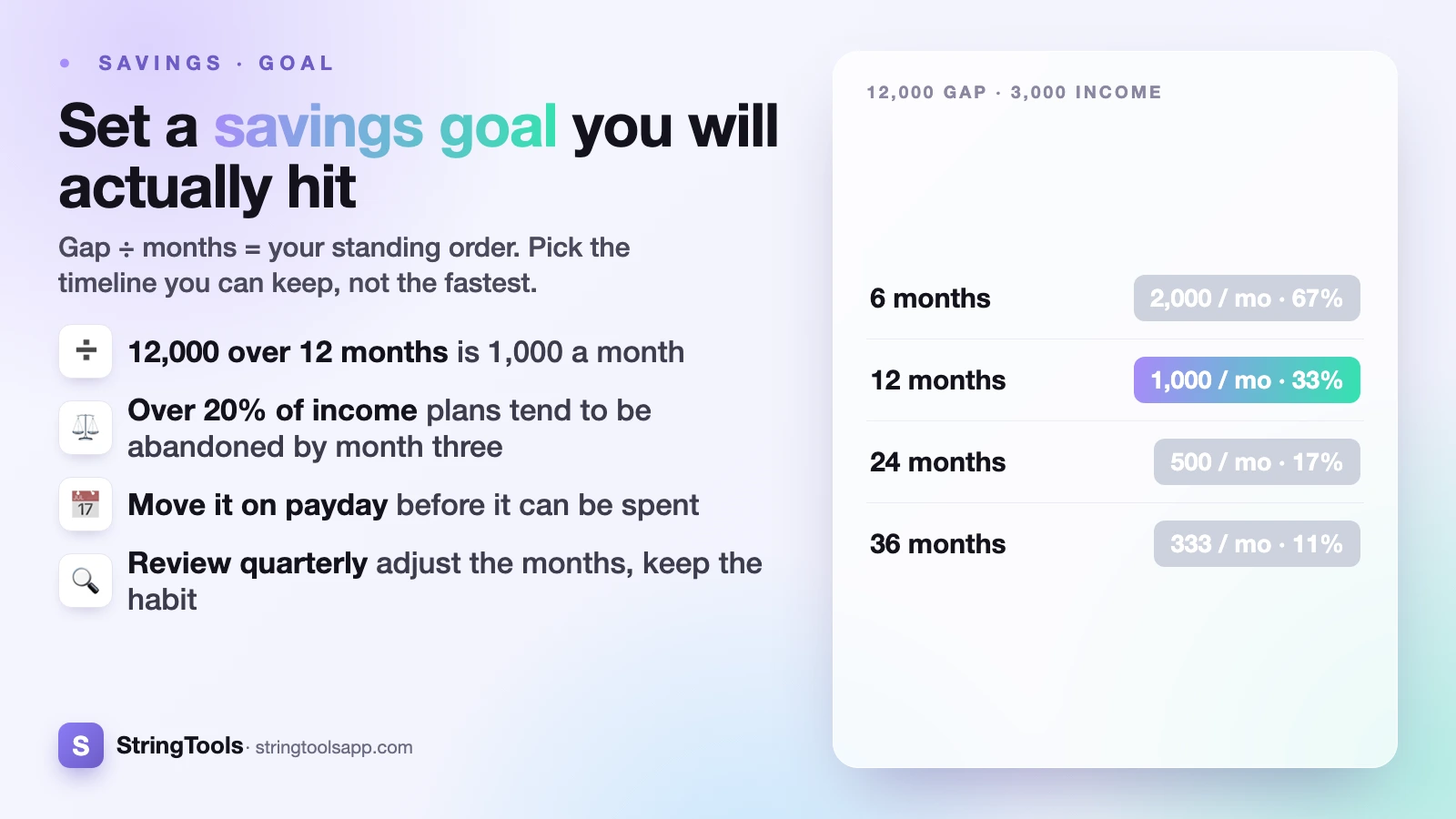
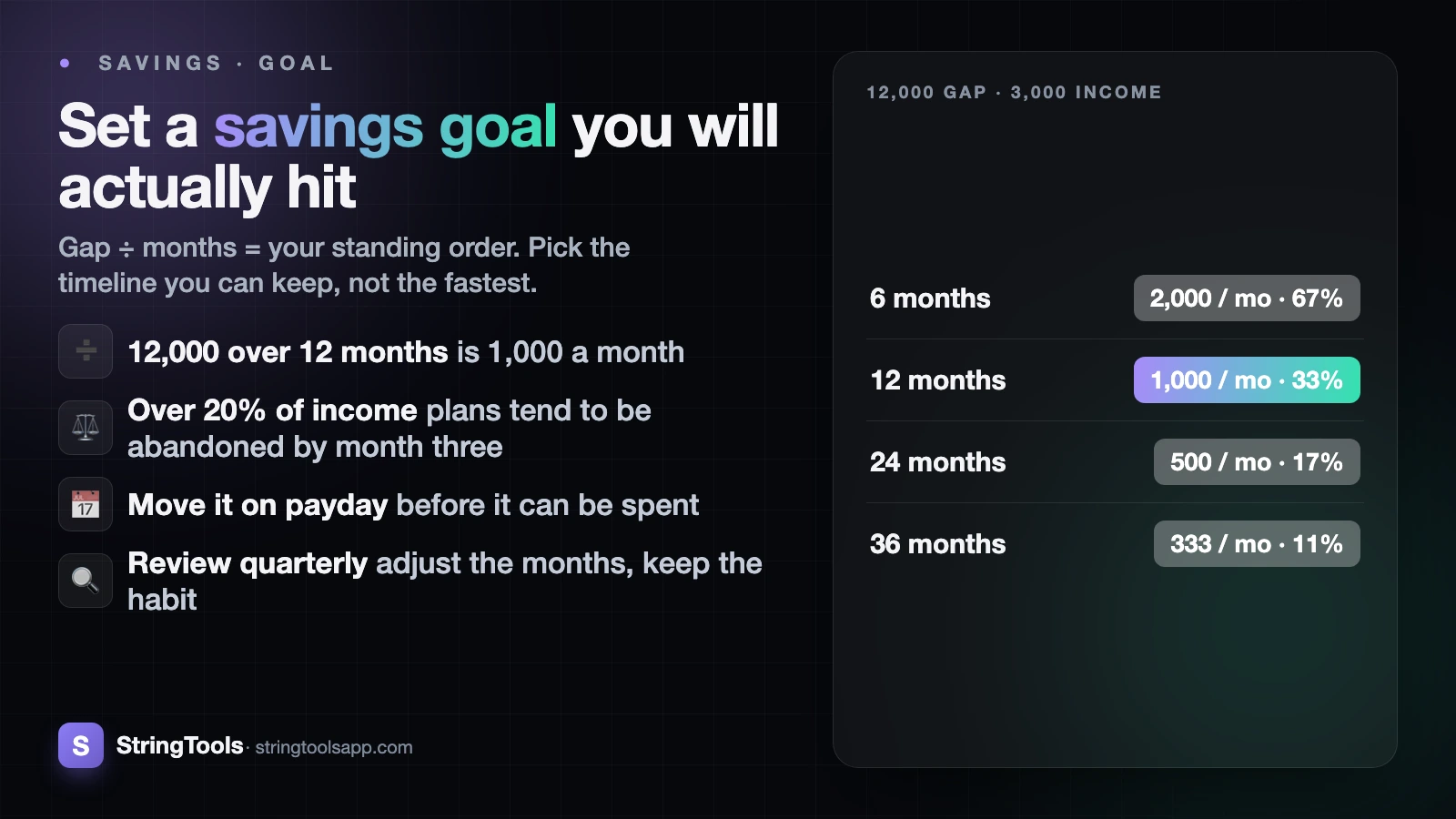
- A 12,000 gap costs 2,000 a month over 6 months, 1,000 over 12, 500 over 24 or roughly 333 over 36. The target does not change; the pain does.
- Anything above roughly 20% of take-home pay is a plan you will quietly break the first time a bill lands. Lengthen the timeline instead.
- Automate the transfer on payday so the money leaves before you can spend it, then review the number every three months, not every week.
- This is general information, not personal financial advice. For a decision that depends on your circumstances, speak to a regulated adviser.
Most people set savings goals the wrong way round: they pick a monthly amount that feels virtuous and hope it adds up. A goal that works starts at the other end, with a target, a date and a piece of arithmetic that tells you whether the two are compatible with the money you actually earn.
Step 1: Name the target and measure the gap
A target is a number attached to a purpose. "Save more" is not a target; "a 15,000 emergency fund" is. A vague goal can never be finished, and a goal that cannot be finished offers no reward for sticking to it.
Once you have the target, subtract what you already hold for that goal. That is the gap. Two mistakes creep in here.
The first is counting money that is spoken for. If your account holds 4,000 but 2,500 of it is next month's rent and a tax bill, your real starting point is 1,500. Use the balance that is genuinely free.
The second is counting money that is locked away. A fixed-term deposit that matures in two years is real savings, but it cannot pay for a boiler that fails in March. For an emergency fund in particular, only instant-access money counts. The emergency fund calculator makes you mark each balance as instant access or locked for exactly this reason, and it works out your gap to a 3-month, 6-month or custom target from the accessible balance alone.
A worked example we will carry through the rest of this post: you want a 15,000 emergency fund. You have 3,000 in an instant-access savings account that is not earmarked for anything else. Your gap is 12,000. Your take-home income is 3,000 a month.
If the goal is an emergency fund and you are not yet sure whether 15,000 is the right target, the sizing question is covered separately in how to build an emergency fund. This post assumes you already know the number and want to reach it.
Step 2: Divide by months and look at the trade-off honestly
Now divide the gap by a range of timelines, not just one. Seeing the whole row is what turns a wish into a decision, because the question stops being "can I save 12,000?" and becomes "which of these monthly amounts can I sustain?"
Here is the 12,000 gap against a 3,000 monthly take-home income:
| Timeline | Monthly amount | Share of 3,000 income | Realistic? |
|---|---|---|---|
| 6 months | 2,000 | 66.7% | Only with a windfall or a second income |
| 12 months | 1,000 | 33.3% | Possible for a short, disciplined push |
| 18 months | 666.67 | 22.2% | Borderline; workable if fixed costs are low |
| 24 months | 500 | 16.7% | Sustainable for most single-goal savers |
| 36 months | 333.33 | 11.1% | Comfortable; leaves room for other goals |
The arithmetic is exact: 12,000 ÷ 18 = 666.67, and 666.67 ÷ 3,000 = 22.2%. Every figure in that table is the same gap, the same income and the same eventual result. The only thing that changes is how much of each pay cheque disappears before you see it.
Notice how the share of income falls steeply at first and then flattens. Going from 6 to 12 months halves the monthly figure; going from 24 to 36 only trims it from 500 to 333. The first extension buys the most relief, and beyond about two years you are mostly adding delay rather than comfort.
The plan table in the emergency fund calculator shows the same idea for the 6, 12 and 24-month rows, and adds the percentage column if you enter your income. The percentage is the figure that predicts whether you will still be saving in month nine.
Step 3: Why plans above roughly 20% of income tend to be abandoned
There is no law that says 20%. But there is a practical reason plans well above a fifth of take-home pay collapse, and it has nothing to do with willpower.
Your fixed costs do not shrink because you set a goal. Rent, utilities, insurance, minimum debt payments, transport and groceries absorb most of a household's take-home pay, and what is left is the only money a plan can draw on. The more of it you commit, the smaller your margin for a normal month going slightly wrong. A car repair or a dental bill forces you to skip a transfer; skip twice and the plan feels broken, and a broken plan gets quietly dropped.
At 16.7% of income (the 24-month row), a 3,000 earner keeps 2,500 for everything else, and a surprise 300 cost is absorbable. At 33.3% (the 12-month row) they keep 2,000, and the same cost now competes directly with the transfer. At 66.7%, the plan only survives if nothing goes wrong for six months, which is not how months work.
There are exceptions: low fixed costs, a bonus or second income on the way, or a short sprint you have consciously chosen. The point is not that 20% is sacred. The point is that you should choose the rate deliberately, with the fixed-cost picture in front of you, and default to the longer timeline when in doubt. A 24-month plan you finish beats a 12-month plan you abandon in month five.
For guidance on how your savings rate fits alongside the rest of a budget, how much of my paycheck should I save walks through the common frameworks. This post is only about hitting one specific target.
Step 4: Turn the number into a standing order on payday
The monthly figure is useless as an intention. It only works as a transfer that happens without you.
Set up an automatic transfer (a standing order in the UK, a recurring transfer in the US and elsewhere) from your current account to the account holding the goal, dated the day your pay lands or the day after. Money that moves on payday is money you never had the chance to spend; money you plan to move "at the end of the month" has usually been spent by then.
A few practical details make this stick:
- Use a separate account for the goal. When savings sit alongside spending money, the balance looks larger than it is and gets nibbled. For an emergency fund the account type should be instant access with no withdrawal penalty; the Consumer Financial Protection Bureau and the UK's MoneyHelper both publish plain guidance on choosing savings accounts.
- Name the account after the goal if your bank allows it. "Emergency fund" or "Car deposit" is harder to raid than "Savings 2".
- Round the figure up, slightly. If the arithmetic says 666.67, set 675 or 700. The plan finishes a little early and the extra is a buffer for the month you cannot manage the full amount.
- Do not link a card to the savings account. Friction is the feature.
If your income is irregular, a fixed standing order can bounce. Save a fixed percentage of each payment as it arrives instead; the freelancer case is covered in emergency fund for freelancers and single-income households.
Automate the end too. When the goal is reached, redirect the transfer to the next goal the same day, or reduce it to a small top-up. A standing order with no target quickly becomes invisible, and invisible money gets spent.
Step 5: Review quarterly, not daily
Checking the balance daily makes small plans feel slow and encourages tinkering. Instead, put a fifteen-minute review in the calendar every three months and ask four questions.
Is the gap shrinking at the rate the plan predicted? With a 500 monthly transfer, the 12,000 gap should be 10,500 after three months, 9,000 after six, 6,000 after twelve and zero after twenty-four. If you are behind, find out which month was skipped and why. If it was a one-off, ignore it; if it was the third time, the rate is too high and the timeline needs lengthening.
Has the target changed? Rent rises, a new dependant, a change in job security or a move all change what an emergency fund needs to cover. Re-run your monthly essentials and see whether 15,000 still represents the number of months you want. The emergency fund calculator keeps your last figures in the browser on that device, so updating a rent line and re-reading the gap takes a minute.
Has your income changed? If take-home pay rises, the same 500 is now a smaller percentage. Decide consciously whether to keep it (and finish on schedule) or raise it (and finish earlier). Either is fine; drifting is not.
Is the money still accessible? If you moved part of the fund into a notice account or fixed-term deposit, check the accessible runway rather than the total. A fund you cannot reach for 90 days is not the same as one you can reach tomorrow.
Here is the 24-month plan at each review, so you know what "on track" means before you start:
| Review point | Months elapsed | Transferred so far | Remaining gap |
|---|---|---|---|
| Start | 0 | 0 | 12,000 |
| First review | 3 | 1,500 | 10,500 |
| Second review | 6 | 3,000 | 9,000 |
| Halfway | 12 | 6,000 | 6,000 |
| Sixth review | 18 | 9,000 | 3,000 |
| Finish | 24 | 12,000 | 0 |
Ignore interest for the purpose of this table. Any interest the account pays shortens the timeline slightly, but rates change and differ by country, so plan on the transfers alone and treat any growth as a bonus.
Running more than one goal at once
Most people have several targets competing for the same leftover money: an emergency fund, a holiday, a car, a deposit. Funding all of them at once is how the 20% ceiling gets breached without anyone noticing, because each goal on its own looks modest.
Add up every monthly figure and check the total against your income, not each goal separately. If the total is too high: lengthen the timelines, pause the lowest-priority goal until another finishes, or fund goals in sequence.
A useful ordering, which most consumer-finance guidance broadly agrees on, is to get a small emergency cushion first (enough to absorb an ordinary surprise bill), then clear expensive short-term debt, then build the fund out to your full target, and only then fund the discretionary goals. Investopedia's overview of the emergency fund is a reasonable neutral definition if you want the concept stated in one place.
Be honest about which goals are savings goals at all. Predictable costs like an annual insurance premium or a car service are not emergencies, and mixing them into the emergency fund makes it look larger than it is. They belong in separate sinking funds with their own gap-÷-months arithmetic, the distinction drawn in sinking fund vs emergency fund.
A checklist you can run tonight
If you still have not written a number down, do this now, in order.
- Write the target as a figure with a purpose: "15,000 emergency fund", not "more savings".
- Write what you already hold for that purpose, counting only money that is free and instant access. Subtract it. That is your gap.
- Write your monthly take-home income.
- Divide the gap by 6, 12, 18, 24 and 36. Write down all five monthly figures and the percentage of income each one represents.
- Circle the longest timeline whose percentage sits comfortably under your fixed-cost reality, which for most people means somewhere around 20% or below.
- Open your banking app and set an automatic transfer for that amount, rounded up a little, dated the day after payday, into a separate account named after the goal.
- Put a fifteen-minute review in the calendar for three months from today, with the expected remaining gap written in the event.
- If the goal is an emergency fund, type your real accounts and bills into the emergency fund calculator so the runway, gap and plan table use your actual numbers. It stores the figures in your browser on that device only; nothing is uploaded and there is no account.
That is the whole method: gap, months, number, standing order, review. Everything else is either a way of making the gap smaller or the months shorter, and both are easier once the arithmetic is written down where you can see it.
Frequently Asked Questions
How much should I save each month to reach a goal?
Divide the amount you still need by the number of months until you want it. A 12,000 gap over 24 months is 500 a month; over 12 months it is 1,000. Then check the monthly figure against your take-home pay. If it is much more than about 20% of income, most people will not sustain it, so lengthen the timeline rather than forcing the number.
Is 20% of my income the right amount to save?
It is a useful ceiling for a single goal, not a rule. Fixed costs like rent, utilities and minimum debt payments do not shrink when you set a target, so committing more than about a fifth of take-home pay leaves too little margin for an ordinary month going wrong. If your fixed costs are unusually low, or you have a windfall or a second income, a higher rate can work for a short, deliberate push.
Should I save for several goals at the same time?
You can, but add up every monthly figure and check the total against your income rather than each goal on its own. Three modest goals can easily breach the 20% mark together. A common order is a small emergency cushion first, then expensive short-term debt, then the full emergency fund, then discretionary goals. Predictable costs like insurance or a car service belong in separate sinking funds, not the emergency fund.
What if my income is irregular and a standing order might bounce?
Save a fixed percentage of each payment as it arrives instead of a fixed monthly sum. Decide the percentage in advance and move it the day the money lands. Over a lumpy year the total ends up close to a fixed plan, but no single thin month breaks it. Keep the target and the gap the same; only the transfer rule changes.
Does interest on the savings account change the plan?
Slightly, and always in your favour, but not enough to plan around. Savings rates change and differ by country, so build the timeline on the transfers alone and treat any interest as a bonus that finishes the goal a little early. For an emergency fund the priority is instant access without a withdrawal penalty, not the best rate.
How often should I check whether I am on track?
Every three months is enough. Work out in advance what the remaining gap should be at each review: with a 500 monthly transfer on a 12,000 gap, it should read 10,500 after three months and 9,000 after six. If you are behind because of a one-off, ignore it. If you have skipped transfers repeatedly, the rate is too high for your fixed costs and the timeline needs lengthening.
Sources and references
Consumer Financial Protection Bureau (consumerfinance.gov) · MoneyHelper (moneyhelper.org.uk) · Investopedia's overview of the emergency fund (investopedia.com). Content was reviewed against these sources as of the last-updated date above; external figures and rules may change after publication.