
The short answer: start at three, add a month for each risk you carry
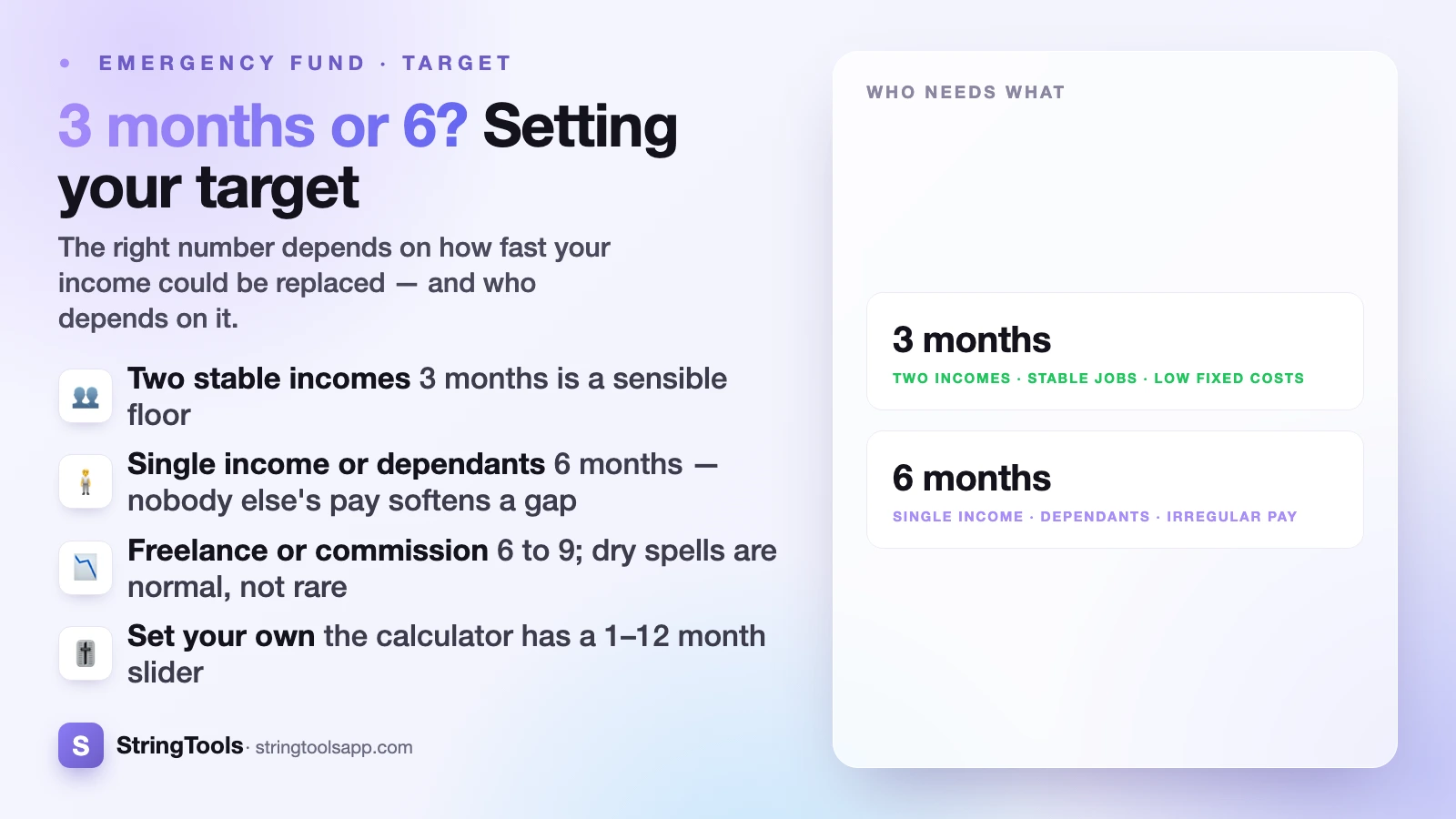
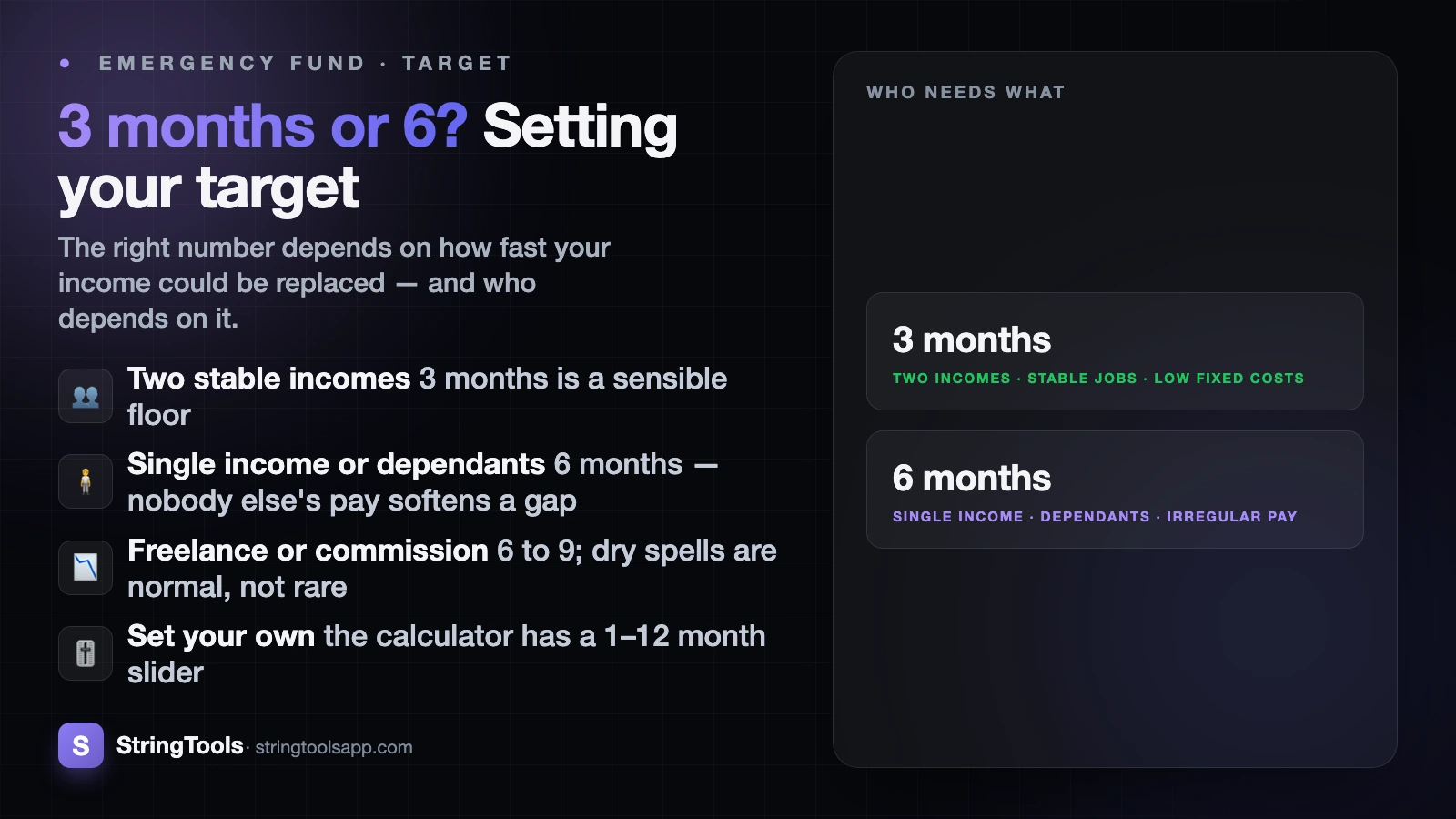
Three months of essential expenses is the floor for a household with two stable incomes and no dependants. Six months is the floor for a single income, self-employment, dependants, or a specialised job that takes time to replace. Set your target by counting your risks, not by picking the number that sounds responsible.
Key Takeaways
- "Three to six months" is guidance used by consumer-finance bodies such as the CFPB and MoneyHelper and by most planners. It is a starting range, not a rule.
- Count the target in months of essential spending, not months of income and not months of total spending. Essentials are what you would still have to pay if your income stopped.
- Five factors move the number: job stability, how many incomes cover the bills, dependants, sick pay, and income variability. Each risk adds one to two months to a three-month base.
- A target above six months is normal for freelancers, single-income families and anyone in a niche field. A target below three months is a stage on the way, not a destination.
- A larger target takes proportionally longer to fund. Pick the number you will actually reach, then raise it.
- This is general information, not personal financial advice. For a decision about your own money, a regulated adviser is the right person to ask.
Why the range exists at all
An emergency fund has one job: to pay the essential bills while your income is interrupted or a large surprise cost is absorbed. The size of that job depends on how long the interruption is likely to last and how many people rely on your money to get through it.
Nobody can know either in advance, so the guidance is a range. The Consumer Financial Protection Bureau in the US and MoneyHelper in the UK both describe three to six months of essential outgoings as a sensible aim for most households. Most planners say the same. It is guidance, not a law, and it was never meant to be applied without looking at your circumstances.
The bottom of the range assumes a short gap: a redundancy where similar work turns up within a quarter, or a month of unpaid sick leave. The top assumes a longer one: a specialised role that takes half a year to replace, or a self-employed dry spell with two clients paying late. Your target sits wherever your own gap is most likely to land.
One unit matters before you start. Count months of essential expenses: rent or mortgage, utilities, groceries, insurance, minimum debt payments and the transport you cannot drop. Not months of income, and not months of everything you currently spend. How Much Emergency Fund Do I Need? walks through building the essentials figure from real bills.
The five factors that move you from three towards six (or past it)
Start every household at three months, then add time for each of the five factors below where you carry the risk. The additions are deliberately rough: the aim is the right neighbourhood, not a formula that claims to see your future.
1. Job stability
Ask how long it would realistically take to replace your income at a similar level. A salaried role in a steady sector with plenty of comparable employers nearby is the low-risk end. A contract or commission-heavy role, a shrinking sector, or a role only a handful of employers hire for is the high-risk end. If the honest answer is more than a quarter, add time.
2. Number of incomes covering the essentials
Two incomes that could each cover the essentials alone is the strongest position: one job lost still leaves the rent paid. Two incomes where one carries most of the load is the middle. A single income is exposed, because the fund is the only thing between a job loss and missed payments. Single-income households should treat six months as their floor, for reasons covered in Emergency Fund for Freelancers and Single-Income Households.
3. Dependants
Children, a partner who does not earn, or a parent you support all raise the cost of a bad month and reduce your freedom to cut spending. You cannot pause childcare the way you can pause a gym membership.
4. Health and sick pay
If you are ill for two months, does money still arrive? Employer sick pay, income protection and any statutory scheme (the UK's is described at GOV.UK: Statutory Sick Pay; entitlements differ by country) change the answer. Self-employed people usually have none of these. A long-term condition in the household also adds time.
5. Income volatility
A fixed salary arrives on the same day every month. Freelance income, bonuses, overtime, tips and seasonal work do not. The more of your essentials are paid from variable income, the more the fund has to smooth the gaps, quite apart from any true emergency.
Situation to target: a table that mirrors the 1 to 12 month slider
The emergency fund calculator has a target slider from 1 to 12 months, defaulting to 6. The table below is a way to choose where to set it: find the row that most resembles you, then move up a row for each additional factor that applies.
| Your situation | Suggested target (months of essentials) |
|---|---|
| Two secure salaried incomes, either could cover the essentials alone, no dependants, good sick pay | 3 |
| Two secure incomes, one carries most of the bills, no dependants | 4 |
| Two incomes with dependants, both in stable sectors | 4 to 5 |
| One secure salaried income, no dependants, employer sick pay | 5 to 6 |
| One income with dependants, stable sector | 6 |
| One income in a volatile or shrinking sector, or a specialised role that takes months to replace | 7 to 8 |
| Self-employed or freelance, no dependants, reliable client base | 8 to 10 |
| Self-employed with dependants, or with income that arrives in lumps | 10 to 12 |
| Sole earner with dependants, no sick pay, and a health condition in the household | 10 to 12 |
| Approaching retirement or otherwise unlikely to re-enter paid work | 12 |
No row goes below three months. One or two months is a real stage in building the fund, and the calculator labels it "Building" rather than failing you for it, but it is not a place to stop on purpose. No row goes above twelve either: past a year of essentials the money is usually better placed in longer-term savings.
If you would rather score it, here is the same logic as points. Begin at 3, add the points, cap at 12.
| Factor | Add 0 | Add 1 | Add 2 |
|---|---|---|---|
| Time to replace income | Under 3 months | 3 to 6 months | Over 6 months |
| Incomes covering essentials | Two, either sufficient alone | Two, one carries most | One |
| Dependants | None | One or two | Three or more, or a dependant with ongoing needs |
| Sick pay and health cover | Employer sick pay or income protection | Statutory or short-term cover only | None, or a long-term condition in the household |
| Income variability | Fixed salary | Some variable pay | Mostly variable or freelance |
A salaried couple with no children in stable jobs scores 3 plus 0, so three months. A single parent on a fixed salary with statutory sick pay only scores 3 plus 0 plus 2 plus 1 plus 1 plus 0, which is seven. A freelancer with a partner who earns a little, one child and no sick pay scores 3 plus 1 plus 1 plus 1 plus 2 plus 2, which is ten.
What the months actually cost: one household, four targets
A target in months only becomes useful when it is turned into money, and that is where the wrong base does damage. Take an illustrative household with a monthly take-home income of 3,600, total monthly spending of 3,000, and essential monthly spending of 2,400 once subscriptions, eating out and other optional items are stripped away. Only the 2,400 matters here.
| Target | Essentials at 2,400 a month | Time to fund at 400 a month | Time to fund at 600 a month |
|---|---|---|---|
| 3 months | 7,200 | 18 months | 12 months |
| 6 months | 14,400 | 36 months | 24 months |
| 9 months | 21,600 | 54 months | 36 months |
| 12 months | 28,800 | 72 months | 48 months |
Notice the same six-month target measured three ways. Six months of income would be 21,600; six months of total spending 18,000; six months of essentials 14,400. The first two are a quarter to a half higher, and they are why so many people decide the target is unreachable before they start. The fund exists for a month in which optional spending has already been cut, so it does not need to cover it.
The right-hand columns are the honest part. Doubling the target from three to six months doubles the money and the time: at 400 a month, eighteen months becomes three years. That is not a reason to pick three when your risks say six, but it is a reason to reach three first and keep going.
Enter the same accounts and bills into the emergency fund calculator and it shows the gap to a 3-month, 6-month and custom target, with a plan table for closing it over 6, 12 or 24 months and, if you gave an income, each plan as a percentage of it.
When three months is genuinely enough
Three months is not the lazy option. For a specific kind of household it is the correct one, and holding much more in instant-access cash has a cost, since that money is not repaying expensive debt or working towards longer goals.
Three months is likely enough if most of the following are true: two incomes, each able to cover the essentials alone; both jobs in sectors with many comparable employers; employer sick pay or income protection; no dependants; and no fixed commitment, such as a mortgage, that takes most of one salary.
There is also a version of "three months is enough for now" that applies far more widely. If you have high-interest debt, a three-month fund followed by aggressive repayment will often leave you better off than a six-month fund built while the debt compounds. Once the debt is cleared, the fund can grow to whatever your score says. How to Build an Emergency Fund covers the sequencing.
What three months does not cover is a long gap. If your field takes six months to rehire into, three months of cash means three months of unpaid bills, and the fund has failed at the one thing it was for. Be honest about the gap before being pleased about the smaller target.
When six months is the floor, not the ceiling
Six months becomes the bottom of the range, not the top, in a few recognisable situations.
- A single income. There is no second pay cheque to absorb a shock. Six months is where to start.
- Self-employment or freelancing. Income is variable, clients pay late, there is usually no sick pay, and tax is paid in lumps from money that looks like savings until the bill arrives. Keep a separate tax pot.
- A specialised or senior role. The narrower the role, the fewer the openings and the longer the search, often well beyond a quarter.
- Dependants who cannot be asked to cut back. Childcare, school costs and support for an older parent continue regardless of what has happened to your income.
- A health condition, or no sick pay. If illness would stop your income at the same time as adding to your costs, the fund is carrying both risks at once.
If two or more of these apply, the scoring table will usually put you between eight and twelve months, and that is not excessive. One distinction matters more as the target grows: money you can reach next week versus money you cannot. The calculator marks each savings entry as instant access or locked and excludes locked money from the runway figure, because a fixed-term deposit maturing in eleven months cannot pay next month's rent. A twelve-month target held mostly in locked accounts is much shorter in practice, and the tool's notes will say so.
Set the target you will reach, then raise it
A target is only useful if it changes what you do on payday. The most common failure is not choosing three when six was right; it is choosing six, saving nothing because the number felt out of reach, and still having nothing when the boiler fails. So set the target in stages, each with a real monthly figure.
- Stage one: one month of essentials. 2,400 in the example. It moves you out of the calculator's "Critical" band, covers a car repair or a short gap between jobs, and stops small emergencies turning into debt.
- Stage two: three months. 7,200 in the example. The floor for the lowest-risk households and the pause point for everyone else. If you carry high-interest debt, this is often where most of the monthly saving switches to repayment.
- Stage three: your scored target. Six, eight, ten or twelve months, whatever the factors gave you. Six months is 14,400 in the example, so the remaining gap after stage two is 7,200: 400 a month for eighteen months, or 600 a month for a year.
Review the target when one of the five factors changes, not on a calendar. A second income, a first child, a move to freelance work, a partner stopping work, a new diagnosis, or a mortgage replacing rent all move the number, sometimes by several months. Scoring rather than guessing means you can see which line of the table changed and by how much.
Once the fund is at target, the monthly amount does not have to stop. Redirecting it to a sinking fund for predictable costs, to overpaying debt, or to longer-term savings keeps the emergency fund for emergencies. The fund is finished when it covers your likely gap, not when it reaches a number someone else chose.
Frequently Asked Questions
Is a 3 month or 6 month emergency fund better?
Neither is better in general. Three months suits a household with two stable incomes, no dependants and sick pay. Six months is the floor for a single income, self-employment, dependants, no sick pay, or a job that takes more than a quarter to replace. Count your risks and set the target from them.
Should my emergency fund be 3 or 6 months of income or of expenses?
Of essential expenses, not income. The fund pays the bills you cannot drop while your income is interrupted, so it should be sized on those bills. In the example in this post, six months of income would be 21,600 while six months of essentials is 14,400, a third less, and the smaller figure is the right one.
How much should I have in my emergency fund if I am self-employed?
Treat six months of essential expenses as the minimum and expect to land between six and ten months once you account for variable income, no sick pay and tax bills. Keep tax money in a separate pot so it is not counted as emergency savings twice, and only count money you can reach within days.
Is 12 months of emergency savings too much?
Not for a sole earner with dependants and no sick pay, or for someone unlikely to return to paid work, which is why the calculator's slider goes to 12. For a lower-risk household it usually is too much, because instant-access cash beyond the likely gap could be repaying debt or working towards longer goals instead.
Can I stop at 3 months if I have credit card debt?
Many people pause there on purpose. A three-month fund stops the next surprise going on the card, and directing the monthly saving to the debt after that point often leaves you better off than building to six months while interest compounds. Once the debt is gone, resume building towards your scored target.
How do I know if my 6 month target is really 6 months?
Divide only your instant-access savings by your essential monthly expenses. Locked money such as a fixed-term deposit cannot pay next month's rent, so it does not count towards runway. Recalculate whenever a factor changes: a new dependant, a move to freelance work, a partner stopping work, or a change in sick pay.
Sources and references
Consumer Financial Protection Bureau (consumerfinance.gov) · MoneyHelper (moneyhelper.org.uk) · GOV.UK: Statutory Sick Pay (gov.uk). Content was reviewed against these sources as of the last-updated date above; external figures and rules may change after publication.