
What financial runway means
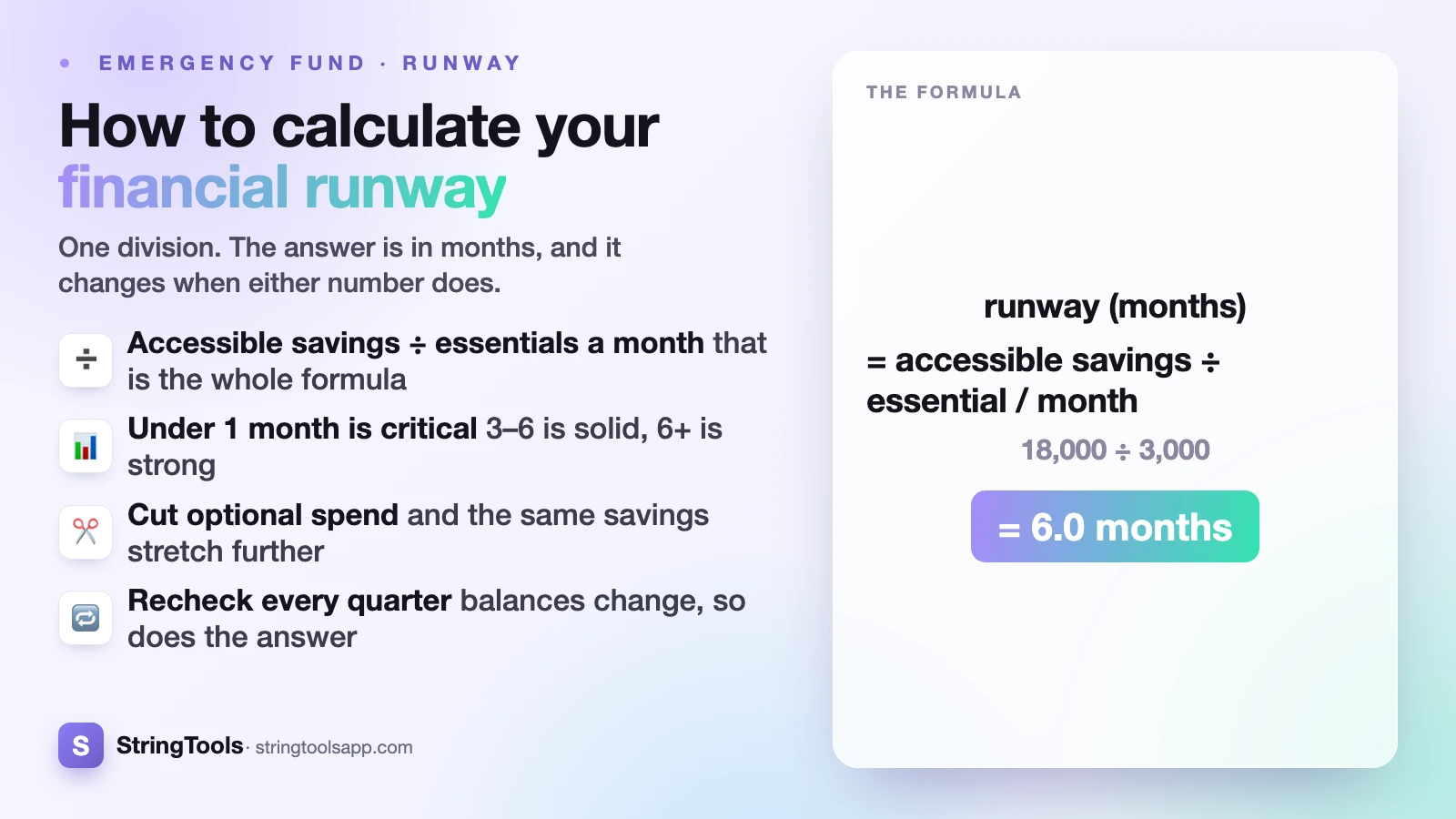
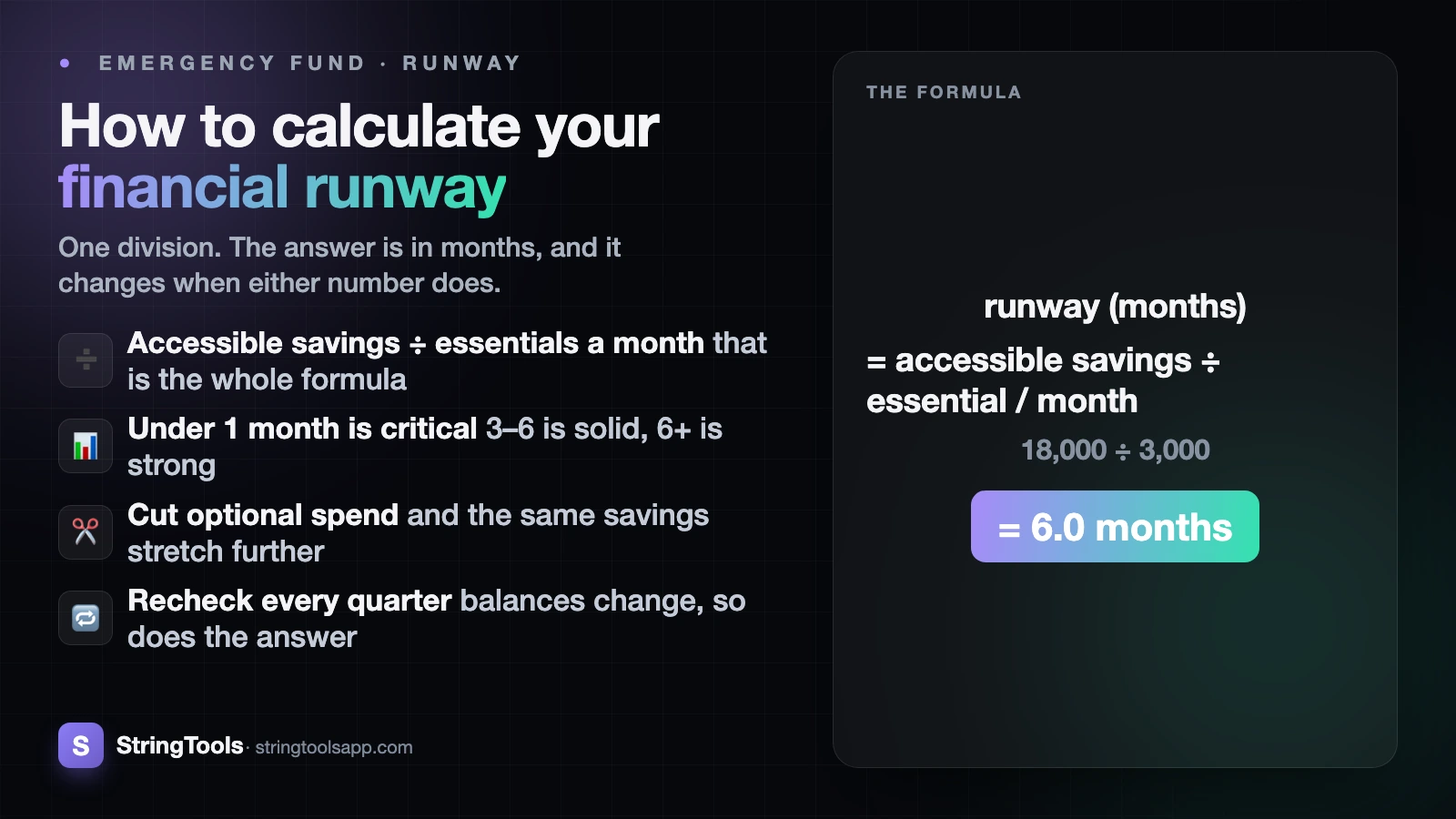
Financial runway is the number of months your instant-access savings would cover your essential bills if your income stopped today. Divide accessible savings by essential monthly expenses: 18,000 saved against 3,000 of essentials gives 6.0 months. It beats a savings total because it tells you how long you can last.
Key Takeaways
- Runway = accessible savings ÷ essential monthly expenses. The answer is in months, not money.
- Only count savings you could withdraw within a day or two. Locked money does not pay next week's rent.
- Only count essential expenses: the bills you would still pay if your income stopped.
- The same 18,000 is a nine-month cushion for one household and a three-month cushion for another.
- Two levers move the number: add to savings, or shrink the essentials line. Shrinking essentials usually moves it faster.
- Three to six months of essentials is the widely used benchmark from consumer-finance bodies and most planners. It is guidance, not a law.
A savings balance answers "how much do I have?". Runway answers the question that matters when something goes wrong: "how long do I have?".
This is general information, not personal financial advice. For a decision about your own money, a regulated adviser is the right person to talk to.
The formula, and what goes into each half
The formula itself is one line:
runway (months) = accessible savings ÷ essential monthly expenses
The hard part is deciding what belongs in the top and bottom of the fraction, because those two decisions are where most people quietly flatter themselves.
The top: accessible savings only
Count money you could have in your current account within a day or two, without a penalty and without selling anything at that morning's market price. That usually means:
- Instant-access savings accounts
- The part of your current account balance you genuinely do not spend each month
- Cash, if you hold any
Leave out fixed-term deposits, notice accounts, pensions, investment accounts, and anything with a withdrawal penalty. They are real assets, but they are not runway. If you lose your job on a Friday, a fixed deposit that matures next spring does not help with Monday's direct debits. The emergency fund calculator makes you tag each account as instant access or locked for exactly this reason, computes runway from the instant-access column only, and shows the "with locked savings" figure separately.
The bottom: essential expenses only
An essential expense is one you would still pay if your income stopped tomorrow: rent or mortgage, council tax or property tax, utilities, groceries, insurance premiums, minimum debt payments, transport to work, childcare you cannot drop, prescriptions. Streaming, restaurants, the gym, the upgraded phone plan are optional. They may be things you love; they are still the first things you would cut.
If you are not sure which side of the line a bill sits on, what counts as an essential expense classifies twenty common ones. The short version is one test: would I still pay this with no money coming in?
The bottom of the fraction matters more, because it is the divisor. Understating essentials makes you feel safer than you are, which is the dangerous direction to be wrong in.
Worked example by hand: 18,000 in savings
Take a household with 18,000 in an instant-access savings account and 9,000 in a one-year fixed deposit. The deposit is locked, so it stays out of the calculation. Their monthly bills, sorted honestly:
- Rent: 1,900
- Utilities and broadband: 250
- Groceries: 600
- Car payment and insurance: 450
- Minimum payments on a credit card: 150
- Phone: 50
- Childcare: 850
- Annual bills averaged per month (home insurance, car tax, school costs): 250
- Streaming, gym, eating out, subscriptions: 400 (optional)
Add up the essentials: 1,900 + 250 + 600 + 450 + 150 + 50 + 850 + 250 = 4,500. The 400 of optional spend is excluded. Notice the 250 line for annual bills: it is the one most people leave out on the first pass.
Runway = 18,000 ÷ 4,500 = 4.0 months.
That is a solid position by the widely used three-to-six-month benchmark, but it is not the 6.0 months the household might have guessed had they counted the locked 9,000 too: 27,000 ÷ 4,500 is exactly 6.0 months on paper. The difference between 4.0 and 6.0 is a fixed deposit they cannot touch until it matures, which is precisely the gap the calculator flags in its notes when locked savings are in the list.
To do the same in the tool: enter each account in the Savings column tagged instant access or locked, each bill in the Monthly expenses column tagged essential or optional, optionally your monthly income, and set the target slider (default 6 months). Runway, the status band, and the gap to a 3-month, 6-month and custom target appear when you press Analyse, then update as you edit. Everything stays in that browser's local storage; nothing is uploaded and there is no account.
The same 18,000, four very different runways
The point of runway is easiest to see when you hold the savings fixed and vary the essentials. Here is 18,000 against four illustrative households:
| Accessible savings | Essential monthly expenses | Runway | Status band |
|---|---|---|---|
| 18,000 | 2,000 | 9.0 months | Strong (6+) |
| 18,000 | 3,000 | 6.0 months | Strong (6+) |
| 18,000 | 4,500 | 4.0 months | Solid (3–6) |
| 18,000 | 6,000 | 3.0 months | Solid (3–6) |
The savings total is identical in every row. A single person renting a room with 2,000 of essentials has three times the runway of a family with a large mortgage and two children in nursery at 6,000. If both told a friend "I have 18,000 in savings", the friend would draw the same conclusion about each, and be wrong about at least one.
It also shows why a fixed lump-sum target ("everyone should have 10,000 put away") does not work: for the 2,000 household that is five months, for the 6,000 household under two. The right target is always a multiple of your own essentials, which is what the calculator's 1-to-12-month slider is for.
The bottom row is not worse at saving than the top row. Their fixed commitments are larger; that is a fact about their life, not a judgement about their discipline.
Two levers: add savings or cut essentials
Stay with the 4,500 household at 4.0 months. They want 6.0, which at 4,500 a month means a target of 27,000 and a gap of 9,000. There are only two ways to move the number, and they behave differently.
Lever 1: add to savings
Put another 2,000 into the instant-access account and the calculation becomes 20,000 ÷ 4,500 = 4.44 months. Every 1,000 saved adds roughly 0.22 months, about a week, at this level of essentials. To close the full 9,000 gap, the calculator's plan table would show 1,500 a month over 6 months, 750 over 12, or 375 over 24.
Lever 2: shrink the essentials line
Now suppose instead that the household renegotiates the car insurance, switches to cheaper broadband, and pays the credit card off from income over the next few months so the minimum payment disappears, trimming essentials from 4,500 to 4,000. Savings are unchanged at 18,000, and 18,000 ÷ 4,000 = 4.5 months. A 500-a-month cut added half a month of runway immediately, slightly more than the 2,000 lump sum did, and it keeps giving: the 6-month target drops from 27,000 to 24,000, so the gap falls from 9,000 to 6,000. Over 12 months that is 500 a month to save rather than 750.
Both together
Do both and it is 20,000 ÷ 4,000 = 5.0 months, from 4.0. The divisor is the powerful end of the fraction: cutting a recurring essential lowers your target and raises your runway at the same time, in the month you make the change rather than the month the savings finally arrive.
What about cutting optional spend?
Cutting the 400 of streaming, gym and eating out does not change runway directly, because optional spend is not in the formula. It frees up money you can redirect into savings, which is lever 1 in disguise. Redirect 300 of it for a year and you have 3,600 more: 21,600 ÷ 4,500 = 4.8 months. It works, but through the slow lever. The calculator's expense breakdown shows how much of your outgoing is optional, and therefore how much you could redirect if you had to.
| Change | Savings | Essentials | Runway |
|---|---|---|---|
| Starting point | 18,000 | 4,500 | 4.0 months |
| Add 2,000 to savings | 20,000 | 4,500 | 4.44 months |
| Cut essentials by 500 | 18,000 | 4,000 | 4.5 months |
| Both | 20,000 | 4,000 | 5.0 months |
| Redirect 300 optional spend for 12 months | 21,600 | 4,500 | 4.8 months |
Reading the four status bands honestly
The calculator groups the runway figure into four bands. They are a guide, not a verdict, and each deserves a different reading.
Critical: under 1 month
One missed pay cheque or one moderate repair and the next bill goes on a card. Many households sit here at some point, often after a life change rather than through carelessness. The first goal is not six months; it is one. Getting from 0.3 months to 1.0 removes the immediate cliff, which matters more than getting from 5 to 6. If you are here, how to build an emergency fund covers where to start.
Building: 1 to 3 months
You can absorb a car repair or a short gap between jobs without debt, but not a long one. This is where the "cut essentials" lever earns its keep, because a smaller divisor makes every month of saving count for more.
Solid: 3 to 6 months
This is inside the range that consumer-finance bodies such as the Consumer Financial Protection Bureau and MoneyHelper describe as a reasonable cushion. Whether 3 or 6 is the right end for you depends on income stability, the number of incomes in the household, and who depends on it. How much emergency fund do I need works through those factors.
Strong: 6 months or more
You could survive most realistic setbacks without touching credit or locked money. More runway has diminishing returns: beyond roughly 6 to 12 months of essentials, cash sitting in instant access is money not working towards anything else. That is a conversation for a regulated adviser, not a calculator.
Two cautions. The bands are thresholds on a continuous number; 2.9 and 3.1 months are not different lives. And a band only means something if the inputs were honest. A Strong reading built on locked savings or understated essentials is a Building reading with a nicer label.
Mistakes that quietly inflate your runway
These are the errors that show up most often on a first attempt, roughly in order of how much damage they do.
- Counting money you would not actually withdraw. Pension pots, investment accounts, a fixed deposit with a penalty. If you would hesitate to use it in a real emergency, it is not runway. The SEC's Investor.gov explains plainly why emergency savings and investments are kept separate.
- Using your income instead of your expenses. "Three months of salary" is a different number from three months of essentials, usually a larger one. The calculator only uses income, if you enter it, to show what percentage of it a savings plan would take.
- Forgetting annual and irregular bills. Insurance renewals, car tax, a boiler service, school trips. Divide the yearly total by twelve and add it to essentials. That is the 250 line in the worked example; without it the household's runway would have read 4.2 months instead of 4.0.
- Treating minimum debt payments as optional. Stop paying them and the interest and consequences keep coming. They are essential for as long as the debt exists, which is another reason clearing a small balance is a strong lever.
- Computing it once and never again. Rent rises, a child starts nursery, a car payment ends. Runway moves every time the divisor moves.
Turning your runway number into a plan
Once you have a runway figure you trust, the next step is a monthly amount, which comes from the gap rather than the target.
- Pick a target in months. Aim for the next threshold, not the far end. From 0.5 months, aim for 1; from 1.5, aim for 3; from 4, aim for 6. The calculator's slider runs from 1 to 12 months for this reason.
- Convert it to money. Target months × essential monthly expenses. For the 4,500 household aiming at 6 months, that is 27,000.
- Subtract what you already have. 27,000 − 18,000 = 9,000. That is the gap, and it is the only number the plan needs.
- Divide by a timeframe you will stick to. 9,000 over 6, 12 or 24 months is 1,500, 750 or 375 a month. If you entered income, the tool shows each as a percentage of it; a plan that eats a third of take-home pay tends to be abandoned by month three.
- Check whether lever 2 can shrink the gap first. If one call to an insurer or one cleared card balance drops essentials by 500, the target falls to 24,000 and the gap to 6,000 before you have saved anything. Do that first, then set the standing order.
- Set the transfer for payday so the money leaves before it can be spent, and recheck the numbers every three months, or sooner if a major bill changes.
By hand, the whole calculation is a division and a subtraction. The emergency fund calculator does the same arithmetic but keeps the account list, the tags and the target in one place on your device, so next time you are updating three numbers rather than starting from a blank page.
Frequently Asked Questions
How do I calculate how many months of expenses I have saved?
Add up your instant-access savings, then divide by your essential monthly expenses (rent or mortgage, utilities, groceries, insurance, minimum debt payments, transport, childcare). The result is months of runway. With 18,000 saved and 4,500 of essentials a month, you have 18,000 ÷ 4,500 = 4.0 months. Leave out locked savings and optional spending, or the number will be flattering rather than accurate.
Is financial runway the same as an emergency fund?
They are two views of the same money. The emergency fund is the pot; runway is how long that pot would last at your current essential spending. Runway is the more useful number because it is what you would actually experience in an emergency, and it makes targets comparable across households with very different bills.
Should I count my pension or investments in my runway?
No. Runway only counts money you could withdraw within a day or two without a penalty or a forced sale. Pensions, fixed-term deposits, notice accounts and investment portfolios are real assets, but they cannot pay next week's rent, and in a downturn the moment you need them is often the worst moment to sell. Track them separately, as the calculator does with its locked column.
Is it better to save more or spend less to increase my runway?
Cutting a recurring essential expense usually moves runway faster, because it raises the figure immediately and lowers your target at the same time. In the worked example, trimming essentials by 500 a month lifted runway from 4.0 to 4.5 months and cut the gap to a 6-month target from 9,000 to 6,000. Adding 2,000 in savings lifted runway only to 4.44 months. Doing both is best, but do the cut first.
What is a good financial runway?
The widely used guidance from consumer-finance bodies such as the CFPB and MoneyHelper, and from most planners, is three to six months of essential expenses. Closer to three may be reasonable with two stable incomes and no dependants; six or more is generally the floor for freelancers, single-income households, or anyone whose income is irregular. It is guidance, not a rule, and a regulated adviser can help you decide what fits your situation.
Does the emergency fund calculator store my financial details?
Only in your own browser's local storage, on that device, so your list is still there when you come back. Nothing is uploaded and there is no account. If you clear your browser data, the figures are gone, so make a note of your essentials total somewhere if you want to keep it.
Sources and references
Consumer Financial Protection Bureau (consumerfinance.gov) · MoneyHelper (moneyhelper.org.uk) · SEC's Investor.gov (investor.gov). Content was reviewed against these sources as of the last-updated date above; external figures and rules may change after publication.