
The short answer
Without an emergency fund, a surprise bill goes on a credit card, interest compounds on it, and the minimum payments crowd out saving, so the next surprise lands on top of the first. Illustratively, a 1,500 bill at 24% APR paid at minimums costs about 1,887 in interest over nine and a half years.
Key Takeaways
- The damage is not the bill itself. It is the interest and the months of payments that follow it, which stop you saving for the next one.
- Paid at an illustrative minimum, an illustrative 1,500 balance at 24% APR takes 114 months to clear and costs about 1,887 in interest, more than the original bill.
- Paid from savings, the same bill costs nothing in interest and you can rebuild the 1,500 in a year at 125 a month.
- The cascade has four stages: the bill, the drift, the stack, and the squeeze. Each one is cheaper to interrupt than the next.
- One month of essential expenses in instant-access savings is the smallest amount that breaks the cycle. Work out your own number with the free emergency fund calculator.
This is general information, not personal financial advice. For a decision about your own debts or savings, speak to a regulated adviser or a free debt charity in your country.
Living paycheck to paycheck is a timing problem, not a maths problem
Most people who describe themselves as living paycheck to paycheck do not have a spending problem in the obvious sense. Their income covers their normal month. What they lack is a buffer between one month and the next, so any cost that arrives out of sequence has nowhere to go.
A car repair, a boiler, a dental bill, a vet, a week of unpaid leave: none of these are unusual over a year. They are only unaffordable when they land in a specific week. An emergency fund does not make you richer. It moves money across time so that a cost arriving in the wrong week is paid with money set aside in a better one.
The Consumer Financial Protection Bureau and MoneyHelper both describe a savings cushion of three to six months of essential expenses as widely used guidance. That is the long-term target. But the immediate question is simpler: what happens in the first bad month when the cushion is zero.
The honest answer is that the bill still gets paid. It just gets paid with borrowed money, and borrowed money has a different price.
The cascade: four stages of one bad month
The cost of having no emergency fund is not one event. It is a sequence, and each stage makes the next one more likely.
Stage 1: the bill
Something breaks. You have no savings, so it goes on a credit card, an overdraft, or an instalment plan. Nothing feels wrong yet; the statement will not arrive for weeks.
Stage 2: the drift
The statement arrives with a minimum payment that looks manageable, so you pay it. Card minimums are designed to be small. On many cards the minimum is roughly the month's interest plus a small slice of the balance, which means most of your payment services the debt rather than reducing it. The balance drifts down very slowly, and interest is charged on whatever remains.
Stage 3: the stack
Before the first balance is cleared, the next surprise arrives and goes on the same card. Now the minimum is larger, more of your income is committed to servicing debt, and the amount you could have saved has shrunk again. Two bills that would each have been survivable are now one balance that is hard to see the end of.
Stage 4: the squeeze
The minimum payments are now a fixed line in your budget. They come out before any saving can happen, so the emergency fund you meant to start never gets its first deposit. You are still living paycheck to paycheck, but with a debt payment attached, which is worse than where you started. Any further shock repeats the cycle from stage one.
Each stage is cheaper to interrupt than the one after it. Interrupting stage one costs the price of the bill. Interrupting stage four can cost years.
A worked example: the same 1,500 bill, three ways to pay
Numbers make the cascade concrete. Everything below is illustrative. The APR, the minimum-payment formula and the savings rate are chosen to keep the arithmetic simple, not to describe any real card or account. Real cards differ, and rates change.
The set-up. A 1,500 bill arrives. Assume a card charging 24% APR, applied as 2% a month with monthly compounding and no fees. Assume the card's minimum payment is the month's interest plus 1% of the balance, with a floor of 25. Assume no new spending goes on the card.
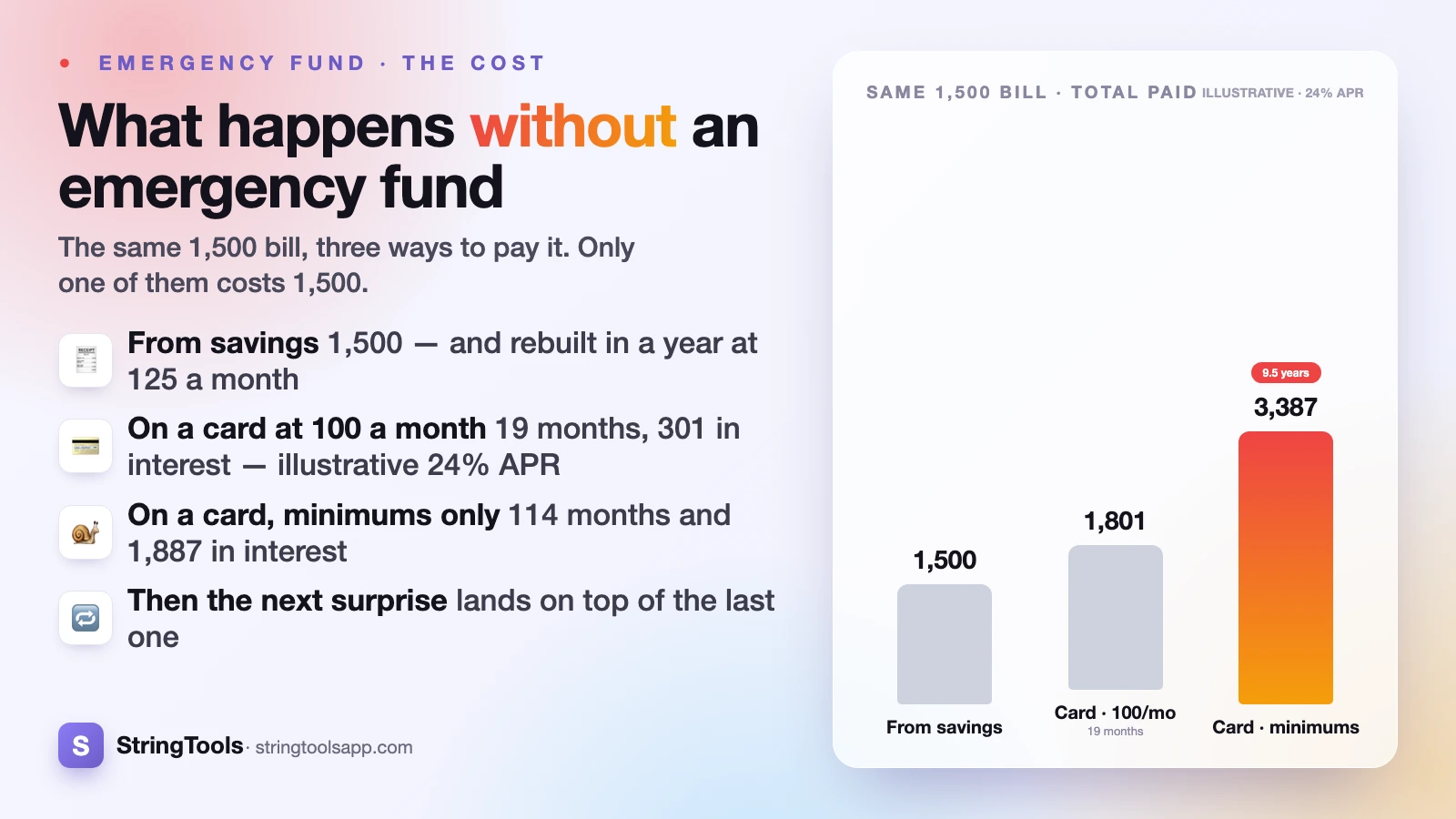
Way 1: pay from savings. The bill is paid in full from an instant-access account. Interest cost: zero. The only cost is the interest the 1,500 would have earned, which is small, and the discipline of rebuilding it, which at 125 a month takes exactly a year.
Way 2: card, paying a fixed 100 a month. The first month's interest is 30. Paying 100 clears the balance in 19 months at a total interest cost of about 301. Total paid: about 1,801.
Way 3: card, paying only the minimum. The first minimum is 45 (30 of interest plus 15 of principal). Because the minimum shrinks as the balance shrinks, progress slows every month. The balance takes 114 months, about nine and a half years, to reach zero. Total interest: about 1,887. Total paid: about 3,387, more than double the original bill.
| How the 1,500 bill is paid | Monthly payment | Months to clear | Interest paid | Total paid |
|---|---|---|---|---|
| From instant-access savings | 125 to rebuild the fund | 12 (to rebuild) | 0 | 1,500 |
| Credit card, fixed 100 a month | 100 | 19 | 301 | 1,801 |
| Credit card, minimum only | 45 falling to 25 | 114 | 1,887 | 3,387 |
The gap between the first row and the third is 1,887. That is the price of not having 1,500 set aside before the bill arrived. It is not a fee or a penalty, simply what 24% a year does to a balance being paid down at a rate designed to keep you paying.
One further note from the same simulation: if a card's minimum were just 2% of the balance with the same 25 floor, the payment would barely exceed the monthly interest and the same 1,500 would take decades to clear. The precise formula on your card matters enormously, and it is printed on your statement. The Federal Reserve publishes consumer guidance on how card minimums and interest work.
Why the minimum payment is the trap, not the interest rate
It is tempting to blame the APR. The rate matters, but the minimum-payment structure is what turns a bad month into a bad decade. Look at the minimum-only path in the example. In month one you pay 45, of which 30 is interest. Only 15 touches the balance. By the time the balance is down to 1,000, the minimum has fallen to 30 and only 10 of it is principal. The payment is always enough to keep the account in good standing and never enough to make visible progress. That is how the product is priced.
Compare that with the fixed 100 path. The interest rate is identical. The only difference is that the payment does not shrink as the balance shrinks, so every month the same 100 buys more principal than the month before. The result is 19 months instead of 114, and 301 in interest instead of 1,887.
The lesson for someone with no emergency fund is therefore not "avoid cards". It is: if a bill has to go on a card, decide the fixed monthly payment on day one and never let it fall to the minimum. Even 100 a month on a 1,500 balance saves roughly 1,586 in interest compared with the minimum path in this example.
If you already have a balance and want to decide between clearing it with a lump sum, a fixed payment or a cheaper form of borrowing, the comparison in personal loan vs credit card walks through the trade-offs.
The cost you do not see on a statement
The interest is the measurable cost. There are three others that never appear on any statement and are often larger.
The saving that never starts. In the minimum-only path, 45 a month is committed for years. That 45 was the money that would have opened a savings account. Every month it goes to the card is a month the fund stays at zero, so the next surprise repeats the cascade. The example is one bill; real life delivers several a year.
The choices you cannot make. With no buffer, a job you dislike becomes one you cannot leave, and a small early repair becomes a large late one. Even one month's essentials in cash changes which options are on the table.
The stress. Hard to put in a table, but real. Not knowing whether next week's rent will clear is a cost you pay every day, not once.
The full case for why a fund matters even when your finances look fine is in why you need an emergency fund. The point of the mechanics here is simple: the fund is cheap, and the alternative is not.
The smallest amount that breaks the cycle
The three-to-six-month benchmark can feel so far away that it stops people starting. Set it aside for a moment and look at the smallest useful number instead.
One bill. In the example, having 1,500 in instant-access savings turned a 1,887 interest bill into zero. That is the difference between the first and third rows of the table above. If you can hold one typical surprise bill in cash, you have already interrupted the cascade at stage one.
One month of essentials. This is the threshold of the Building band in the emergency fund calculator. Enter each savings balance and mark it instant access or locked, enter each monthly expense and mark it essential or optional, and the tool divides your accessible savings by your essential monthly expenses to give you a runway in months. Below one month it shows Critical, one to three is Building, three to six is Solid and six or more is Strong. It also shows the gap to a three-month and six-month target, and a plan table with what you would need to save a month over 6, 12 or 24 months to close it. The figures stay in your browser on that device; nothing is uploaded and there is no account.
The reason the tool separates locked savings from accessible ones is exactly the cascade in this post. Money in a fixed-term account or a pension is still yours, but it cannot pay a bill that is due on Friday, so it does not stop the card being used. Only the instant-access figure counts toward the runway.
A realistic first target. Take your essential monthly expenses from the tool and divide by 12: that monthly saving gets you to one month of runway in a year. If it is more than you can manage, use the 24-month column instead. A smaller plan you keep beats a larger one you abandon.
For the broader picture on how much to hold, where to keep it and how fast to build it, how to build an emergency fund is the hub post for this series.
If you are already in the cascade
If you are reading this with a card balance that started as a surprise bill, the order of operations matters more than the theory.
- Fix the payment, not the minimum. Choose a fixed monthly amount you can sustain and set it up as a standing payment. In the example, the difference between 45 falling to 25 and a flat 100 was 95 months and about 1,586 of interest.
- Build a small cash buffer at the same time. It feels wrong to save while paying 24% on a card, and on pure arithmetic it is. But with zero savings, the next surprise goes straight back on the card. Even a few hundred in instant-access savings stops the stack growing. Once that exists, direct everything else at the debt.
- Stop the card being the default. Remove it from saved payment methods, or move it out of your wallet, so a new expense forces a decision rather than a reflex.
- Ask for help early. MoneyHelper (UK) lists free debt-advice services and the CFPB (US) explains your options with card issuers. Contacting a lender before a missed payment is almost always better than after one.
Then run your numbers through the emergency fund calculator using the emergency fund calculator with the debt payment entered as an essential expense, because it is one. The runway figure will be honest about where you stand today, and the plan table will tell you what one month of safety costs per month to build. That number is usually smaller than the interest you are already paying.
Frequently Asked Questions
What happens if you have no emergency fund and an unexpected bill arrives?
The bill is usually paid with borrowed money: a credit card, overdraft or instalment plan. Interest is then charged on the balance, and the minimum payments reduce the amount you can save each month. If another surprise arrives before the first is cleared, the balances stack and the cycle repeats. In the illustrative example in this post, a 1,500 bill at 24% APR paid at minimums cost about 1,887 in interest over 114 months.
How long does it take to pay off a 1,500 credit card balance paying only the minimum?
It depends entirely on the card's minimum formula and APR. Using illustrative assumptions of 24% APR and a minimum of the month's interest plus 1% of the balance with a 25 floor, our simulation cleared 1,500 in 114 months, about nine and a half years, with 1,887 in interest. Paying a fixed 100 a month instead cleared it in 19 months with about 301 in interest. Your own statement shows the exact formula your card uses.
Is it better to pay a surprise bill from savings or put it on a credit card?
From instant-access savings, almost always. The only cost is the small amount of interest the savings would have earned and the effort of rebuilding them. On a card at an illustrative 24% APR, the same 1,500 bill costs between about 301 and 1,887 in interest depending on how fast you repay it. If the money genuinely is not there, a fixed monthly payment set on day one is the next best option, and a personal loan at a lower rate may be worth comparing for larger amounts.
Should I save an emergency fund or pay off credit card debt first?
On pure arithmetic, clearing a high-interest balance first wins, because no savings account pays anything close to a card's APR. In practice most planners and consumer bodies suggest a small cash buffer first, enough for one typical surprise, precisely so the next unexpected cost does not go back on the card and undo your progress. After that buffer exists, direct the rest at the debt. This is general information, not personal advice.
What is the smallest emergency fund that actually helps?
Enough to cover one typical surprise bill in cash, then one month of essential expenses. One month is the threshold of the calculator's Building band, which divides your instant-access savings by your essential monthly costs to give a runway in months. It is a fraction of the three-to-six-month benchmark, but it is the amount that stops a single bad month from turning into a credit card balance.
Why does living paycheck to paycheck make surprise bills so expensive?
Because there is no gap between income and committed spending, any cost that arrives out of sequence has to be borrowed. Borrowing at card rates adds interest, and the minimum payments then reduce next month's spare income, which makes the next surprise more likely to be borrowed too. The cost is not the bill; it is the interest and the months of payments that follow it, and the saving that never starts because of them.
Sources and references
Consumer Financial Protection Bureau (consumerfinance.gov) · MoneyHelper (moneyhelper.org.uk) · Federal Reserve (federalreserve.gov). Content was reviewed against these sources as of the last-updated date above; external figures and rules may change after publication.