
The short answer
An emergency fund is cash you can reach within a day or two, kept to cover essential bills when income stops or an unplanned cost lands. You need one because emergencies arrive on their own schedule, and without ready cash the only options are borrowing at interest, missing payments, or selling at a bad time.
Key Takeaways
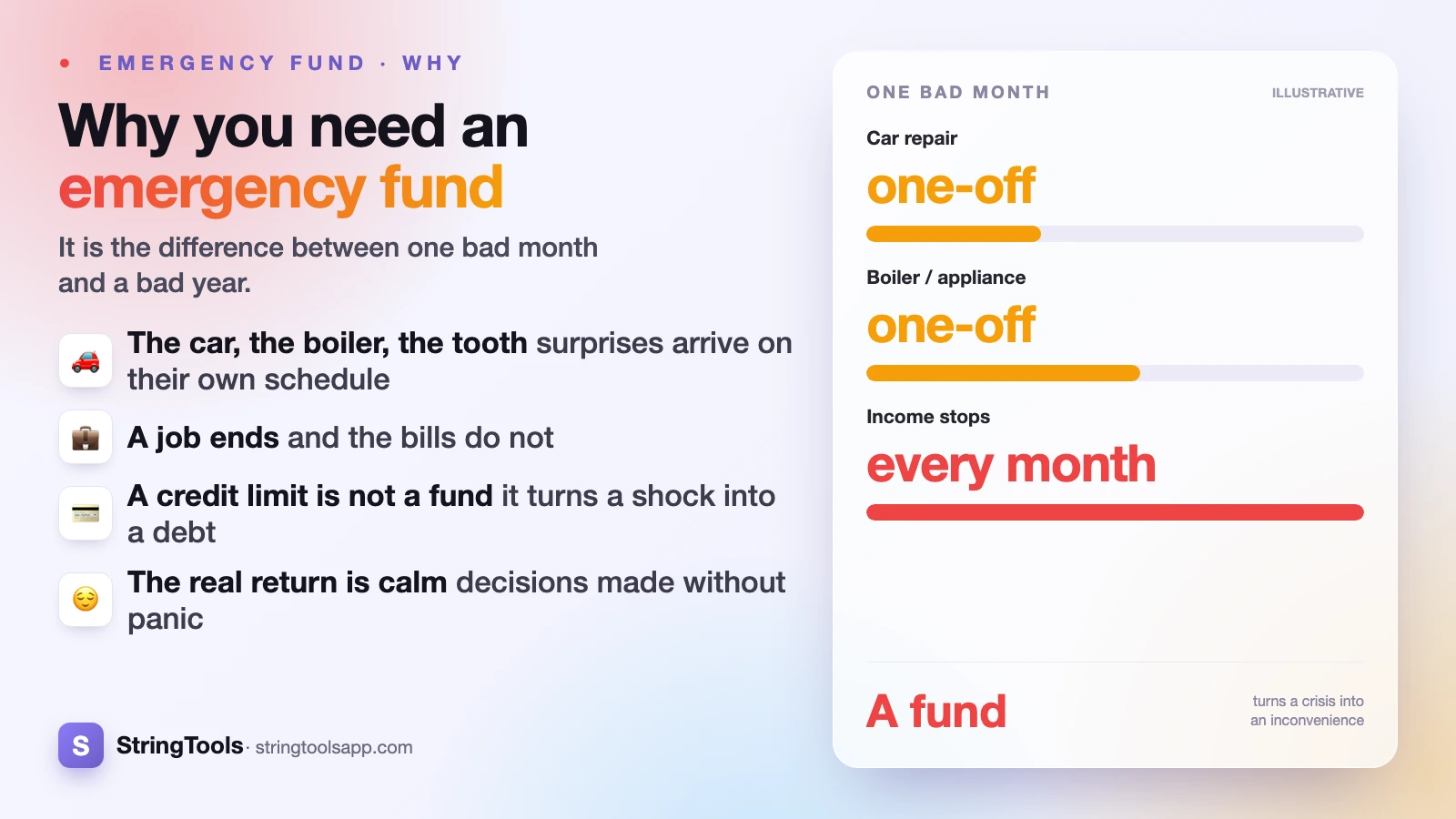
- The fund's job is narrow: to stop one bad month from turning into a bad year.
- A good job protects your income only for as long as you keep it, and a notice period is not the same as savings.
- Having no debt is a strength, but it is not a cushion. A cushion is money you can spend, not money you do not owe.
- A credit limit is somebody else's money, lent at their price, on terms they can change when you are least able to cope.
- The widely used benchmark from bodies such as the CFPB and MoneyHelper is three to six months of essential expenses, measured as runway in months rather than a lump sum.
- The first target is one month. It is the difference between a crisis and an inconvenience for the most common emergencies.
This article is general information, not personal financial advice. For a decision about your own circumstances, a regulated adviser is the right person to ask.
One bad month, or one bad year
Most people picture an emergency as a single event: the boiler dies, the car fails its inspection, a redundancy letter arrives. The event itself is rarely what does the damage. The damage comes from the chain of small decisions that follow when there is no cash to absorb it.
Picture the sequence without a fund. A repair bill of 1,200 goes on a credit card because the current account cannot cover it. The minimum payment starts the following month. That payment squeezes the budget, so the next unexpected cost, a dental bill or a school trip, also goes on the card. Interest compounds on the growing balance. Six months on, the household is paying every month for problems that were solved long ago, with nothing put aside for the next one. The bad month has quietly become a bad year.
Now the same sequence with a fund. The 1,200 comes out of savings. The card balance stays at zero. The budget the next month is the same as it was before, with one extra line: rebuild the fund. Nothing compounds. The problem was expensive, but it was contained to the month it happened in.
That containment is the entire point: the fund stops a shock from propagating through the rest of your finances. What happens without an emergency fund walks through the arithmetic of that cascade in detail, with a 1,500 bill paid three different ways.
The emergencies that actually happen
"Emergency" sounds dramatic, but most of the events a fund exists for are ordinary; they happen to nearly every household eventually, and the only unknown is when. The table below describes the common categories as ranges in words rather than precise averages, because the real figures depend heavily on where you live, what you own, and what insurance you carry.
| Emergency | How it usually shows up | Typical size, described honestly | What a fund changes |
|---|---|---|---|
| Job loss or reduced hours | Sudden, sometimes with a short notice period; income drops to zero or near zero | Weeks to many months of lost income, the largest risk by far | Time to find the right job rather than the first job |
| Medical or dental | An excess or deductible, a prescription, a procedure not fully covered, time off unpaid | From a few hundred to several thousand, depending on cover and country | You can say yes to treatment now, not later |
| Car | Failed inspection, breakdown, accident excess, or a replacement | A few hundred for a repair up to a few thousand for a major fault or replacement | You keep getting to work, which protects the income that funds everything else |
| Home | Boiler or furnace, roof leak, appliance failure, burst pipe, emergency locksmith | A few hundred for an appliance to several thousand for heating or structural work | The house stays warm and dry without a high-interest balance |
| Family | Travel for a bereavement, supporting a relative, childcare falling through, a pet's vet bill | Highly variable, from a few hundred to thousands, often with no warning at all | You can go, help, or pay without adding a money worry to a human one |
Two things stand out. Several of these are close to inevitable over a few years of ownership. And the largest, job loss, is measured in months of income rather than as a single bill, which is why the standard benchmark is expressed in months of essential expenses rather than a fixed sum. The Consumer Financial Protection Bureau and the UK's MoneyHelper both frame the target this way, and most planners use a range of three to six months.
If you would rather see your own number than a generic range, the emergency fund calculator works it out from your actual accounts and bills: you list your savings, mark each as instant access or locked, list your monthly outgoings, mark each as essential or optional, and it divides the accessible savings by the essential spend to give your runway in months.
Why a good job and no debt do not protect you
The title makes a specific claim: that even someone with a secure job and no debt needs a fund. It is worth taking seriously, because "I am fine, I earn well" is the most common reason people give for not having one.
A good job protects your income for exactly as long as you keep it
Job security is real, but it is a property of the job, not of you. Companies restructure, get acquired, lose contracts, and close divisions that were profitable last year. A notice period, where you have one, gives you weeks of pay and then stops; redundancy pay varies enormously by country, employer and length of service, and is often modest. None of this means your job is at risk today. It means the thing standing between you and zero income is a decision made by other people, and you cannot save for that after it happens.
There is also the quieter version: not losing the job, but being unable to do it for a while. Sick pay rules differ by country and employer, and self-employed people usually have none at all. A month of illness or injury can cut income sharply while the bills continue at full rate.
Having no debt is a strength, but it is not a cushion
Being debt-free means you have no monthly repayments draining your budget, which is an excellent position. What it does not do is give you anything to spend. If your current account holds two weeks of expenses and your investments are locked or volatile, then an unexpected 1,200 bill is exactly as hard to pay as it would be for someone carrying a loan. The common response, "I would just put it on a card", is precisely how debt-free households stop being debt-free.
The honest test is simple. If your income stopped this Friday, how many months could you pay rent or mortgage, food, utilities, insurance, transport and minimum obligations from money you can reach within a couple of days? If the answer is "less than one", the good job and the clean balance sheet are not doing what you think they are doing. How much emergency fund do I need shows how to turn that question into a figure built from your real bills.
A credit limit is not an emergency fund
"I have a credit card with a 5,000 limit, so I am covered." It is the most common substitute for a fund, and it fails for four reasons that are worth separating out.
It costs money at the worst possible time. Suppose a 1,200 car repair goes on a card at an illustrative 24% APR, chosen only to keep the arithmetic simple. Cleared in equal payments over 12 months, the interest comes to roughly 160, so the repair costs about 1,360. Stretched over 24 months, the interest is roughly 320 and the same repair costs about 1,520. Paid from a fund, it costs 1,200 and nothing more. The card does not make the emergency cheaper; it makes it more expensive, and it does so at the moment you have least room to absorb extra cost.
It is somebody else's money on their terms. A credit limit is not yours. The lender can reduce it, freeze the card, or raise the rate, and lenders tend to tighten exactly when the economy weakens, which is also when job losses cluster. A fund in your own account cannot be withdrawn by anyone but you.
It fails the "income stopped" scenario. A card can cover a one-off bill. It cannot cover six months of rent, because the balance grows while you have no income to pay it down, and once the limit is reached there is nothing left. The largest emergency on the list is the one a card is worst at handling.
It removes your negotiating position. With cash you can choose the sensible repair rather than the cheapest. With a card at its limit, every subsequent decision is made under pressure. Investopedia's definition of an emergency fund makes the same distinction: the fund is a reserve of liquid cash, not a line of credit.
Credit has a place in an emergency, as a bridge for a few days or as a last resort behind a fund. What it cannot be is the fund itself.
What the fund buys you: time, and the freedom to choose
The value of a fund is easiest to see in the largest scenario, so take a worked example with round figures.
Assume a household whose essential expenses come to 2,400 a month: rent, food, utilities, insurance, transport and a minimum loan payment, with subscriptions and eating out excluded because they can be cut the same day. One earner loses their job with four weeks of notice pay.
- With 1,500 in accessible savings, runway is under one month. The calculator would label this Critical. The notice pay covers one more month. After that, every week without a new job is a week of missed bills or growing card balances. The rational move is to take the first job offered, at whatever pay, because the alternative is falling behind on rent.
- With 12,000 in accessible savings, runway is five months, plus the notice month. The calculator would label this Solid. Five months is enough to apply properly, interview well, and decline an offer that pays less than the last role. It is also enough that a car repair during the job search is an annoyance rather than a second crisis.
The difference between those two households is not luck or salary; it is about 10,500 of savings built in advance. The fund converts into time, and time converts into better decisions. Five months of runway negotiates from strength; three weeks accepts whatever is on the table.
The calculator makes this trade-off explicit. Alongside the runway figure it shows a status band (Critical under one month, Building at one to three, Solid at three to six, Strong at six and above), the gap to a three-month and six-month target, and a plan table showing what you would need to save per month to close that gap over 6, 12 or 24 months, with the percentage of income if you enter one. It also flags a subtle trap: savings that are locked in a fixed-term account or an investment would inflate the total, so it counts them separately and notes that they could not pay next week's rent. Figures stay in your browser's local storage on that device; nothing is uploaded and there is no account.
Where to start this week
If the argument has landed, the risk now is that "three to six months" feels so far away that nothing happens. So start smaller.
Get your number. Open the emergency fund calculator, list every account you could draw on within a couple of days, and list your monthly bills, marking each one essential or optional. The runway figure it gives you is the truth about your position today, and most people have never seen it written down.
Make one month the first target. One month of essentials covers the large majority of the events in the table: the repair, the appliance, the medical excess, the emergency trip. It also means a job loss with a notice period gives you two months rather than one. For the household above, that is 2,400. If that seems a stretch, the plan table on the calculator shows the monthly amount over 6, 12 or 24 months; over 12 months it is 200 a month.
Fund it before you spend, not after. A standing order to a separate instant-access account on payday, for a fixed amount, is the single habit that separates people who have a fund from people who intend to. The amount matters less than the automation.
Keep it boring and reachable. The money's job is to be there, not to grow. An instant-access savings account you never see in daily banking is the usual home; fixed-term deposits and investments are not the fund, for the reasons the calculator flags.
Then extend the target. Once one month is in place, move the slider to three, and later to six if you have a single income, dependants, or variable earnings. How to build an emergency fund covers the mechanics of getting there: how much, where, and how fast.
One bad month is coming for every household at some point. The only real decision is whether it arrives when there is money waiting for it.
Frequently Asked Questions
Why is an emergency fund important if I have a stable job?
Because job security belongs to the job, not to you. Restructures, acquisitions and closures happen to secure roles, and a notice period is measured in weeks. Illness and injury can also stop income without the job ending. A fund of three to six months of essential expenses, the range widely used by bodies such as the CFPB and MoneyHelper, gives you time to find the right next role rather than the first one.
Is a credit card a good substitute for an emergency fund?
No. A card can bridge a one-off bill for a few days, but it charges interest at the moment you can least afford it, the lender can cut the limit or freeze the card, and it cannot cover months of rent when income has stopped. At an illustrative 24% APR, a 1,200 repair cleared over 12 months costs about 1,360; from a fund it costs 1,200.
Do I need an emergency fund if I have no debt?
Yes. Having no debt means no repayments draining your budget, which is a strong position, but it gives you nothing to spend when a bill lands. If your accessible cash covers only a couple of weeks of expenses, an unexpected cost is as hard to pay as it would be for someone with a loan, and the usual response, putting it on a card, is how debt-free households stop being debt-free.
How many months of expenses should an emergency fund cover?
The widely used guidance is three to six months of essential expenses, not total spending. One month is a sensible first target because it covers most single-event emergencies such as a repair or a medical excess. Six months or more makes sense for single-income households, freelancers, and anyone with dependants. The emergency fund calculator lets you set a target from one to twelve months and shows the gap to each.
What counts as an emergency for the fund?
An unexpected, necessary cost or a loss of income: job loss or reduced hours, medical or dental bills, a car repair that keeps you getting to work, a home repair such as heating or a leak, and family events such as bereavement travel. Predictable costs such as annual insurance, holidays or a routine car service are better handled by a separate sinking fund so the emergency fund stays intact.
Where should I keep an emergency fund?
Somewhere you can reach it within a day or two without a penalty: usually an instant-access savings account kept separate from everyday banking. Fixed-term deposits, notice accounts and investments may sit alongside it but should not be counted as the fund, because they cannot pay next week's rent. The calculator separates instant-access from locked savings for exactly this reason.
Sources and references
Consumer Financial Protection Bureau (consumerfinance.gov) · MoneyHelper (moneyhelper.org.uk) · Investopedia's definition of an emergency fund (investopedia.com). Content was reviewed against these sources as of the last-updated date above; external figures and rules may change after publication.