
The method in one paragraph
Budget on an irregular income by paying yourself a fixed monthly amount from a buffer account. Set that amount below your average income, then check it survives your worst run of lean months. Surplus months top the buffer up, quiet months draw it down, and your budget sees the same figure every month.
Key Takeaways
- Do not budget the income. Budget a base month you pay yourself, and let a buffer account absorb the variation.
- Set the base month at a conservative fraction of your average, around 80%, and then prove it by walking the buffer through your worst stretch. A base set at the full average runs the buffer underwater in the first bad run of months.
- Every payment that arrives gets split by percentage on the day it lands: tax set-aside, buffer, then what is available to spend.
- Three separate accounts do most of the work: one that receives income, one that holds tax, one you spend from.
- The budget itself is ordinary once the base month exists. Percentage splits, needs and wants, sinking funds — all of it works normally against a fixed figure.
- Build the buffer before you tighten the base month. A base of zero with no buffer is not a budget, it is a hope.
This is general information, not personal financial or tax advice, and tax rules differ by country.
Why percentage budgets break on variable pay
A split like 50/30/20 assumes a number to split. On a salary that number arrives on the same day for the same amount, so the percentages describe something real. On irregular income the multiplier changes every month, which produces two distinct failures.
The obvious one is that the targets move. Half of 900 and half of 7,100 are not the same rent. Housing is fixed whatever arrives, so in a lean month the needs bucket takes almost everything and in a rich month it looks trivially small. Neither figure tells you anything.
The subtler one is worse. Fixed transfers get cancelled. A standing order of 400 to savings fails in the first month that only 900 arrives, gets switched off to avoid an overdraft, and is never switched back on in the month that 7,100 lands. The saving habit does not survive its first collision with a quiet month, and the rich month gets absorbed by catching up rather than getting ahead.
Both problems come from the same source: you are trying to budget a moving input. Fix the input and the ordinary tools work again, including the splits set out in the 50/30/20 budget explained.
Step one: set a base month below your average, then test it
Your base month is the fixed amount you will pay yourself from the buffer account into your everyday account on the same date each month. It is the number your whole budget runs on.
Start from a conservative fraction of your average rather than the average itself, then test that figure against your actual lean months before you commit to it. Here is a real-shaped year of twelve payments totalling 45,000, which averages 3,750 a month.
| Month | Income received | Paid to yourself | Buffer movement | Buffer balance |
|---|---|---|---|---|
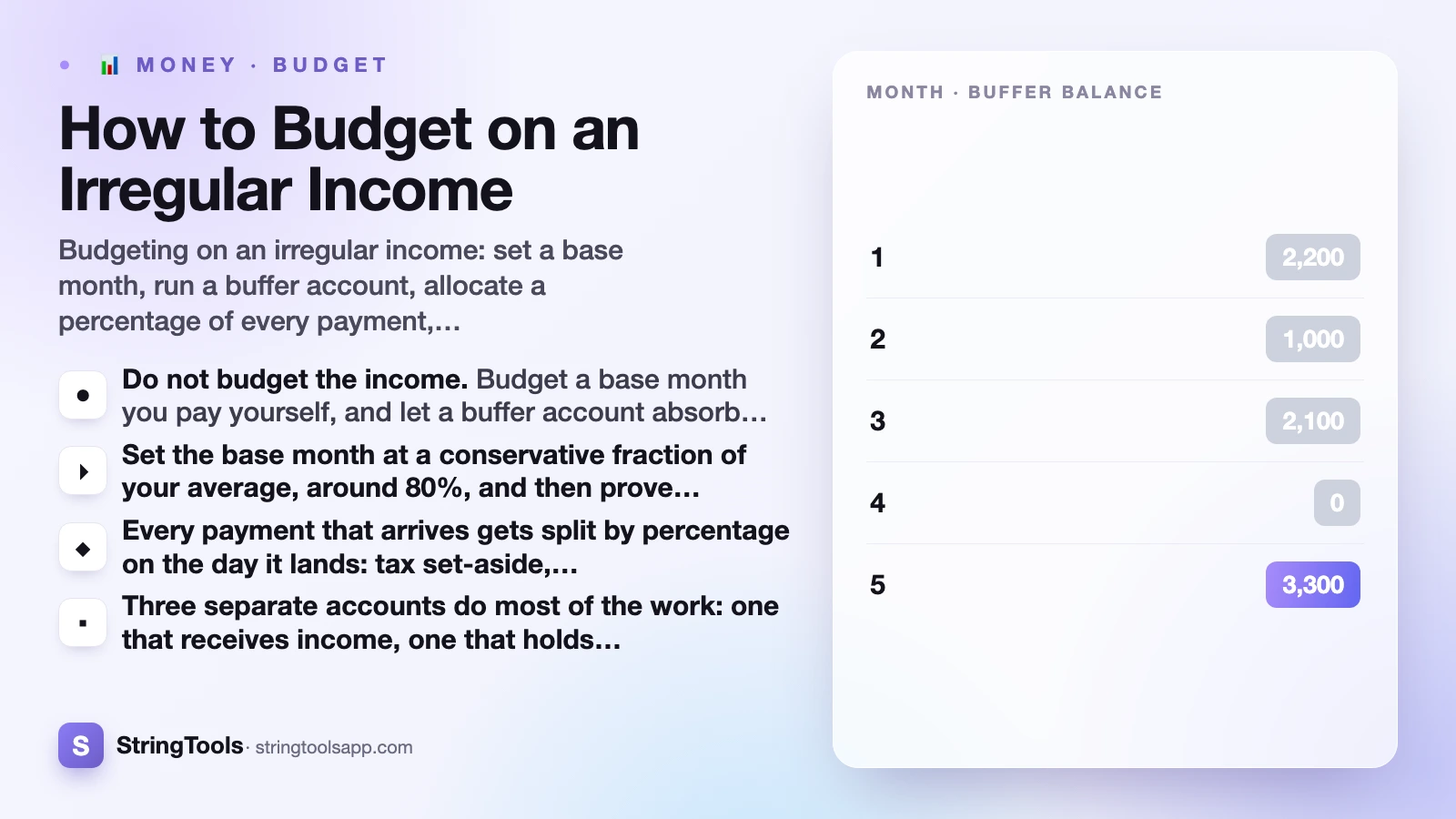
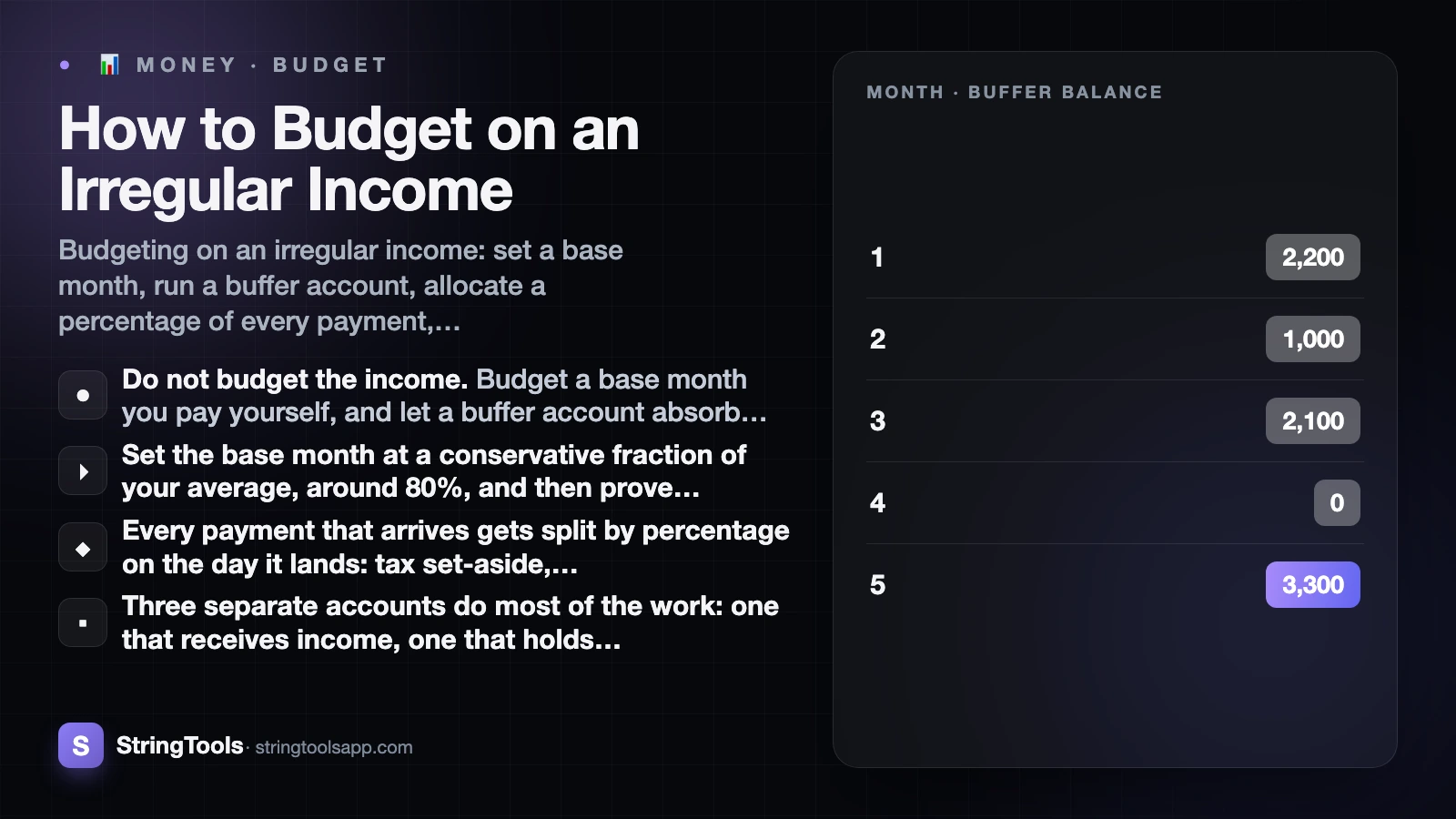
| 1 | 5,200 | 3,000 | +2,200 | 2,200 |
| 2 | 1,800 | 3,000 | -1,200 | 1,000 |
| 3 | 4,100 | 3,000 | +1,100 | 2,100 |
| 4 | 900 | 3,000 | -2,100 | 0 |
| 5 | 6,300 | 3,000 | +3,300 | 3,300 |
| 6 | 2,600 | 3,000 | -400 | 2,900 |
| 7 | 3,400 | 3,000 | +400 | 3,300 |
| 8 | 7,100 | 3,000 | +4,100 | 7,400 |
| 9 | 1,500 | 3,000 | -1,500 | 5,900 |
| 10 | 4,800 | 3,000 | +1,800 | 7,700 |
| 11 | 2,200 | 3,000 | -800 | 6,900 |
| 12 | 5,100 | 3,000 | +2,100 | 9,000 |
The base is 3,000, which is 80% of the 3,750 average. That is the starting guess. The test is the fourth column: run the buffer month by month and check it never goes negative. Starting from a buffer of zero, the account survives — but only just. It reaches exactly zero at the end of month 4, the worst stretch of the year, and only then starts to build. By month 12 it holds 9,000, which is the year's total less the twelve payments of 3,000.
Now look at what a more optimistic base would have done to the same twelve payments.
| Base month | Lowest buffer balance | Month it happens | Buffer at year end |
|---|---|---|---|
| 3,000 | 0 | Month 4 | 9,000 |
| 3,250 | -1,000 | Month 4 | 6,000 |
| 3,500 | -2,000 | Month 4 | 3,000 |
| 3,750 | -3,000 | Month 4 | 0 |
Every one of those bases is affordable across the full year. Only the lowest is affordable in month four. A base set at the average leaves the buffer at zero after twelve months of work and puts the account 3,000 underwater in the spring, which in practice means a credit card and a very unpleasant summer.
That is the whole argument for the haircut: the year-end figure is not what breaks you. The lowest point is, and the lowest point is set by your lean months landing back to back. If 80% of your average does not survive that walk, cut it to 70% and walk it again.
Step two: three accounts and a percentage split
The mechanism needs three accounts, which most banks let you open in a few minutes.
- The receiving account. Every payment lands here. You never spend from it.
- The tax account. A set-aside you treat as not yours. In the US this is what covers estimated tax payments; in the UK it covers the bill from Self Assessment. The percentage depends on your country, your profit and your circumstances, so find your own rate rather than copying one.
- The everyday account. Receives the base month on a fixed date. This is the only account your budget looks at.
On the day each payment arrives, split it by percentage. Illustrative shares of 25% to tax and 15% to the buffer are used below purely to keep the arithmetic readable — your tax share in particular must come from your own position.
| Payment received | Tax set-aside at 25% | Buffer top-up at 15% | Left in the receiving account |
|---|---|---|---|
| 900 | 225 | 135 | 540 |
| 1,500 | 375 | 225 | 900 |
| 2,600 | 650 | 390 | 1,560 |
| 4,100 | 1,025 | 615 | 2,460 |
| 7,100 | 1,775 | 1,065 | 4,260 |
A percentage works where a fixed transfer does not, because it scales with what actually arrived. The quiet month still contributes 135 and keeps the habit alive. The 7,100 month contributes 1,065 without requiring you to remember anything.
Keep the tax money out of every other figure. It is the most common way a self-employed budget flatters itself: the balance looks healthy for ten months and then a bill takes a third of it. Emergency fund for freelancers and single-income households goes into the tax pot and the emergency fund in more depth, and they are three separate pots for three separate jobs.
Step three: budget the base month like a salary
Once a fixed amount lands in your everyday account on a fixed date, the hard part is over. A base of 3,000 budgets exactly like a salary of 3,000.
| Split | Needs | Wants | Savings and debt |
|---|---|---|---|
| 50 / 30 / 20 | 1,500 | 900 | 600 |
| 60 / 20 / 20 | 1,800 | 600 | 600 |
| 70 / 20 / 10 | 2,100 | 600 | 300 |
Two adjustments are worth making for irregular income specifically.
Put the sinking funds in the needs bucket, not the wants bucket. Annual insurance, the car service, the accountant, professional subscriptions and equipment replacement are all obligations that arrive whether the month was good or not. Divide each by twelve and treat the twelfth as a fixed cost. Treating them as wants means they get cut in exactly the months you can least afford to skip them.
Keep the savings line small enough to survive the lean stretch. A 10% savings line you never touch is worth more than a 20% line you suspend twice a year, because the suspended one takes the whole habit with it. Raise it once the buffer is solid rather than before.
The budget calculator works on the base month figure: enter 3,000 as take-home, pick a split, add each line tagged need, want or saving, and it shows target against actual per bucket plus anything unassigned. Your figures stay in your browser on that device. Re-enter the base month only when you change it, which should be about once a year.
What to do with a good month
Surplus is where irregular incomes are actually won or lost, and the default outcome is that a good month simply disappears.
Decide the rule before the money arrives, because deciding afterwards always favours spending. A workable default, once the tax share is out and the buffer top-up has gone:
- Until the buffer holds three base months, everything goes to the buffer. At a base of 3,000 that is 9,000, which is the level the worked year reaches only at the very end. Until you are there, you are still exposed to a month-four problem.
- Once the buffer is full, split the surplus. Half to savings and debt, a quarter held against the next quiet month, a quarter to spend. The spending share matters: a rule that assigns none of it will be broken within two months.
- Raise the base month only after two full good quarters, and raise it by less than the improvement. If your lean months have genuinely moved from 1,500 to 2,200, move the base from 3,000 to 3,200, not to 3,700. Lifestyle costs are easy to raise and very hard to lower.
The order matters more than the percentages. Buffer, then savings, then lifestyle — and the base month moves last of all.
The failure modes, and how each one shows up
Spending the receiving account. The account holds 7,100 and a card payment comes out of it because it was easier. Within a quarter the separation stops meaning anything. The fix is mechanical: no debit card on the receiving account, no card details saved from it.
Counting the tax pot as savings. The balance looks reassuring right up to the filing deadline. Keep it in a differently named account and leave it out of every figure you quote to yourself.
Setting the base month from a good quarter. This is the mistake the second table above is built to show. Three strong months in a row feel like a new normal and almost never are, and an average taken from them is inflated before the haircut is even applied. Use a full twelve months if you have them.
No buffer, only a plan. The method assumes the buffer exists. Starting from zero, the first few months are genuinely tight — in the worked year, the buffer touches zero at month four. Until you have one base month banked, treat the base as provisional and keep it low.
Treating a quiet month as an emergency. Two lean months in a row is a normal year, not a crisis, and paying for it from the emergency fund empties the thing that exists for actual emergencies. The buffer absorbs variation; the emergency fund absorbs disaster. Confusing the two is also one of the reasons budgets fail in month three.
If you are still building the buffer, the honest short version is this: keep the base month well under your average, split every payment by percentage on the day it arrives, and resist raising anything until the buffer holds three base months. That sequence is slow and it is the only one that survives a bad spring.
Frequently Asked Questions
How do I budget when my income is different every month?
Stop budgeting the income and start budgeting a fixed amount you pay yourself. All income lands in a receiving account, a percentage goes to tax and a percentage tops up a buffer, and on the same date each month the buffer pays you a fixed base month into your everyday account. Your budget only ever sees that fixed figure, so ordinary percentage splits, sinking funds and standing orders all work normally again.
How do I set my base month amount?
Take twelve months of income, work out the average, and set the base at a conservative fraction of it rather than the full figure. In the worked year in this article, twelve payments totalling 45,000 average 3,750 a month, so 80% gives a base of 3,000. Then test that figure: walk the buffer through the year month by month and check it never goes negative. A base of 3,750 would put the buffer 3,000 underwater by month four, while 3,000 survives the same year and ends with 9,000 in the buffer. The lowest point of the year decides whether the base is affordable, not the total.
Should I save a fixed amount each month or a percentage of each payment?
A percentage of each payment. A fixed monthly transfer fails in the first quiet month, gets switched off to avoid an overdraft, and is rarely switched back on when a large payment arrives. A percentage scales automatically: on the illustrative 15% buffer share used here, a 900 payment contributes 135 and a 7,100 payment contributes 1,065, with nothing to remember or adjust.
How much should I set aside for tax if I am self-employed?
That depends entirely on your country, your profit level and your personal circumstances, so take the figure from your own tax authority or an accountant rather than a rule of thumb. The mechanism is what transfers: move the share on the day each payment arrives, keep it in a separate account you never count as savings, and treat it as money you are holding rather than money you have earned. The IRS guidance on estimated taxes and the UK Self Assessment pages are the right starting points.
What is the difference between a buffer account and an emergency fund?
A buffer absorbs normal variation. It turns twelve uneven payments into twelve identical pay days, and over a typical year it ends roughly where it started. An emergency fund absorbs the abnormal: illness, a client folding, a long gap in work. Paying for a predictably quiet month out of the emergency fund empties the pot that exists for real shocks, which is why they need to be two separate balances.
When should I increase the amount I pay myself?
After the buffer holds about three base months and after two full good quarters, and then by less than your income improved. If your lean months have genuinely moved up by 700, raise the base by 200. Fixed costs rise easily and come down very slowly, so a base month that outruns your lean months converts a manageable quiet patch into a borrowing problem.
Sources and references
estimated tax payments (irs.gov) · Self Assessment (gov.uk). Content was reviewed against these sources as of the last-updated date above; external figures and rules may change after publication.