
What zero-based budgeting means
A zero-based budget assigns every unit of your monthly take-home pay to a named line — bills, food, savings, debt, fun — until the unassigned figure reaches exactly zero. Zero does not mean your account is empty. It means no money is left without a job attached to it.
Key Takeaways
- The target is income minus every assigned line equals zero, not a zero balance in the bank.
- Savings, sinking funds and debt overpayments are lines like any other. Assigning money to them is what gets the balance to zero.
- It is the only common method that makes unassigned money visible, which is the money that tends to disappear without a decision.
- It is compatible with 50/30/20. Use the percentages as the shape and zero-based as the discipline that fills it in.
- Overspending is handled by moving money between lines, not by ignoring the plan. The plan stays balanced all month.
- It suits people with stable take-home pay who want control. It is harder work than a percentage split, and the work is the point.
This is general information rather than personal financial advice.
Zero balance is the wrong mental image
The name puts people off, because it sounds like a method that instructs you to spend everything. It does the opposite.
The arithmetic is take-home pay, less every line you have written down, equals zero. If you have 3,600 coming in and you assign 3,600 across rent, food, transport, savings, debt and fun, the plan balances. Several hundred of those units are sitting in a savings account and a sinking fund at the end of the month. The bank balance is not zero; the unassigned figure is.
The value of forcing that figure to zero is entirely about what it reveals. A budget that lists the bills and stops usually leaves a few hundred floating. Nobody decided to spend it and nobody can say afterwards where it went, which is why a month can feel careful and still produce no savings. Assigning it — even to a line literally called fun — converts an invisible leak into a decision.
That is why the budget calculator shows any unassigned amount as its own figure rather than folding it into a total. Unassigned money is information.
A full month, assigned to zero
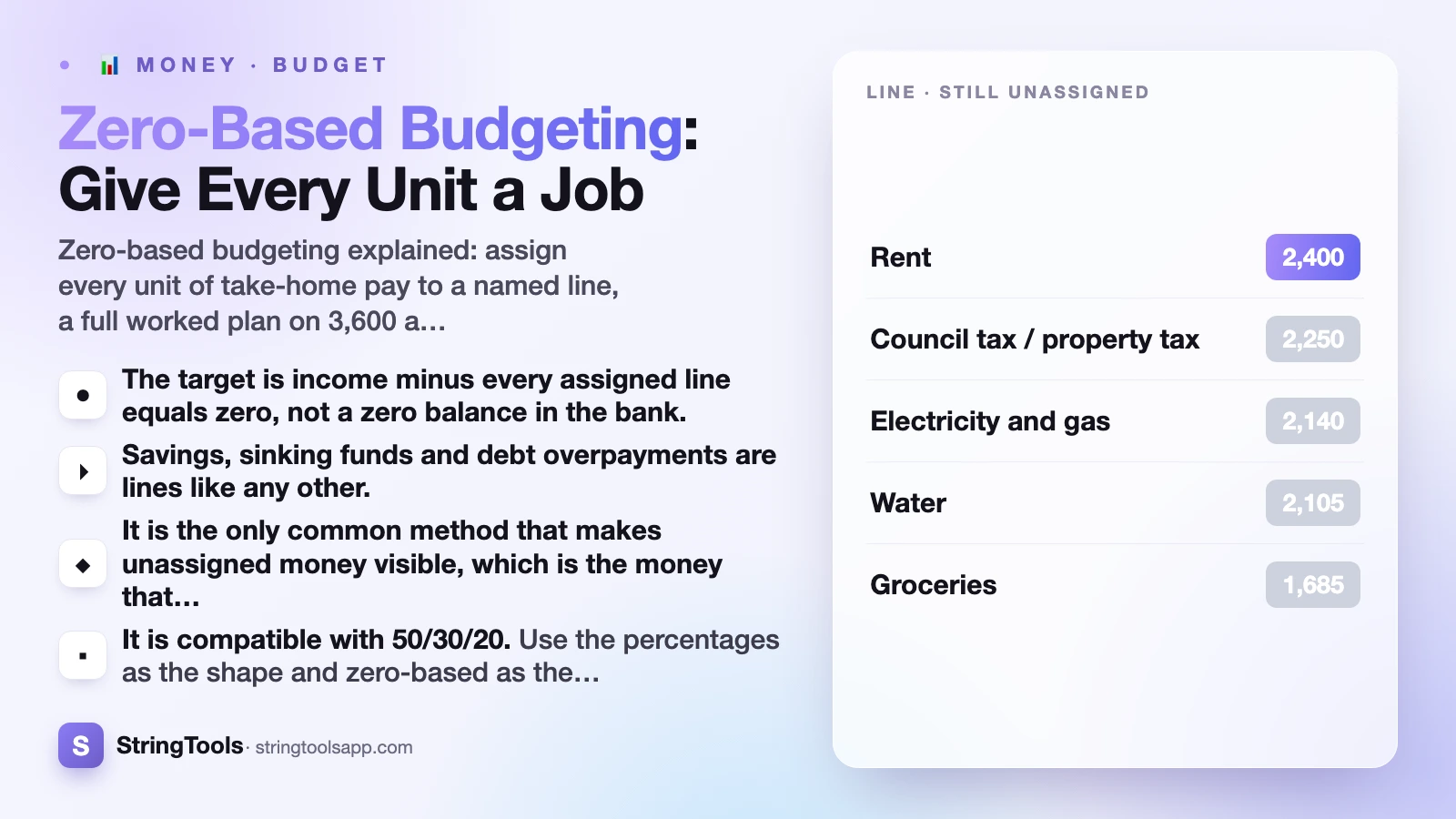
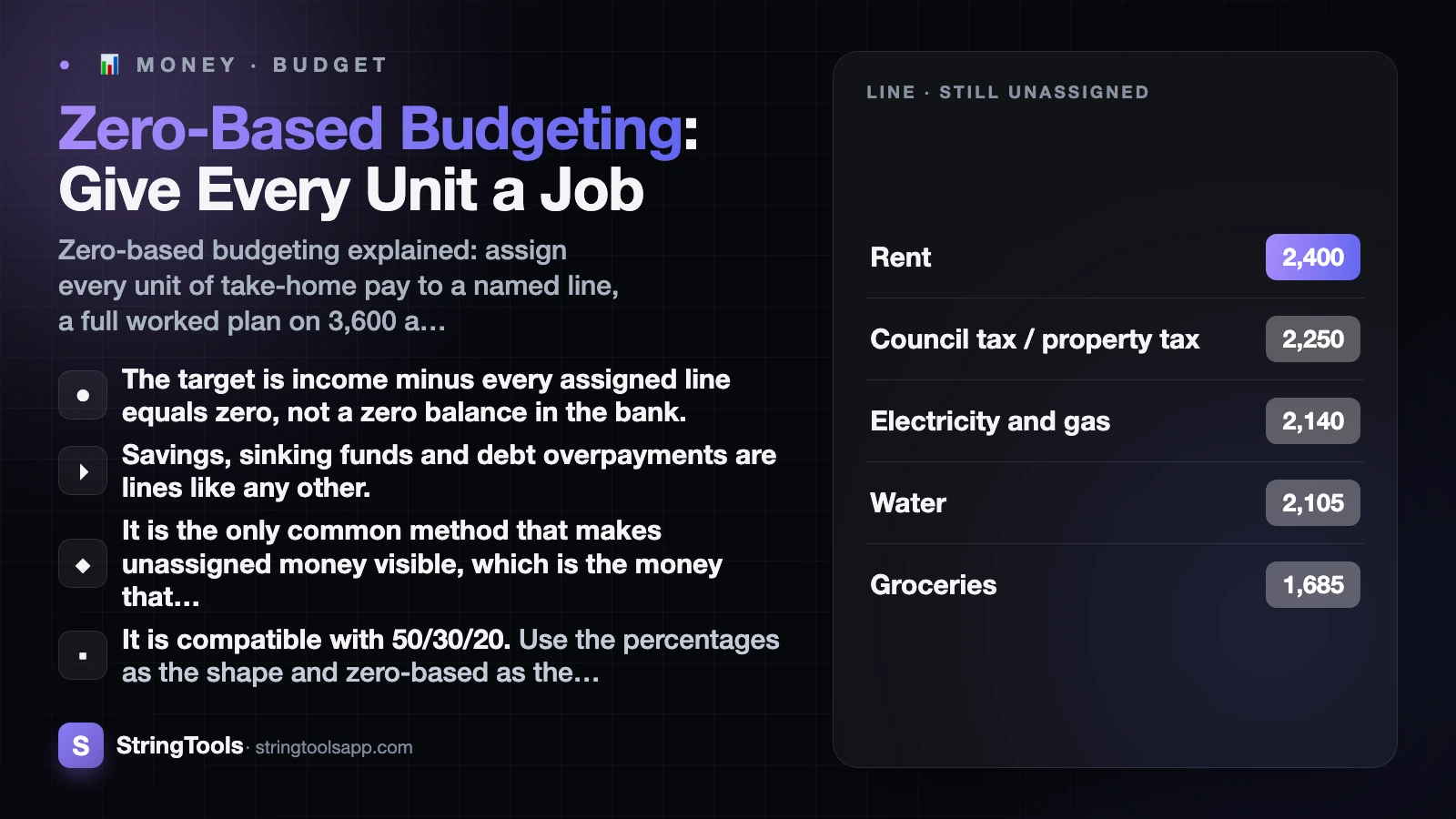
Here is a complete zero-based plan for a household with 3,600 a month in take-home pay. The right-hand column is what is still unassigned after each line, so you can watch it walk down to zero.
| Line | Bucket | Amount | Still unassigned |
|---|---|---|---|
| Rent | Need | 1,200 | 2,400 |
| Council tax / property tax | Need | 150 | 2,250 |
| Electricity and gas | Need | 110 | 2,140 |
| Water | Need | 35 | 2,105 |
| Groceries | Need | 420 | 1,685 |
| Transport to work | Need | 145 | 1,540 |
| Phone and broadband | Need | 70 | 1,470 |
| Insurance, home car and life | Need | 125 | 1,345 |
| Student loan minimum | Need | 90 | 1,255 |
| Restaurants and coffee | Want | 180 | 1,075 |
| Streaming and apps | Want | 40 | 1,035 |
| Hobbies and nights out | Want | 150 | 885 |
| Clothes | Want | 60 | 825 |
| Gifts | Want | 45 | 780 |
| Car service sinking fund | Need | 50 | 730 |
| Christmas sinking fund | Want | 40 | 690 |
| Emergency fund | Saving | 250 | 440 |
| Pension top-up | Saving | 200 | 240 |
| Extra off the student loan | Saving | 150 | 90 |
| Flexible buffer | Want | 90 | 0 |
Totalled by bucket that is 2,395 to needs, 605 to wants and 600 to savings — needs at 66.53% of take-home, which is a long way from a 50% target and entirely normal where rent is a third of the pay packet.
Three lines in that plan are the ones a simpler budget usually omits, and they are worth pointing at.
The two sinking funds. The car service and Christmas lines are money set aside monthly for costs that do not arrive monthly. They are the difference between a December that is planned for and a December that goes on a credit card.
The flexible buffer of 90. This is not slack, and it is not the same as leaving 90 unassigned. It is a named line for the small unpredictable things — a prescription, a school trip, a birthday you forgot — and when they happen you spend it deliberately. Without it, every surprise is taken from the savings line by default.
The debt split. The student loan appears twice: 90 as a minimum payment tagged need, and 150 of overpayment tagged saving. That split is explained in needs vs wants and it matters here because it changes what the savings figure actually tells you.
How it differs from 50/30/20
They are often presented as rivals. They are not: one decides the shape, the other decides the detail.
| 50/30/20 | Zero-based | |
|---|---|---|
| Unit of planning | Three buckets | Every individual line |
| Time to set up | Twenty minutes from a statement | An hour or two the first month |
| Monthly effort | Low | Moderate, and it does not fall to zero |
| Handles leftover money | Tolerates it | Forbids it |
| Handles irregular costs | Poorly, unless you add them yourself | Naturally, through sinking funds |
| Suits | Anyone wanting a quick diagnosis | Anyone who wants control over each line |
| Main failure mode | The targets never change anything | Too many lines, then abandonment |
The practical answer is to run both. Use the percentage split as the target shape — the 50/30/20 budget explained covers the five common splits and when each one fits — and then zero-base within it. The buckets tell you whether the shape is wrong. The lines tell you what to do about it.
The plan above illustrates that exactly. Its bucket totals say needs are far above any reasonable target and savings are respectable anyway. Its line detail says the reason is rent at 1,200, and that no rearrangement of groceries or streaming will change that. Two different pieces of information, and you need both.
When the month does not go to plan
The plan will be wrong. Groceries will run 40 over, the car will need something, a friend will get married. Zero-based budgeting has one rule for this, and following it is the whole method.
Move the money from another line, and write it down.
Groceries at 460 instead of 420 means 40 has to come from somewhere. Take it from hobbies, which drops from 150 to 110, and the plan still balances. What you must not do is let groceries run over and leave the rest of the plan untouched, because then the plan quietly stops describing reality and you are guessing again by the third week.
The order to raid lines in, when something has to give:
- The flexible buffer first. That is exactly what it is for, and using it is a success rather than a failure.
- Then a want line. Hobbies, clothes, restaurants. Reversible, and no consequences beyond a duller fortnight.
- Then a sinking fund, reluctantly. You are borrowing from a future bill and you will have to repay it next month. Note the amount.
- The savings and needs lines last. Raiding the emergency fund line for an ordinary overspend is how the fund ends the year smaller than it started.
Two or three months of doing this teaches you more about your spending than any category report, because you find out which lines you were consistently optimistic about. Those lines get bigger next month, funded by the ones you were pessimistic about. That adjustment is the point, and it is why budgets fail in month three less often when they are zero-based: the plan is designed to be edited rather than obeyed.
Who it suits, and who it does not
It works well if your take-home pay is stable and predictable, you want to know where the money goes rather than just how much is left, you are clearing debt and want every spare unit directed at it, or you have tried a percentage budget and found that the money still vanished.
It works badly if your income is irregular, at least until you have a buffer account paying you a fixed base month — the method assumes a known income figure, and budgeting on an irregular income sets out how to manufacture one.
It also works badly if you write forty lines. This is the common way it collapses. The plan becomes an accounting exercise, the monthly edit takes two hours, and by month three nobody opens it. Fifteen to twenty-five lines is the sustainable range. Group anything small: not three streaming lines but one subscriptions line.
For a plain, product-free grounding in spending plans, MyMoney.gov and the FDIC's Money Smart programme both cover the basics without trying to sell anything.
Setting one up this month
Start from your take-home figure — the amount that lands in your account after tax and payroll deductions, not your salary.
Write the fixed bills first, from your statements rather than memory. Then the variable needs: food, fuel, household. Then take every annual or irregular cost you can think of, divide each by twelve, and give it a sinking-fund line. Then the wants, honestly, including the ones you would rather not write down. Then savings and any debt overpayment. Then a flexible buffer line of whatever remains.
If the unassigned figure goes negative before you reach savings, you have found something useful rather than failed. It means your committed spending exceeds your income, and that has been true whether or not you were measuring it. The response is structural — the large fixed costs — rather than another round of cutting subscriptions.
The budget calculator will run this: enter take-home pay, add a row per line tagged need, want or saving, and it shows the bucket totals against your chosen split plus the unassigned figure, which is the number you are driving to zero. It keeps your figures in your browser on that device, so next month is an edit rather than a rebuild.
Expect the first month to be wrong and the third to be roughly right. The plan you finish the quarter with is the one that was actually built from your spending rather than your intentions, and it is the only version worth keeping.
Frequently Asked Questions
What is zero-based budgeting in personal finance?
It is a method where you assign every unit of your monthly take-home pay to a specific line until nothing is left unassigned. Income minus all assigned lines equals zero. Savings, sinking funds and debt overpayments are lines like any other, so reaching zero usually means several hundred units are sitting safely in savings rather than spent. The aim is that no money exists in your plan without a job attached to it.
Does a zero-based budget mean spending all my money?
No. Zero refers to the unassigned figure, not your bank balance. In the worked plan in this article, 3,600 of take-home pay is fully assigned, and 600 of that goes to an emergency fund, a pension top-up and a student loan overpayment, with another 90 in sinking funds. The plan balances to zero while the actual account balance grows month by month.
What is the difference between zero-based budgeting and the 50/30/20 rule?
50/30/20 assigns percentages to three broad buckets and tolerates leftover money. Zero-based assigns every unit to a named line and forbids leftovers. They are complementary rather than competing: use the percentage split to decide the shape of the budget, then zero-base the individual lines within it. The buckets tell you whether the shape is wrong; the lines tell you what to change.
What do I do when I overspend a category?
Move the money from another line so the plan still balances, and record the move. Groceries running 40 over means 40 comes out of hobbies. Take it from the flexible buffer first, then a want line, then a sinking fund if you must, and leave savings and needs alone. Letting an overspend sit unaccounted for is what turns a written plan back into guesswork by the third week.
How many lines should a zero-based budget have?
Roughly fifteen to twenty-five. Too few and the irregular costs get missed; too many and the monthly edit becomes an accounting job you stop doing. Group the small recurring items, so one subscriptions line rather than three streaming lines, and keep separate lines only where you actually make separate decisions. Abandonment through excessive detail is the most common way this method fails.
Can I use zero-based budgeting with an irregular income?
Only once you have manufactured a fixed figure to budget. Pay all income into a receiving account, set aside tax, and pay yourself a fixed base month from a buffer account. The zero-based plan then runs against that base month exactly as it would against a salary. Trying to zero-base a variable input directly means rewriting the whole plan every month, which very few people sustain.
Sources and references
MyMoney.gov (mymoney.gov) · Money Smart (fdic.gov). Content was reviewed against these sources as of the last-updated date above; external figures and rules may change after publication.