
Three buckets, and the sorting is the hard part
The 50/30/20 split sends 50% of take-home pay to needs, 30% to wants and 20% to savings and debt repayment above the minimum. The percentages take five seconds. The work is deciding which bucket each line of your actual spending belongs in, and then reading the gap between the two.
Key Takeaways
- Run the percentages on take-home pay — after tax and after payroll deductions. Contributions taken from gross pay never enter the buckets at all, because that money never reached you.
- Needs are what you would still pay if income stopped, wants are the part you could pause, and savings is anything that improves your net worth, including overpayments on debt.
- One expense can belong to two buckets. A card payment splits: the minimum is a need, everything above it is saving. Getting that one line wrong is the most common tagging error.
- The output is not the split. It is the difference between the split and what you actually spent, bucket by bucket, which tells you whether your problem is large and fixed or small and frequent.
- When the sort shows needs are structurally above 50%, change the split rather than keep failing it. Four alternatives are costed below on identical take-home pay.
- Every unit of take-home should land in one of the three buckets. Whatever is left unassigned is the money that quietly disappears.
The appeal is that you can hold it in your head. Most budgets fail because they ask you to sort spending into twenty-five categories every month, and nobody sustains that. Three buckets you can do from a bank statement in twenty minutes, repeatedly, without dreading it.
This article is general information, not personal financial advice. For a decision that turns on your own circumstances, a regulated adviser is the right person to ask.
Take-home pay, not salary — and why that one word matters
Every percentage below is a percentage of what actually arrives in your bank account: after income tax, after national insurance or payroll taxes, after pension or retirement contributions taken at source, after health insurance premiums deducted by an employer.
Running the split on gross salary is the single most common way people mis-size a budget. The targets come out too large, the plan looks comfortable on paper, and then reality quietly overspends every bucket from month one. A salary figure is a negotiating number. A take-home figure is a budget.
Two details worth getting right before you start:
- Pension and retirement contributions taken from your gross pay never appear in the budget at all. They were removed before the money reached you. They are still saving, and they still count towards your real savings rate, but they sit outside the three buckets because they are outside your take-home.
- Variable pay needs an average or a floor. Overtime, commission and bonuses distort a single month. Use your lowest recent month as the planning figure, and treat anything above it as a surplus to assign deliberately. If that is your normal pattern, how to budget on an irregular income sets out the buffer method that makes the percentages work again.
The budget calculator starts from a single take-home figure for exactly this reason. It asks for one number, splits it, and then compares the split with the spending you enter.
The arithmetic, on nine take-home figures
There is nothing subtle about the maths — it is income multiplied by 0.5, 0.3 and 0.2 — but seeing it in money rather than percentages changes how the split reads.
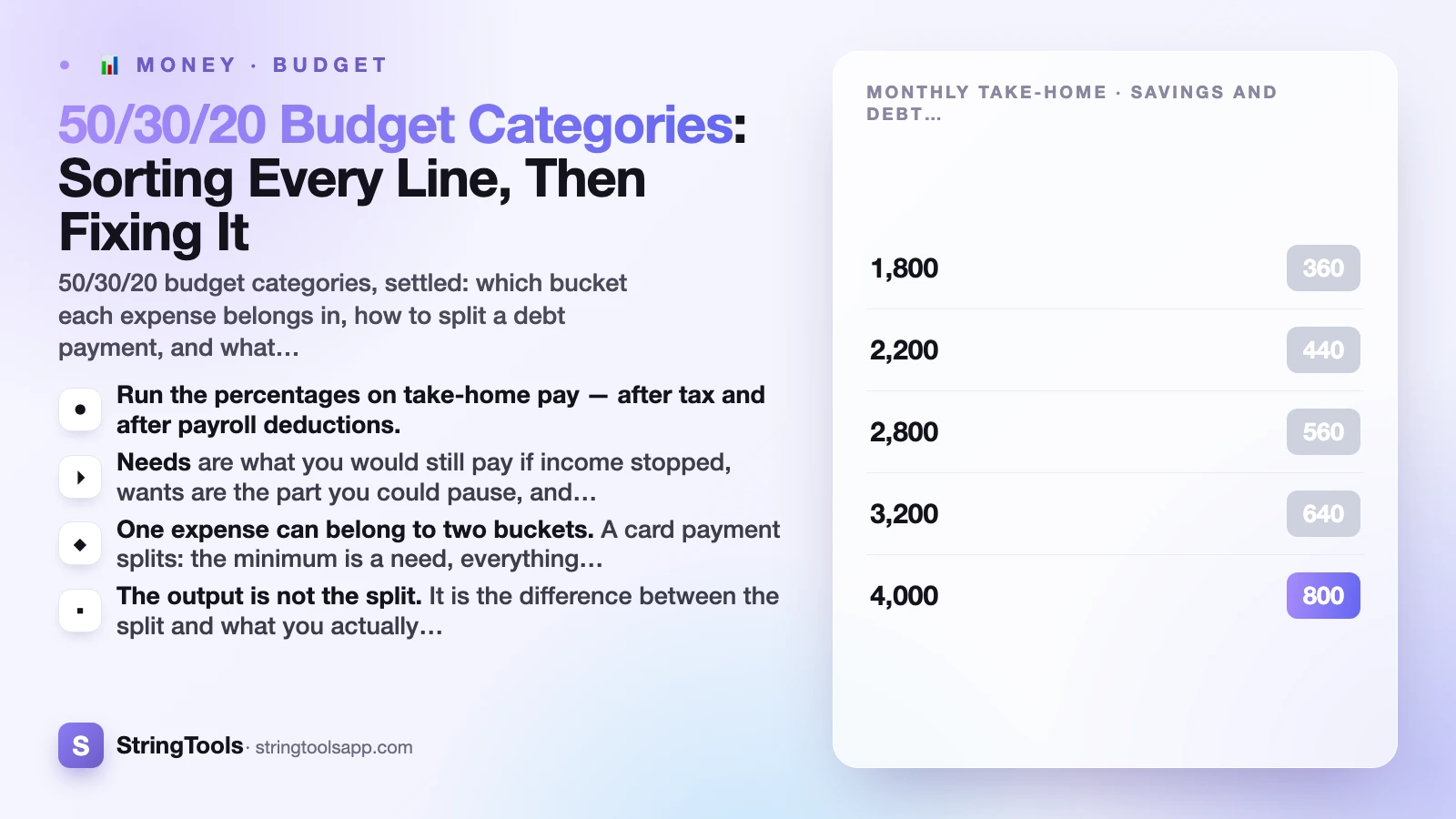
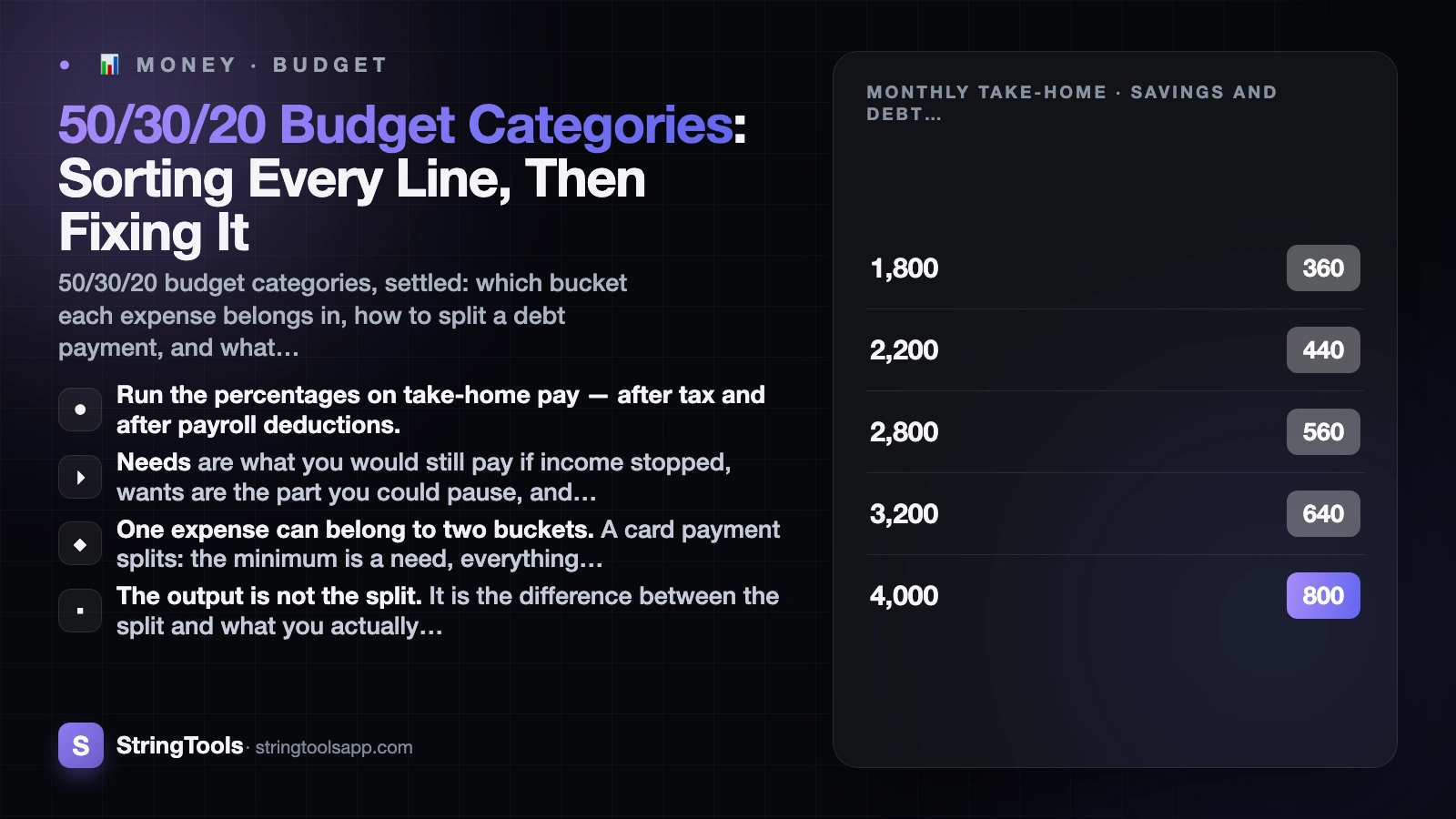
| Monthly take-home | Needs (50%) | Wants (30%) | Savings and debt (20%) |
|---|---|---|---|
| 1,800 | 900 | 540 | 360 |
| 2,200 | 1,100 | 660 | 440 |
| 2,800 | 1,400 | 840 | 560 |
| 3,200 | 1,600 | 960 | 640 |
| 4,000 | 2,000 | 1,200 | 800 |
| 4,800 | 2,400 | 1,440 | 960 |
| 5,600 | 2,800 | 1,680 | 1,120 |
| 6,400 | 3,200 | 1,920 | 1,280 |
| 7,200 | 3,600 | 2,160 | 1,440 |
The figures are shown without a currency symbol on purpose: the arithmetic is identical in dollars, pounds, euros or rupees, and only the affordability changes.
Read down the needs column and the problem with a single fixed percentage becomes obvious. At 1,800 take-home, 900 has to cover rent, energy, food, transport and insurance. At 7,200, the same 50% gives 3,600 for the same list of obligations, which in most places is generous. The split is far kinder to higher incomes, because needs do not scale with pay — they are mostly set by where you live and who depends on you.
That is the honest limitation of any percentage rule: it describes a shape, but cannot make the shape fit. Which is why the sorting exercise below matters more than the numbers above — the sort tells you which shape you are actually in.
What goes in each bucket, including the four lines people get wrong
Needs. Anything you would still have to pay if your income stopped tomorrow: rent or mortgage, property or council tax, utilities, basic groceries, insurance, transport to work, childcare, prescriptions, and the minimum payment on every loan and card.
Wants. The upgrades and the choices: restaurants, takeaways, streaming, hobbies, holidays, the nicer phone plan, clothes beyond replacement. None of it is wrong. It is simply the part you could pause without losing your home, your health or your credit rating.
Savings and debt. Money that improves your net worth: the emergency fund, investment and pension contributions you make yourself, and every unit of debt repayment above the minimum.
Four lines cause nearly all the arguments:
- Debt payments split across two buckets. The minimum is a need. Everything above the minimum is savings, because it is buying down a liability. If your card minimum is 65 and you pay 160, that is 65 in needs and 95 in savings.
- Groceries are a need; the way you shop is partly a want. Nobody sensibly puts the whole food budget in wants, and nobody honestly claims the entire supermarket bill is the minimum required to stay alive.
- A gym membership is a want, even if you go four times a week and it is the best money you spend. The test is whether it could be paused, not whether it is worthwhile.
- Insurance is a need; the excess cover you chose is arguable. Treat the premium you would still buy if money were tight as the need.
Sorting is where budgets get quietly dishonest, so needs vs wants works through the grey areas in detail, including how to split a single line between two buckets instead of forcing it into one.
A worked household: plan against reality
Here is where the rule earns its place. Take a household with 4,000 a month in take-home pay, whose targets from the table above are 2,000, 1,200 and 800. This is what they actually spent.
| Line | Bucket | Amount |
|---|---|---|
| Rent | Need | 1,450 |
| Council tax / property tax | Need | 180 |
| Gas, electricity, water | Need | 170 |
| Groceries | Need | 480 |
| Car insurance and fuel | Need | 230 |
| Phone and broadband | Need | 75 |
| Credit card minimum | Need | 65 |
| Restaurants and takeaways | Want | 290 |
| Streaming and subscriptions | Want | 55 |
| Clothes and household extras | Want | 150 |
| Hobbies and nights out | Want | 210 |
| Holiday saving | Want | 120 |
| Pension top-up | Saving | 180 |
| Emergency fund transfer | Saving | 100 |
| Extra off the credit card | Saving | 95 |
Totalled into buckets and set against the plan:
| Bucket | Target (50/30/20) | Actual | Difference | Actual share of take-home |
|---|---|---|---|---|
| Needs | 2,000 | 2,650 | +650 | 66.25% |
| Wants | 1,200 | 825 | -375 | 20.63% |
| Savings and debt | 800 | 375 | -425 | 9.38% |
Three things fall out of that comparison, and none of them are visible from a bank statement alone.
First, this household is not overspending on lifestyle. Wants are more than nine points below target. The common advice — cancel the subscriptions, stop the takeaways — would recover very little, because there is very little there.
Second, needs are at 66.25% of take-home, sixteen points above target, and rent alone is 36% of it. That is the whole story.
Third, the savings bucket has absorbed the difference. It is at 9.38% instead of 20%, which is 425 a month short. That gap is not a discipline problem; it is what a fixed housing cost does to a plan built on a 50% needs assumption.
The listed spending comes to 3,850, so 150 a month is unassigned. Left floating it will be spent without anyone noticing. Sent to savings it would be 1,800 over a year, which nearly halves the shortfall on its own.
When the split breaks, change the split rather than the plan
The household above cannot reach 50% needs by shopping more carefully. Rent, council tax, insurance and the card minimum are fixed for the year, and squeezing groceries and fuel might find 80 a month against a 650 gap. The correct response is to pick a split that matches the life you are actually living, and then work on the two or three large fixed costs rather than the twenty small ones.
| Split | Needs | Wants | Savings and debt | Best suited to |
|---|---|---|---|---|
| 50 / 30 / 20 | 2,000 | 1,200 | 800 | The common starting point |
| 60 / 20 / 20 | 2,400 | 800 | 800 | Housing alone takes a large share of pay |
| 70 / 20 / 10 | 2,800 | 800 | 400 | A tight month or a modest income; keeps the habit alive |
| 50 / 20 / 30 | 2,000 | 800 | 1,200 | Clearing expensive debt, or catching up on retirement |
| 40 / 30 / 30 | 1,600 | 1,200 | 1,200 | Housing is cheap or shared |
All five are shown on the same 4,000 take-home, so they are directly comparable, and all five total exactly 4,000.
For our household, 60/20/20 is still out of reach on needs, but 70/20/10 gives 2,800 for needs against 2,650 actual, and 400 for savings against 375 actual. The plan is now honest, almost met, and carries one clear instruction: get needs below 2,800, and every unit of improvement goes to the savings line. That is a budget somebody will still be running in month four, and the reasons plans collapse before then are set out in why budgets fail in month three.
Note what changing the split does and does not do. It does not make you better off by a single unit; the 2,650 of needs is still 2,650. What it changes is the measurement, and therefore what the next month's sort will tell you. A target you miss by 650 every month reports the same failure indefinitely and eventually stops being read. A target you miss by nothing reports movement, which is the only signal a budget can actually give you. For where the units in the savings bucket should go once they exist — buffer, employer match, expensive debt, then the rest — how much of your paycheck you should save sets out the priority order.
How to run it in twenty minutes, once a month
Pull the last full month from your bank and card statements, then work down every line and tag it need, want or saving. Do not try to be clever, and do not restructure your life. Just sort, total each bucket, and compare with the targets. The gap is the output; everything else is noise.
A few practical points that make the difference between a budget you repeat and one you abandon:
- Use a real month, not a typical one. There is no typical month. Use last month, with its car repair and its birthday, because those months are the ones that decide your year.
- Tag consistently. If takeaways were a want in January they must be a want in February, otherwise the trend between months means nothing.
- Count annual bills as monthly. Divide each yearly cost by twelve and put a twelfth of it in the plan every month. This is the single biggest source of month-three surprises.
- Review quarterly, not weekly. A monthly sort with a quarterly decision is sustainable; a weekly review is not.
- Change one thing. A budget that asks for six changes at once gets none of them.
The budget calculator does the totalling and the comparison for you: enter take-home pay, choose 50/30/20 or one of the other splits, add a row for each real expense tagged need, want or saving, and it shows the target, the actual, the difference and the percentage for each bucket, plus anything left unassigned. It saves your figures in your browser on that device, so next month you edit rather than start again. Nothing is uploaded and there is no account.
For the government-backed basics on spending plans, MyMoney.gov and Citizens Advice both publish plain guidance with no product attached, and the three-to-six-months benchmark for the emergency-fund part of the savings bucket comes from consumer-finance bodies such as the CFPB in the US and MoneyHelper in the UK.
What to do with the number the comparison gives you
Three outcomes, three different jobs.
Needs are above target and wants are low. This is the household above, and it is by far the most common result. Your problem is large and fixed, not small and frequent. The levers are housing, debt, insurance and transport, in that order, and each takes months rather than weeks: a remortgage or a cheaper tenancy, a balance transfer, an insurance switch at renewal, a car with lower running costs. In the meantime, drop to a split you can meet so that the plan stops lying to you.
Wants are above target. This is the situation the advice industry assumes and the easiest to fix, because it is made of many small reversible decisions. Pick the two largest want lines and halve them for one month. Do not cancel everything; a budget with no pleasure in it gets abandoned by March.
Everything is on target and there is still money unassigned. Assign it. Unallocated money is spent without being noticed. Give every remaining unit a job — even if that job is "fun" — which is the idea behind zero-based budgeting.
Whichever you land in, the next step is the same: pick one change, apply it, re-run the sort next month. A budget is a measurement you repeat, not a document you write once.
Frequently Asked Questions
Which take-home figure do I use if my pay changes every month?
Use your lowest recent month as the planning figure rather than an average, and treat anything above it as a surplus you assign deliberately when it arrives. An average quietly builds a good month into every target, which is why variable-pay budgets fail in the thin months. Contributions taken from gross pay stay outside all three buckets whichever figure you pick, because that money never reached your account.
What if my needs are more than 50% of my take-home pay?
That is very common where housing is expensive or income is modest, and it does not mean you have failed at budgeting. Switch to a split that matches reality, such as 60/20/20 or 70/20/10, so the plan is something you can actually meet. On 4,000 a month, 70/20/10 gives 2,800 for needs, 800 for wants and 400 for savings. Keep the savings bucket alive even at 10%, and put your effort into the few large fixed costs rather than the many small ones.
Do credit card and loan payments count as needs or savings?
Both, split across the two buckets. The minimum payment is a need, because missing it brings fees, interest and a mark on your credit record. Anything you pay above the minimum belongs in the savings bucket, because it improves your net worth. If your minimum is 65 and you pay 160, that is 65 in needs and 95 in savings. Sorting it all into one bucket is the most common tagging error people make.
My wants are under target and I still save nothing. What now?
That result means your problem is large and fixed, not small and frequent, and it is by far the most common outcome of the sort. In the worked household, wants ran nine points below target while needs ran sixteen above, so cancelling subscriptions would have recovered very little. The levers are housing, debt, insurance and transport, in that order, and each takes months rather than weeks.
How do I split one expense across two buckets?
Decide what the minimum version of that line would cost if money were tight, tag that part as a need, and tag the difference as a want or a saving. A card payment of 160 against a 65 minimum is 65 need and 95 saving. An insurance premium splits into the cover you would still buy and the extra you chose. Whatever rule you pick, apply it the same way every month or the trend between months means nothing.
How often should I redo the 50/30/20 split?
Sort your spending monthly, but only make decisions quarterly. A monthly sort takes about twenty minutes from a bank statement and tells you which bucket moved. Acting on a single month is usually overreacting, since one month contains one car repair or one birthday. Re-set the percentages themselves whenever something structural changes: a move, a pay rise, a new loan, a debt cleared, or a change in who depends on your income.
Sources and references
MyMoney.gov (mymoney.gov) · Citizens Advice (citizensadvice.org.uk). Content was reviewed against these sources as of the last-updated date above; external figures and rules may change after publication.