
The fastest way to work out a tip in your head
Move the decimal point one place left to get 10% of the bill. That single number gives you everything else: halve it and add for 15%, double it for 20%, halve it again for 5%. On a 47.00 bill, 10% is 4.70, so 15% is 7.05 and 20% is 9.40. No other arithmetic is required.
Key Takeaways
- Every mental tip method is built on the same move: shifting the decimal point one place to get 10%.
- From that one figure you can reach 5%, 12.5%, 15%, 20% and 25% by halving, doubling or quartering.
- Rounding the bill before you start costs you very little accuracy and saves most of the effort.
- Working out the tip per person first is often easier than working out the whole tip and dividing it.
- Aiming for a round total, rather than a round percentage, is how most people actually pay.
- The tip calculator is there for the bills that are not worth the effort, and for splitting an uneven bill across a group.
The percentages in this article are worked examples chosen because the arithmetic is clean. What is customary depends on the country and the venue, which is covered in how much should you tip.
The building block: one decimal place
Ten per cent of any number is that number with the decimal point moved one place to the left. That is not a trick, it is how a base-ten number system works, and it means the hardest step in tip arithmetic is reading the bill correctly.
Once you have 10%, everything useful is one further operation away.
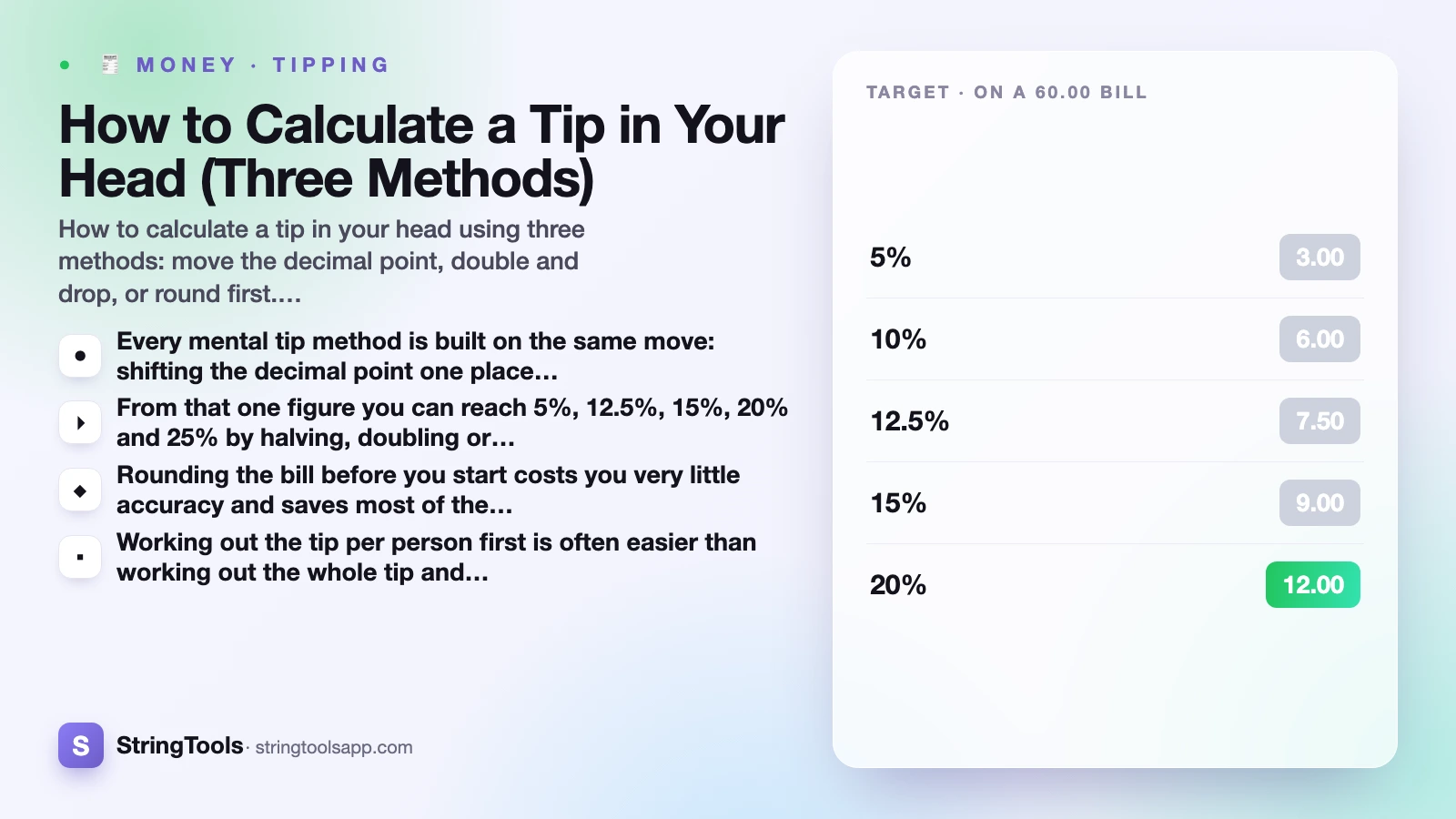
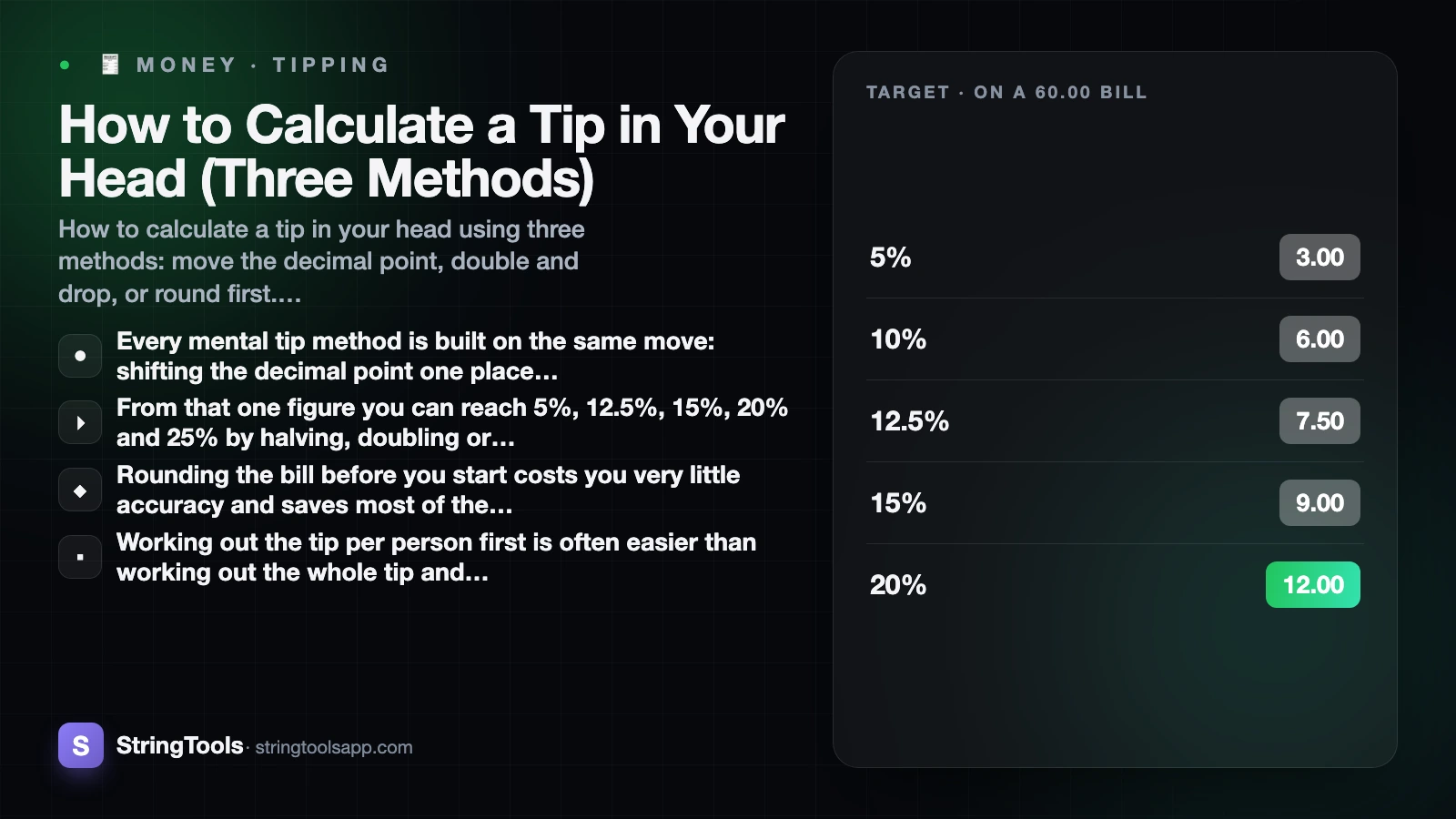
| Target | How to get there from 10% | On a 60.00 bill |
|---|---|---|
| 5% | Halve it | 3.00 |
| 10% | The number itself | 6.00 |
| 12.5% | Add a quarter of it | 7.50 |
| 15% | Add half of it | 9.00 |
| 20% | Double it | 12.00 |
| 25% | Double it, then add half of the 10% figure | 15.00 |
The 60.00 column is deliberately clean so the relationships are visible. The relationships hold for any bill, however awkward.
Two things make this harder in practice than it looks on a page. The first is that restaurant bills rarely end in round numbers. The second is that you are usually doing this while talking to someone. Both are solved by rounding, which is the third method below.
The only three facts you need
- Decimal point one place left gives 10%.
- Halving is easy. Doubling is easy. Everything else is built from those two.
- An answer that is 20 cents out has never caused a problem for anybody.
Method one: ten and halve
This is the classic, and it is the one to learn if you only learn one.
Take 10% by moving the decimal point. Halve it. Add the two together. That gives 15%.
On a 63.00 bill: 10% is 6.30, half of that is 3.15, and the two added together give 9.45.
The method scales without effort. If you want 20%, do not bother with halves at all: just double the 10%, which gives 12.60. If you want 25%, double the 10% to get 12.60 and add half the 10%, which is 3.15, giving 15.75.
Why it works well. Halving is the operation people are fastest at, faster even than doubling, and it keeps you working with a number you already have rather than starting again.
Where it gets awkward. Halving an odd number of cents produces an extra decimal place, which is precisely when you should stop being precise. Half of 6.30 is 3.15, which is fine. Half of 6.35 is 3.175, which is nobody's idea of a useful figure at a dinner table. Round it and move on.
A useful variant. If you want something between 15% and 20%, take the 10% and add anything between a half and a full extra 10%. There is no requirement to land on a round percentage, and nobody is checking.
Method two: double and drop
This one goes straight to 20% and skips the halving entirely.
Double the bill, then move the decimal point one place left. Doubling 86.00 gives 172.00, and moving the decimal gives 17.20. That is 20% of 86.00.
It is the same arithmetic as doubling the 10%, but in the other order, and for many people doubling a whole number is easier than doubling a number that already has a decimal in it. Doubling 86 to 172 feels like nothing; doubling 8.60 to 17.20 requires a little more care about where the point goes.
Where this method shines. Round-ish bills. Doubling 45 to 90 and dropping to 9.00 takes about a second.
Where it does not. Large bills, where doubling three-digit numbers in your head is more work than halving a small one. On a 286.00 bill, doubling to 572.00 is harder than taking 28.60 and doubling it.
The half-step. If you want 10% you have already got it before the doubling, and if you want 15% you can take the doubled figure of 17.20 and subtract a quarter of it. That subtraction is harder than the ten-and-halve route, so use method one when 15% is the target and method two when 20% is.
Two methods sounds like one too many. The reason to know both is that the easy one depends on the bill, and you can see which within a second of reading it.
Method three: round first, then adjust
This is what people who are good at this actually do. They do not calculate a percentage of the bill. They calculate a percentage of a nearby, friendlier number.
Take a bill of 47.30. Round it to 50.00. Ten per cent of 50.00 is 5.00, so 20% is 10.00. You are done, in about two seconds.
How wrong is that answer? An exact 20% of 47.30 is 9.46, so rounding up to 10.00 leaves an extra 0.54 on the table. That is the entire cost of the shortcut.
Rounding down works the same way when you want to be a little more conservative: round 47.30 to 45.00, take 10% as 4.50, double it to 9.00, and you are 0.46 under the exact figure.
The total-first version. Instead of choosing a percentage and calculating a tip, choose the total you want to pay and let the tip be whatever fills the gap. On the 47.30 bill, paying a round 57.00 means a tip of 9.70, which happens to be a little over 20%. This is how most rounding cultures handle tipping in practice, and it is the fastest method of all because it involves one subtraction rather than any multiplication.
When rounding is a bad idea. On very small bills, rounding distorts the percentage heavily: rounding a 4.20 coffee up to 5.00 is close to a 19% tip whether you intended one or not. That is usually fine, but it is worth knowing that is what you did.
A reference table for common bills
If you would rather recognise the answer than calculate it, this is the table to remember the shape of. All figures are exact.
| Bill | 10% | 15% | 20% |
|---|---|---|---|
| 18.00 | 1.80 | 2.70 | 3.60 |
| 32.00 | 3.20 | 4.80 | 6.40 |
| 47.00 | 4.70 | 7.05 | 9.40 |
| 63.00 | 6.30 | 9.45 | 12.60 |
| 86.00 | 8.60 | 12.90 | 17.20 |
Read across any row and the three relationships are visible: the middle column is the first plus half of itself, and the last column is the first doubled. Once you have seen that a few times, the arithmetic stops feeling like arithmetic.
Two practical notes on which number you apply this to. Where a bill shows tax as a separate line, you have a choice of base, and the difference is worked through in do you tip on the pre-tax or post-tax total. And where a service charge is already on the bill, the percentage should not be applied to a total that includes it, because that means paying for service twice.
If you are on the receiving end of tips rather than the paying end, the tax treatment is a separate question: the US Department of Labor covers tips under the Fair Labor Standards Act, and the UK rules for workers are set out on GOV.UK.
Doing it for a group without losing track
The mental arithmetic gets harder when a total has to be divided as well as multiplied. The fix is to change the order of operations.
Divide first, then tip. A bill of 86.00 split four ways is 21.50 each. Adding 20% to 21.50 means adding 4.30, giving 25.80 per person. That is two small operations on a small number.
Tip first, then divide. The same bill with 20% added is 103.20, divided by four, which is 25.80. Identical answer, but you had to divide a three-digit number with a decimal in it.
Both give 25.80. The first route is easier to do standing up.
When people ordered very differently, neither shortcut applies, because an even split is no longer the right answer. That is a different problem with its own solutions, worked through in how to split a bill fairly.
When to stop doing it in your head
- When the bill is large. On a 300.00 bill, a rounding shortcut can be several units of currency out, which is worth more than the seconds saved.
- When people are paying each other back. Approximate numbers are fine when one person pays; they cause confusion when four people are transferring money afterwards.
- When the split is uneven. Per-person subtotals plus a tip allocation is not mental arithmetic, it is bookkeeping.
- When you have had a long evening and would rather not.
For those cases the tip calculator will take the bill, the tip percentage and the number of people, handle uneven shares, split the tip either proportionally or evenly, and round each person up to the next 1, 5 or 10. For everything else, the decimal point is enough.
Frequently Asked Questions
What is the quickest way to work out a 20% tip?
Double the bill and move the decimal point one place left. Doubling 86.00 gives 172.00, which becomes 17.20. Alternatively, take 10% first by moving the decimal, then double it: 8.60 doubled is also 17.20. Use whichever doubling feels easier for the number in front of you, which usually depends on whether the bill is a round figure.
How do you calculate 15% in your head?
Take 10% by moving the decimal point one place left, halve that, and add the two together. On a 63.00 bill, 10% is 6.30 and half of that is 3.15, so 15% is 9.45. The method works on any bill, and when the halving produces a third decimal place, round it rather than carrying it.
Is it acceptable to round the bill before calculating?
Yes, and it is what most people do. Rounding 47.30 up to 50.00 and taking 20% gives 10.00 against an exact figure of 9.46, so the shortcut costs 0.54. On ordinary restaurant bills the error is small enough not to matter. On a very small bill it distorts the percentage considerably, and on a very large one it can be worth several units of currency.
Should I work out the tip before or after splitting the bill?
Before or after gives the same answer, but dividing first is easier mentally. A bill of 86.00 split four ways is 21.50 each, and adding 20% to that gives 25.80 per person. Adding the tip first gives 103.20 to divide by four, which is also 25.80 but involves harder arithmetic. Dividing first only works when the split is even.
How do I get to a round total instead of a round percentage?
Pick the total you want to pay and subtract the bill. On a 47.30 bill, deciding to pay 57.00 leaves a tip of 9.70, a little over 20%. This is a single subtraction and it is how rounding-up cultures handle tipping generally. It also makes the payment tidy, which matters when you are paying in cash.
Does the tip percentage apply to the whole bill including tax and service?
Not to a service charge, no. A service charge or automatic gratuity is already payment for service, so calculating a percentage on a total containing one means paying twice. Tax is a genuine choice between two conventions, and the difference is small and predictable, which is set out in do you tip on the pre-tax or post-tax total.
Sources and references
tips under the Fair Labor Standards Act (dol.gov) · GOV.UK (gov.uk). Content was reviewed against these sources as of the last-updated date above; external figures and rules may change after publication.