
The short answer on splitting a bill
Split evenly when everyone ordered roughly the same, and itemise when they did not. The fair middle ground is a hybrid: each person pays for what they ordered, shared dishes are divided by however many people ate them, and the tip is added on top in proportion to each person's share.
Key Takeaways
- An even split is a social convention, not an arithmetic one. It works when the orders are close and it quietly transfers money when they are not.
- Itemising is fairer but slower, and it only stays fair if you decide what to do with shared dishes before you start.
- The tip can be split proportionally or evenly, and the two produce different answers. Neither is wrong; pick one and say so out loud.
- Rounding each person up to a convenient note is the fastest way to finish, and it usually leaves a small surplus that should be handed to the payer or added to the tip.
- Decide the method before the food arrives, not while one person is holding a card machine.
- The tip calculator handles uneven per-person shares, splits the tip either way, and rounds each person up to the next 1, 5 or 10 so the collection is quick.
This is general information, not financial advice.
Three ways to split, and what each one is really saying
Every method is a statement about what the group thinks it is doing. That is why bill-splitting causes friction out of all proportion to the money involved.
The even split. Total divided by heads. It says: we are one group, we ate together, the differences wash out over time. It is fast, it requires no arithmetic, and it is genuinely the right answer among people who eat together often, because the person who ordered the steak tonight had the salad last time.
The itemised split. Each person pays for their own lines. It says: we are individuals who happen to be sitting at the same table. It is the right answer for a large group, a one-off gathering, colleagues who do not eat together regularly, or any table where the orders differ by a lot.
The hybrid. Individual items to individuals, shared items divided among the people who shared them, tip on top. It says: we are being fair without being forensic. In practice this is what most groups actually want, and it is what the rest of this article works through.
When each one fits
- Even split: similar orders, small group, people who eat together regularly, a celebration where one person is the reason everybody is there.
- Itemised: a wide spread in what people ordered, anyone on a tight budget, a large table, or a group where somebody did not drink.
- Hybrid: almost everything else, and in particular any meal with shared starters or side dishes.
The one rule that matters more than the method: announce it early. A group that agreed on "we will split it evenly" before ordering has no problem. A group that discovers the method only when the bill lands has a negotiation in front of it, at the worst possible moment, in front of a waiter.
A worked example with four people
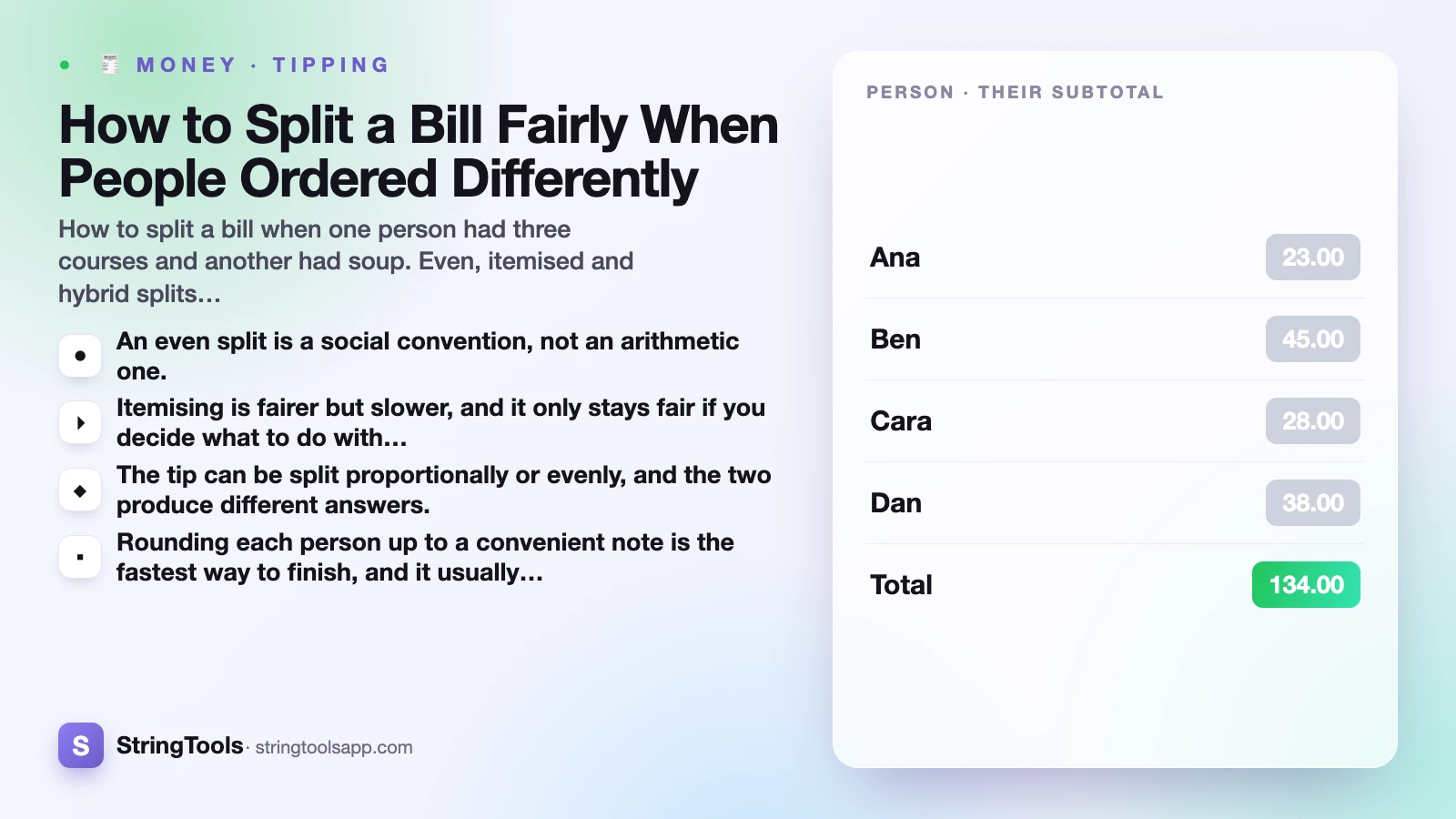
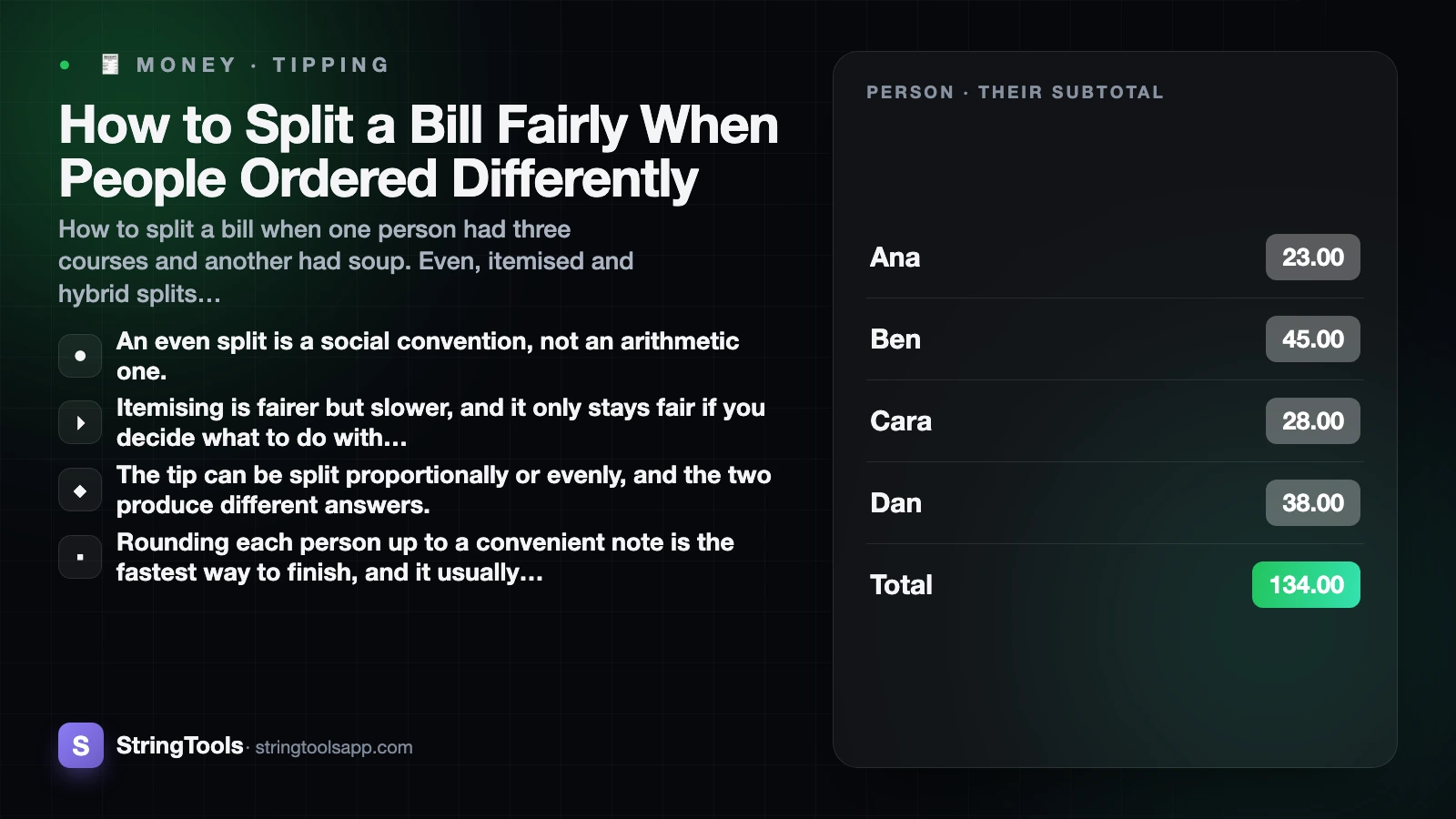
Four people eat together. They order individually and share two starters that cost 20.00 between them. The figures below are illustrative and the tip is set at 20% purely to make the arithmetic readable.
| Person | Food | Drinks | Share of shared starters | Their subtotal |
|---|---|---|---|---|
| Ana | 18.00 | 0.00 | 5.00 | 23.00 |
| Ben | 24.00 | 16.00 | 5.00 | 45.00 |
| Cara | 15.00 | 8.00 | 5.00 | 28.00 |
| Dan | 21.00 | 12.00 | 5.00 | 38.00 |
| Total | 78.00 | 36.00 | 20.00 | 134.00 |
The subtotal is 134.00. A 20% tip on that subtotal is 26.80, so the bill to be collected is 160.80.
An even split is 160.80 divided by four, which is 40.20 each.
Now look at what the even split does to Ana. She ordered one dish, drank nothing, and her own share of the bill including tip is 27.60. Splitting evenly asks her for 40.20. She is paying 12.60 more than she consumed, and Ben is paying 13.80 less than he consumed. Over one dinner between close friends that is nothing. Across a table of eight where three people did not drink, it is the reason somebody stops coming to the dinners.
Splitting the tip: proportionally or evenly
Once each person has a subtotal, there are two defensible ways to add the tip.
Proportionally. Everyone pays the same percentage on their own subtotal, so each person's share is multiplied by 1.20. The person with the biggest order contributes the biggest tip.
Evenly. The tip is treated as payment for the table, not for the food, so the 26.80 is divided by four and each person adds 6.70 on top of their own subtotal. The argument is that the server carried plates to all four of you regardless of what was on them.
| Person | Subtotal | Even split of the whole bill | Tip proportional | Tip split evenly |
|---|---|---|---|---|
| Ana | 23.00 | 40.20 | 27.60 | 29.70 |
| Ben | 45.00 | 40.20 | 54.00 | 51.70 |
| Cara | 28.00 | 40.20 | 33.60 | 34.70 |
| Dan | 38.00 | 40.20 | 45.60 | 44.70 |
| Total | 134.00 | 160.80 | 160.80 | 160.80 |
All three columns collect exactly 160.80. The difference between the two tip methods is small here, at most 2.30 for any one person, which is worth knowing because groups sometimes spend ten minutes arguing about a distinction worth about the price of a coffee.
The far bigger number in that table is the first column against the last two. That is the decision that actually moves money.
If the bill shows tax as a separate line, you also have to decide whether the tip is calculated on the subtotal or on the taxed total. That choice is worked through in do you tip on the pre-tax or post-tax total, and it changes the numbers above by a predictable amount.
The drinker and non-drinker problem
This is the single most common source of quiet resentment at a shared table, and it has a clean solution.
Drinks are the line item with the widest spread. In the example above, food ranged from 15.00 to 24.00, a spread of 9.00. Drinks ranged from 0.00 to 16.00, a spread of 16.00, on a much smaller base. A round of cocktails can cost more than a main course, and wine ordered by the bottle for the table is not always drunk by the table.
Three workable approaches, in increasing order of formality.
- Split the food, itemise the drinks. Food is divided evenly because it is roughly comparable, and each person's drinks are added on individually. This is quick and it fixes most of the unfairness with very little effort.
- Two tabs. Ask for drinks on a separate bill at the start of the evening. Many venues will do this without blinking, and it removes the problem entirely.
- Full itemisation. Everything to the person who ordered it. Fairest, slowest.
Do not put a non-drinker in the position of having to raise it. If you are the one organising, offer the food-split-drinks-itemised method yourself. The person who has to ask for it always feels like they are making a fuss, which is exactly why they usually say nothing and pay the 12.60.
Rounding, the missing pennies, and where the tip goes
Two practical problems remain once the arithmetic is done.
Rounding. Asking four people for 27.60, 54.00, 33.60 and 45.60 is precise and annoying. Rounding each person up to the next 5 gives 30.00, 55.00, 35.00 and 50.00, which collects 170.00 against a bill of 160.80. The surplus of 9.20 has to go somewhere, and it should be decided out loud: either it goes back to whoever paid the card, or it goes on the tip. Silently pocketing it is how a payer gets a reputation.
Rounding down has the opposite problem and leaves the payer short, so if the group prefers round numbers, round up and say where the extra goes.
The missing penny. When a total does not divide cleanly, the last unit has to land on somebody. Give it to the person paying the card, every time. It is one cent and it saves a conversation.
Where a card tip ends up. If everyone pays their own share on their own card, a tip added to one card and a tip handed over in cash do not necessarily follow the same route inside the venue. In the United States, the Department of Labor's rules on tips cover tip pooling and what an employer may and may not do with tips. In the UK, GOV.UK explains how tips at work must be treated. It is worth knowing which regime you are in before deciding whether to leave the tip on a card or in cash on the table.
If you want to know what to leave in the first place rather than how to divide it, how much should you tip walks through restaurants, bars, delivery and the rest.
How to do it without an argument
The mechanics are easy. The social part is the actual skill, and it comes down to sequencing.
Before ordering. One sentence from whoever booked the table settles it: "shall we split it evenly, or pay for what we order?" Nobody minds being asked at that point, and the person who wants to order carefully now knows they can.
While ordering. If shared plates are going on, name the sharers as they are ordered. "Two starters for the table" is a commitment; "two starters, but I am allergic to the prawns" is useful information that is much harder to raise forty minutes later.
When the bill arrives. One person picks it up and reads out the subtotal, any tax line, and any service charge, before anyone opens a wallet. A service charge nobody noticed is a common cause of bill disputes.
Collecting. One card pays, everybody transfers. This is faster than four card taps, it gets the table cleared, and it avoids the venue's split-payment limits. Put the per-person figures in a message so the numbers are visible rather than remembered.
Afterwards. Chase once, kindly, and then let it go. Being the person who paid and then sent three reminders costs more socially than the amount usually is.
One last thought. Fairness at a dinner table is not the same as precision. A group that itemises to the cent every time is usually a group that has stopped trusting itself. A group that splits evenly forever is usually one where somebody is being quietly subsidised. The hybrid exists because most tables are somewhere in between, and the method should match the table rather than the arithmetic.
When you do want the arithmetic done for you, put each person's items into the tip calculator, choose whether the tip is split in proportion or evenly, and set the rounding to the next 1, 5 or 10. It gives a per-person table you can read out, and nothing is uploaded anywhere.
Frequently Asked Questions
Is it rude to ask to split a bill by item?
No, and it is much less awkward if it is raised before anyone orders rather than after the bill lands. Most tables are happy either way; the friction comes from surprise, not from the method. If you are the person who ordered least, you are also the person least able to raise it comfortably, which is a good reason for the organiser to offer the choice up front.
How do you split a bill when one person did not drink?
Split the food evenly and itemise the drinks. It takes seconds, it deals with the biggest source of unfairness at most tables, and it does not require anybody to audit the whole bill. Alternatively, ask for drinks on a separate tab at the start of the evening and the problem never arises.
Should the tip be split evenly or in proportion?
Both are defensible. In the worked example above, a 26.80 tip split evenly costs Ana 6.70 and costs Ben 6.70, while the proportional version costs Ana 4.60 and Ben 9.00. The totals collected are identical at 160.80 either way. Pick one, say which you are using, and move on; the difference for any one person is small compared with the choice between an even split and an itemised one.
Who pays for shared starters?
The people who ate them, divided by how many of them there were. Dividing by the whole table is fine when the whole table picked at the dish, and unfair when one person did not touch it. Naming the sharers at the moment the dish is ordered removes the ambiguity entirely.
What if the restaurant will not split the payment across cards?
Many venues limit split payments, especially at busy times. The simplest answer is one card paying the whole bill and everyone transferring their share afterwards. Send the per-person figures in a message so people can see how the number was reached rather than taking it on trust.
Does an automatic service charge change how we split?
It changes the total, not the method. Apply whatever split you chose to the bill including the service charge, in the same proportions. What it should change is whether you add a further tip on top, because a service charge is already a charge for service and adding a full tip on top of it means paying for the same thing twice.
Sources and references
rules on tips (dol.gov) · GOV.UK explains how tips at work (gov.uk). Content was reviewed against these sources as of the last-updated date above; external figures and rules may change after publication.