
Tipping customs are not one custom
Tipping practice around the world falls into roughly four types: countries where tips form part of hospitality pay, countries where service is built into the price, countries where rounding up is the polite gesture, and countries where tipping is simply not done. Identify which type you are in before you think about any number.
Key Takeaways
- A percentage that is normal in one country can read as excessive, insulting or baffling in another. The percentage does not travel; the category does.
- A frequent traveller mistake is exporting a home-country habit, rather than tipping too little or too much.
- In much of Europe, service is included in the menu price, and rounding up is the gesture rather than a calculated percentage.
- In several East Asian countries, tipping is not customary and a refused tip is not rudeness.
- Where a service charge or cover charge appears on the bill, it is part of the bill, not a tip you are adding.
- Cash in the local currency is almost always more useful to the recipient than a line on a card slip.
This article deliberately gives no per-country percentages. Customs shift, venues differ, and a number written down once tends to be quoted for years after it stopped being true. For general travel information, the UK government publishes country-by-country foreign travel advice.
The four types, and how to tell them apart
Type one: tipping is part of pay. In some countries, parts of the hospitality workforce are paid a base wage set on the assumption that customer tips will make up the rest of their earnings. The United States is the clearest example, and the Department of Labor's guidance on tips sets out how tipped wages, tip credits and tip pooling work there. In these countries, tipping at table service is not a bonus; it is closer to an unlisted part of the price.
Type two: service is included in the price. The menu price already contains the service element, either by law or by long convention, and the staff are on a full wage. Anything left is genuinely extra. Much of Western Europe works this way.
Type three: rounding up is the gesture. Tipping exists, but not as arithmetic. You round the bill up to a convenient figure when paying, or tell the server the total you want to pay. The gesture is about convenience and goodwill, not about compensating anyone.
Type four: tipping is not customary. The price is the price. Offering extra can create confusion, and in some settings it is politely declined. This is not stinginess on the visitor's part; it is simply a different understanding of what the transaction is.
How to work out which one you are in
- Look at the menu and the bill for the words service, servizio, service compris, or an equivalent.
- Watch what the table next to you does at the moment of paying.
- Ask the person you are travelling with, or the hotel front desk, which is a normal thing to ask and saves a lot of guessing.
- If the card machine offers no tip line at all, that is usually a strong signal.
A region-by-region picture, in words rather than numbers
The table below describes the shape of the custom, not an amount. Amounts vary by venue, by city, by how formal the setting is, and over time.
| Country or region | Shape of the custom | What visitors most often get wrong |
|---|---|---|
| United States | Tipping is structural at table service and built into hospitality pay | Assuming a counter prompt carries the same weight as a table tip |
| Canada | Broadly similar to the United States, with tipping widely expected at table service | Forgetting that provincial practice and card prompts vary |
| United Kingdom | Discretionary on a full wage; a discretionary service charge is often added in restaurants | Tipping at a pub bar, where it is not the convention |
| Ireland | Discretionary; service charges appear in some restaurants | Adding a tip on top of an already-added service charge |
| France | Service is included in the price; leaving small change is a common gesture | Calculating a percentage as though service were not included |
| Italy | A per-person cover charge is common; tipping is modest and optional | Reading the cover charge as a tip, or as a scam |
| Spain and Portugal | Service is included; rounding up is common, especially in cafes | Over-tipping in a way that marks you out as a tourist |
| Germany, Austria, Switzerland | Rounding up when paying, usually by telling the server the total | Leaving coins on the table instead of stating the amount |
| Netherlands and Belgium | Service included; rounding up is common and small | Assuming a percentage is expected at every meal |
| Nordic countries | Service included and staff well paid; tipping is genuinely optional | Treating a card tip prompt as an obligation |
| Japan | Tipping is not customary and can cause confusion | Leaving cash on a table, which will often be returned to you |
| South Korea | Tipping is not customary in most settings | Insisting after a tip has been politely declined |
| Mainland China | Generally not customary, with exceptions in international hotels and organised tours | Applying a home-country habit in an ordinary restaurant |
| Hong Kong and Singapore | A service charge is commonly added at restaurants | Not noticing it and adding a full tip on top |
| Australia and New Zealand | Staff are paid full wages; tipping is not expected and is occasional | Tipping automatically out of habit in casual venues |
| India | Tipping is common in restaurants; a service charge may appear on the bill and its mandatory status has been publicly disputed | Paying an added service charge without realising it can be queried |
| Middle East and Gulf states | Service charges are common in hotels and restaurants; cash tips for hotel staff are usual | Assuming the service charge reaches the individual |
| Brazil and much of Latin America | A service line is commonly added to restaurant bills and commonly paid | Adding a second tip on top of it |
| Argentina | Cash tips are customary and sometimes cannot be added to a card | Arriving with no cash at all |
| Southeast Asia | Rounding up is common and optional; upscale venues add a service charge | Assuming a single rule covers a very varied region |
| North Africa and Egypt | Small cash tips for a wide range of services are deeply embedded | Not carrying small denominations |
Two general truths sit behind all of that. First, capital cities and tourist districts everywhere tend to be more tipping-friendly than the rest of the country, because they have adapted to visitors. Second, the more formal the venue, the more likely a service charge already exists.
The mistakes travellers actually make
The errors that cause real awkwardness are not about the size of the tip.
Exporting your home habit. The single most common one. Someone from a heavy-tipping culture tips generously in a country where it is not done, and someone from a no-tipping culture leaves nothing at a table-service restaurant in a country where the server's pay depends on it. Both are acting in good faith, and both land badly.
Paying for service twice. A service charge, a cover charge or a hotel service fee is already on the bill. Adding a full tip on top of it is a common and expensive mistake, particularly on a large restaurant bill or a long hotel stay.
Carrying no cash. In plenty of countries a tip only functions as cash, either because card systems have no tip line or because a card tip does not reach the individual. Small denominations in the local currency solve this for almost nothing.
Tipping in the wrong currency. Handing over notes in a foreign currency can be a nuisance rather than a gift, because the recipient may face a poor exchange rate or may not be able to change small denominations at all.
Treating a screen prompt as a local norm. Card terminals are configured by payment providers and merchants, and the same three-button tip screen now appears in countries with no tipping tradition whatsoever. The prompt tells you about the software, not the culture.
Trying to correct the system at the table. Views on whether tipping should exist at all are strongly held, and a restaurant table with a server standing next to it is the wrong place to act on them. The person in front of you did not design the pay structure of their industry.
Rounding up: the one method that works nearly everywhere
In most of the world, rounding the bill up to a convenient figure is either the actual custom or a perfectly acceptable version of it. It is fast, it needs no percentage, and it works in any currency.
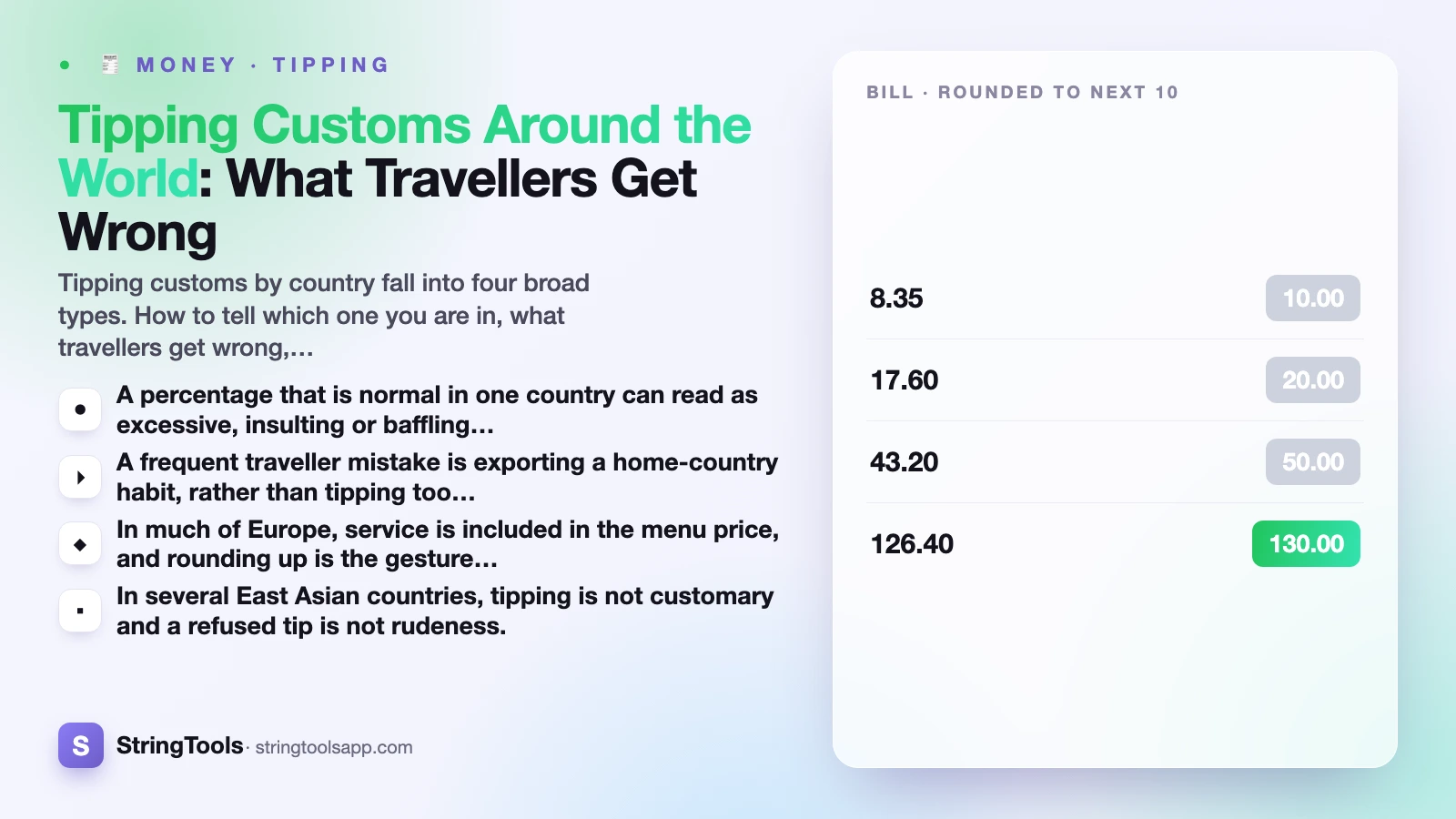
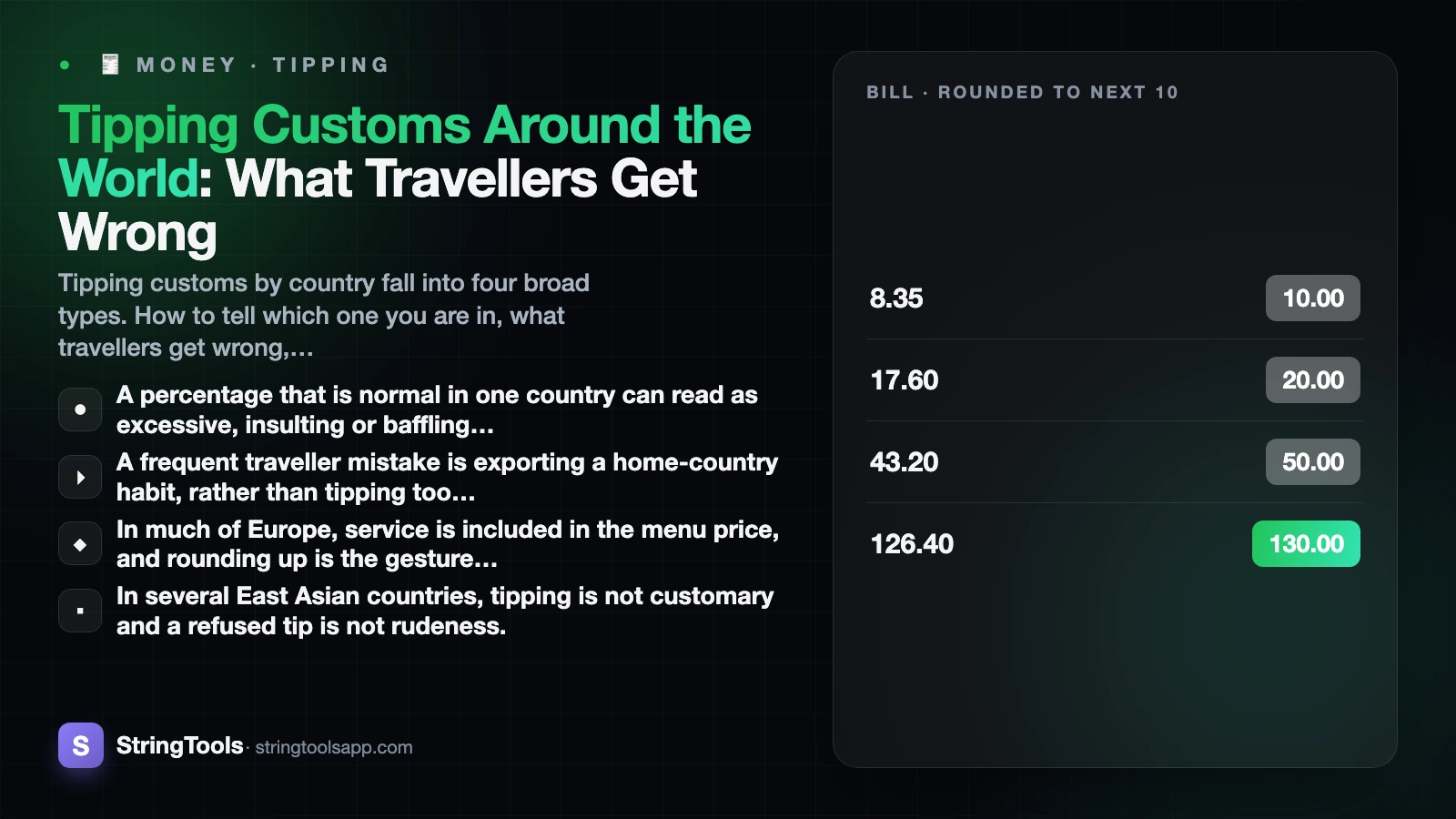
The arithmetic is trivial and currency-neutral.
| Bill | Rounded to next 1 | Rounded to next 5 | Rounded to next 10 |
|---|---|---|---|
| 8.35 | 9.00 | 10.00 | 10.00 |
| 17.60 | 18.00 | 20.00 | 20.00 |
| 43.20 | 44.00 | 45.00 | 50.00 |
| 126.40 | 127.00 | 130.00 | 130.00 |
Notice how uneven rounding is as a percentage: on 8.35, rounding to the next 10 adds 1.65, while on 126.40 rounding to the next 10 adds only 3.60. That is the point. Rounding is a gesture of convenience, not a calculation, which is exactly why it fits cultures where tipping is not meant to be arithmetic.
In German-speaking countries the mechanism has a particular form: you say the total you want to pay as you hand over the money or the card, rather than leaving anything behind on the table. In several other European countries, leaving the coins from your change is the equivalent gesture.
The tip calculator will round each person up to the next 1, 5 or 10, which is useful when a group is settling a bill in a country where rounding is the norm and nobody wants to do the division out loud.
A traveller's checklist
What to do on arrival, once, so you are not deciding at every meal.
- Find out which of the four types you are in. One question at the hotel desk, or five minutes of reading, settles it for the whole trip.
- Get small notes and coins early. In cash-tipping countries this matters far more than knowing a percentage.
- Read the bill the first time. Whatever a restaurant bill looks like in that country, it will look the same for the rest of the trip. Find the service line, the cover line and the tax line once.
- Default to rounding up if you are unsure. It is rarely wrong and it is never expensive.
- Accept a refusal gracefully. In no-tipping cultures, a declined tip is not a negotiation.
- Keep your home habits at home. Including the habit of not tipping, if you are visiting a country where tips are part of pay.
One point worth ending on. Tipping is often discussed as though it were etiquette, but in several countries it is a pay mechanism with legal machinery around it. In the UK, for instance, employers have obligations about passing tips on to workers, which Acas covers in its guidance on tips and service charges. Understanding whether a tip is a gift or a wage in the country you are standing in explains almost everything else about the local custom.
For the situation-by-situation view once you know which country you are in, how much should you tip covers restaurants, bars, delivery, taxis and hotels. And if you want to do the sums at the table without a phone, how to calculate a tip in your head has three methods that work in any currency.
Frequently Asked Questions
Is it true that you should never tip in Japan?
Tipping is not customary in Japan, and cash left on a table is commonly returned to you as something you forgot. It is not treated as an insult so much as a misunderstanding. There are narrow exceptions around private guides and traditional inns, where a gratuity may be given in an envelope rather than handed over as loose cash, and where the form matters more than the amount.
Do you tip in Europe?
Europe is not one answer, but the general pattern is that service is included in the price and staff are on full wages, so tipping is optional and small where it happens at all. Rounding up is the most widespread gesture. The habit of calculating a percentage of the bill, which is standard in some other parts of the world, is not the European norm.
What does service compris or servizio incluso mean?
Both mean the service element is already included in what you are paying, so no further calculation is expected. Italian bills also frequently carry a separate per-person cover charge, which is a charge for the table setting rather than a tip and does not function as one. If you see either phrase, the decision has essentially been made for you.
Should I tip on a card or in cash when abroad?
Cash in the local currency is the more reliable option in most countries. A card tip depends on the venue's system and on local rules about how tips are distributed, and in some countries the card slip has no tip line at all. Cash also avoids the problem of a tip arriving weeks later through a payroll system the visitor knows nothing about.
Why does the card machine offer a tip in a country where nobody tips?
Because the prompt comes from the payment terminal and its configuration, not from local custom. The same software is deployed internationally, and the tip screen has spread into settings where no tipping tradition exists, including self-service kiosks. Declining it is entirely normal and is not a comment on the service.
How much cash should I carry for tips on a trip?
Rather than a fixed amount, carry a supply of the smallest useful notes and coins, and top it up when you break a larger note. Most tipping abroad is per-task and small: a bag carried, a taxi fare rounded up, a coffee. Running out of small denominations is the practical problem travellers actually hit, not deciding the size of a restaurant tip.
Sources and references
foreign travel advice (gov.uk) · guidance on tips (dol.gov) · tips and service charges (acas.org.uk). Content was reviewed against these sources as of the last-updated date above; external figures and rules may change after publication.