
The honest answer to how much you should tip
There is no universal tipping percentage. What you tip depends on the country you are in, the type of venue, whether a service charge is already printed on the bill, and whether the staff are paid on the assumption that tips will top up their wage. Read the situation first, then do the arithmetic.
Key Takeaways
- Tipping norms are local. A figure that reads as generous in one country reads as odd in another, so the first question is always "what is normal here", not "what percentage".
- Check the bill before you decide anything. A service charge, a cover charge or an automatic gratuity for large groups may already be on it.
- The percentage is only ever applied to a number you choose: the pre-tax subtotal or the full total. Which one you pick changes the tip, and both conventions exist.
- In counter-service and self-service settings, the norm is looser than at a table, and a prompt on a payment screen is a request, not a rule.
- In cash-tipping cultures, small denominations matter more than arithmetic. Carry some.
- Whatever you land on, the tip calculator will do the split, the rounding and the per-person share so nobody has to argue over a phone at the table.
This is general information about a social convention, not financial or legal advice.
Why there is no single correct percentage
Tipping is not one practice. It is at least three different practices that happen to share a name.
In some countries, tipping is structural. Parts of the hospitality workforce are paid a base wage set on the assumption that customer tips will make up the rest, which is why a tip there is closer to part of the price than a bonus. The United States Department of Labor explains the mechanics of tipped wages, tip credits and tip pooling in its guidance on tips under the Fair Labor Standards Act.
In other countries, tipping is discretionary on top of a full wage. Staff are paid properly whether or not you leave anything, and a tip is a genuine extra. In the UK, for example, employers must pass qualifying tips on to workers in full, and Acas sets out how tips and service charges are meant to be handled and allocated.
And in a third group of countries, tipping is simply not part of the transaction. Attempting it can be confusing at best and mildly insulting at worst, because the price on the menu is understood to be the whole price.
Any article that gives you one number for "how much to tip" is quietly assuming you are in the first group. That is why the rest of this guide describes what to look for in each situation rather than handing you a percentage to memorise. If you are travelling, tipping customs around the world covers the shape of the convention country by country.
The three questions worth asking
- Is service already included, in any form, on this bill?
- In this country, is a tip part of how the staff get paid, or a genuine extra?
- Is this table service, counter service, or no service at all?
Answer those three and the number becomes obvious enough that you can stop agonising over it.
Restaurants: table service versus counter service
Table service is where tipping conventions are strongest, because there is an identifiable person who looked after you for an hour. In tipping cultures, this is the setting where a tip is expected as a matter of course, and where leaving nothing is read as a complaint rather than an oversight.
Counter service is a different transaction. You ordered at a till, carried your own tray, and cleared your own table. In tipping cultures there is usually still a tip jar or a screen prompt, but the norm is looser and much smaller. Nobody is tracking your table.
The bit people miss is the difference between a service charge and a tip. A service charge is a line the restaurant adds to the bill, often for larger groups or as a house policy. It is part of the bill you are agreeing to pay. A tip is what you add voluntarily on top. If a service charge is on the bill and you add a full tip on top without noticing, you have tipped twice.
Look for any of these on the bill before you add anything:
- "Service charge" or "service" as a percentage line
- "Gratuity added for parties of six or more", or similar
- "Service included" or "service compris" printed on the menu or receipt
- A cover charge or per-person seating charge, which is not a tip and does not reach staff as one
What to do when a service charge is already there
- If the service was fine, treating the included charge as the tip is a perfectly normal choice.
- If the service was genuinely exceptional, a small extra in cash handed directly to someone is the usual way people express that.
- If the service was poor, ask about removing a discretionary service charge. In many places it is discretionary, which is the whole point of the word.
Bars, delivery, taxis and rides
Bars. A drink poured at a bar takes seconds; a round built by a bartender who remembers your order over a long evening is a different thing. In cash-tipping cultures, per-round tipping and per-tab tipping are both common, and rounding up is the usual mechanism rather than a calculated percentage. Table service in a bar tends to follow restaurant conventions rather than bar conventions.
Delivery. Delivery involves a person, a vehicle and weather, so it sits closer to a service than a purchase. Two things affect what people give: distance and conditions. A short, dry, easy delivery and a long one in heavy rain are not the same job, and most people who tip delivery adjust for that. Check the app first, because some platforms add a delivery fee that does not reach the driver and some add a separate service fee that also does not.
Taxis and rides. Rounding up to a convenient note or a whole unit of currency is the most widespread taxi convention worldwide, including in many countries where restaurant tipping is not customary. Help with heavy luggage is generally treated as separate from the fare.
Screen prompts. Payment terminals that suggest three tip options have spread far beyond the settings where tipping was ever customary, including to places with no service element at all. A prompt is the terminal's default configuration, not a local norm. It is entirely reasonable to select the custom option, or to select nothing, without treating it as a moral decision.
Hotels, salons and the rest
Away from restaurants, tipping is usually per-task and in cash rather than as a percentage of a bill.
| Situation | How the convention usually works | What to check first |
|---|---|---|
| Hotel porter | Per bag, in cash, handed over at the door | Whether a resort or service fee is already charged nightly |
| Housekeeping | Per night, in cash, left where it is obviously intended | Whether the hotel states that gratuities are included |
| Concierge | Only when they did something genuinely out of the ordinary | Nothing for directions or a standard booking |
| Hair salon and barber | Percentage of the service in tipping cultures; nothing in many others | Whether the stylist owns the salon, which changes the norm in some places |
| Spa and massage | Often a percentage, and often already added as a service charge | The treatment menu, where the policy is usually printed |
| Tour guide | Per person at the end, in cash, in the local currency | Whether the tour was sold as gratuity-inclusive |
| Food counter or coffee | A jar or a screen prompt; small and discretionary | Nothing else |
| Movers and trades | Usually not a percentage; often food and drink instead | The quote, which may already include a labour charge |
Two practical notes. First, in most of these settings cash is easier for the recipient than a card line, and in some of them a card line does not reach the individual at all. Second, if you are staying somewhere for several nights, tipping housekeeping daily rather than in one lump at the end is more likely to reach the person who actually cleaned your room, because the staff rota changes.
What each rate actually costs: a worked example
Once you have decided what is normal for the situation, the arithmetic is trivial. It still helps to see the numbers, because the gap between the options on a payment screen is often much smaller in money than it feels in the moment.
These are illustrative percentages applied to illustrative bills. They are arithmetic, not a recommendation about what you should leave.
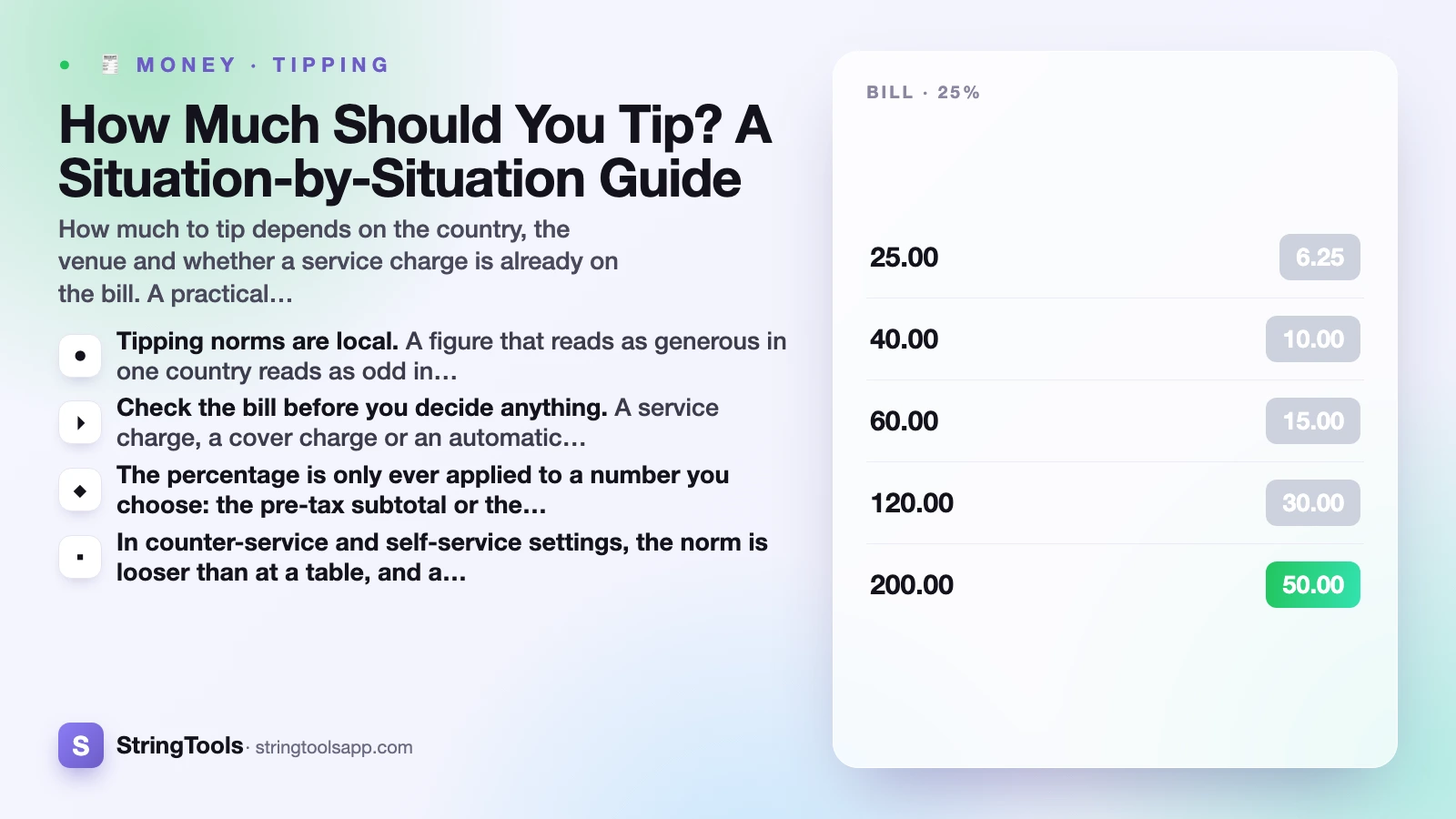
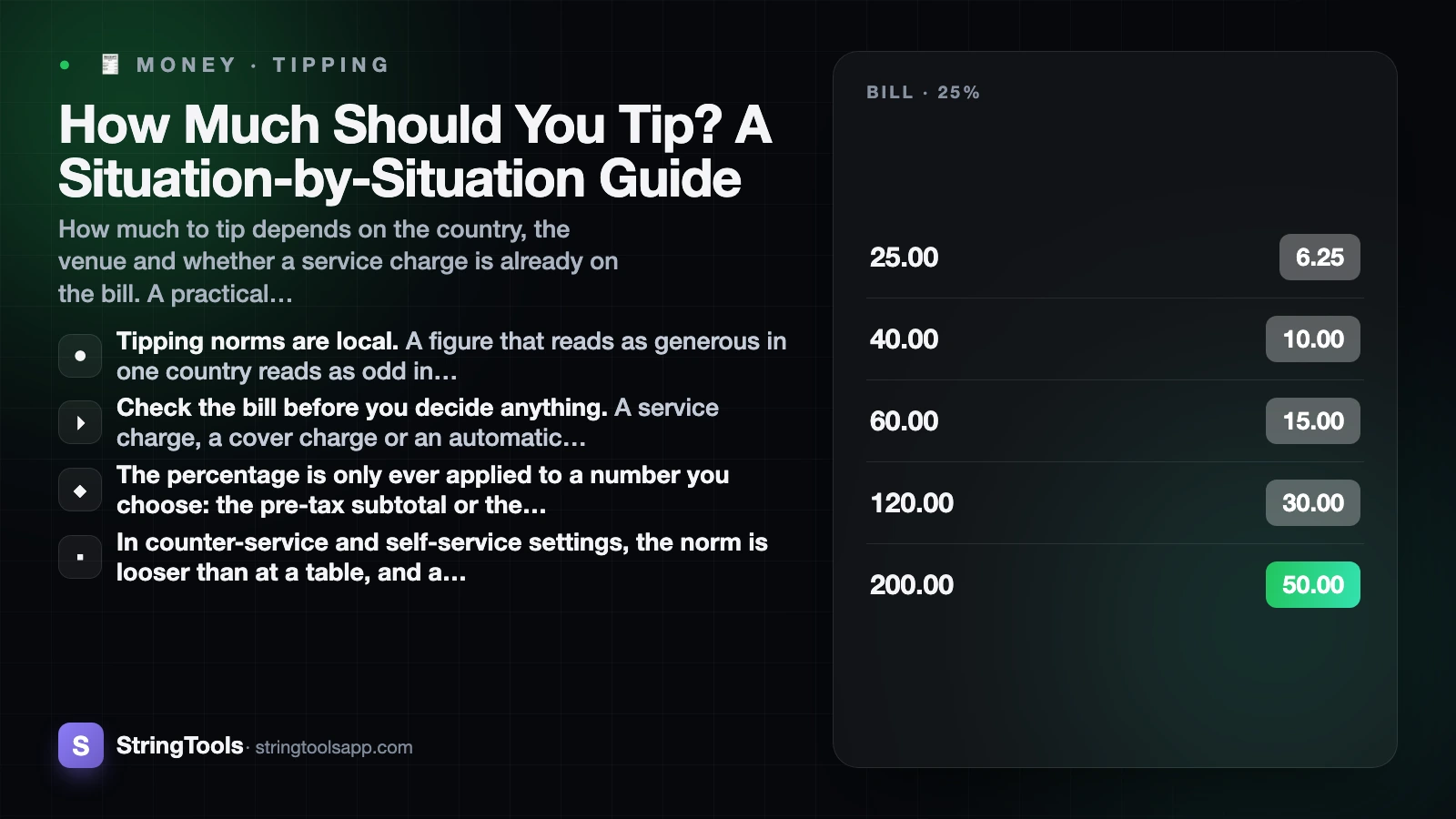
| Bill | 15% | 18% | 20% | 25% |
|---|---|---|---|---|
| 25.00 | 3.75 | 4.50 | 5.00 | 6.25 |
| 40.00 | 6.00 | 7.20 | 8.00 | 10.00 |
| 60.00 | 9.00 | 10.80 | 12.00 | 15.00 |
| 120.00 | 18.00 | 21.60 | 24.00 | 30.00 |
| 200.00 | 30.00 | 36.00 | 40.00 | 50.00 |
On a 60.00 bill, the difference between the 18% and the 20% option is 1.20. On a 25.00 bill it is 50 cents. The decision that actually moves money is whether you tip at all and on what base, not which of two adjacent screen buttons you press.
The larger the bill, the more the choice matters: on 200.00, the gap between 15% and 25% is 20.00. That is the point at which it is worth being deliberate rather than reflexive, particularly for a group meal where one person is paying and collecting from everyone else afterwards.
If you would rather not do this arithmetic at the table at all, how to calculate a tip in your head covers three methods that work without a phone.
Pre-tax or post-tax, and other base questions
A percentage needs a number to be a percentage of, and bills contain several candidates.
Pre-tax subtotal or full total. Where prices exclude tax at the shelf, the bill shows a subtotal, then tax, then a total. Tipping on the subtotal and tipping on the total are both conventions in active use. The difference is smaller than people assume and it is fully worked through in do you tip on the pre-tax or post-tax total.
Discounts, vouchers and set menus. If you used a voucher, the conventional base is the value of what you actually consumed rather than the discounted amount you paid, on the grounds that the same work was done either way.
Drinks bought at the bar and brought to the table. These usually appear on the final bill and form part of the same base as the food.
Alcohol on a large bill. A single expensive bottle can distort a percentage badly, because pouring it took no more work than pouring a cheap one. Some people tip the food and the wine on different bases for exactly this reason. There is no rule here, only a judgement about what the percentage is meant to be paying for.
The tip calculator has a one-tap switch between the pre-tax subtotal and the full check, so you can work out the tip on either base and flip between them to see what the choice is worth.
How to decide in the moment without overthinking it
A workable sequence, in the order it actually happens at a table.
- Look at the bill. Find the subtotal, find any tax line, and find any service charge, cover charge or automatic gratuity. This takes five seconds and prevents the most common tipping mistake, which is paying a service charge twice.
- Locate yourself. Tipping culture, discretionary culture, or no-tipping culture. If you do not know and you are travelling, ask the person you are with, or watch what the table next to you does.
- Match the setting. Table service, counter service, or a screen at a till where nobody served you.
- Pick a base. Subtotal or total. Be consistent with yourself rather than optimising each time.
- Round to something convenient. Rounding the total up to a clean number is the most common real-world behaviour anywhere in the world, and it is faster than any percentage.
One more thing worth saying plainly: a tip is not a performance review with a decimal point. In cultures where tipping funds part of someone's wage, withholding it over a slow kitchen punishes the wrong person, because the server did not cook the food. Where a genuine service problem needs raising, raising it with a manager does more than a silent deduction.
If you are the one paying for a group and collecting afterwards, the tip is usually the smaller half of the problem. Working out who owes what when people ordered very differently is the hard part, and how to split a bill fairly works through an itemised example, including what to do about shared plates and the drinkers-versus-non-drinkers question.
For the tax side of tips, if you are on the receiving end rather than the paying end, the IRS covers reporting obligations for tipped workers in the United States under Topic 761, and the UK rules for workers are on GOV.UK.
Frequently Asked Questions
Is it rude not to tip?
It depends entirely on where you are. In countries where hospitality pay is structured around tips, leaving nothing at a table-service restaurant is read as a strong negative signal. In countries where staff are paid a full wage and tipping is discretionary, leaving nothing is unremarkable. In countries where tipping is not customary, leaving a tip can itself be the awkward move. See tipping customs around the world for the shape of the convention in each type of country.
Do I tip on a service charge that is already on the bill?
No. A service charge is part of the bill. If you calculate a percentage on the grand total after a service charge has been added, you are paying a percentage on top of the service charge as well, which is almost never what anyone intends. Work out any additional tip from the subtotal for food and drink, before both tax and service.
Should I tip in cash or on the card?
Cash goes to a person immediately and with no processing in between. A card tip goes through the venue's system and is then distributed, which may be perfectly fair and transparent or may not be, depending on the venue and the country. If the venue is required to pass tips on in full, as UK employers are, the card route is less of a concern. When in doubt, cash handed to someone is the least ambiguous option.
What about the tip prompt on a card machine at a counter?
Those prompts are a default configuration set by the payment provider or the merchant. They have appeared in plenty of settings where no tipping convention ever existed, including self-service kiosks. Selecting the custom option, entering zero, or skipping the screen entirely are all normal things to do, and the terminal is not making a judgement about you.
How much should I tip for takeaway I collect myself?
Collection involves no delivery, no table service and no cleaning up, so in most places there is no tipping convention attached to it at all. Where a jar exists, small change is the usual gesture. If the order was large or complicated, or the kitchen did something specific for you, people often leave something modest, but nothing about it is expected.
Does the tip change for a large group?
Often the venue changes it for you. Many restaurants add an automatic gratuity or service charge for parties above a certain size, and it is normally printed on the menu as well as the bill. Check for that line before adding anything, then use the tip calculator to split the total across the group, including rounding each person up to a convenient amount so the collection is quick.
Sources and references
guidance on tips under the Fair Labor Standards Act (dol.gov) · tips and service charges (acas.org.uk) · Topic 761 (irs.gov) · GOV.UK (gov.uk). Content was reviewed against these sources as of the last-updated date above; external figures and rules may change after publication.