
The short answer: pre-tax or post-tax
Both conventions are in active use. Tipping on the pre-tax subtotal is the more traditional convention, on the logic that tax is money the restaurant collects for the government rather than payment for service. Tipping on the post-tax total is common because it is what card machines and apps calculate by default.
Key Takeaways
- The difference is exactly the tip rate applied to the tax amount, and nothing else. It is a predictable number, not a mystery.
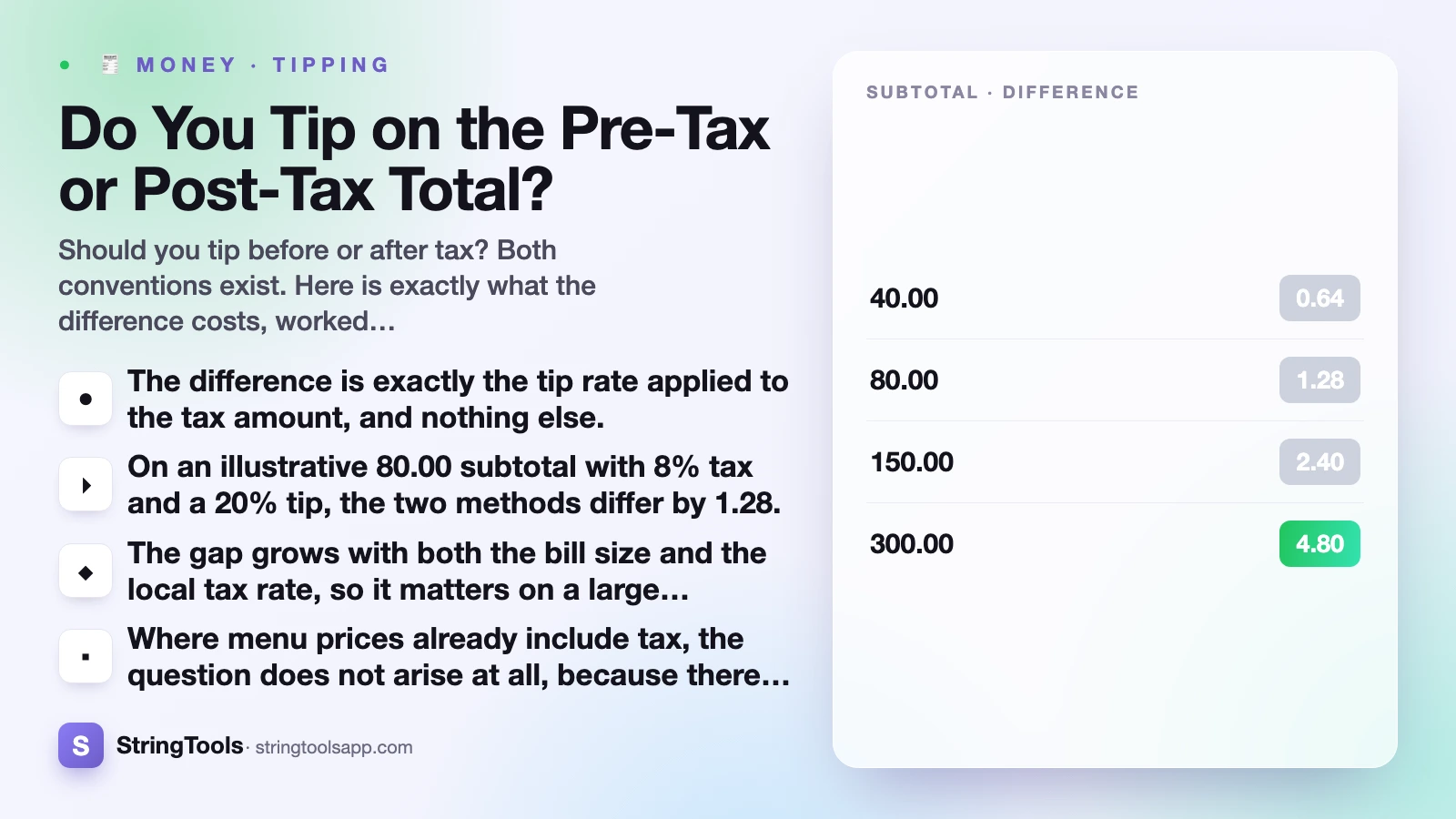
- On an illustrative 80.00 subtotal with 8% tax and a 20% tip, the two methods differ by 1.28.
- The gap grows with both the bill size and the local tax rate, so it matters on a large group bill and barely registers on a coffee.
- Where menu prices already include tax, the question does not arise at all, because there is no separate tax line to argue about.
- Card terminals usually default to the post-tax total. That is a software default, not a rule.
- The tip calculator has a one-tap switch between the pre-tax subtotal and the full check, so you can see what each base gives.
This is general information about a convention, not financial or tax advice.
Why the question exists in the first place
This is a question that only some countries have.
Where consumption tax is added at the till rather than shown on the shelf, the bill arrives as three lines: a subtotal for what you ordered, a tax line, and a total. That structure creates a choice about which line the tip percentage is applied to. The United States is the largest example of tax-exclusive pricing, which is why the pre-tax versus post-tax argument is largely an American one.
Where tax is included in the displayed price, as with value-added tax in the UK and across the EU, the menu price is the price. There is no separate tax line on the bill, so there is nothing to tip on or not tip on, and the question never comes up.
The traditional argument for the pre-tax base is that a tip is payment for service, and tax is not a service. The restaurant collects that money and passes it on; the server does not benefit from it and did no additional work because of it. On that reading, applying a service percentage to a tax line is a category error.
The argument for the post-tax base is mostly practical. The total is the biggest number on the receipt, it is the number the card machine has, and working from it avoids squinting at a line-by-line breakdown in bad lighting. A number of people also treat the difference as too small to think about, which, as the next section shows, is often a defensible position.
Neither side is winning. Both bases are normal, and nobody at the table will be able to tell which one you used.
What is actually being decided
- Whether the percentage applies to the goods you bought, or to the goods plus the tax on them
- The size of that decision, which is the tip rate multiplied by the tax amount
- Nothing else. Everything else on the receipt is unaffected
What the difference actually costs
The whole thing can be reduced to one line of arithmetic: the extra you pay by tipping post-tax equals the tip rate multiplied by the tax amount.
The table below uses an illustrative sales tax rate of 8% and an illustrative tip of 20%. Both figures are chosen to keep the arithmetic readable; they are not a recommendation and they are not the rate anywhere in particular.
| Subtotal | Tax at 8% | Total | Tip on subtotal | Tip on total | Difference |
|---|---|---|---|---|---|
| 40.00 | 3.20 | 43.20 | 8.00 | 8.64 | 0.64 |
| 80.00 | 6.40 | 86.40 | 16.00 | 17.28 | 1.28 |
| 150.00 | 12.00 | 162.00 | 30.00 | 32.40 | 2.40 |
| 300.00 | 24.00 | 324.00 | 60.00 | 64.80 | 4.80 |
Notice the shape of the last column. At these illustrative rates, the difference is always 1.6% of the subtotal, because 20% of 8% is 1.6%. That is the entire disagreement.
On a 40.00 dinner for two, the choice is worth 64 cents. On a 300.00 bill for a group of eight, it is worth 4.80, which is still less than a single drink. It is a real number and it is worth knowing, but it is not the number that decides whether your dinner was expensive.
Where it does add up is over a year. Somebody who eats out at an illustrative 80.00 subtotal fifty times a year and always tips on the total pays 64.00 more across the year than someone who always tips on the subtotal. That is a genuine amount, and it is also the strongest honest argument for picking a base and sticking to it rather than deciding afresh each time.
How the local tax rate changes the answer
The difference depends on the tax rate as much as the bill. Holding the subtotal at 80.00 and the tip at an illustrative 20%, here is what different tax rates do.
| Tax rate | Tax on 80.00 | Extra paid by tipping post-tax |
|---|---|---|
| 0% | 0.00 | 0.00 |
| 5% | 4.00 | 0.80 |
| 8% | 6.40 | 1.28 |
| 10% | 8.00 | 1.60 |
Where there is no sales tax on prepared food, the two methods are identical and the question is moot. Where combined state and local rates stack up, the gap widens in direct proportion.
This is also why the argument gets more heated in some places than others. In a jurisdiction where restaurant meals carry a high combined rate, tipping post-tax can mean paying a service percentage on a meaningful amount of tax. In a jurisdiction with a low rate or a food exemption, the same debate is about pocket change.
If you want to see what the tax component of your own bill actually is, the sales tax calculator will work backwards from a tax-inclusive total to the pre-tax price, which is exactly the number you need if the receipt only shows the total.
The one thing worth avoiding is the hybrid mistake: reading the total off the bottom of the receipt, applying a percentage, and believing you tipped on the subtotal. That is how people end up convinced they are frugal tippers while consistently paying the higher of the two numbers.
Things on the bill that are not tax
Before applying a percentage to anything, it is worth knowing what else might be sitting in the total. Several common lines are neither food nor tax, and treating them as either will distort the tip.
| Line | What it is | Should the tip percentage apply to it |
|---|---|---|
| Sales tax or VAT | Collected for the government | The subject of this article; either base is normal |
| Service charge | The venue's own charge, often for larger groups | No, it is already a charge for service |
| Automatic gratuity | A tip the venue has added for you | No, it is the tip |
| Cover or seating charge | A per-person charge for the table | Usually not, it is not service and not food |
| Delivery fee | Charged by the venue or the platform | No, and it does not necessarily reach the driver |
| Platform service fee | The app's own cut | No |
| Corkage | A charge for opening wine you brought | A judgement call, but usually treated as a service line |
| Bottle deposit | Refundable, not a purchase | No |
The single most expensive mistake on this list is not the tax question at all. It is calculating a percentage on a grand total that already contains a service charge or an automatic gratuity, which means paying a tip on top of a tip. On a large group bill with an automatic gratuity already added, that error is worth several times the entire pre-tax versus post-tax difference.
If you are the one receiving tips rather than paying them, the tax treatment is a separate matter again: the IRS sets out reporting obligations for tipped workers under Topic 761, and the Department of Labor covers tips under the Fair Labor Standards Act.
What to do in practice
A short, workable position.
- Pick one base and use it every time. The consistency is worth more than the choice, because at these illustrative rates the entire argument is worth about 1.6% of a subtotal. Re-deciding at every meal spends attention on a rounding error.
- Read the bill before you calculate. Find the subtotal, the tax line and any service charge. Ten seconds of reading prevents the expensive mistake described above.
- If the receipt shows only a total, work backwards. Dividing the total by one plus the tax rate gives the pre-tax figure. On the example above, 86.40 divided by 1.08 gives 80.00.
- On a large bill, be deliberate. The gap scales with the bill, so it is worth ten seconds of thought at 300.00 in a way it is not at 40.00.
- Do not let the base substitute for the decision. Tipping a lower percentage on a higher base, or a higher percentage on a lower base, will land in much the same place. What you leave overall matters far more than which line you started from.
The broader question of what percentage is appropriate in the first place depends on the country, the venue and whether service is already included, and that is worked through in how much should you tip. If you would rather do the arithmetic without a phone, how to calculate a tip in your head gives three methods that work on either base.
And if the bill is being split across a group, the base question compounds: every person's share carries its own slice of the same decision. The tip calculator handles that directly, applying whichever base you choose across uneven per-person shares, so the whole table is calculated the same way.
Frequently Asked Questions
Is it wrong to tip on the post-tax total?
No. It is one of two normal conventions, and it is the one most card terminals calculate by default. The pre-tax base has the stronger logical argument, since tax is not a service, but nobody at the venue will know or mind which one you used. What matters more is that you are consistent, because switching between the two only makes the amount unpredictable to you.
How much more does tipping on the post-tax total cost?
Exactly the tip rate multiplied by the tax. On an illustrative 80.00 subtotal with 8% sales tax and a 20% tip, tipping on the subtotal gives 16.00 and tipping on the 86.40 total gives 17.28, a difference of 1.28. At those rates the gap is always 1.6% of the subtotal, whatever the bill.
Do you tip on tax in the UK?
The question does not really arise, because UK menu prices include VAT rather than showing it as an added line. The price you read is the price you pay, so any tip is calculated on that. The live question in the UK is a different one: whether a discretionary service charge is already on the bill, and whether you want it there.
How do I find the pre-tax amount if the receipt only shows a total?
Divide the total by one plus the tax rate expressed as a decimal. A total of 86.40 with an 8% rate gives 86.40 divided by 1.08, which is 80.00. Subtracting 8% from the total is a common error and gives the wrong answer, because the 8% was applied to the smaller number. The sales tax calculator does the reverse calculation directly.
Should I tip on a service charge that is already on the bill?
No. A service charge and an automatic gratuity are both charges for service, so applying a tip percentage to a total that includes one means paying twice for the same thing. Work any additional tip from the bill before the service charge, on whichever base you normally use. On a large group bill this mistake costs far more than the pre-tax versus post-tax difference ever will.
Does the same question apply to delivery orders?
The tax part does, but delivery bills usually contain more non-food lines: a delivery fee, a platform service fee, and sometimes a small-order fee. None of those are payment for the driver, and a percentage applied to the grand total is being applied to all of them. Working from the food subtotal is the cleaner base for a delivery order.
Sources and references
Topic 761 (irs.gov) · tips under the Fair Labor Standards Act (dol.gov). Content was reviewed against these sources as of the last-updated date above; external figures and rules may change after publication.