
Margin and Markup Are Not the Same Number
Margin is profit as a share of the selling price. Markup is the same profit as a share of the cost. A product costing 40 and selling for 80 carries a 50% margin and a 100% markup — one profit, two denominators. Confusing them underprices goods, because markup is always the larger of the two numbers, so anyone who applies a margin target as a markup sets the price too low.
Key Takeaways
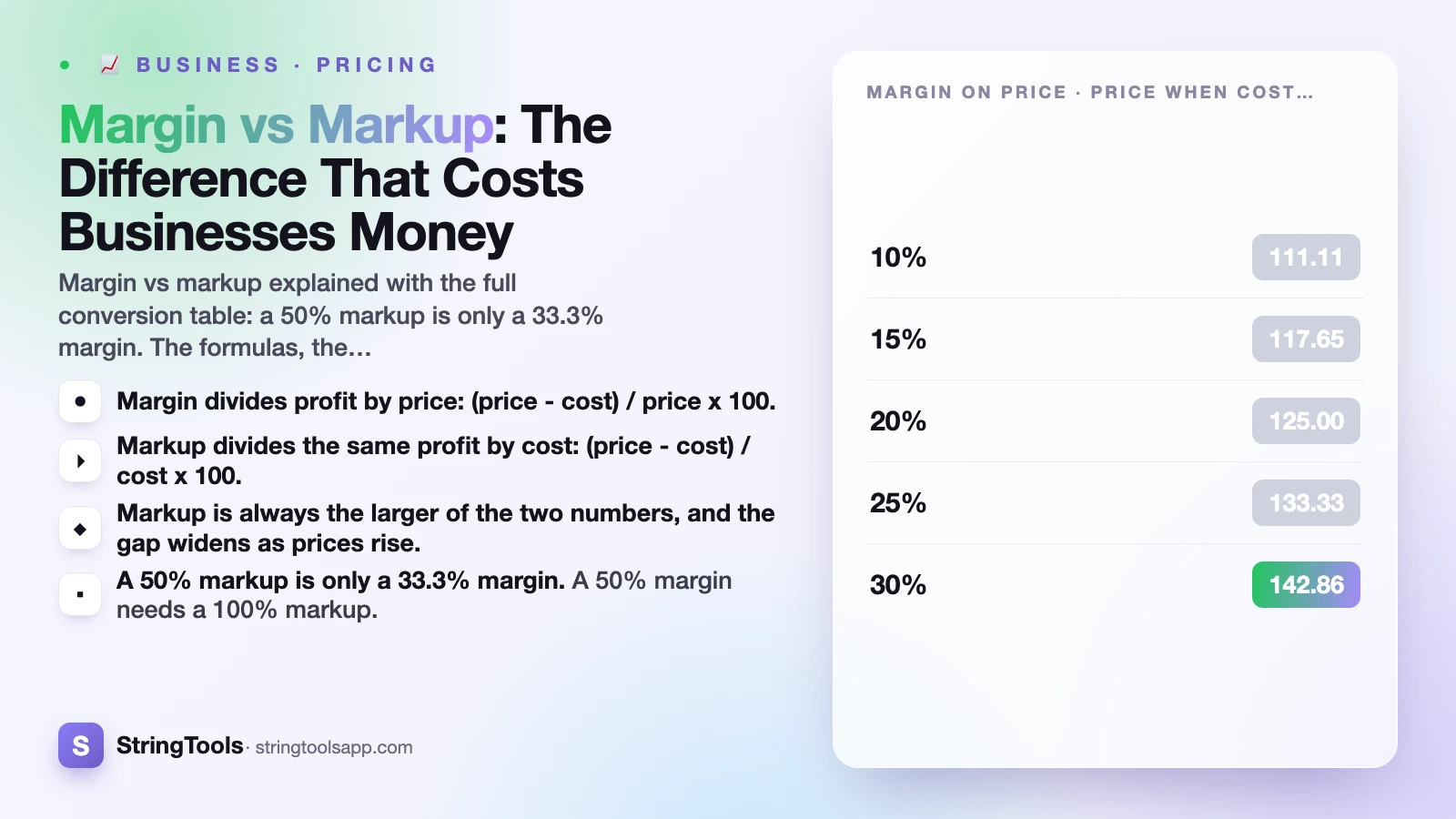
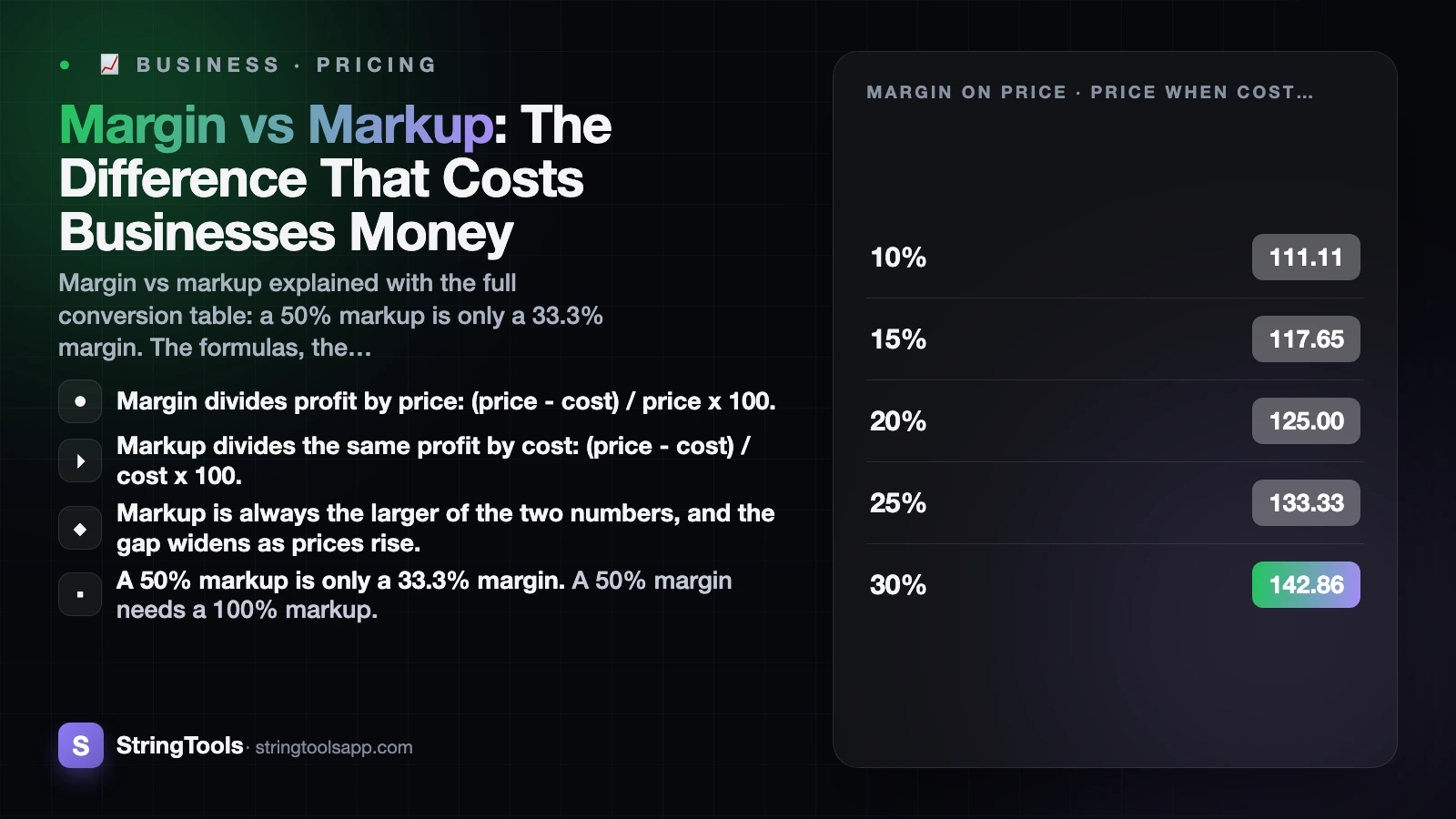
- Margin divides profit by price:
(price - cost) / price x 100. - Markup divides the same profit by cost:
(price - cost) / cost x 100. - Markup is always the larger of the two numbers, and the gap widens as prices rise.
- A 50% markup is only a 33.3% margin. A 50% margin needs a 100% markup.
- Margin can never reach 100%. Markup has no ceiling at all.
- Both are gross figures. Rent, wages, software and tax still come out of what is left.
Once the two definitions sit side by side the arithmetic is trivial. The damage is done when a supplier quotes one, a spreadsheet assumes the other, and nobody notices for a year. The profit margin calculator shows margin and markup together on every result for exactly that reason — you cannot quote one without seeing the other.
The Two Formulas, With One Worked Example
Take a single product. It costs you 40 to buy or make. You sell it for 80.
The profit is 80 minus 40, which is 40.
Margin asks what share of the 80 you keep: 40 divided by 80 is 0.5, so the margin is 50%.
Markup asks what you added to the 40: 40 divided by 40 is 1.0, so the markup is 100%.
Nothing has changed about the product, the price or the profit. Only the denominator moved. That is the entire difference, and it is why the two numbers can never be swapped.
Running the formulas the other way is just as important, because pricing normally starts from a cost and a target rather than from a finished price.
- Price from a target margin:
cost / (1 - margin/100). At a cost of 40 and a 50% target, 40 / 0.5 = 80. - Price from a target markup:
cost x (1 + markup/100). At a cost of 40 and a 100% markup, 40 x 2 = 80.
The two routes meet at the same price only because 50% margin and 100% markup are the same thing. Pick the wrong pairing and they diverge immediately.
The Conversion Table Worth Keeping
This is the table that ends the argument. Every row is one profit expressed both ways, with the price you would charge on a cost of exactly 100 so the difference is visible in money rather than percentages.
| Margin on price | Markup on cost | Price when cost is 100 |
|---|---|---|
| 10% | 11.1% | 111.11 |
| 15% | 17.6% | 117.65 |
| 20% | 25% | 125.00 |
| 25% | 33.3% | 133.33 |
| 30% | 42.9% | 142.86 |
| 33.3% | 50% | 150.00 |
| 40% | 66.7% | 166.67 |
| 50% | 100% | 200.00 |
| 60% | 150% | 250.00 |
| 66.7% | 200% | 300.00 |
| 75% | 300% | 400.00 |
| 80% | 400% | 500.00 |
Two rows deserve a second look. At 20% margin the markup is 25% — close enough that mixing them up costs little. At 75% margin the markup is 300%, a fourfold difference in the number you say out loud. The higher your margin, the more expensive the confusion becomes.
The conversions themselves are one line each:
- Markup from margin:
margin / (100 - margin) x 100. - Margin from markup:
markup / (100 + markup) x 100.
Check the 33.3% row with the first formula: 33.333 divided by 66.667 is 0.5, so 50% markup. Check the 60% row: 60 divided by 40 is 1.5, so 150% markup. The table is not a lookup of approximations, it is those two formulas applied twelve times.
What the Mistake Actually Costs
Suppose the 40-cost product needs a 50% margin to cover the rest of the business. Someone in the team hears "fifty percent" and applies it as a markup instead.
- Intended: 40 / 0.5 = a price of 80, a profit of 40, a 50% margin.
- Applied as markup: 40 x 1.5 = a price of 60, a profit of 20, a 33.3% margin.
The price is 20 too low and the profit per unit has halved. Sell 500 units and the gap is 10,000 of gross profit that never existed, on a product that looked correctly priced in every report.
The error is systematically one-directional. Because markup is always the larger number for any given profit, treating a margin target as a markup always underprices. There is no version of this mistake that accidentally makes you money. That asymmetry is why it survives so long inside businesses: nothing breaks loudly, the products still sell, and the shortfall only shows up as a thin year.
The US Small Business Administration's guidance on managing business finances is a reasonable starting point for the wider bookkeeping picture around this.
Why Margin Stops at 100% and Markup Does Not
Margin is a share of the price, so it is capped by the price. To reach a 100% margin the cost would have to be zero. Above 100% the profit would have to exceed the money the customer handed over, which is not a thing that can happen. Any calculator that offers you a 120% margin is wrong, and any spreadsheet that returns one has a sign error in it somewhere.
Markup has no such ceiling. A 900% markup simply means the price is ten times the cost, which is ordinary in software, jewellery, cosmetics and anything where the manufacturing cost is a small part of the value.
There is one more edge worth naming. If the cost is zero, the markup is undefined rather than zero — you cannot divide by nothing. A free sample sold for anything at all is not a 0% markup, it is an infinite one. The margin in that case is 100% — the one theoretical case that reaches the ceiling, and only because the cost is zero. This matters more than it sounds for digital goods with a genuinely zero marginal cost, where the sensible framing is margin, not markup.
As margin climbs, markup runs away from it:
| Margin | Markup |
|---|---|
| 50% | 100% |
| 80% | 400% |
| 90% | 900% |
| 95% | 1,900% |
| 99% | 9,900% |
Margin approaches 100% and reaches it only if the cost falls to zero. Markup heads for infinity.
Which One Should You Actually Use
Use markup when you are setting a price from a cost. It is the natural operation: here is what the item cost, multiply it up. Retail buyers, wholesalers and trade counters usually talk in markup because their day starts with a supplier invoice.
Use margin when you are judging whether the business works. Margin is a share of revenue, which means it lines up directly with every other line on a profit-and-loss account, it compares cleanly between products with different costs, and it tells you how much of each sale survives to pay for everything else. Accountants, investors and reporting software speak margin almost exclusively.
In practice most businesses need both in the same breath: price in markup, report in margin, and keep the conversion visible so nobody quietly substitutes one for the other.
A short protocol that prevents the whole class of error:
- Write the unit on every number. "40% margin" and "40% markup" are different instructions, so never write "40%" alone.
- Set targets in margin, because that is what has to cover your overheads.
- Convert to markup only at the moment you calculate a price, then check the resulting margin.
- Make one person own the pricing sheet. Most of these mistakes are handover mistakes.
If you are setting prices from scratch rather than converting, how to price a product takes the same cost figure and walks through what the market side of the decision looks like.
Blended Margin: The Averaging Trap
Once you sell more than one thing, a second error appears. People take the margin of each product and average them. That is almost always wrong.
Blended margin is total gross profit divided by total revenue. It weights each product by how much of it you actually sell, which is the only weighting that matches your accounts.
| Product | Cost | Price | Margin | Units | Gross profit |
|---|---|---|---|---|---|
| A | 1.70 | 2.00 | 15% | 200,000 | 60,000 |
| B | 200.00 | 500.00 | 60% | 400 | 120,000 |
The plain average of 15% and 60% is 37.5%. The real blended figure is total profit of 180,000 on total revenue of 600,000, which is 30%. The averaged number flatters the business by more than seven percentage points, because it treats a product sold four hundred times as equal to one sold two hundred thousand times.
The rule is simple: never average percentages that sit on different bases. Add the money first, then divide once.
A Five-Minute Audit of Your Own Prices
Rather than a summary, here is something to actually do this week.
Pull your ten best-selling lines into a sheet with three columns: unit cost, selling price, and units sold in the last year. Then work through four checks.
First, compute the margin on each line as (price - cost) / price. Compare it to the number you believe you are running. Any line where your belief is higher than the arithmetic is a line where somebody applied a margin target as a markup.
Second, compute the blended figure — add all the gross profit, add all the revenue, divide once. Compare that to the average of the individual margins. If they differ by more than a point or two, your volume is concentrated in your weakest product.
Third, check that unit cost really is unit cost. Inbound shipping, duty, packaging and payment processing all belong in there. Costs that quietly live outside the cost field inflate every margin on the sheet. What marketplace fees do to your margin covers the selling-side version of the same leak.
Fourth, write down which number each part of the business quotes. If purchasing talks markup and the board pack shows margin and nobody converts explicitly, that gap is where the money goes.
Run each line through the profit margin calculator if you want the conversion done for you — it solves any missing value from two knowns and always prints margin and markup side by side.
This is general business information, not accounting or tax advice. Every figure here is gross margin: it is revenue minus the direct cost of the goods, and it deliberately ignores rent, salaries, overheads and tax. For how tax authorities expect the cost of goods sold to be treated, the IRS Tax Guide for Small Business sets out the US position, and GOV.UK's guidance for setting up a business is the UK equivalent starting point. A qualified accountant is the right person for your own numbers.
Frequently Asked Questions
Is a 50% markup the same as a 50% margin?
No. A 50% markup means the price is 1.5 times the cost, which works out as a 33.3% margin. A 50% margin means the price is double the cost, which is a 100% markup. On a cost of 40, a 50% markup gives a price of 60 and a 50% margin gives a price of 80.
How do I convert markup to margin?
Use margin = markup / (100 + markup) x 100. So a 60% markup becomes 60 / 160 x 100 = 37.5% margin. Going the other way, markup = margin / (100 - margin) x 100, so a 40% margin needs a 66.7% markup.
Which is bigger, margin or markup?
Markup is always the bigger number for any given profit, because it divides by the smaller denominator. The gap grows as profit rises: at a 10% margin the markup is 11.1%, but at an 80% margin the markup is 400%.
Can a profit margin be more than 100%?
No. Margin is profit as a share of the selling price, so a 100% margin would mean the item cost nothing, and anything above that would mean profit larger than the money the customer paid. Markup has no upper limit, which is why very high-value items are usually described in markup terms.
What is a keystone markup?
Keystone means doubling the cost — a 100% markup, which is a 50% margin. It is an old retail rule of thumb rather than a rule, used because it is quick to do in your head. Whether it is enough depends entirely on your overheads and how fast the stock sells.
Does margin include overheads and tax?
Gross margin does not. It is revenue minus the direct cost of the goods only. Rent, salaries, software, marketing, interest and tax all come out afterwards, which is why net margin is much smaller. This is general information rather than accounting advice.
Sources and references
US Small Business Administration's guidance on managing business finances (sba.gov) · IRS Tax Guide for Small Business (irs.gov) · GOV.UK's guidance for setting up a business (gov.uk). Content was reviewed against these sources as of the last-updated date above; external figures and rules may change after publication.