
Fees Come Off the Price, Not Off the Profit
Marketplace fees are usually a percentage of the selling price plus a fixed amount per item, and both are taken before you see anything. An item costing 14 and selling for 35 has a 60% gross margin, but on an illustrative 12% plus 0.60 fee structure the platform takes 4.80, leaving 16.20 — a net margin of 46.3%. Nearly fourteen points, gone.
Key Takeaways
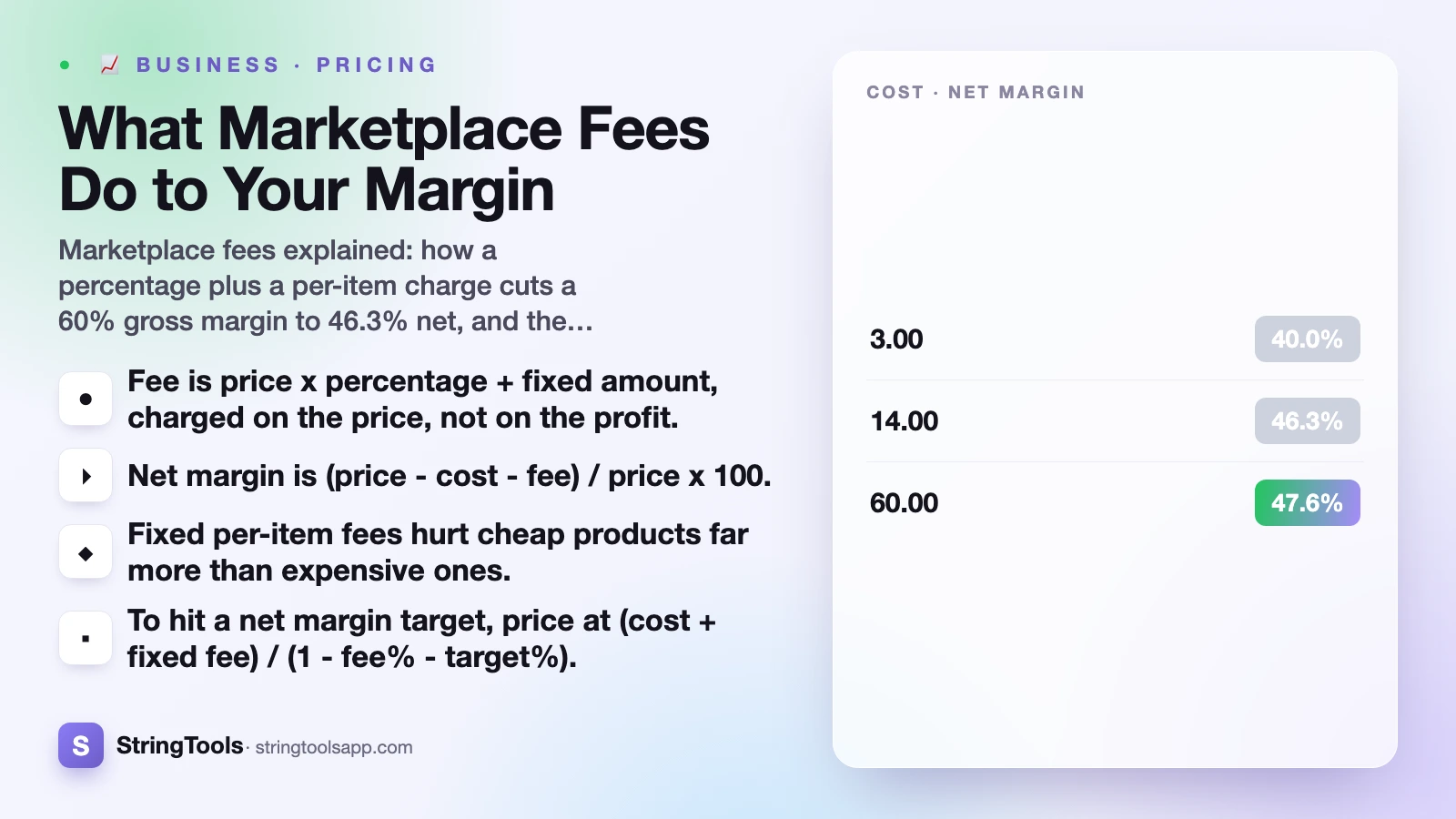
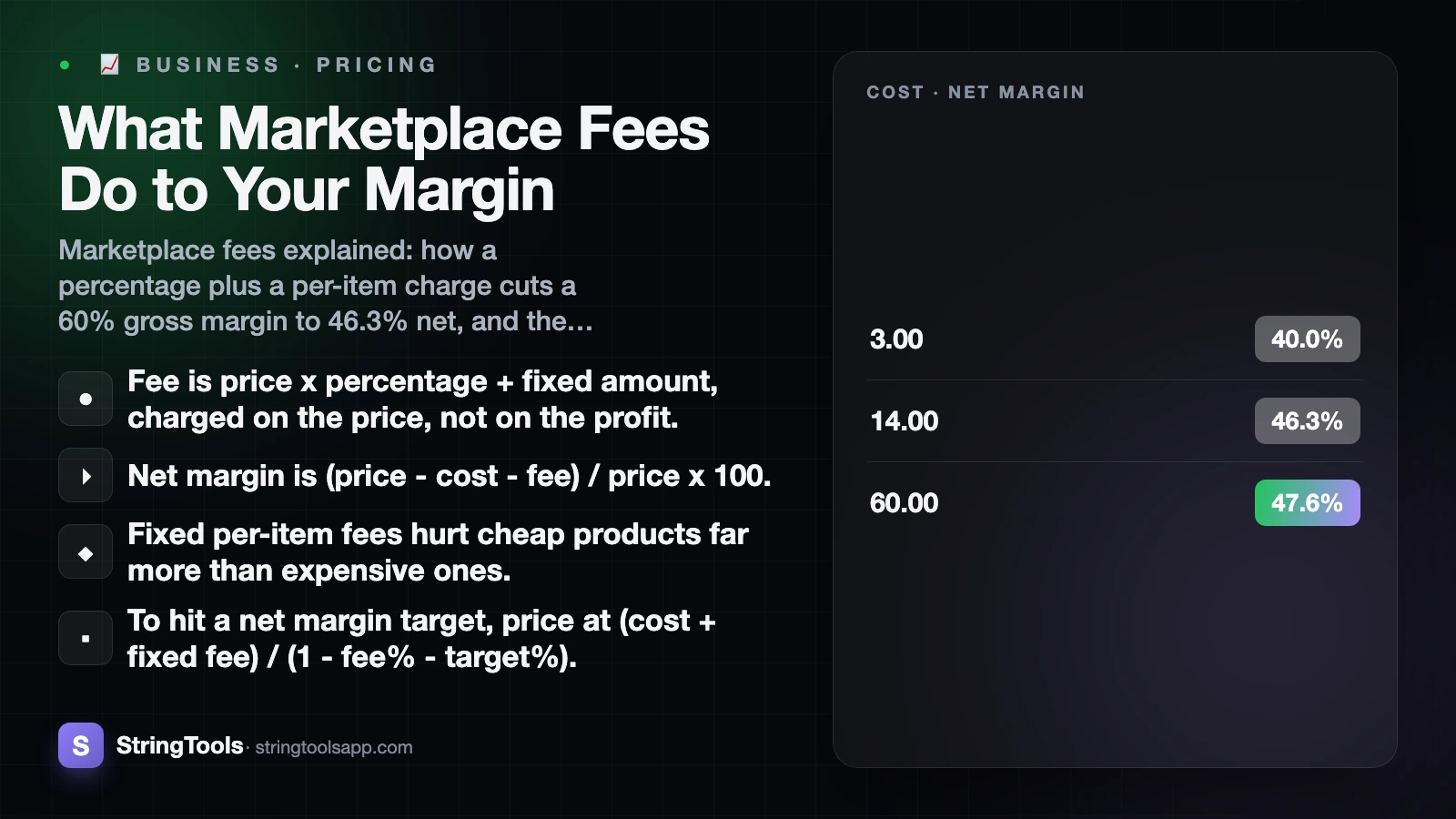
- Fee is
price x percentage + fixed amount, charged on the price, not on the profit. - Net margin is
(price - cost - fee) / price x 100. - Fixed per-item fees hurt cheap products far more than expensive ones.
- To hit a net margin target, price at
(cost + fixed fee) / (1 - fee% - target%). - You cannot reach a net margin target if the fee percentage plus the target exceeds 100%.
- Shipping, returns and advertising are separate costs on top of the listing fee.
The arithmetic is not hard. What catches people out is doing it in the wrong order: adding the fee percentage to the cost, or subtracting it from the margin, instead of taking it off the price before calculating anything.
The Correct Order of Operations
Work in this sequence and the result is always right.
- Start with the selling price, the amount the customer pays you through the platform.
- Compute the fee:
price x fee percentage + fixed per-item fee. - Subtract the unit cost and the fee from the price. That is net profit per unit.
- Divide net profit by the price for net margin.
With the illustrative structure of 12% of price plus 0.60 per item, a unit costing 14 sold at 35:
- Fee: 35 x 0.12 = 4.20, plus 0.60 = 4.80.
- Net profit: 35 - 14 - 4.80 = 16.20.
- Net margin: 16.20 / 35 = 46.3%.
- Gross margin, for comparison: 21 / 35 = 60%.
The common wrong method is to say the gross margin is 60%, the fee is 12%, so the net margin is 48%. That ignores the fixed 0.60 entirely and happens to land close enough that nobody checks. On a cheaper item the same shortcut is badly wrong, which is the next section.
Every percentage in this article is illustrative. Real fee structures differ by platform, by category and by seller plan, and they change. Take the numbers from your own current fee schedule and put them through the arithmetic here.
Why Fixed Fees Punish Cheap Items
A percentage fee is neutral across price points. A fixed per-item fee is not — it is a much larger share of a small price than of a large one. Three items, all at a 60% gross margin, all on the same illustrative 12% plus 0.60 structure:
| Cost | Price | Gross margin | Fee | Fee as share of price | Net margin |
|---|---|---|---|---|---|
| 3.00 | 7.50 | 60% | 1.50 | 20.0% | 40.0% |
| 14.00 | 35.00 | 60% | 4.80 | 13.7% | 46.3% |
| 60.00 | 150.00 | 60% | 18.60 | 12.4% | 47.6% |
Identical gross margins, net margins nearly eight points apart. The 0.60 is 8% of the 7.50 price and 0.4% of the 150 price, and that single line does all the damage.
This is the structural reason low-value items are hard to sell profitably on any platform with a per-item charge. Adding shipping makes it worse, because postage is also closer to fixed than proportional. A 7.50 item can be squeezed to nothing by two flat charges that a 150 item barely notices.
The practical responses are to raise the price, to sell in multipacks so one fee covers several units, or to accept that the cheap line exists to bring people in rather than to earn.
The multipack point is worth spelling out, because it is the one lever that does not involve raising a unit price. Sell the 3.00-cost item singly at 7.50 and the fee is 1.50. Sell four of them as one listing at 30.00 and the fee on the illustrative structure is 3.60 plus 0.60, which is 4.20 across four units, or 1.05 each rather than 1.50. The percentage element is unchanged; only the fixed charge has been spread. Nothing about the product moved, and 0.45 per unit came back.
Pricing to Absorb the Fee
If you want a specific net margin after fees, solve for it directly rather than guessing upwards.
The formula is price = (cost + fixed fee) / (1 - fee percentage - target net margin), with both percentages as decimals.
For the 14-cost item at the illustrative 12% plus 0.60, targeting a 60% net margin:
- Numerator: 14 + 0.60 = 14.60.
- Denominator: 1 - 0.12 - 0.60 = 0.28.
- Price: 14.60 / 0.28 = 52.14.
At 52.14 the gross margin is 73.2%, which looks aggressive until you remember that the fee takes it back down to the 60% net you asked for. That is the whole point: a marketplace price and a direct-sale price are not the same number for the same product.
A ladder of targets on the same item:
| Target net margin | Price | Gross margin at that price |
|---|---|---|
| 40% | 30.42 | 54.0% |
| 50% | 38.42 | 63.6% |
| 60% | 52.14 | 73.2% |
Notice the acceleration. Each ten points of net margin costs progressively more price, because the percentage fee rises alongside the price and has to be outrun.
There is a hard limit hiding in the denominator. If the fee percentage plus your target net margin reaches 100%, the denominator is zero or negative and no price works at all — raising the price adds fee as fast as it adds profit. At a 12% fee, an 88% net margin is the ceiling, and it is unreachable in practice because the cost is still there. The profit margin calculator takes a percentage-of-price fee and a per-unit fee and shows gross and net margin side by side, so you can see the gap without doing this by hand.
The Costs That Are Not on the Fee Schedule
The listing commission is the visible cost. Several others land in the same place and are routinely left out of the sum.
Payment processing, where it is charged separately from the commission. Another percentage plus another fixed amount, applied to the same price.
Shipping. If postage is included in the price, it belongs in the cost side of the calculation. If the customer pays it separately, check whether the platform charges commission on the shipping element too, because several do and it turns a break-even postage line into a loss.
Returns. A return usually costs you the outbound postage, sometimes the return postage, and the item if it comes back unsellable. If a small share of orders are returned, the effective cost per sale rises across every unit. Model it as a percentage uplift on unit cost rather than pretending it is zero.
Advertising on the platform. Optional in theory, close to mandatory in practice for visibility in a crowded category, and it is a direct cost of each sale it produces.
Storage or subscription charges. A monthly seller plan or storage fee is fixed rather than per-unit, so it belongs with your overheads — but it still has to be covered by the gross profit the platform sales generate.
Add all of those to the illustrative 12% plus 0.60 and the real take can be a great deal larger than the headline rate. Work from your own statement rather than the published schedule: the amount that actually reaches your bank, divided by the amount the customer paid, is the only fee percentage that is definitely correct.
For the tax side of platform selling, the relevant authorities publish guidance directly — the IRS explanation of Form 1099-K for US sellers, and GOV.UK's guidance on selling goods or services on a digital platform for the UK.
Deciding Whether the Channel Is Worth It
Once you can compute net margin per channel, the comparison becomes concrete rather than emotional.
Take the same item and price it for each route. Direct, you might sell at 35 with payment processing of a couple of percent and no commission, but you carry the cost of getting the customer there. On a marketplace, you sell at 52.14 to reach the same net margin, but the platform supplies the traffic.
Two questions decide it.
What does the marketplace actually provide. If it brings customers you could not reach, the fee is a customer-acquisition cost, and it should be compared against what you would otherwise spend on advertising rather than against zero. If buyers were going to find you anyway, the fee is pure loss.
What does it cost you to keep it. Channel-specific listings, stock allocation, separate support and separate returns handling all consume time that does not appear on any fee schedule.
A reasonable default is to treat the platform as a paid acquisition channel and the fee as the price of the customer, while building a direct route in parallel. Both can be worth running: the platform for volume, the direct channel for margin.
Before comparing channels, be sure the underlying price is right in the first place — how to price a product covers the cost floor and the market ceiling, and margin vs markup covers the conversion error that leaves the gross margin too thin to absorb any fee at all.
Two closing cautions. Everything above is gross and net margin at the product level: it accounts for the direct cost of goods and the selling fees, and it still ignores rent, salaries, overheads and tax, which come out afterwards. And this is general business information, not accounting or tax advice. Platform fees, sales tax collection and reporting obligations differ by country and by platform, and an accountant is the right person for your own position.
Frequently Asked Questions
How do I calculate my margin after marketplace fees?
Compute the fee as price x fee percentage + fixed per-item fee, then net margin is (price - cost - fee) / price x 100. On an illustrative 12% plus 0.60 structure, an item costing 14 and selling for 35 pays 4.80 in fees and nets 16.20, a 46.3% net margin against a 60% gross margin.
How much should I raise my price to cover fees?
Solve it rather than guessing: price = (cost + fixed fee) / (1 - fee percentage - target net margin). For a cost of 14 with an illustrative 12% plus 0.60 fee and a 60% net margin target, that is 14.60 / 0.28 = 52.14.
Why do fees hurt cheap products more?
Because the fixed per-item element is a much larger share of a small price. At an illustrative 0.60 per item, that charge is 8% of a 7.50 price and 0.4% of a 150 price. Three items at the same 60% gross margin net 40.0%, 46.3% and 47.6% purely because of price level.
Is there a fee level at which no price works?
Yes. If the fee percentage plus your target net margin reaches 100%, the denominator in the pricing formula hits zero and raising the price adds fee as fast as it adds profit. At a 12% fee, 88% net margin is the theoretical ceiling and the cost of goods puts the practical limit well below it.
Do marketplace fees reduce gross margin or net margin?
Net margin. They are selling costs, conventionally reported below the gross line, so gross margin stays at the product level while the money that reaches you falls. This is why gross margin alone is misleading for platform sellers.
What costs do sellers forget to include?
Payment processing charged separately, commission on the shipping element, returns, platform advertising, and monthly seller or storage plans. The safest check is to divide what actually landed in your bank by what the customer paid — that is your real effective fee rate.
Sources and references
IRS explanation of Form 1099-K (irs.gov) · GOV.UK's guidance on selling goods or services on a digital platform (gov.uk). Content was reviewed against these sources as of the last-updated date above; external figures and rules may change after publication.