
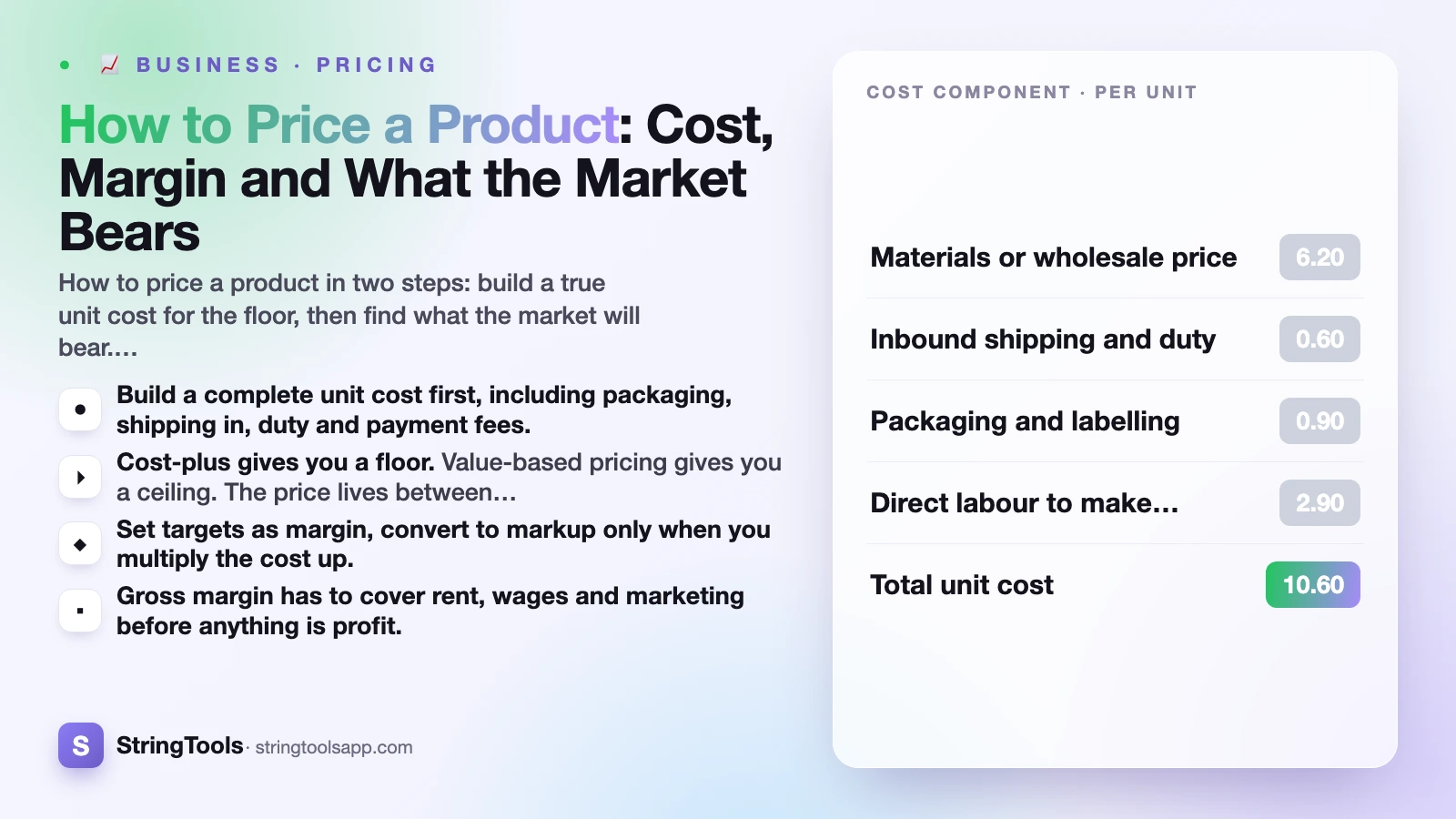

Start With the Floor, Then Decide the Price
Price a product in two moves. First work out the floor: the true unit cost, marked up far enough to cover overheads and leave a profit. Then work out what the market will actually pay, which is a separate question with a separate answer. Cost tells you the price you cannot go below. It never tells you the price you should charge.
Key Takeaways
- Build a complete unit cost first, including packaging, shipping in, duty and payment fees.
- Cost-plus gives you a floor. Value-based pricing gives you a ceiling. The price lives between them.
- Set targets as margin, convert to markup only when you multiply the cost up.
- Gross margin has to cover rent, wages and marketing before anything is profit.
- Test the price against volume: a higher margin on fewer units can earn less money.
- Rounding, tiers and bundles move the perceived price without moving the cost.
The trap is stopping after the first move. Cost-plus alone produces a price that is defensible and frequently wrong — too low for something people badly want, too high for something they can get anywhere.
Step One: Build a Real Unit Cost
Most underpricing starts here, with a cost that is missing pieces. The unit cost is everything that scales with one more unit sold, not just the invoice from the supplier.
For an illustrative physical product:
| Cost component | Per unit |
|---|---|
| Materials or wholesale price | 6.20 |
| Inbound shipping and duty | 0.60 |
| Packaging and labelling | 0.90 |
| Direct labour to make or pack | 2.90 |
| Total unit cost | 10.60 |
Ten pounds sixty, not six twenty. The difference between those two numbers is a whole pricing strategy.
Two rules keep this honest. Anything that goes up when you sell one more unit belongs in unit cost. Anything that stays the same whether you sell one or a thousand — rent, your salary, the website, insurance — does not belong here and gets covered by margin instead. Payment processing and marketplace commission sit awkwardly between the two; they scale with sales, so treat them as a selling cost and take them off the price rather than adding them to the cost. What marketplace fees do to your margin works that version through.
If you are pricing a service rather than a product, the unit is an hour and the cost is your own time at a rate that already covers your non-billable hours.
Step Two: Turn Cost Into a Floor Price
Now apply a target margin. Price from margin is cost / (1 - margin/100).
On the 10.60 unit cost above:
| Target margin | Price | Equivalent markup | Gross profit per unit |
|---|---|---|---|
| 40% | 17.67 | 66.7% | 7.07 |
| 50% | 21.20 | 100% | 10.60 |
| 55% | 23.56 | 122.2% | 12.96 |
| 60% | 26.50 | 150% | 15.90 |
| 65% | 30.29 | 185.7% | 19.69 |
| 70% | 35.33 | 233.3% | 24.73 |
Notice how fast markup climbs relative to margin. The 50% margin row is what retail traditionally calls keystone: you double the cost, which is a 100% markup. Anything above a 50% margin requires more than doubling.
This is exactly where the classic error lands. Aim for a 60% margin, apply 60% as a markup by mistake, and you price at 16.96 instead of 26.50 — a 37.5% margin, and nearly ten pounds of profit gone per unit. Margin vs markup sets out the conversion in full.
Which target is right depends on what your margin has to pay for. Add up your annual fixed costs, divide by the units you expect to sell, and that is the overhead each unit must carry before any of the gross profit is yours. If fixed costs are 90,000 a year and you expect 6,000 units, each unit owes 15 of overhead — which rules out every row above except the last three. The 60% target clears it by only 0.90 a unit, the 65% target by 4.69 and the 70% target by 9.73.
Step Three: Find Out What the Market Will Bear
The floor is arithmetic. The ceiling is research, and it is the half most small businesses skip.
Four things to look at, none of which require a budget:
- What comparable products sell for, including the cheap end and the expensive end. The spread tells you how much room the category has.
- What the product replaces. If it saves a customer four hours of work, the value is anchored to four hours of their time, not to your materials bill.
- Who is buying. The same item sold to a business, a hobbyist and a gift buyer supports three different prices.
- What happens at the edges. Ask a handful of buyers what they would expect to pay, then ask what price would make them assume it was poor quality. The lower bound is often higher than you think.
Value-based pricing means setting the price from what the outcome is worth to the buyer, then checking it clears your floor. Cost-plus means setting it from your costs, then hoping the market agrees. Where the two disagree, the market wins — but only downwards. If the market supports more than cost-plus suggests, charge the higher number and let the extra margin fund the business.
The Small Business Administration's guide to managing business finances covers the surrounding cash-flow discipline, and GOV.UK's set-up guidance is the UK equivalent for the registration and record-keeping side.
One practical shortcut: price the first version slightly higher than feels comfortable. You can always run a promotion, offer a lower tier or negotiate on a large order, and every one of those moves is easy. Raising a price that was set too low is the hard direction, because existing customers have already anchored on the old number and a rise reads as a penalty rather than a correction. Starting high and flexing down gives you options that starting low does not.
Price Against Volume, Not in Isolation
A higher margin is not automatically more money. Price changes demand, and the only figure that matters is total gross profit.
Using the same 10.60 unit cost, three illustrative price points with the volume each might support:
| Price | Margin | Units a year | Gross profit |
|---|---|---|---|
| 19.90 | 46.7% | 1,200 | 11,160 |
| 26.50 | 60% | 700 | 11,130 |
| 35.00 | 69.7% | 380 | 9,272 |
The first two make almost identical money by completely different routes. The cheap route carries 1,200 units of packing, shipping, support and returns to get there; the middle route carries 700. Once you account for the work, the higher price is clearly better, even though the profit line looks like a tie.
The third row shows the other failure: a lovely margin on a volume too thin to cover the fixed costs sitting underneath it.
Volume figures like these are guesses until you test them. The point is not the exact numbers, it is that you have to multiply. A margin percentage on its own cannot tell you whether a price is right.
Making the Number Look Right
Once you have a defensible price, a few presentation decisions change how it lands without changing your costs at all.
Round deliberately. A price of 26.50 reads as considered. A price of 26.47 reads as a spreadsheet output. Prices ending in 9 signal value and prices ending in 0 or 5 signal quality, which is a stylistic choice rather than a law.
Offer more than one option. A single price gives the buyer a yes-or-no decision. Three options turn it into a which-one decision, and the middle one usually wins. The cheapest option exists to make the middle look reasonable, not to be bought.
Bundle rather than discount. A discount cuts margin directly. A bundle that adds something with a low marginal cost raises the perceived value while the margin holds up, and it raises the average order value at the same time.
Handle increases in the open. When costs rise, a clear note that prices change on a given date, with the old price honoured until then, does far less damage than a quiet adjustment a customer discovers at checkout. Small, regular increases are absorbed. Rare, large ones are resented.
Separate price from payment terms. Late payment is a cash-flow problem, not a pricing one, and it is better fixed with terms than with a padded price — invoice payment terms explained covers that side.
Review the Price Like a Number, Not a Decision
Prices are usually set once and then treated as permanent. Costs are not permanent, so a price left alone is a margin that quietly erodes.
Put a recurring review in the calendar, twice a year is enough for most businesses, and check four things.
Has the unit cost moved. Suppliers change prices, shipping changes, packaging changes. Recompute the full stack from the table in step one and see what your current price now yields as a margin.
Has the mix moved. If your sales have shifted toward the thinner products, your blended margin has fallen even though no individual price changed. Blended margin is total gross profit divided by total revenue, never the average of the individual margins.
Are the fixed costs still covered. Divide this year's fixed costs by this year's realistic volume and check the per-unit overhead against your gross profit per unit.
Is anything selling below its floor. Run each line through the profit margin calculator, which solves cost, price, margin or markup from any two of them and shows margin and markup together so the two never get swapped.
One caution to close on. Every margin in this article is gross margin — revenue minus the direct cost of the goods. It says nothing about rent, salaries, marketing, interest or tax, all of which come out of the gross profit before anything is genuinely yours. Gross vs net margin walks the full distance between the two. This is general business information rather than accounting or tax advice, and an accountant is the right person to check your own figures.
Frequently Asked Questions
What is the formula for pricing a product?
The floor price is unit cost / (1 - target margin/100). On a unit cost of 10.60 with a 60% target margin, that is 10.60 / 0.4 = 26.50. That is the lowest sensible price, not necessarily the right one — what the market will pay is a separate question.
Should I use cost-plus or value-based pricing?
Both, in that order. Cost-plus gives you a floor you must clear. Value-based pricing tells you what the buyer thinks the outcome is worth, which sets the ceiling. Price between the two, and if the market supports more than cost-plus suggests, charge it.
What should I include in unit cost?
Everything that increases when you sell one more unit: materials or wholesale price, inbound shipping and duty, packaging, and direct labour to make or pack it. Rent, your salary, software and insurance do not belong in unit cost — they are covered by the margin instead.
How much margin do I need to cover overheads?
Divide your annual fixed costs by the units you realistically expect to sell. If fixed costs are 90,000 and you expect 6,000 units, each unit carries 15 of overhead, so your gross profit per unit has to exceed 15 before anything is profit.
Is a higher price always better?
No, because price changes volume. In the example above, 19.90 on 1,200 units yields 11,160 of gross profit and 26.50 on 700 units yields 11,130 — nearly identical money for far less work at the higher price. Total gross profit is the number to compare, not the margin percentage.
How often should I change my prices?
Review twice a year against current costs, current volume and current mix. Small regular adjustments are absorbed by customers far better than rare large ones. Always announce an increase with a date and honour the old price until then.
Sources and references
Small Business Administration's guide to managing business finances (sba.gov) · GOV.UK's set-up guidance (gov.uk). Content was reviewed against these sources as of the last-updated date above; external figures and rules may change after publication.