
The number on the windshield is a down payment on the truth
A dealer quotes you a price and a monthly finance figure, and it feels like the whole story. It isn't. The advertised payment covers exactly one of the six things a car costs you every month. The other five keep arriving whether you look at them or not: fuel or charging, insurance, servicing, road tax and registration, and the quiet giant of them all — depreciation.
That gap is why two people can buy the "same-priced" car and end up hundreds a month apart. A cheap-to-buy car can be brutal to run; a pricier one can hold its value and sip fuel until it quietly wins. This guide breaks each bucket down honestly, walks through a full monthly example, and shows you which two numbers are actually worth your energy to control.
All figures here are illustrative and vary a lot by country, car, and driver. The point isn't the exact pounds or dollars — it's the shape of where your money goes.
The finance payment: usually the biggest line, and the most visible
If you borrow to buy, the loan payment is normally the largest single monthly cost — and the only one the dealer volunteers. It's driven by three levers: how much you borrow, the interest rate (APR), and the term length.
The term is where people quietly overpay. Stretching a loan from four years to six shrinks the monthly figure, which feels like a win, but you pay more total interest and you spend longer owing more than the car is worth. A lower monthly number is not the same as a cheaper car.
This is the single most controllable number in the whole equation, because you choose the loan before you sign. Run your real price, rate, and term through the loan calculator and try a couple of term lengths side by side — the difference in total interest between a 5-year and a 7-year loan is often eye-watering. If you already have a loan, our guide on how to pay off your car loan faster shows how small extra payments cut both time and interest.
Depreciation: the cost you never get a bill for
Here's the one that hides in plain sight. Depreciation is the value your car loses over time — and it's real money, even though no statement ever lands in your inbox for it. You feel it only on the day you sell or trade in, when the car is worth thousands less than you paid.
Most cars lose a large chunk of value in the first few years, with the steepest drop early on. If a car costs 30,000 and is worth 18,000 after three years, that's 12,000 gone — roughly 333 a month you spent without noticing. For many cars, depreciation quietly rivals or beats the fuel bill, and sometimes the finance interest too.
You can't eliminate it, but you can shop for it. Cars with strong resale reputations, sensible trims, and moderate mileage hold value far better. Buying a two-to-three-year-old car lets the first owner absorb the worst of the drop. Depreciation is why the "expensive" car sometimes wins: a model that holds 60% of its value beats a cheap one that holds 35%.
Fuel or charging: the number you control every single day
After the loan, energy is often your biggest ongoing outlay — and unlike depreciation, you influence it with every trip. Your monthly fuel cost is really three inputs: how far you drive, how efficient the car is, and the price of petrol, diesel, or electricity where you live.
This is where fuel type reshapes the whole budget. An EV charged at home can cost a fraction per mile of a petrol car, while a diesel may win on long motorway runs but lose on short urban hops. The right answer genuinely depends on your mileage and driving pattern — there's no universal winner. Our breakdown of diesel vs petrol: which to buy unpacks that trade-off in detail.
Because this number moves with your actual habits, it's the second one worth calculating precisely. Put your real weekly distance, your car's economy, and today's local fuel price into the fuel cost calculator to see the monthly figure — then rerun it for a petrol, diesel, and EV version of the same commute. The gap will surprise you.
Insurance, servicing, and tax: the steady background costs
Three smaller buckets round out the picture. Individually they're modest; together they add up to a meaningful monthly slice.
Insurance varies enormously by driver age, location, claims history, and the car itself — a powerful or high-theft model costs far more to cover. Get real quotes before you buy, not after; the premium on your dream car can quietly change which car is affordable.
Maintenance and servicing is part predictable (annual service, tyres, brake pads, wipers) and part lottery (the surprise repair). A sensible habit is to set aside a fixed monthly amount so a big bill doesn't blow up your budget. Older or luxury cars generally cost more to keep running, which is another reason the cheap purchase price can mislead.
Road tax and registration is usually the smallest line, but it's not zero, and in some countries it scales with emissions or value — worth checking for the specific car before you commit.
A worked monthly example (assumptions stated up front)
Let's put it together for a made-up but realistic mid-size petrol car. Assumptions: purchase price 30,000, financed over 5 years at around 7% APR; roughly 1,000 miles a month; average fuel economy; typical insurance and servicing for a mid-range driver. Currency-neutral — read the units as your own.
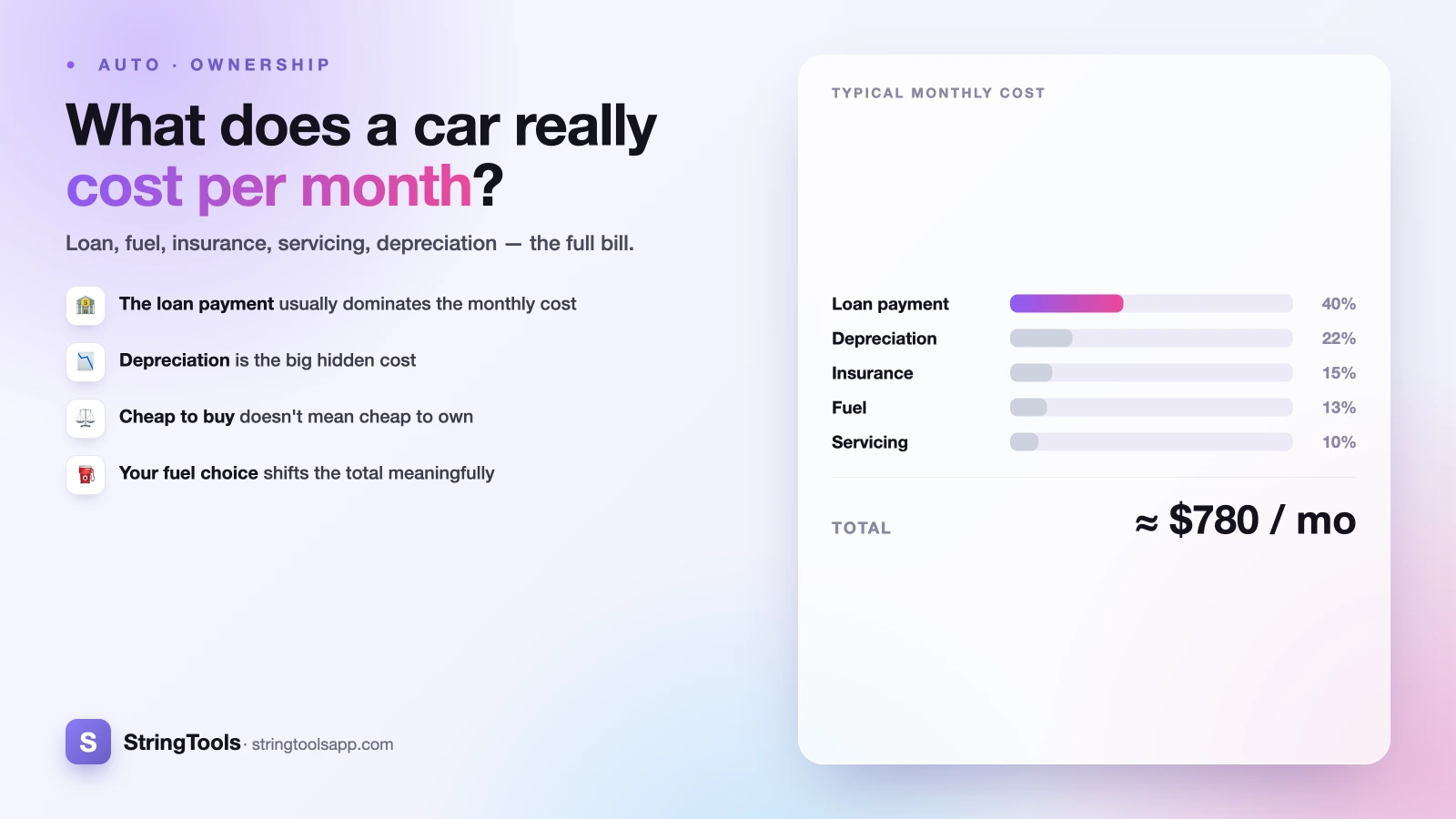
Finance payment: ~590. Depreciation: ~330 (value lost, not a bill). Fuel: ~160. Insurance: ~90. Servicing set-aside: ~60. Road tax: ~20. True monthly cost: roughly 1,250 — more than double the ~590 the dealer advertised.
Now swap the engine. Choose an efficient EV charged at home and the fuel line might fall from ~160 toward ~50, trimming over 100 a month. Pick a thirstier model and it climbs the other way. Notice the pattern: the loan payment dominates the total, but fuel choice is the biggest lever you can still pull after purchase — and depreciation, the number nobody quotes you, sits second and silent.
Your real figures will differ. That's exactly why you should compute your own.
Focus your energy on the two numbers you can actually move
You could spreadsheet all six buckets, but two of them are both large and controllable: the finance payment and the fuel cost. Nail those and you've handled most of what's in your power. Depreciation matters hugely, but you mostly manage it at the point of purchase by choosing a car that holds value. Insurance, servicing, and tax are worth quoting once and then budgeting around.
So before you sign anything, do two quick calculations. First, run the loan properly — try different terms and rates so you know the true cost of the money, not just the shrunk-down monthly figure. Use the loan calculator and compare a shorter term against a longer one.
Second, price the fuel for your actual driving, and compare fuel types while you're at it, with the fuel cost calculator. Both tools run entirely in your browser — nothing you type is uploaded or stored. Ten minutes there will tell you more about what a car really costs than any dealer ever will.
Frequently Asked Questions
What is the true monthly cost of owning a car?
It's the sum of six buckets: your loan or finance payment, fuel or charging, insurance, servicing and maintenance, road tax and registration, and depreciation. The dealer's advertised payment usually covers only the loan, so the real total is often roughly double once every ongoing cost is counted. All figures vary by country, car, and driver.
Why does depreciation count if I never pay a monthly bill for it?
Depreciation is the value your car loses over time, and it becomes real money the day you sell or trade in for far less than you paid. Spread across the years you own the car, it's often one of the largest monthly costs — frequently rivalling fuel or loan interest — even though no invoice ever arrives for it.
Which car cost should I focus on controlling?
Concentrate on the two that are both big and controllable: the finance payment and the fuel cost. You set the loan terms before signing, and you influence fuel use with every trip. Depreciation is best managed at purchase by choosing a car that holds its value; insurance, servicing, and tax are worth quoting once and budgeting around.
Can a cheap car be more expensive than a pricier one?
Yes. A low purchase price can hide heavy depreciation, poor fuel economy, high insurance, or costly repairs. A pricier car that holds its value, sips fuel, and rarely breaks down can cost less per month over time. That's why comparing total running cost, not just the sticker, is the smarter way to shop.
Does fuel type really change the monthly total that much?
It can. An EV charged at home may cost a fraction per mile of a petrol car, while a diesel can win on long motorway trips but lose on short urban ones. The best choice depends on your mileage and driving pattern. Running your real numbers through a fuel cost calculator for each fuel type is the only reliable way to know.