
The question that costs people thousands
Walk into any showroom and you'll face the same fork in the road: the same car, offered with a petrol engine or a diesel one. The diesel usually costs more up front, yet the salesperson swears it'll "save you money on fuel." Both things can be true at once, and that's exactly what makes the choice confusing.
Here's the honest version nobody tells you clearly: diesel only saves money if you drive enough miles for the fuel savings to outrun the higher purchase price and servicing costs. There's a specific number of annual miles where the two even out. Below it, petrol is the smarter buy. Above it, diesel wins. That number is your break-even mileage, and this post shows you how to find yours.
We'll use running cost as the headline figure, then layer in the parts people forget. Along the way, you can plug your own numbers into our free fuel cost calculator to compare petrol and diesel side by side for your exact car and commute.
Why diesel engines squeeze more distance from a litre
Diesel fuel is denser and carries more energy per litre than petrol, roughly 10 to 15 percent more. On top of that, diesel engines run at a higher compression ratio and burn fuel more efficiently, especially at steady highway speeds. The combined result is that a diesel car typically travels noticeably further on the same volume of fuel.
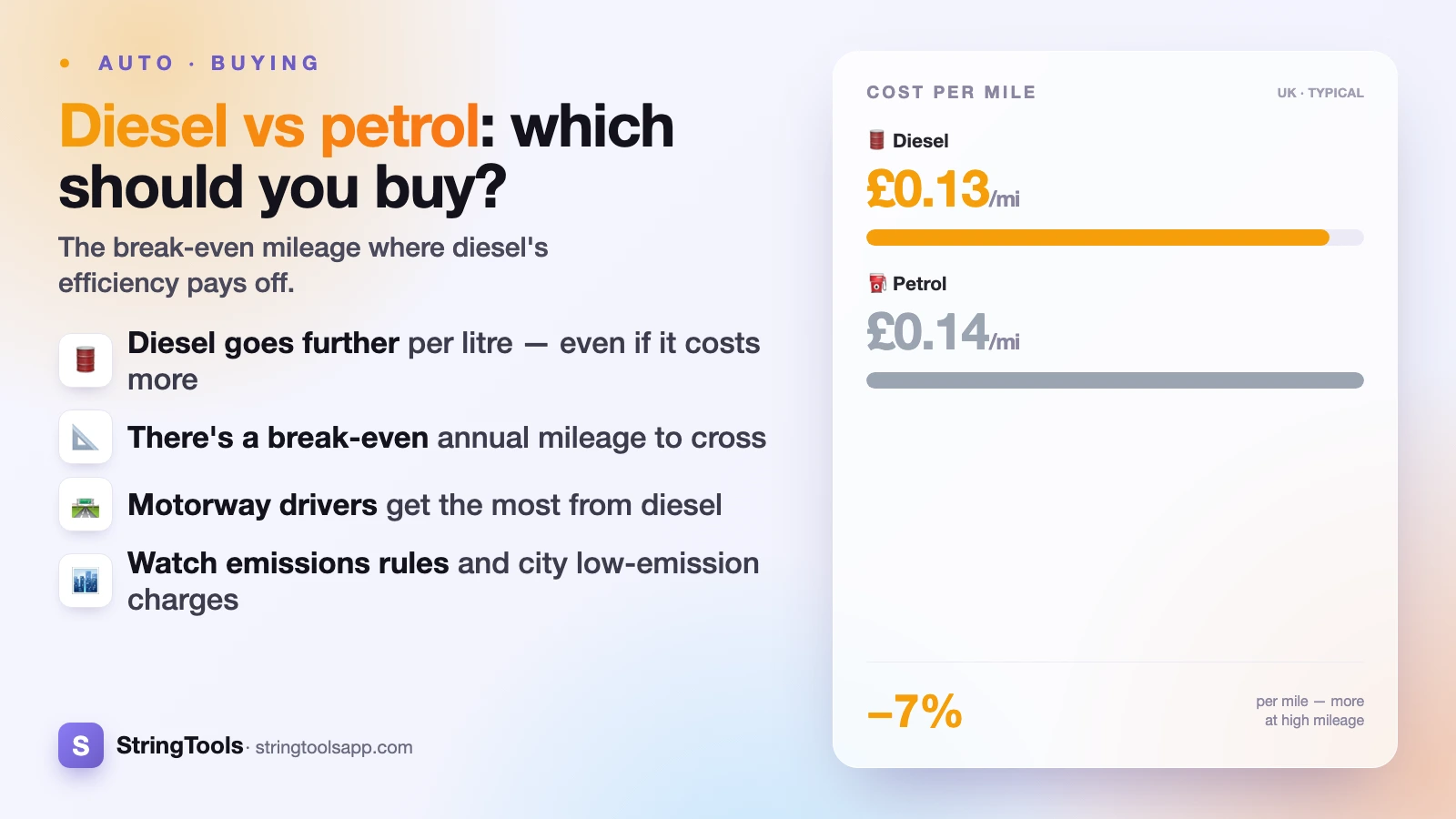
That efficiency is why diesel can win even where diesel costs more at the pump. Consider the UK, where diesel is usually priced a little above petrol. Using indicative August 2026 figures: petrol at about £1.40 a litre in a car doing 45 MPG works out near £0.14 per mile, while diesel at about £1.48 a litre in a car doing 50 MPG works out near £0.13 per mile. The diesel fuel is dearer, yet the greater distance per litre makes each mile slightly cheaper.
Pump prices vary by region and change week to week, so treat every number here as a starting point, not a guarantee. The principle holds regardless: efficiency, not the sticker price on the fuel pump, decides the per-mile cost.
Cost per mile around the world: three quick snapshots
The size of diesel's running-cost advantage depends heavily on where you live, because fuel taxes and pricing differ enormously. Here are three indicative snapshots for August 2026. Prices vary and are not live figures.
United States: petrol at $3.20 a gallon at 30 MPG is about $0.11 per mile; diesel at $3.85 a gallon at 34 MPG is also about $0.11 per mile. In much of the US the two are close to a wash on running cost, which is one reason diesel cars stayed niche there.
United Kingdom: petrol near £0.14 per mile versus diesel near £0.13 per mile, as shown above. Diesel is slightly cheaper to run, but the gap is small.
India: petrol at ₹100 a litre at 16 km/l is about ₹6.25 per km; diesel at ₹90 a litre at 20 km/l is about ₹4.50 per km. Here diesel is both cheaper at the pump and more efficient, so it wins clearly, saving roughly ₹1.75 per km. The lesson: diesel's edge is tiny in some markets and large in others. Run your own country's prices through the fuel cost calculator before you assume anything.
The catch: diesels cost more to buy and to service
If diesel were simply cheaper per mile, everyone would buy one. The reason petrol still dominates is what happens off the fuel bill.
Diesel engines are built to withstand higher pressures, so they cost more to manufacture. That shows up as a purchase-price premium, commonly a few thousand dollars, pounds, or the equivalent, for the diesel version of the same model. You pay that gap on day one, before you've saved a penny on fuel.
Servicing tends to run higher too. Modern diesels carry emissions hardware that petrol cars don't, including diesel particulate filters and, on many, an AdBlue system that needs topping up. Those parts can be costly to clean or replace, and short-trip city driving can clog a particulate filter that never gets hot enough to clear itself. Insurance and some taxes can also skew higher for diesel in certain regions. None of this appears in a simple per-mile fuel comparison, which is why the headline running-cost number never tells the whole story.
Finding your break-even mileage (the actual arithmetic)
Break-even is the mileage at which your accumulated fuel savings finally cancel out diesel's extra up-front and servicing costs. The formula is simple:
Break-even miles = extra cost of the diesel divided by fuel saving per mile.
Example one, the US-style close case. Say the diesel costs $2,500 more to buy and saves about $0.02 per mile on fuel. Break-even = $2,500 / $0.02 = 125,000 miles. You'd need to drive 125,000 miles before the diesel pays back its premium. If you keep the car eight years at 12,000 miles a year (96,000 miles), you never reach break-even, and petrol was the cheaper choice.
Example two, where the saving is bigger. In India, with a saving near ₹1.75 per km and a diesel premium of, say, ₹150,000, break-even = ₹150,000 / ₹1.75 ≈ 85,700 km. A driver covering 20,000 km a year passes that in roughly four and a half years, well within typical ownership. Same math, very different verdict, purely because the per-mile saving is larger.
Add higher diesel servicing into the premium and the break-even mileage climbs further. That's the number to compute before you sign anything.
So who should actually buy diesel, and who shouldn't
Once you've seen the arithmetic, the profiles fall out naturally.
Diesel tends to make sense for high-mileage drivers, the motorway and highway commuters, sales reps, and long-distance families who rack up big annual miles at steady speeds. Diesel engines are happiest cruising, they clear their particulate filters on long hot runs, and heavy annual mileage blows past the break-even point quickly. If you're doing 20,000 miles a year, mostly on open roads, diesel's economics can be genuinely compelling.
Petrol tends to win for low-mileage city drivers. If most of your trips are short urban hops, a petrol car is cheaper to buy, cheaper to service, and its lower per-mile efficiency barely matters because you're not covering the distance to exploit diesel's advantage. Worse, stop-start city driving is the exact condition that clogs diesel particulate filters. For the average commuter doing modest miles, petrol is usually the calmer, cheaper ownership experience.
Resale, emissions zones, and the EV that changed the conversation
Three more factors deserve a seat at the table.
Resale value: diesels traditionally held value well with high-mileage buyers, but sentiment has shifted in several markets since the emissions scandals of the last decade. In some cities diesel now depreciates faster, so check current local demand rather than assuming the old rule.
Emissions and low-emission zones: diesel faces tighter scrutiny for nitrogen oxides and particulates. A growing number of cities operate low-emission or clean-air zones that charge, or even ban, older diesels. If you regularly drive into such a zone, an older diesel could face daily fees that quietly wreck its running-cost advantage. Newer diesels meeting the latest standards are usually exempt, but rules keep tightening.
And then there's the EV. Electric cars have upended the petrol-versus-diesel question entirely, often offering a far lower cost per mile than either, though with a higher purchase price and charging logistics to weigh. Before committing to any combustion engine, it's worth comparing all the options. Our guides on petrol vs diesel vs CNG vs EV running cost and whether an electric car is cheaper than petrol dig into that trade-off.
The bottom line: run your numbers before you decide
Diesel isn't universally cheaper, and neither is petrol. The right answer depends on three things: how many miles you drive each year, how big the fuel saving per mile is where you live, and how large the diesel's purchase and servicing premium is. Compute your break-even mileage, compare it to your realistic annual driving, and the choice usually becomes obvious.
As a rough guide: high annual mileage on open roads leans diesel; low-mileage city driving leans petrol; and if the sums are close, the simpler, cheaper-to-service petrol often wins on peace of mind alone. Remember the headline per-mile figures here cover running cost only. They exclude purchase price, insurance, servicing, and depreciation, all of which you should fold into the break-even decision.
Start by getting your real per-mile numbers. Plug your car's fuel economy and local prices into our free fuel cost calculator to see petrol and diesel costs per day, week, month, and year. If you're financing the car, our loan calculator helps you weigh the higher diesel price against monthly repayments. And if you want the per-mile method spelled out step by step, see how to calculate fuel cost per mile. Do the arithmetic first. It's the cheapest few minutes you'll spend on the whole purchase.
Frequently Asked Questions
Is diesel actually cheaper than petrol to run?
Often per mile, yes, because diesel engines travel further on a litre. But the size of the saving varies hugely by country. In India diesel is clearly cheaper per km, in the UK only slightly, and in much of the US the two are roughly level. Fuel prices change weekly, so check your own local numbers with a fuel cost calculator rather than assuming.
What is break-even mileage in simple terms?
It's the number of miles you must drive before a diesel's fuel savings pay back its higher purchase and servicing costs. Divide the diesel's extra cost by the fuel saving per mile. If you'll cover more than that figure over your ownership, diesel saves money overall. If you drive less, petrol was the cheaper choice.
How many miles a year makes diesel worth it?
There's no single figure because it depends on the price gap and per-mile saving in your market. Where the saving is small, like the US or UK, you may need well over 100,000 total miles to break even, favouring only very high-mileage drivers. Where the saving is large, like India, break-even arrives much sooner. Calculate yours before deciding.
Why do diesels cost more to service?
Diesel engines are built for higher pressures and carry extra emissions hardware, such as diesel particulate filters and AdBlue systems, that petrol cars lack. These parts can be expensive to clean or replace. Short city trips are especially hard on particulate filters, which need long hot runs to clear themselves, so servicing costs can climb for urban diesel drivers.
Should I just buy an EV instead of choosing between petrol and diesel?
It's worth comparing. Electric cars often have a much lower cost per mile than either petrol or diesel, though they carry a higher purchase price and charging considerations. If your driving and charging access suit an EV, it can beat both. Compare all four options, petrol, diesel, CNG and EV, before committing to any combustion engine.