
The short answer nobody wants to give you
"Are electric cars cheaper than petrol?" gets answered two ways online: EV fans say "absolutely, half the cost" and petrol loyalists say "only if you ignore the price tag." Both are right, which is exactly why the honest answer is: it depends on how you charge and how much you drive.
On fuel alone, an EV charged at home is genuinely cheaper to run than a petrol car — often by half. That part isn't marketing. But "cheaper to run" and "cheaper to own" are different questions, and the gap between them is where most people get burned.
This post walks the real math for the US, UK, and India, shows you where the EV advantage quietly disappears (hint: the public rapid charger), and gives you a simple way to work out your own break-even. All the prices here are indicative for August 2026 — they vary by region, change weekly, and are the kind of thing you should plug into our free fuel cost calculator with your own local numbers rather than trust from a blog.
Running cost per mile: the part that's actually true
Start with energy alone. Here's what it costs to move one mile or kilometre, using representative August 2026 prices.
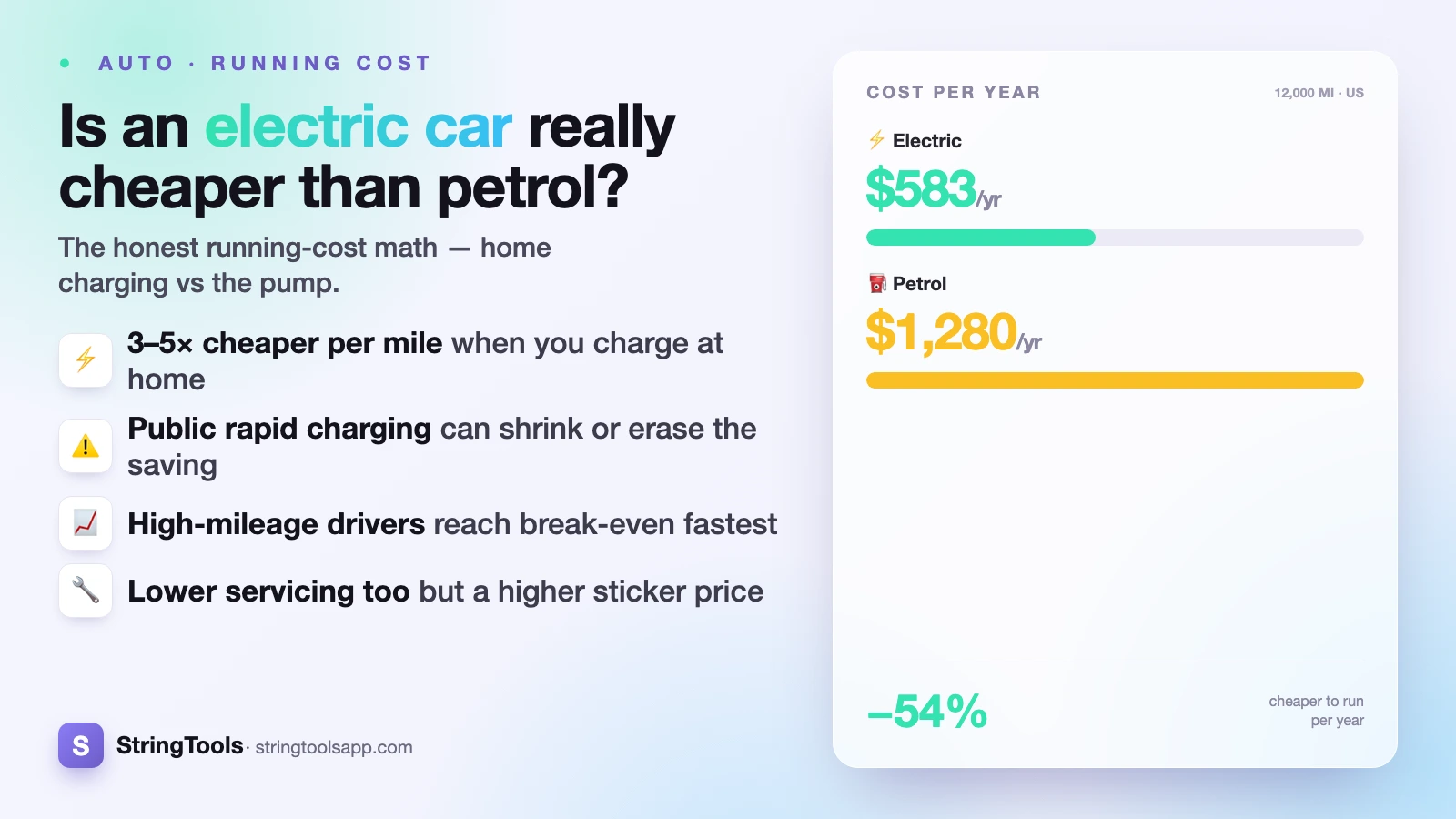
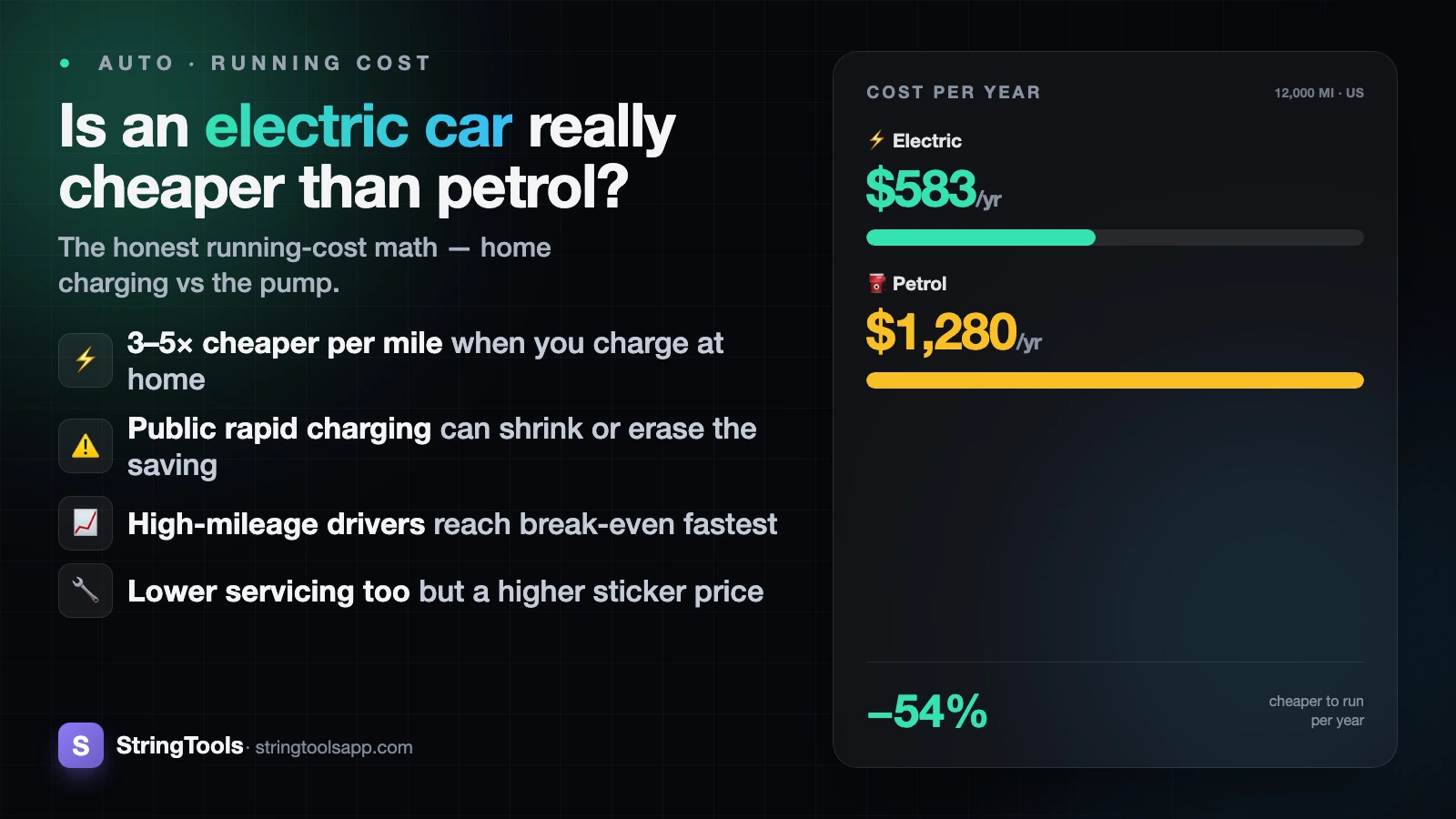
United States: Petrol at $3.20/gallon in a car doing 30 MPG works out to about $0.11 per mile. An EV charged at home at $0.17/kWh, doing 3.5 miles per kWh, costs about $0.05 per mile. Over 12,000 miles a year that's roughly $1,280 for petrol versus $583 for the EV — a saving of around $700 a year.
United Kingdom: Petrol at £1.40/litre at 45 MPG is about £0.14 per mile. A home-charged EV at £0.27/kWh doing 3.6 miles per kWh is about £0.08 per mile — a little over half.
India: Petrol at ₹100/litre at 16 km/l is roughly ₹6.25 per km. An EV charged at ₹8/kWh doing 8 km/kWh is about ₹1.00 per km. Across 15,000 km a year that's about ₹93,750 for petrol against ₹15,000 for the EV — a saving near ₹78,750.
So yes: on fuel, the EV wins clearly in every market. But notice one word doing all the heavy lifting — home.
Home vs public charging: where the advantage can vanish
Every one of those EV numbers assumes you plug in at home overnight. Public rapid charging is a different animal, and it's the single biggest reason some EV owners quietly go back to petrol.
Rapid and ultra-rapid chargers commonly cost two to four times a home electricity rate. If your home rate is $0.17/kWh but the motorway rapid charger is $0.55/kWh, your EV's cost per mile jumps from about $0.05 to roughly $0.16 — which can land above the petrol car you were trying to beat. The same holds in the UK, where public rapid networks routinely charge well over double a home tariff, and in India, where fast-charging stations cost far more than a home connection.
The practical rule: an EV is cheapest for people who can charge at home (or cheaply at work) most of the time and only rapid-charge occasionally on long trips. If you live in a flat with no driveway and rely on public chargers for the bulk of your miles, the running-cost gap narrows sharply and can disappear entirely. Be honest with yourself about your charging reality before you count the savings. Model both a home rate and a public rate in the fuel cost calculator — the difference is often eye-opening.
The break-even: paying more upfront to save later
Here's the part the per-mile figures hide. EVs usually cost more to buy than the equivalent petrol car, so you're spending extra money now to save on fuel later. The question is how many years it takes for the fuel savings to pay back that extra sticker price.
The formula is refreshingly simple:
Payback years = extra upfront cost ÷ annual fuel saving
US example: say the EV costs $8,000 more than the comparable petrol model and saves you about $700 a year in fuel. That's $8,000 ÷ $700 ≈ 11 years before the fuel savings alone cover the price difference. For a driver keeping the car six or seven years, the fuel maths alone doesn't close the gap.
India example: if the EV costs ₹4 lakh more but saves ₹78,750 a year, that's ₹400,000 ÷ ₹78,750 ≈ 5 years. Very different story — India's steep petrol prices and cheap home electricity make the payback much faster.
Two things move this number a lot. Drive more miles and the annual saving grows, shortening payback. And the upfront gap isn't fixed — government incentives, discounts, and a narrowing price premium on newer EVs can shrink the "extra cost" side of the equation, sometimes dramatically. If you're financing either car, remember the monthly repayment matters too — a loan calculator or EMI calculator will show how the higher EV price affects your instalment, not just your fuel bill.
Servicing and maintenance: the quiet EV win
Fuel is only half the running-cost story; maintenance is the other half, and here EVs have a structural advantage that doesn't depend on how you charge.
An electric motor has a handful of moving parts. There's no engine oil to change, no timing belt, no spark plugs, no exhaust system, no clutch or complex multi-speed gearbox in most EVs. Regenerative braking also means brake pads and discs tend to last far longer, because the motor does much of the slowing down. The result is fewer scheduled service items and fewer things that fail out of warranty.
This won't make a break-even car cheaper overnight, but over years of ownership it's a real, recurring saving that quietly tilts the total in the EV's favour — and it applies whether you charge at home or on the road.
The honest caveats: EV tyres can wear faster because the cars are heavier and torquey, so budget a little more there. And the big one is the battery. Batteries slowly lose capacity over time (degradation), which reduces range rather than causing sudden failure, and an out-of-warranty battery replacement is expensive. Most modern EVs come with an 8-year or 160,000 km battery warranty, but it's a factor to weigh, especially if you buy used.
Who actually saves — and who doesn't
Put it all together and a clear pattern emerges. The people who save the most from an EV are high-mileage drivers who charge at home. More miles means the fuel saving per year is bigger, which shortens the payback on the higher purchase price and stacks up the maintenance savings faster. A home-charging commuter doing 15,000+ miles a year is close to the ideal case.
The people who save least — and may not save at all on the numbers — are low-mileage drivers, people who can only charge on expensive public networks, and anyone who trades cars every three or four years and never reaches the fuel-saving break-even. If you drive 4,000 miles a year and rely on rapid chargers, the honest answer might be that a petrol or hybrid is cheaper for you today.
Market also matters. In India, high petrol prices and cheap home power make the payback fast; in the US, cheaper petrol and pricier EVs stretch it out. There's no universal answer — which is the whole point.
The honest bottom line — and how to run your own numbers
So, is an electric car really cheaper than petrol? On home-charged fuel, almost always. On total cost, it depends on your mileage, your charging setup, how long you keep the car, and how big the price premium is after incentives.
One firm caveat: every figure in this post is running cost — energy and, loosely, maintenance. It deliberately excludes purchase price beyond the break-even calc, insurance, road tax, and depreciation. A full total-cost-of-ownership picture needs all of those, and depreciation in particular can swing either way for EVs. Treat this as the fuel-and-servicing layer, not the last word.
Don't take our averages as gospel — they're indicative for August 2026, vary by region, and change weekly. The right move is to plug your own petrol price, your own home and public charging rates, your real efficiency, and your actual annual mileage into our free fuel cost calculator. It compares petrol, diesel, CNG, and EV side by side per day, week, month, and year, so you can see your break-even instead of guessing at it.
Want to go deeper? Compare all four fuel types in petrol vs diesel vs CNG vs EV running cost, settle the older debate in diesel vs petrol: which to buy, or learn the underlying method in how to calculate fuel cost per mile.
Frequently Asked Questions
Is an electric car actually cheaper to run than petrol?
On fuel alone, yes — if you charge at home. A home-charged EV often costs around half as much per mile as a petrol car. For example, in the US an EV might cost about $0.05/mile versus $0.11 for petrol. But rely mainly on public rapid chargers and that advantage shrinks or disappears, because rapid charging can cost two to four times the home rate.
How do I calculate the break-even point for an EV?
Divide the extra upfront cost by your annual fuel saving. If an EV costs $8,000 more than a petrol equivalent and saves you $700 a year in fuel, that's about an 11-year payback on fuel alone. Higher mileage and government incentives shorten it; in markets with expensive petrol and cheap electricity, like India, the payback can be around five years.
Does public charging really wipe out the savings?
It can. Public rapid and ultra-rapid chargers commonly cost two to four times a home electricity rate. At a high public rate, an EV's cost per mile can climb above a comparable petrol car's. EVs are cheapest for people who charge at home most of the time and only rapid-charge occasionally on long journeys, not for those who depend on public networks daily.
Are EVs cheaper to service and maintain?
Generally yes. EVs have far fewer moving parts — no oil changes, spark plugs, timing belts, or complex gearbox — and regenerative braking makes brakes last longer, so scheduled servicing tends to cost less. The caveats: heavier EVs can wear tyres faster, and an out-of-warranty battery replacement is expensive, though most batteries carry an 8-year or 160,000 km warranty.
Do these running-cost figures include the purchase price and insurance?
No. The per-mile figures cover energy, and we touch on servicing separately. They deliberately exclude the full purchase price beyond the break-even calculation, insurance, road tax, and depreciation. A complete total-cost-of-ownership comparison needs all of those. Use our fuel cost calculator for the running-cost layer, then add ownership costs separately for the full picture.