
The question every driver eventually asks
Standing at the pump watching the numbers spin, or plugging in at home and barely noticing the meter move, you've probably wondered the same thing I have: am I driving the cheapest option, or quietly overpaying every single week?
Here's the honest answer up front. In 2026, for pure running cost — the money that leaves your account to actually move the car a mile or a kilometre — the usual ranking is EV first, then CNG, then diesel, then petrol. Electric charged at home is almost always the cheapest, and petrol is almost always the most expensive. But "usually" is doing a lot of work in that sentence, because the gap between them swings wildly depending on which country you're in, what you pay for electricity, and whether CNG is even available near you.
This post walks through all four fuels, shows you the arithmetic with real 2026 numbers, and — this matters — is upfront about the one thing that trips people up: running cost is not the same as total cost. Let's get into it.
First, what "running cost" actually means (and doesn't)
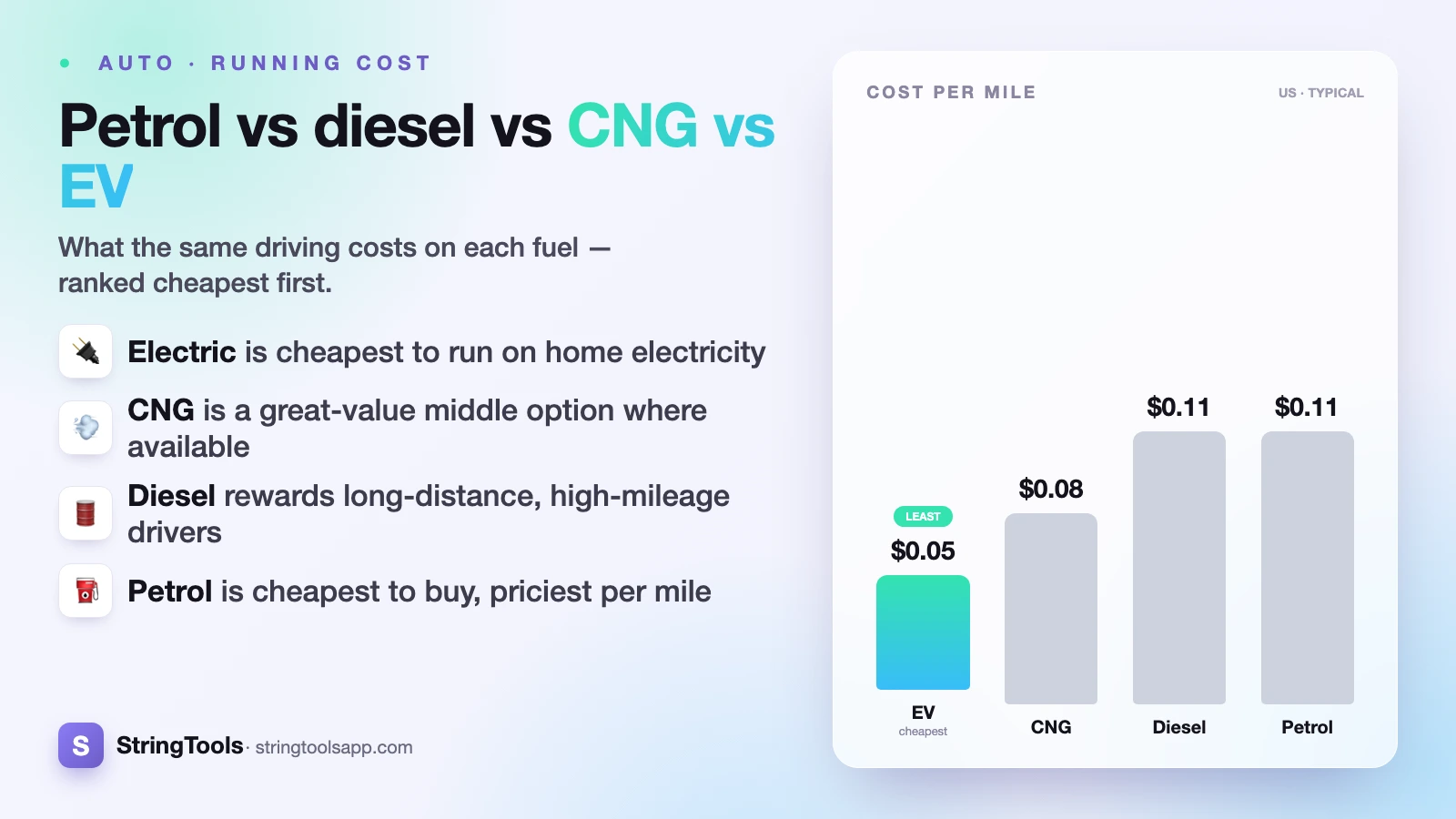
Running cost is narrow and specific. It's the fuel or energy you buy to cover distance — nothing more. When I say an EV costs $0.05 a mile and petrol costs $0.11, I'm comparing energy in versus miles out. That's it.
Running cost deliberately excludes the purchase price of the car, insurance, servicing and repairs, road tax or registration, and depreciation. Those belong to a bigger calculation called total cost of ownership, and I'll come back to it near the end because it can completely flip the winner. An EV that's cheap to charge but expensive to buy, or a diesel that sips fuel but costs a fortune to service, tells a different story once you add everything up.
So treat this comparison as the answer to one clean question: for every mile or kilometre I drive, which fuel bleeds the least money at the point of use? For that, the four fuels line up in a fairly predictable order — but the size of the gaps is where it gets interesting. You can run any of these numbers against your own local prices in the free fuel cost calculator.
The four fuels, ranked — and why the order holds
Electric (charged at home) is the cheapest to run in nearly every market. Electricity is simply a cheaper way to buy a mile of motion than refined liquid fuel, and electric motors waste far less energy as heat than a combustion engine does. The big asterisk: this assumes home charging. Public rapid chargers typically cost two to four times more per unit, and if you rely on them exclusively, an EV's running-cost advantage shrinks dramatically — sometimes to nothing.
CNG (compressed natural gas) is the cheapest where it's actually available. In India it's a genuine money-saver and widely used; in the US, UK, Canada and Australia the fuelling network is thin and CNG cars are niche, so most drivers there can ignore it. Where you can fill up, it usually undercuts both petrol and diesel per mile.
Diesel sits in the middle. Diesel engines are more efficient and squeeze more miles from each litre or gallon, which is why long-distance and motorway drivers still favour them — even though diesel fuel often costs more per litre than petrol, the better economy tends to win.
Petrol is typically the most expensive to run, but it's the default for a reason: cheapest cars to buy, cheapest to service, fuel available everywhere. For low-mileage drivers, that simplicity often outweighs the higher per-mile cost. Each of these gets its own deep-dive — see is an electric car cheaper than petrol, is a CNG car worth it, and diesel vs petrol: which to buy.
The numbers, country by country (August 2026)
Before the figures, one honest disclaimer: these prices are indicative. They vary by city and supplier, they change most weeks, and they are not live or guaranteed. Treat them as a realistic starting point, then swap in your own local prices. Every number below is arithmetically consistent with the assumptions stated next to it.
United States (per mile): Petrol at $3.20/gallon and 30 MPG works out to about $0.11/mile. Diesel at $3.85/gallon and 34 MPG is also about $0.11/mile — the better economy cancels out the pricier fuel. CNG at $2.30 per gallon-equivalent and 28 miles per GGE is about $0.08/mile. An EV at $0.17/kWh and 3.5 miles/kWh is about $0.05/mile. So EV, then CNG, then petrol and diesel roughly tied.
United Kingdom (per mile): Petrol at £1.40/litre and 45 MPG is about £0.14/mile. Diesel at £1.48/litre and 50 MPG is about £0.13/mile. An EV at £0.27/kWh and 3.6 miles/kWh is about £0.08/mile. CNG cars are rare in the UK, so most drivers are really choosing between those three — and the EV is clearly ahead on running cost.
India (per kilometre): Petrol at ₹100/litre and 16 km/l is about ₹6.25/km. Diesel at ₹90/litre and 20 km/l is about ₹4.50/km. CNG at ₹85/kg and 26 km/kg is about ₹3.27/km. An EV at ₹8/kWh and 8 km/kWh is about ₹1.00/km. This is the most dramatic spread anywhere — the EV costs roughly a sixth of petrol per kilometre, and CNG is a strong, widely-available middle option.
A worked annual example (so it's not just abstract)
Per-mile pennies feel trivial until you multiply by a year of driving. Let's use India, where the gap is widest and the fuels are all genuinely on the table, and assume a typical 15,000 km a year.
On petrol at ₹6.25/km: 15,000 × 6.25 = ₹93,750 a year. On diesel at ₹4.50/km: 15,000 × 4.50 = ₹67,500. On CNG at ₹3.27/km: 15,000 × 3.27 ≈ ₹49,050. On an EV at ₹1.00/km: 15,000 × 1.00 = ₹15,000.
Sit with those for a second. Switching from petrol to CNG saves roughly ₹44,700 a year in fuel. Going from petrol to a home-charged EV saves about ₹78,750 a year — the EV's fuel bill is under a sixth of the petrol car's.
Run the same 15,000 km through US numbers (call it ~9,300 miles): petrol at $0.11/mile is about $1,025 a year, while an EV at $0.05/mile is about $465 — a saving near $560. Real money, but nowhere near India's spread, because US petrol is comparatively cheap and US home electricity isn't dirt-cheap. That contrast is the whole point of the next section. Plug your own annual distance into the fuel cost calculator to see your personal figure.
Why the gap is huge in India but modest in the US
Same ranking, wildly different magnitude. Why? Because running cost is a ratio — fuel price divided by efficiency — and both halves differ by country.
The savings gap depends almost entirely on two local numbers: how expensive your petrol or diesel is, and how cheap your electricity is. In India, petrol is expensive relative to incomes while household and EV-tariff electricity is very cheap, so the EV-versus-petrol ratio is enormous. In the US, pump prices are among the lowest in the developed world while electricity isn't especially cheap, so the ratio compresses — the EV still wins, just by less.
The UK sits in between: high petrol and diesel prices make combustion painful, but home electricity isn't cheap either, so the EV lead is solid without being India-sized. Germany follows a similar pattern to the UK — steep fuel duty and meaningful home-electricity costs, with the EV ahead on running cost but the margin sensitive to your specific tariff.
The lesson: never trust a per-mile figure from a different country as if it were your own. A YouTuber in Texas and a driver in Mumbai can both be completely right and completely irrelevant to each other. Your local prices are the only ones that decide your ranking, which is exactly why the calculator lets you edit all six countries' numbers.
The caveat that can flip everything: total cost of ownership
Everything above is running cost only, and I want to be scrupulously honest that running cost is not the whole picture. The cheapest car to fuel is not automatically the cheapest car to own.
EVs usually have the lowest running and servicing costs but the highest purchase price, and home charging assumes you have somewhere to plug in — if you're renting a flat and relying on public rapid chargers at two to four times the home rate, much of the advantage evaporates. Diesels reward high-mileage motorway drivers but can carry pricier servicing and, in some cities, clean-air charges. CNG saves fuel money but often means a smaller boot (the tank eats space) and a limited refuelling network outside India. Petrol cars are cheapest to buy and service, which is why they still make sense for low-mileage drivers who'd never claw back an EV's premium.
To do total cost of ownership properly you'd add purchase price (or finance), insurance, servicing, tax and depreciation on top of the fuel numbers here. If you're financing the car, an EMI calculator or loan calculator will show the monthly repayment, which for most buyers dwarfs the fuel difference. Fuel is one line in the budget — an important one, but not the only one.
How to actually decide — and see your own numbers
Here's the practical shortcut. If you do high mileage and can charge at home, an EV almost always wins on running cost, often by a wide margin. If CNG is available and well-supported where you live — most obviously in India — it's a superb-value middle path with far cheaper fuel than petrol and none of the EV's charging logistics. If you drive long motorway distances, diesel's economy still earns its keep. And if you're a low-mileage driver who values the lowest upfront price and zero fuss, petrol remains a perfectly rational choice despite costing the most per mile.
But don't take my ranking on faith — the whole reason numbers matter is that yours are different from mine. Put in your real fuel price, your car's real economy, and your real annual distance, and let the arithmetic decide. That's exactly what the free fuel cost calculator is built for: it compares petrol, diesel, CNG and EV side by side, per day, week, month and year, with editable local prices for the US, UK, Canada, Australia, India and Germany. If you want to go deeper on the method, how to calculate fuel cost per mile breaks the formula down step by step.
Spend two minutes with your own figures. Whatever you're driving today, you'll know for certain whether you're on the cheapest fuel for your life — or quietly overpaying every week.
Frequently Asked Questions
Which fuel is cheapest to run in 2026?
For running cost only, the usual 2026 ranking is EV cheapest, then CNG, then diesel, then petrol. A home-charged EV is almost always the least expensive per mile, and petrol is typically the priciest. But the size of the gap depends heavily on your local fuel and electricity prices, so your own numbers decide the exact order.
Is an EV always cheaper to run than petrol?
Almost always on running cost, but only if you charge at home. Home electricity buys a mile far more cheaply than petrol in every market shown here. Public rapid charging costs roughly two to four times the home rate, and relying on it exclusively can shrink or even erase the EV's per-mile advantage over petrol.
Why is CNG so much cheaper in India than elsewhere?
In India, CNG is priced low and has a genuine refuelling network, so it's a mainstream money-saver — around ₹3.27/km versus ₹6.25/km for petrol in our example. In the US, UK, Canada and Australia, CNG stations are scarce and CNG cars are niche, so most drivers there can't realistically use it even though the fuel itself is cheap.
Does this comparison include the cost of buying the car?
No. These figures are running cost only — the fuel or electricity to cover distance. They exclude purchase price, insurance, servicing, tax and depreciation. A full total-cost-of-ownership picture needs all of those added, and it can change the winner: EVs cost less to fuel but more to buy, while petrol cars are cheapest upfront.
How do I work out the cheapest fuel for my own car?
Take your local fuel price and divide by your car's real-world economy to get cost per mile or per kilometre, then multiply by your annual distance. The free fuel cost calculator does this for petrol, diesel, CNG and EV at once, with editable prices for six countries, so you can compare all four against your actual driving in a couple of minutes.